The best noise cancelling microphone is the one that keeps your voice clear when the room isn’t: keyboard clatter, an air conditioner humming, traffic outside the window. Our verdict after comparing the strongest noise-rejecting options on the market: the Shure MV7+ is the best noise cancelling microphone for most people in 2026. Its real-time Denoiser DSP strips out steady background hum while a tight cardioid pattern rejects sound from the sides and rear, and it works over both USB-C and XLR — a simple desk setup now, a pro interface upgrade later. If you need to move around while you talk, the DJI Mic 2 is the best wireless noise cancelling microphone, with intelligent noise cancelling you can toggle with a tap.
But “best” depends on the job. A desktop USB microphone wins for Zoom calls and podcasting, a wireless lavalier wins for filming on the move, and a streamer’s microphone wins on software control. Here are our top five picks, ranked by how well they actually kill background noise.
Our Top Picks: Best Noise Cancelling Microphone in 2026
- Best overall: Shure MV7+ — real-time Denoiser DSP with USB-C and XLR
- Best wireless: DJI Mic 2 — intelligent noise cancelling with 32-bit float recording
- Best budget wireless: Hollyland Lark M2 — one-click noise cancellation, 9-gram transmitter
- Best for streaming: Elgato Wave:3 — Wave Link noise suppression with a tight cardioid capsule
- Best for podcasting: MAONO PD200W — three-stage noise cancellation, wireless/USB/XLR hybrid
1. Shure MV7+ — Best Overall Noise Cancelling Microphone

Best for: Podcasters, streamers, and remote workers who want studio-clean voice without sound-treating the room.
The MV7+ is the rare microphone that does noise reduction in hardware instead of asking your streaming or conferencing app to do it. The approach has two parts, and Shure’s own support documentation spells them out plainly: Voice Isolation Technology — the cardioid pickup pattern doing what the legendary SM7B’s pattern does, picking up your voice from the front while rejecting sound from the sides and rear — plus a Real-time Denoiser DSP you toggle in the MOTIV Mix app, which removes persistent background noise like fans and air conditioners.
Here’s the honest caveat, straight from Shure: the Denoiser handles steady hum, but it won’t erase keyboard clicks, barking dogs, or voices in the next room. That’s the physics of microphones — and it’s still the strongest desktop option we’ve evaluated, because it attacks noise at the source instead of after the fact. The dynamic capsule is naturally less sensitive to room echo than condenser mics, Auto Level Mode rides the gain as you move, the digital pop filter tames plosives, and the LED touch panel gives you tap-to-mute at a glance.
Key specs: Dynamic capsule, cardioid pattern · USB-C and XLR outputs · Real-time Denoiser DSP · 24-bit/48kHz over USB · 3.5mm zero-latency monitoring · MOTIV Mix app control
2. DJI Mic 2 — Best Wireless Noise Cancelling Microphone

Best for: Creators and mobile workers who record on the move — walk-and-talk video, field interviews, livestreams from noisy spaces.
The DJI Mic 2 earns its spot because its noise cancelling is genuinely intelligent rather than a fixed filter: toggle it on the transmitter and it adapts to erratic, unpredictable background sound — the kind that ruins outdoor takes. Backup matters too, and this is where DJI pulls ahead of cheaper wireless systems: each transmitter records internally in 32-bit float, so a sudden loud sound that would clip a normal recording stays recoverable, with up to 14 hours of internal recording as a safety net.
One thing to know before buying, straight from DJI’s own product notes: intelligent noise cancelling can’t be enabled when the transmitter connects to a smartphone via Bluetooth. If your workflow is phone-only, use the receiver instead and you keep the feature. Wireless range runs up to 250 meters, and the charging case stretches total operation to around 18 hours.
Key specs: Intelligent Noise Cancelling · 32-bit float internal recording (14 hours) · Up to 250m wireless range · Up to 18 hours with charging case · USB-C and Lightning receiver adapters
3. Hollyland Lark M2 — Best Budget Wireless Noise Cancelling Microphone

Best for: Budget creators who want wireless freedom with real noise control.
The Lark M2 proves you don’t need a flagship budget to get effective noise cancellation. One press on the transmitter toggles ENC (environmental noise cancellation), and Hollyland’s audio algorithms keep voices clear and undistorted even in noisy environments. At just 9 grams per transmitter, it’s the lightest mini wireless mic on the market — you forget you’re wearing it, which matters when you’re recording for an hour straight.
Audio quality is serious for the tier: 48kHz/24-bit recording, a 70dB signal-to-noise ratio, and up to 1,000 feet of line-of-sight wireless range. The charging case delivers up to 40 hours of total use (camera version), with about 10 hours per charge when noise cancellation is off. It works with iPhone, Android, cameras, and PCs, so one kit covers desk calls and field recording alike.
Key specs: One-click ENC noise cancellation · 9g transmitters · 48kHz/24-bit, 70dB SNR · Up to 1,000ft range · Up to 40 hours with charging case
4. Elgato Wave:3 — Best Noise Cancelling Microphone for Streaming

Best for: Streamers and gamers who want software-level control over their audio.
An honest note first: the Wave:3’s hardware doesn’t carry an onboard AI denoiser. Its noise rejection comes from two things working together — a tight cardioid condenser capsule that keeps keyboard and room noise out of the pickup pattern, and the free Wave Link software, which adds a noise gate and noise suppression effects to your chain. For a streamer, that combination is arguably better than a hardware denoiser: the pattern rejects the noise physically, and the gate silences the mic between sentences so your audience hears nothing but you.
The rest of the package is built for live work: proprietary Clipguard technology makes distortion from sudden loud moments virtually impossible, recording runs up to 24-bit/96kHz, the capacitive top is a tap-to-mute button with an LED ring, and the headphone jack gives you zero-latency monitoring. Wave Link doubles as a full virtual mixer for game audio, chat, and music.
Key specs: Cardioid condenser capsule · Wave Link noise gate + noise suppression · Clipguard anti-distortion · 24-bit/96kHz · Capacitive mute, zero-latency monitoring
5. MAONO PD200W — Best Noise Cancelling Microphone for Podcasting

Best for: Podcasters who want wireless convenience with a wired upgrade path.
The PD200W is the most flexible microphone on this list. Its headline feature is a three-stage noise cancellation system paired with a cardioid dynamic capsule — MAONO’s pitch is “no soundproof booth needed,” and the combination of pattern rejection plus staged DSP genuinely minimizes both background noise and room echo. The 30mm dynamic capsule delivers an 82dB signal-to-noise ratio, clean enough for broadcast-ready vocal work.
What sets it apart is the hybrid design: go wireless for maximum freedom (up to 60 meters), plug in via USB for easy computer recording, or connect over XLR when you graduate to an audio interface. A single receiver can pair two wireless mics for co-hosted shows, each recorded to its own track, and the MaonoLink app gives you EQ, reverb, and four tuned presets. Battery life runs up to 60 hours with the RGB lighting off.
Key specs: Three-stage noise cancellation · 30mm dynamic capsule, cardioid · Wireless + USB + XLR hybrid · Dual-mic pairing for co-hosts · Up to 60h battery (RGB off) · MaonoLink app
Best Noise Cancelling Microphone: Quick Comparison
| Microphone | Noise reduction | Connection | Best for |
|---|---|---|---|
| Shure MV7+ | Real-time Denoiser DSP + cardioid pattern | USB-C, XLR | Most people — calls, podcasting, streaming |
| DJI Mic 2 | Intelligent Noise Cancelling | Wireless (2.4GHz) | Recording on the move |
| Hollyland Lark M2 | One-click ENC | Wireless (2.4GHz) | Budget wireless creators |
| Elgato Wave:3 | Wave Link noise gate + suppression | USB-C | Streamers and gamers |
| MAONO PD200W | Three-stage noise cancellation | Wireless, USB, XLR | Podcasters, co-hosted shows |
How Noise Cancelling Actually Works in a Microphone
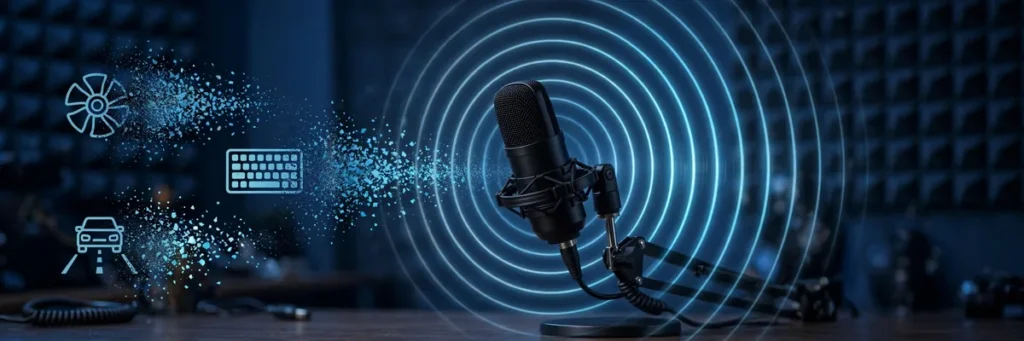
“Noise cancelling” on a microphone means something different from the active noise cancelling in your headphones — that technology cancels noise for the listener, while a noise cancelling microphone removes noise for the person hearing you. (If you’re curious about the headphone side, here’s how noise cancelling headphones work.) On a mic, noise reduction comes from two mechanisms, and the best picks on this list use both:
- Pickup pattern (physical): A cardioid or tight directional pattern captures sound from the front and rejects it from the sides and rear. This is why a dynamic broadcast-style mic sounds cleaner in a noisy room than an omnidirectional one — the noise never enters the capsule in the first place.
- DSP / AI denoising (digital): A processor analyzes the signal and removes steady, predictable noise — fan hum, air conditioning, room tone — in real time. This is what the Shure MV7+’s Denoiser, DJI’s intelligent noise cancelling, and the Lark M2’s ENC do.
The honest limit, confirmed by Shure’s own support documentation: digital denoisers remove persistent background noise. They can’t erase sudden, voice-like sounds — keyboard clicks, barking dogs, someone talking in the next room. For those, the pickup pattern and your recording technique (speaking close to the mic, pointing it away from the noise) do the real work.
USB vs XLR vs Wireless: Which Connection Should You Choose?
USB is the simplest choice for Zoom calls, streaming, and first podcasts — plug it in and you’re recording. The Shure MV7+, Elgato Wave:3, and MAONO PD200W all work this way. XLR is the pro upgrade path: it connects to audio interfaces and mixers for cleaner gain and more control, and both the MV7+ and PD200W give you USB and XLR in one mic, so you buy once and grow into it. Wireless is about freedom — the DJI Mic 2, Hollyland Lark M2, and PD200W’s wireless mode let you walk, gesture, and film without a cable tethering you to the desk.
Best Noise Cancelling Microphone for Zoom Calls
For remote work, prioritize simplicity: a USB mic you can mute in one tap. The Shure MV7+ is our top call pick — its LED touch panel shows mute status at a glance, and the Denoiser kills the air-conditioner hum that plagues home offices. If you’d rather have nothing on your desk in frame, clip on the Hollyland Lark M2 and take calls from anywhere in the room.
Zoom, Teams, and Meet all have their own software noise removal now, but a microphone that rejects noise at the source sounds more natural than one that leans on aggressive app processing. And if you’d rather have a single device for ears and mic, a dedicated call headset may suit you better — see our guides to the best noise cancelling headphones with a microphone for clear calls, the best noise cancelling headphones for work and call centers, and the best noise cancelling earbuds for phone calls.
Best Noise Cancelling Microphone for Streaming
Streamers live in Wave Link territory: the Elgato Wave:3 pairs its tight cardioid capsule with a software noise gate and suppression effects, plus full mixing of game audio, voice chat, and music in one app. If your stream is growing into something more serious, the Shure MV7+ is the step-up — the same Denoiser DSP, with an XLR output ready for a dedicated interface when you outgrow USB.
Frequently Asked Questions
What is the best noise cancelling microphone for Zoom calls?
The Shure MV7+ is the best noise cancelling microphone for Zoom calls for most people: USB plug-and-play, a real-time Denoiser that removes fan and AC hum, and a tap-to-mute LED panel. For a cable-free option, the Hollyland Lark M2 clips to your shirt and works with any conferencing app.
Do noise cancelling microphones really work?
Yes, within honest limits. DSP-based noise reduction genuinely removes steady background noise like fans, air conditioners, and room hum, while cardioid pickup patterns physically reject sound from the sides and rear. What they can’t do is erase sudden, voice-like sounds such as keyboard clicks, barking dogs, or nearby conversations — no microphone can distinguish those from your voice on its own.
Should I get a USB or XLR microphone for streaming?
Start with USB — it’s plug-and-play and every streaming app accepts it. Choose a mic with both outputs, like the Shure MV7+ or MAONO PD200W, and you get an XLR upgrade path to an audio interface later without buying a second microphone.
Does the Elgato Wave 3 have noise cancellation?
Not as an onboard hardware denoiser. The Wave:3 rejects noise through its tight cardioid capsule plus the free Wave Link software, which includes a noise gate and noise suppression effects. For streamers, that combination is highly effective — the pattern keeps noise out and the gate silences the mic between sentences.
Can I use a wireless lavalier mic for Zoom calls?
Yes. Wireless systems like the DJI Mic 2 and Hollyland Lark M2 connect to your computer via USB-C receivers and work with Zoom, Teams, and Meet like any USB microphone. They’re ideal if you present standing up or move around during calls. For iPhone video recording specifically, see our guide to the best wireless microphones for iPhone.
Check Price on Amazon — DJI Mic 2
Check Price on Amazon — Hollyland Lark M2
Check Price on Amazon — Elgato Wave:3
Check Price on Amazon — MAONO PD200W

I am the founder of Sound Mavericks, where I provide the polite truth about audio equipment. I started this site because consumer electronics reviews are often too technical. Instead of using a silent lab, I test headphones, earbuds, and Bluetooth speakers in the real world – like on a noisy subway or in a busy coffee shop.
To stay independent, I buy my own review units (mostly from the United States) rather than accepting free gifts from brands. Once I finish testing a product, I sell it locally to our community. My goal is to help you understand sound quality, active noise cancellation (ANC), and battery life without the marketing hype.