
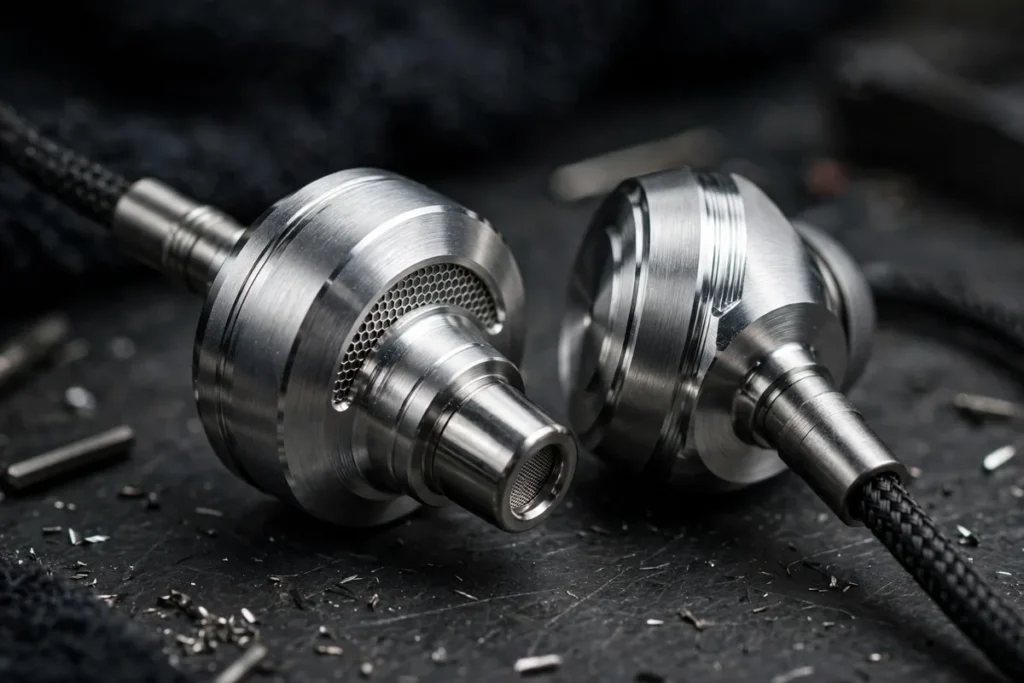
Plastic shells crack, glued seams loosen, and thin housings can add their own buzz to the music. That is why the best metal housing earbuds earn their place: a rigid shell made from zinc alloy, aluminum or stainless steel resists drops, damps unwanted resonance and simply feels like a tool built to last. Our SoundMavericks verdict, based on manufacturer specifications and listing research, is straightforward. The Moondrop Aria 2 is the best all-round metal IEM for most listeners, the FiiO FH3 is the lightweight aluminum-magnesium pick for bass and detail, and the Final E5000 is the premium stainless steel option. Metal is not magic, though, and this guide is honest about the weight, cold feel and cost that come with it.
Our Top Picks at a Glance
- Best overall: Moondrop Aria 2 — CNC-milled zinc alloy shell with a brass nozzle and a balanced, low-distortion tuning.
- Best lightweight metal: FiiO FH3 — aluminum-magnesium alloy hybrid with strong bass and two Knowles balanced armatures.
- Best premium stainless steel: Final E5000 — mirror-finished stainless housing built to suppress vibration.
- Best simple metal classic: SoundMAGIC E10 — all-metal aluminum housing, fixed cable, no fuss.
What Counts as a Metal Housing — and What Does Not
Before the picks, a definition matters, because marketing blurs it. A true metal housing earbud carries its driver in a shell machined or cast from metal: zinc alloy, aluminum, aluminum-magnesium alloy or stainless steel. A metal faceplate screwed onto a resin body is a hybrid — tougher than plain plastic at the front, but not a full metal shell, and we label it that way below. A metallic paint finish is not metal at all.
We checked every pick here against the manufacturer’s own material claim. That check is why some famous names are absent: the Sennheiser IE 200 uses a non-metal shell and the TinHiFi T3 Plus is resin, so neither belongs here. If durability is your starting point, our wider guide to the best wired earbuds and our roundup of the best IEMs show how these metal models compare with the broader field.
1. Moondrop Aria 2 — Best Overall Metal Housing Earbud

The Moondrop Aria 2 is the clearest expression of what a metal shell should do. Moondrop casts and CNC-mills the cavity from zinc alloy, fastens it with screws rather than glue, and fits a separate CNC-machined brass nozzle with a gold-plated finish. Screw assembly matters in practice: adhesive joints are a common failure point on budget IEMs, and a screwed alloy shell removes that weakness while making the housing far harder to crack in a drop.
Inside is a single dynamic driver with a TiN ceramic-coated dome composite diaphragm, an internal and external composite magnetic circuit and a composite brass inner cavity. Moondrop rates it at 33 ohms with 122 dB/Vrms sensitivity, and the tuning follows the company’s balanced, neutral-leaning target with smooth, extended treble. SoundMavericks analysis: this is the metal pick for listeners who want clarity and control rather than boosted bass — the rigid shell and resonance-controlled cavity suit that clean presentation well.
The trade-offs are real. At roughly 11.8 g per side in published measurements, the Aria 2 is noticeably heavier than resin IEMs, and small ears may feel that weight on long sessions. There is no microphone and no water-resistance rating. The detachable 0.78 mm 2-pin cable, supplied with interchangeable 3.5 mm and 4.4 mm plugs, is a genuine longevity plus: when a cable wears out, you replace the cable, not the earbuds.
2. FiiO FH3 — Best Lightweight Aluminum-Magnesium Hybrid

If zinc alloy sounds too heavy, aluminum-magnesium alloy is the answer, and the FiiO FH3 is its best-known showcase. FiiO machines the FH3 shell from aluminum-magnesium alloy, a material chosen because it delivers metal rigidity at a fraction of stainless steel’s weight — FiiO lists the earpiece at about 7 g. The shell is shaped to sit securely with an over-ear cable route, which helps distribute that weight.
The driver array is a triple hybrid: a 10 mm beryllium-coated dynamic driver for bass, plus two Knowles balanced armature drivers for mids and treble, with FiiO’s S.TURBO acoustic design guiding the low frequencies. The result, on specification and tuning, is a warmer, bass-forward signature with more low-end authority than the Aria 2, while the metal cavity keeps that bass from sounding loose or boomy. Impedance is 24 ohms and sensitivity 114 dB, so phones and dongle DACs drive it easily — see our explainer on impedance and whether you need an amp if you are unsure what those numbers mean for your source.
The detachable cable uses MMCX connectors and high-purity monocrystalline silver-plated copper. Our caution is fit: the FH3 shell is on the larger side, so listeners with small ears should pay attention to tip choice. For everyone else, it is the metal earbud that best balances durability, comfort and fun tuning.
3. FiiO FD3 — Best Single-Driver Metal Earbud for Tuning Options

The FiiO FD3 shares the FH3’s aluminum-magnesium alloy construction — five-axis CNC machined and hand-polished, in FiiO’s description — but takes a purist single-driver route. A 12 mm dynamic driver with a DLC (diamond-like carbon) diaphragm handles the full range, which many listeners prefer for coherence: one driver, one voice, no crossover hand-offs.
The FD3’s party trick is its interchangeable sound tubes. Swapping the nozzle tube changes the treble presentation, letting you lean brighter or smoother without buying a second earbud. That kind of physical tuning pairs naturally with a metal shell, because the rigid cavity gives those small acoustic changes a stable platform. The cable is detachable via an expanded MMCX connector, which FiiO designed to be easier to grip than standard MMCX — a small detail that matters if you swap cables often.
Choose the FD3 over the FH3 if you value a single-driver’s evenness and want to experiment with tuning; choose the FH3 if you want the hybrid’s bass weight and BA detail.
4. Final E5000 — Best Premium Stainless Steel Earbud

Stainless steel is the heavyweight of earbud metals, and the Final E5000 leans into it completely. Final machines the housing from stainless steel with a mirror finish, and states the purpose plainly: the rigid housing firmly supports the driver unit and suppresses unnecessary vibration. That density is the E5000’s whole acoustic argument — a shell that does not flex, ring or add coloration of its own.
The driver is a small 6.4 mm dynamic unit, and Final’s swing-fit mechanism lets each earpiece pivot so the sound tube points directly down the ear canal. The supplied cable is a high-purity OFC silver-coated design on MMCX connectors, developed in-house. Sensitivity is low at 93 dB with 14 ohms impedance, which is the E5000’s honest caveat: it asks more of your source than most earbuds here, and a decent dongle DAC or player will serve it better than a weak phone output. Our comparison of IEMs vs headphones explains where a demanding earbud like this fits in a setup.
At about 24 g for the pair, the E5000 feels substantial in the hand and in the ear. That is the stainless bargain: maximum rigidity and a genuine heirloom feel, in exchange for weight and a source requirement. For listeners who buy once and keep for years, it is the most convincing metal housing on this page.
5. 1MORE Triple Driver — Best Metal Earbud With a Microphone

Most metal IEMs in this roundup are music-first designs without a microphone. The 1MORE Triple Driver is the exception, and its aluminum-alloy earpieces have made it a long-running favorite for everyday use. Inside each metal housing sit three drivers — two balanced armatures and one dynamic driver — tuned for a warm, spacious presentation with a Hi-Res Audio frequency range rated to 40 kHz.
The inline MEMS microphone and remote handle calls and playback control, which none of the audiophile-leaning picks above offer in the box. The cable is fixed rather than detachable and is Kevlar-reinforced for toughness, but that is also the model’s main durability trade-off: the housings will likely outlast the cable, and a cable failure cannot be fixed with a simple swap. Treat the cable kindly, use the included travel case, and the metal shells themselves should shrug off years of bag and pocket duty.
SoundMavericks verdict: pick the Triple Driver if your metal earbuds need to double as a daily headset for calls and commuting, and accept the fixed cable as the price of that convenience.
6. KZ ZS10 Pro — Best Budget Metal-Faceplate Hybrid

Honesty first: the KZ ZS10 Pro is not a full metal shell. Linsoul’s listing describes it accurately — a 304 stainless steel faceplate over a resin cavity. We include it because that faceplate is real metal where drops and scratches usually land, because the price tier it occupies is where most buyers actually shop, and because its five-driver hybrid array (one dynamic driver plus four balanced armatures per side) delivers detail that embarrasses many pricier plastic earbuds.
The steel faceplate gives the ZS10 Pro a premium look and a hard front surface, while the resin back keeps weight and cost down. The detachable recessed 2-pin cable uses a limit-slot design intended to protect the pins from bending — the most common way budget IEMs die. Tuning is bright and energetic, which suits gaming and detail-focused listening; treble-sensitive listeners should know it can sound sharp on some recordings.
Think of the ZS10 Pro as the entry point to metal construction: partial metal, full value. If the faceplate compromise bothers you, step up to the Aria 2’s full zinc alloy shell instead.
7. SoundMAGIC E10 — Best Simple All-Metal Classic

The SoundMAGIC E10 is the old-school answer to this entire category: a machined aluminum housing, a 10 mm dynamic driver, a tangle-free twisted cable and nothing you do not need. SoundMAGIC’s metal body construction has been the E10’s calling card for years, and the enclosure material is listed as aluminum — a full metal shell at a starter tier, which is rarer than it should be.
The tuning is fun and forgiving: weighty bass, clear mids and a treble that avoids harshness, with strong passive isolation from the fitted tips. At 46 ohms it is slightly less sensitive than phone-friendly rivals, but any modern phone, laptop or dongle drives it without drama. There is no detachable cable and no microphone on this version, so the E10 is a pure listening tool — and its simplicity is exactly why it keeps selling.
For a first metal earbud, or a spare pair that lives in a work bag without anxiety, the E10’s aluminum build makes a stronger long-term case than any plastic rival at its level.
Metal Housing Earbuds Compared
| Earbud | Housing Material | Driver | Cable | Connector | Check Price |
|---|---|---|---|---|---|
| Moondrop Aria 2 | Zinc alloy + brass nozzle | Single dynamic, TiN ceramic-coated dome | Detachable, silver-plated copper, 3.5 mm + 4.4 mm plugs | 0.78 mm 2-pin | Check Price |
| FiiO FH3 | Aluminum-magnesium alloy | Hybrid: 10 mm dynamic + 2 Knowles BA | Detachable, monocrystalline silver-plated copper | MMCX | Check Price |
| FiiO FD3 | Aluminum-magnesium alloy | Single 12 mm dynamic, DLC diaphragm | Detachable, monocrystalline copper | MMCX | Check Price |
| Final E5000 | Stainless steel, mirror finish | Single 6.4 mm dynamic | Detachable, OFC silver-coated | MMCX | Check Price |
| 1MORE Triple Driver | Aluminum alloy | Triple: 1 dynamic + 2 balanced armature | Fixed, Kevlar-reinforced, inline mic/remote | 3.5 mm (fixed) | Check Price |
| KZ ZS10 Pro | 304 stainless steel faceplate + resin cavity | Hybrid: 1 dynamic + 4 balanced armature | Detachable, recessed 2-pin | QDC-type 2-pin | Check Price |
| SoundMAGIC E10 | Aluminum | Single 10 mm dynamic | Fixed, twisted-pair tangle-free | 3.5 mm (fixed) | Check Price |
Why Choose Metal Housing Earbuds?
Durability where earbuds actually fail
Earbuds die from drops, pocket crush, cracked shells and loosened seams far more often than from driver failure. A machined or cast metal shell resists all four. Zinc alloy and stainless steel shrug off impacts that would spider-crack thin plastic, aluminum dents rather than shatters, and screwed or press-fit metal assemblies do not rely on glue that ages and softens with heat and sweat.
Resonance control and cleaner sound
A housing is part of the acoustic system. Rigid, dense materials vibrate less at the frequencies a driver produces, so less of what you hear is the shell singing along. Manufacturers state this directly — Final says the E5000’s stainless housing suppresses unnecessary vibration, and Moondrop builds the Aria 2 around a separate brass inner cavity for the same reason. The audible goal is not a different tuning, but a cleaner version of it: tighter bass, less smear, lower distortion.
Premium feel and repairability
Metal feels cool, dense and precise in the hand in a way plastic rarely does, and most metal IEMs pair that shell with a detachable cable — the single biggest longevity feature an earbud can have. Replace the cable, refresh the tips, and a metal earbud can serve for many years.
The Honest Trade-Offs of Metal Earbuds
Weight. Metal is heavier. Stainless and zinc designs can weigh two to three times as much per earpiece as resin rivals, and that shows up as fatigue or a less secure fit for small ears. Aluminum-magnesium models like the FiiO pair are the counter-argument.
Cold feel and finish wear. Metal feels cold on first contact in winter, and coated zinc shells — the Aria line included — have a known history of paint or finish chipping with rough handling. The metal underneath survives; the cosmetics may not.
Cost and no waterproofing. Machining costs more than molding, so metal models carry a premium over equivalent plastic designs, and most wired metal IEMs here carry no IP rating. They are durable against drops, not against dunks. Keep them dry, store them in a case, and the durability advantage stays real.
How to Choose the Best Metal Housing Earbuds for You
Start with the metal itself. Choose aluminum or aluminum-magnesium if you listen for hours and want the lightest rigid shell. Choose zinc alloy for the best balance of price, toughness and a solid in-hand feel. Choose stainless steel if maximum rigidity and a premium, long-ownership purchase matter more than weight. Then check the cable: detachable is the safer long-term buy, and MMCX and 2-pin systems both have deep aftermarket support. Finally, match the tuning to your music — balanced for detail, hybrid and bass-forward for energy — because the shell protects the sound, but the driver and tuning decide it.
Frequently Asked Questions
Are metal earbuds better than plastic earbuds?
For durability and resonance control, generally yes: metal shells resist cracking, drops and seam failure better than thin plastic, and their rigidity reduces unwanted vibration. Plastic and resin win on weight and cost, and a well-made resin IEM can outlast a poorly assembled metal one. Build quality matters more than material alone.
Do metal housing earbuds sound better?
A metal housing does not create good sound by itself, but it protects good tuning. By suppressing shell vibration and holding the driver firmly, a rigid metal cavity can deliver cleaner bass and lower distortion than a flexible shell using the same driver. Driver quality and tuning still matter most.
Which metal is best for earbud housings?
Aluminum and aluminum-magnesium alloys are best for lightweight comfort. Zinc alloy offers excellent toughness and value with a premium heft. Stainless steel is the most rigid and durable, but also the heaviest and usually the most expensive. The best choice depends on whether you prioritize comfort, toughness or longevity.
Are metal earbuds uncomfortable because of the weight?
They can be, especially stainless steel and zinc alloy models during long sessions or for listeners with small ears. A secure tip fit and an over-ear cable route spread the weight and solve the problem for most people. If comfort is your top concern, start with an aluminum-magnesium model such as the FiiO FH3 or FD3.
Do metal earbuds last longer?
Usually, yes — the shell itself is far harder to break. Total lifespan, however, is often decided by the cable, which is why most picks in this guide use detachable cables. A metal earbud with a replaceable cable is the longest-lived combination you can buy.
Are metal earbuds cold to wear in winter?
They feel cold for the first few seconds, because metal conducts heat away from the skin faster than plastic. Once seated, the earpiece warms to body temperature quickly and the sensation disappears. It is a minor quirk, but a real one worth knowing before you buy.

I am the founder of Sound Mavericks, where I provide the polite truth about audio equipment. I started this site because consumer electronics reviews are often too technical. Instead of using a silent lab, I test headphones, earbuds, and Bluetooth speakers in the real world – like on a noisy subway or in a busy coffee shop.
To stay independent, I buy my own review units (mostly from the United States) rather than accepting free gifts from brands. Once I finish testing a product, I sell it locally to our community. My goal is to help you understand sound quality, active noise cancellation (ANC), and battery life without the marketing hype.

