Singers ask more of an in-ear monitor than anyone else on stage. A guitarist can survive a muddy mix; a vocalist cannot. If you can’t hear the fine detail of your own voice — pitch, breath, dynamics — you push harder, sing louder, and pay for it by the third set. The best in ear monitors for singers solve a specific problem: they put your voice clearly on top of a loud band, at a volume your ears can live with, in a fit that stays sealed while you move, emote, and open your jaw wide on the high notes.
SoundMavericks ranked seven stage-ready IEMs specifically for vocalists. We judged them on vocal clarity first — how cleanly the midrange presents a voice — then isolation on loud stages, fit security for singers, driver separation in a busy mix, and how well each model works with the wireless bodypack systems singers actually use. This is a live-performance guide, not a budget listening list: if you want cheap IEMs for everyday music, our best budget in-ear monitors guide covers that ground, and our best IEMs 2026 roundup covers the wider audiophile tier. Here, every pick has to earn its place in a monitor mix.
Best in-ear monitors for singers compared
| In-ear monitor | Drivers | Isolation | Best for |
|---|---|---|---|
| Shure SE215 PRO | Single dynamic MicroDriver | Up to 37 dB | Best overall for most singers |
| Sennheiser IE 100 PRO | Single 10mm dynamic | Up to 26 dB | Best straightforward live monitor |
| Shure SE425 PRO | Dual balanced armature | Up to 37 dB | Best for vocal clarity and detail |
| Mackie MP-240 | Hybrid: dynamic + balanced armature | Up to 40 dB | Best isolation on loud stages |
| Westone AM Pro X30 | Triple balanced armature | Passive ambient design | Best for singers who need stage awareness |
| Shure SE535 PRO | Triple high-definition MicroDrivers | Up to 37 dB | Best premium universal fit |
| Etymotic ER2XR | Single dynamic | 35–42 dB | Best maximum isolation and accuracy |
Why do singers use in-ear monitors instead of wedges?
Floor wedges point a loudspeaker at your face and hope for the best. On a real stage they compete with guitar amps, drums, and room reflections, they feed back when you move toward them, and the mix changes every time you step away from your mark. In-ear monitors replace all of that with a sealed, personal mix that sounds the same at the front of the stage, the back of the stage, and everywhere in between — at a lower, safer volume, because the seal does the work that wedge volume used to do.
For singers the benefits compound. A consistent vocal level means you stop straining to hear yourself over the band, which protects your voice across a tour. A personal mix means you can ask for more of your own voice, a touch of reverb, the keyboard, and very little else — exactly the information you need to pitch accurately. And because IEMs cut stage volume dramatically, the front-of-house engineer gets a cleaner room to mix for the audience. This is SoundMavericks’ own analysis of the stage-monitoring evidence; it matches the consistent conclusion of live-sound publications such as Sound On Sound, which recommends IEMs as a serious step up for working vocalists.
1. Shure SE215 PRO — Best in-ear monitor for singers overall

The SE215 PRO is the default first stage IEM for a reason, and for singers it remains our top recommendation. Its single dynamic MicroDriver is tuned warm, with enough low-end body to keep a vocal feeling grounded and clear mids that let you track pitch and dynamics without the mix turning analytical or harsh. You don’t get the instrument separation of a multi-driver set — in a dense band mix, backing vocals and keys can sit closer together — but for hearing yourself, which is the job, the SE215 presentation is honest and forgiving.
Where it wins for vocalists is the seal. With the right foam or silicone sleeve, Shure rates the isolation at up to 37 dB, which is enough to take a loud club stage down to a level where your monitor mix can stay moderate. The low-profile housing sits flat, the cable routes over and behind the ear with a formable wire that holds its shape, and the whole thing stays put when you move. The detachable MMCX cable is Kevlar-reinforced and replaceable — the part that actually wears out on tour is the part you can swap. It also drops straight onto Shure’s own wireless bodypacks and any standard wireless pack with a 3.5mm output, which makes it the easiest upgrade path in this guide: start wired from the mixer, go wireless later, keep the same earphones.
- Driver: single dynamic MicroDriver
- Isolation: up to 37 dB with a proper seal
- Cable: detachable MMCX, Kevlar-reinforced, over-ear routing
- Fit: low-profile housing with foam and silicone sleeve options
- Wireless ready: works with standard IEM bodypack receivers
| Vocal Clarity | 8.6 |
| Isolation | 9.2 |
| Comfort & Fit | 9.0 |
| Build | 9.0 |
| Value | 9.4 |
2. Sennheiser IE 100 PRO — Best straightforward live monitor for singers

If the SE215 is the American stage standard, the IE 100 PRO is Sennheiser’s answer built specifically for live monitoring. A single 10mm dynamic driver covers 20 Hz to 18 kHz with a natural, warm presentation that keeps vocals easy to follow without exaggerating bass or treble — useful when your monitor engineer is sending you a mix, not a mastered record. At 115 dB SPL sensitivity and 20 ohms impedance, any bodypack or mixer headphone output drives it without strain.
The housing is the story for singers who wear IEMs for a full show. Sennheiser shaped it against hundreds of ear shapes; it sits flat and light, and owners consistently describe it as the set they forget they’re wearing. Passive attenuation is rated at up to 26 dB — less than the Shures on this list, so on the very loudest stages you’ll run your mix a touch hotter — but the trade is comfort over long sets and rehearsals. The detachable cable uses an internal cable duct designed for stage abuse, and Sennheiser’s optional Bluetooth connector can swap in off-stage, though for live singing you should always run the wired cable into your pack: Bluetooth latency has no place in a monitor mix.
- Driver: 10mm dynamic, 20 Hz – 18 kHz
- Isolation: up to 26 dB passive attenuation
- Sensitivity / impedance: 115 dB SPL (1 kHz / 1 Vrms), 20 ohms
- Cable: detachable 1.3 m with stage-ready internal duct
- Fit: ultra-flat, lightweight housing; silicone and foam adapters included
| Vocal Clarity | 8.8 |
| Isolation | 8.0 |
| Comfort & Fit | 9.4 |
| Build | 8.8 |
| Value | 9.0 |
3. Shure SE425 PRO — Best in-ear monitor for vocal clarity

Step up one rung in Shure’s range and the singer-specific benefit is immediate: the SE425 PRO splits the work between two balanced armature drivers — a dedicated tweeter and a woofer — so your voice stops competing with the low end of the band for the same driver. The result is the clearest, most detailed vocal presentation in the middle of this list. Breaths, consonants, and the small pitch corrections you make mid-phrase are all easier to hear, which is exactly the feedback loop a serious vocalist is buying.
The tuning is balanced rather than bass-forward, so kick and bass guitar stay in their lane instead of washing over your vocal. Isolation matches the SE215 at up to 37 dB, the housing uses the same proven low-profile shape and over-ear cable routing, and the MMCX cable is detachable and replaceable. SoundMavericks’ verdict: if you sing lead in a full band and your one complaint about starter IEMs is that your voice gets lost in the wash, the SE425 is the upgrade that directly fixes it. Singers who also play keys — where you need to separate your vocal from your own instrument in the same mix — will feel the difference most.
- Drivers: dual balanced armature (dedicated tweeter + woofer)
- Isolation: up to 37 dB with a proper seal
- Tuning: balanced, accurate — built for detail over bass weight
- Cable: detachable MMCX, over-ear routing
- Best for: lead vocalists in full-band mixes, singer-keyboardists
| Vocal Clarity | 9.2 |
| Isolation | 9.2 |
| Comfort & Fit | 9.0 |
| Build | 9.0 |
| Value | 8.4 |
4. Mackie MP-240 — Best isolation for loud stages
Some stages are simply louder than others — a drummer behind you with no shield, guitar amps pointed at your back, a room that reflects everything. That’s the MP-240’s home turf. Mackie’s hybrid design pairs a dynamic driver for low frequencies with a balanced armature driver for mids and highs, and the molded, low-profile enclosure is rated for up to 40 dB of sound isolation with a good seal — the highest figure in this guide. When the seal holds, your monitor mix doesn’t have to fight the room, and your voice can sit at a sane level all night.
The hybrid split also suits singers: the balanced armature keeps vocal detail articulate while the dynamic driver gives the band enough weight to feel musical rather than thin. You get three types of ear tips in three sizes each — foam, silicone, and double-flange — which matters more than any spec here, because 40 dB only happens with the right tip in your ear. The shielded, braided cable detaches at MMCX connectors for replacement or storage. One honest note: Amazon availability for the MP-240 comes and goes, so the button below runs a tagged Amazon search for the current listing rather than pointing at a stale product page.
- Drivers: hybrid dual — dynamic woofer + balanced armature for mids/highs
- Isolation: up to 40 dB with a proper seal
- Frequency response: 20 Hz – 20 kHz
- Cable: detachable MMCX, shielded and braided
- In the box: three ear tip types in three sizes, hard case, 1/4-inch adapter
| Vocal Clarity | 8.8 |
| Isolation | 9.4 |
| Comfort & Fit | 8.6 |
| Build | 8.6 |
| Value | 8.6 |
5. Westone AM Pro X30 — Best for singers who need to hear the room
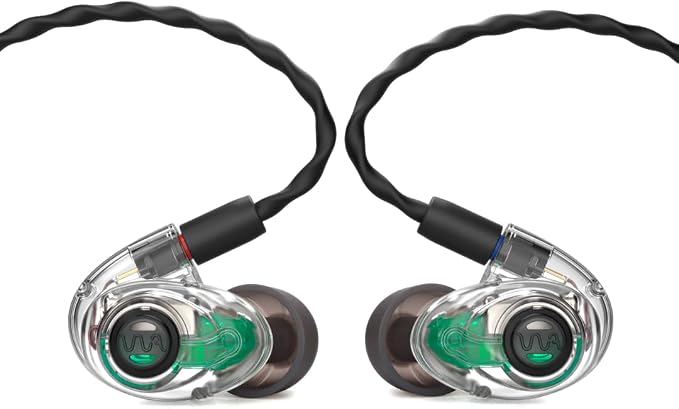
Total isolation isn’t always what a singer wants. Worship vocalists, acoustic performers, and singers who take requests or lead a room often feel cut off inside a fully sealed monitor — you can’t hear the congregation, the audience response, or the band member calling an audible. Westone built the AM Pro X30 for exactly that singer. Its passive ambient design lets a controlled amount of stage sound blend with your monitor mix, so you stay connected to the room while still hearing yourself clearly.
Inside, three proprietary balanced armature drivers with a three-way passive crossover deliver the detail: articulate mids where your voice lives, clean highs, and lows that stay controlled rather than boomy. Westone’s decades of hearing-product experience show in the fit — a low-profile, ergonomic universal shell with True-Fit foam and silicone tips in multiple sizes, plus the thin, strong Linum BaX T2 detachable cable that disappears over the ear. The trade-off is honest: because the ambient port lets sound in, this is not the pick for a punishingly loud rock stage — that’s the Mackie or the sealed Shures above. For singers whose performance depends on hearing the room, nothing else here does this job.
- Drivers: triple balanced armature, three-way passive crossover
- Design: passive ambient — blends stage sound with your monitor mix
- Cable: detachable Linum BaX T2 with T2 connectors
- Fit: low-profile ergonomic shell, True-Fit tips in multiple sizes
- Best for: worship singers, acoustic acts, performers who work the room
| Vocal Clarity | 9.2 |
| Isolation | 7.4 |
| Comfort & Fit | 9.2 |
| Build | 8.8 |
| Value | 8.2 |
6. Shure SE535 PRO — Best premium universal in-ear monitor for singers

The SE535 PRO is where Shure’s universal range turns professional. Three high-definition MicroDrivers per ear — a dedicated tweeter plus dual woofers — produce the spacious, separated sound that busy monitor mixes demand. Your voice occupies its own clear space, backing vocals stack behind it instead of smearing into it, and the low end stays rich without crowding the midrange you sing in. Frequency response runs 18 Hz to 19 kHz with 119 dB sensitivity, so any bodypack drives it with headroom to spare.
Everything around the drivers is built for working singers: up to 37 dB of isolation, the same secure low-profile fit as the rest of the SE range, and a detachable Kevlar-reinforced MMCX cable. SoundMavericks’ take: this is the ceiling of what a universal-fit IEM does for a vocalist before custom molds enter the conversation. If you gig weekly, sing lead over a full band, and want one set that stays your set for years, the SE535 is the buy-once answer in this guide. If you gig occasionally, the SE425 above delivers most of the vocal-clarity benefit — the SE535’s extra separation earns its keep in dense, loud, professional mixes.
- Drivers: triple high-definition MicroDrivers (tweeter + dual woofers)
- Frequency response / sensitivity: 18 Hz – 19 kHz, 119 dB SPL/mW
- Isolation: up to 37 dB with a proper seal
- Cable: detachable MMCX, Kevlar-reinforced
- Best for: professional and weekly-gigging lead vocalists
| Vocal Clarity | 9.4 |
| Isolation | 9.2 |
| Comfort & Fit | 9.0 |
| Build | 9.2 |
| Value | 8.0 |
7. Etymotic ER2XR — Best maximum isolation for singers
Etymotic takes the opposite approach to everyone else here: a single dynamic driver, a deep-insertion fit, and isolation figures nobody else matches. With the triple-flange or foam tips seated properly, the ER2XR blocks 35 to 42 dB of external noise — earplug territory. On a stage where the band’s volume is simply out of your control, that seal is what lets you keep your monitor mix genuinely quiet and still hear every detail of your voice.
The tuning helps too. The ER2XR’s Extended Response voicing pairs Etymotic’s famously accurate midrange — the frequencies your pitch perception depends on — with a modest bass lift so the band doesn’t feel anemic. The honest trade-offs: the deep fit takes real getting used to, the straight-down cable is less stage-proof than the over-ear designs above (route it under clothing and use the shirt clip), and the fit can shift for some singers on wide jaw movements, so test your seal while actually singing, not just listening. Amazon’s US listing for this model has been inconsistent, so the button below runs a tagged Amazon search for the current listing.
- Driver: single high-performance dynamic (moving coil)
- Isolation: 35–42 dB depending on ear tip
- Frequency response: 20 Hz – 16 kHz
- Cable: detachable, with user-replaceable filters
- Best for: singers on uncontrolled, very loud stages; accuracy-first vocalists
| Vocal Clarity | 9.0 |
| Isolation | 9.6 |
| Comfort & Fit | 7.4 |
| Build | 8.4 |
| Value | 8.8 |
Custom vs universal in-ear monitors for singers: which fit is right?
Every pick above is a universal-fit IEM: it seals with foam or silicone tips and works for almost any ear. Custom IEMs are molded from impressions of your ear canals, taken by an audiologist, and they are the endgame for many touring vocalists. Here’s the honest comparison from SoundMavericks’ analysis.
Universal fit wins on: price (a fraction of custom cost), immediacy (order today, sing this weekend), resale and backup pairs, and easy experimentation — you can own an SE215 as a spare and an SE535 as your main set for less than one custom build. Modern tip options, including memory foam, close much of the old fit gap.
Custom fit wins on: seal consistency — the mold matches your canal exactly, so the seal survives jaw movement, sweating, and two-hour sets better than tips can; isolation at lower tip pressure; and comfort for singers whose canals simply don’t suit standard tips. The costs are real: audiologist impressions, a build wait of weeks, no returns, and reshelling if your ears change.
Our recommendation for most singers: start universal with a proven stage model, learn what your monitor mix needs, and go custom only when you’re gigging constantly and fit — not sound — is your remaining problem. One singer-specific warning either way: test your seal while singing. Opening your jaw wide changes your ear canal shape, and a seal that breaks on high notes is a fit problem to solve with different tips or a mold, not with more volume.
Wireless in-ear monitor systems: what singers need to know
The earphones in this guide are passive — the wireless part is a separate system: a transmitter at the mixer sends your personal mix to a bodypack receiver you wear, and any of these IEMs plug into that pack. Choosing the pack matters as much as choosing the earphones.
- Go wireless for freedom, wired for certainty. A wired pack or a simple headphone feed from the mixer has zero dropout risk and no latency. Wireless earns its cost when you move — which, for a front-person, is most of the job.
- Analog UHF is the touring standard. Systems like Shure’s PSM series and Sennheiser’s EW IEM range dominate professional stages because they’re proven in crowded radio environments. Compact 2.4 GHz and 5.8 GHz systems from makers like Xvive suit smaller stages and rehearsals, but can struggle in venues saturated with Wi-Fi — match the system to your stages, and always check that its frequency band is legal where you perform.
- Stereo vs mono: a stereo mix lets your engineer place your voice dead center with the band spread around it, which many singers find dramatically easier to pitch against. Mono systems are cheaper and simpler; stereo is the upgrade singers notice most.
- Latency is non-negotiable. Analog systems add effectively none. With digital systems, keep total latency low — singers are exquisitely sensitive to delay in their own voice, and a delayed monitor mix feels like singing in a canyon.
- Never use Bluetooth earbuds as stage monitors. Bluetooth’s latency and dropouts disqualify it for live singing. Bluetooth adaptors are fine for practice and travel — the stage feed should be wired or a proper IEM wireless system. For the listening side of wireless, our guide to noise cancelling earbuds for phone calls covers everyday carry; stage monitoring is a different tool entirely.
How to get a good singer’s monitor mix
The best IEMs can’t fix a bad mix. Ask your engineer — or set your own mixer app — like this:
- Your voice first, louder than feels polite. Your vocal should be the unmistakable center of the mix. Everything else is reference.
- One pitch reference instrument. Keys or guitar — whichever you pitch against — present but under your voice.
- Rhythm quieter than you expect. You can feel drums and bass through the floor and your body; in your ears they mostly mask your voice.
- A touch of reverb on your voice only. A dry, sealed vocal sounds unnaturally dead and pushes singers to over-sing. A little ambience restores confidence.
- Limit the pack, not your technique. Most bodypacks have a limiter — set it. It protects your hearing on the one dropped-mic moment per tour.
- Run one ear out only as a last resort. It destroys your level judgment and usually ends with the sealed ear getting blasted. If you need room sound, choose an ambient design like the Westone above, or ask for an audience mic in your mix.
And protect the long game: IEMs only protect your hearing if you keep levels moderate, which the seal makes possible. If you want the underlying science, our explainer on how noise cancelling headphones work covers active cancellation — IEMs use the passive version of the same idea, a physical seal, which is why fit is everything here. Singers who also record at home should pair their stage set with a proper wired listening option from our best wired earbuds coverage for practice and pitch work between shows.
Frequently asked questions
What are the best in-ear monitors for singers?
For most singers, the Shure SE215 PRO: up to 37 dB of isolation, a secure over-ear fit, a warm vocal-friendly tuning, and a detachable cable that works with any wireless bodypack. Singers who need more vocal detail should step up to the dual-driver Shure SE425 PRO, and professionals to the triple-driver SE535 PRO.
Are in-ear monitors good for singers?
Yes — they are the professional standard for live singing. A sealed personal mix lets you hear your pitch, breath, and dynamics consistently anywhere on stage, at lower and safer volumes than floor wedges, which helps protect both your hearing and your voice across a run of shows.
Do singers need custom in-ear monitors?
Not to start. Universal-fit models with the right tips serve most singers well, including weekly gigging vocalists. Customs become worth it when you perform constantly, struggle to keep a seal with standard tips, or sing long sets where fit fatigue is your main problem.
Can singers use wireless earbuds instead of in-ear monitors?
No — not for live monitoring. Bluetooth latency delays your own voice in your ears, which is deeply disruptive to singing, and dropouts are a real risk on stage. Use a proper wireless IEM system (a transmitter plus bodypack) with wired earphones plugged into the pack, or a fully wired feed.
How loud should a singer’s in-ear monitor mix be?
As quiet as you can comfortably sing with. The seal does the work: with 30-plus dB of isolation, your mix can sit at a moderate level and still dominate what you hear. If you keep turning up, fix the seal first — a broken seal, not a quiet mix, is usually the problem.
What is the difference between in-ear monitors and earbuds for singers?
In-ear monitors are built for stage monitoring: they seal deeply for isolation, route cables over the ear so they stay in while you move, use detachable cables, and are tuned to present vocals and instruments accurately in a live mix. Consumer earbuds prioritize convenience and features like Bluetooth, which makes them unsuitable as live monitor tools.
Our final verdict
Buy the Shure SE215 PRO if you’re a singer building your first serious monitor setup — it gets isolation, fit, vocal clarity, and wireless-pack compatibility right at once, and it’s the set we’d hand to any vocalist stepping up from wedges. Choose the Sennheiser IE 100 PRO if long-set comfort is your priority, the Shure SE425 PRO if your voice disappears in a full-band mix, and the Mackie MP-240 if your stages are brutally loud. The Westone AM Pro X30 is the specialist pick for worship and acoustic singers who need to hear the room, the Shure SE535 PRO is the premium universal ceiling, and the Etymotic ER2XR is the maximum-isolation outlier for accuracy-first vocalists. Whichever you choose, spend your first rehearsal on fit and mix, not volume — that’s where great singer monitoring actually comes from. Singers building a full stage and travel kit may also want our best headphones for airplane guide for the flights between shows, and our best IEMs for gaming roundup shows what these same driver technologies do off stage.

I am the founder of Sound Mavericks, where I provide the polite truth about audio equipment. I started this site because consumer electronics reviews are often too technical. Instead of using a silent lab, I test headphones, earbuds, and Bluetooth speakers in the real world – like on a noisy subway or in a busy coffee shop.
To stay independent, I buy my own review units (mostly from the United States) rather than accepting free gifts from brands. Once I finish testing a product, I sell it locally to our community. My goal is to help you understand sound quality, active noise cancellation (ANC), and battery life without the marketing hype.