
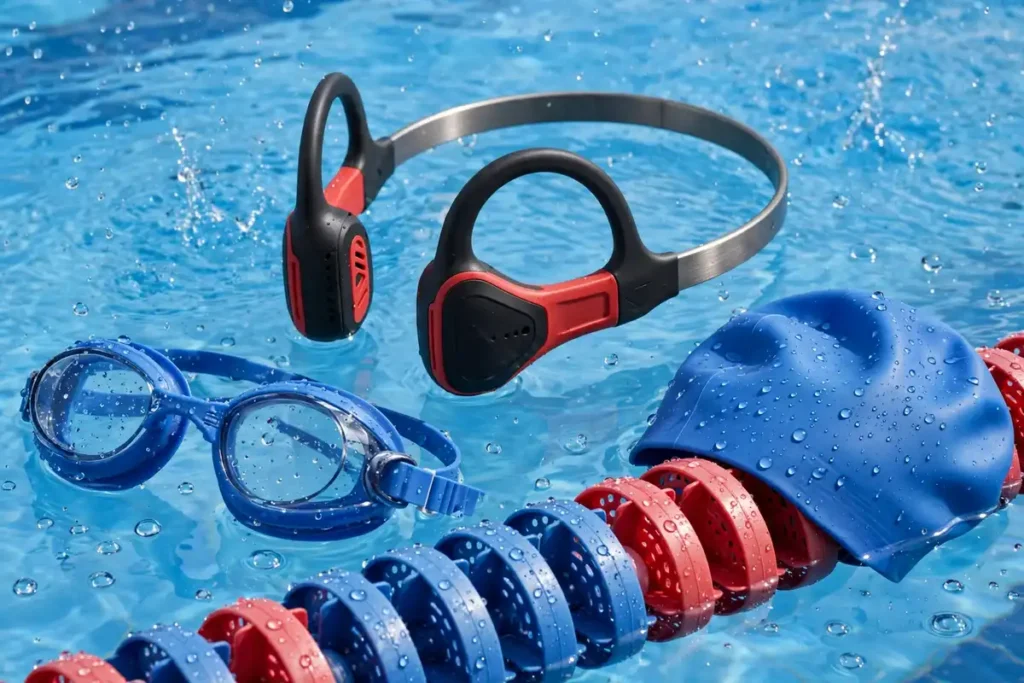
Long lap sets are where good intentions go quiet. The wall, the turn, the same black line — lap swimming is repetitive by design, and music or a podcast is the simplest way to make the metres pass. The best headphones for swimming laps solve a very specific problem, though, and it is not the problem most sport headphones solve. They have to keep playing while your head is fully underwater, stay put through flip turns, and fit alongside goggles and a swim cap without a fight.
That is why this guide is built around bone-conduction headphones, not earbuds. Bone-conduction models sit on your cheekbones, leave your ear canals completely open, and wrap around the back of your head in a single band that a cap can hold in place. If you would rather seal your ears with an in-ear design, our guide to the best earbuds for swimming covers that form factor instead — the picks there are different products, chosen for a different fit. Here, every pick is an open-ear bone-conduction model with onboard music storage, because, as we explain below, storage is the feature that decides whether a pair works in the water at all.
Our verdict: The Shokz OpenSwim Pro is the best pick for most lap swimmers — IP68 waterproofing, 32GB of onboard storage, and a Bluetooth mode for dry land in one light frame. Triathletes who want to capture streaming playlists for the swim should look at the H2O Audio Tri 2 Pro, and budget lap swimmers get the same core formula for less with the PSIER S18.
Best Headphones for Swimming Laps at a Glance
| Headphones | Best for | Rating | Storage | Battery | Check |
|---|---|---|---|---|---|
| Shokz OpenSwim Pro | Most lap swimmers | IP68 | 32GB | Up to 9 hrs Bluetooth, 6 hrs MP3 | Check Price |
| H2O Audio Tri 2 Pro | Triathletes | IPX8 | See note in review* | Up to 9 hrs Bluetooth, 6 hrs MP3 | Check Price |
| Nank Runner Diver2 Pro | Open water and rough conditions | IP69 | 32GB | Up to 10 hrs | Check Price |
| FINIS Duo | Pure lap training | IPX8 | 4GB | Up to 7 hrs | Check Price |
| Shokz OpenSwim | Swim-only simplicity | IP68 | 4GB | Up to 8 hrs | Check Price |
| PSIER S18 | Budget laps | IPX8 | 32GB | Up to 8 hrs | Check Price |
*Storage on the Tri 2 Pro is listed differently in the current Amazon listing title and in H2O Audio’s own product material — we flag the detail in its review below so you can check the live listing before you buy.
Why Bluetooth Does Not Work Underwater
This is the single most important thing to understand before you buy anything for the pool. Bluetooth runs on 2.4GHz radio waves, and water absorbs that signal almost immediately. The moment your head goes under, the connection to your phone — sitting in your bag or at the end of the lane — is gone. No setting, codec or newer Bluetooth version changes the physics. A pair can be completely waterproof and still be silent in the water if it depends on a phone for its music.
So for laps, the music has to live on the headphones themselves. Every pick in this guide has onboard storage and an MP3 mode: you connect the headphones to a computer, copy across music, podcasts or audiobooks you own, and play them back with no phone involved. Bluetooth still earns its place — for the warm-up on deck, the run or ride home, and, for triathletes, the other two legs of training — but treat it as the dry-land half of the product. If a swimming headphone advertises Bluetooth alone with no storage, it is not a lap-swimming headphone, whatever its waterproof rating says. If the underlying technology is new to you, our explainer on how bone conduction works covers how the cheekbone transducers deliver sound while your ears stay open.
1. Shokz OpenSwim Pro — Best Overall for Lap Swimming
The Shokz OpenSwim Pro is the most complete answer to the lap swimmer’s brief, and it is where our own analysis lands for most people. Shokz rates it IP68, submersible in up to 2 metres of fresh water for up to 2 hours, which comfortably covers any pool session. Inside is 32GB of storage — Shokz puts that at up to 8,000 songs — supporting MP3, FLAC, WAV, AAC, M4A, APE and WMA files, so audiobooks and podcasts load just as happily as music.
- Waterproof rating: IP68, up to 2m for 2 hours
- Storage: 32GB onboard MP3 storage
- Battery: Up to 9 hours in Bluetooth mode, up to 6 hours in MP3 mode; 10-minute charge gives up to 3 hours
- Connectivity: Bluetooth 5.4 for dry land, MP3 mode for the water
- Weight: 27.3g, nickel-titanium alloy frame
Two details lift it above swim-only rivals. First, the dual-mode design means one frame covers your whole training week: stream over Bluetooth 5.4 on a run, then switch to stored files in the pool, with a dedicated swimming EQ mode alongside the standard profile. Second, the fit is properly thought through for the water. At 27.3 grams the wraparound frame is light enough to forget, the transducers sit clear of goggle straps, and Shokz includes swimming earplugs in the box for swimmers who want a fuller sound in noisy pools. Physical buttons, rather than touch controls, are the right call here — they still work with wet hands and under a cap edge.
The honest trade-offs: battery life drops from 9 hours to 6 in MP3 mode, which still covers a week of hour-long swims, and you need your own music files, because no swimming headphone can store offline copies from a streaming app by itself. If you own your files and swim regularly, this is the pick.
2. H2O Audio Tri 2 Pro — Best for Triathletes
The H2O Audio Tri 2 Pro was designed from the start for the swim-bike-run problem: one headphone that survives the water, then keeps working on the bike and the run where open-ear awareness matters for traffic and race marshals. H2O Audio rates it beyond standard IPX8, submersible to 12 feet, with Bluetooth 5.3 for land use and an MP3 mode for the swim.
- Waterproof rating: IPX8, submersible to 12 feet per H2O Audio
- Storage: Onboard memory — check the live listing (see note below)
- Battery: Up to 9 hours Bluetooth and 6 hours MP3 playback per the brand’s product description
- Connectivity: Bluetooth 5.3 plus MP3 mode, with the H2O Audio app
- Standout feature: Playlist+ — records streamed audio into stored files for underwater playback
Playlist+ is the Tri 2 Pro’s genuine point of difference. Instead of requiring a library of owned MP3s, it captures audio you stream through the app and stores it on the headphones for the swim — a practical workaround to the streaming problem that defines this category, and one no other pick here offers. The soft silicone finish and redesigned buttons also suit long training days, and a hard protective case is included.
One flag from our listing check, stated plainly: the current Amazon listing title and H2O Audio’s own material do not agree on the onboard storage figure, so confirm the capacity on the live listing before you buy if storage size is decisive for you. Sound quality from bone conduction also will not match good in-ear buds on land — that is a category trade-off, not a fault of this model — and some swimmers find the frame less locked-in than the Shokz fit during hard flip turns, so the included earplugs and a cap help.
3. Nank Runner Diver2 Pro — Best for Open Water and Rough Conditions
If your laps happen in open water as often as in a pool, the Nank Runner Diver2 Pro brings the heaviest waterproofing in this guide. Nank rates it IP69 — a step beyond the usual IP68/IPX8 swim ratings, built around a sealed, non-porous design — with 32GB of onboard storage and Bluetooth 5.4 for dry-land use.
- Waterproof rating: IP69 per Nank
- Storage: 32GB onboard storage
- Battery: Up to 10 hours of playtime; a 10-minute charge gives around 2 hours
- Connectivity: Bluetooth 5.4 plus MP3 mode
- Fit: 35-degree adjustable ear hooks for dialling in transducer pressure
The adjustable ear hooks are the practical highlight. Bone-conduction sound depends on how firmly the transducers press against your cheekbones, and fit varies a lot between heads — the ability to adjust that angle and pressure is worth more in the water than another EQ preset. At around 32 grams it is a touch heavier than the OpenSwim Pro, and the trade is durability and adjustability rather than minimal weight. For triathletes whose swim leg is in a lake or the sea, and for swimmers who train without a cap and need the frame to hold on its own, that trade makes sense.
4. FINIS Duo — Best for Pure Lap Training
The FINIS Duo takes the opposite approach to everyone else here: no headband at all. It is a two-piece bone-conduction MP3 player that clips directly onto your goggle straps, resting the transducers on your cheekbones. Because the goggles hold it, there is nothing to slip during flip turns and nothing competing with a swim cap — for interval sets and technique work, that simplicity is the whole appeal.
- Waterproof rating: IPX8, up to 3 metres for 30 minutes per FINIS
- Storage: 4GB — roughly 1,000 songs per FINIS
- Battery: Up to 7 hours
- Connectivity: MP3 and WMA playback only — no Bluetooth
- Controls: Four physical buttons, including shuffle
The limits are equally clear, and FINIS does not hide them. With no Bluetooth and a goggle-clip design, the Duo is a pool tool, not a training all-rounder — it will not join you on the run home. Its 4GB of storage is plenty for a rotating set of training playlists and podcasts, but small next to the 32GB models above. Buy it if your swimming is structured lap training and you want the most streamlined, set-and-forget option in the guide; skip it if you want one headphone for every sport.
5. Shokz OpenSwim — Best Swim-Only Simplicity
The original Shokz OpenSwim is the Pro’s predecessor, and it still earns its place for swimmers who want Shokz build quality without paying for features they will never use. It is MP3-only by design — Shokz is explicit that it is not Bluetooth compatible — with 4GB of storage for up to 1,200 songs and the same IP68 rating as the Pro: submersible to 2 metres for up to 2 hours.
- Waterproof rating: IP68, up to 2m for 2 hours
- Storage: 4GB, supporting MP3, WAV, WMA, AAC and FLAC
- Battery: Up to 8 hours
- Connectivity: Onboard MP3 playback only
- Weight: 30g titanium wraparound frame
Our framing is simple: if every session starts at the pool wall and you already own your music files, the OpenSwim gives you the essential experience — secure fit, proven waterproofing, a full training week’s battery — and nothing superfluous. The moment you want the same headphones to stream on a run, step up to the OpenSwim Pro instead. A nose clip and earplugs are included.
6. PSIER S18 — Best Budget Pick for Lap Swimming
The PSIER S18 delivers the category’s core formula — bone conduction, IPX8 waterproofing and a large slab of onboard storage — at a budget position. Its manual lists IPX8 submersion up to 2 metres for 1 hour, 32GB of internal memory for MP3 mode, and up to 8 hours of playtime, with support for MP3, WMA, WAV, APE and FLAC files.
- Waterproof rating: IPX8, up to 2m for 1 hour per the product manual
- Storage: 32GB onboard storage
- Battery: Up to 8 hours; around 2 hours to charge
- Connectivity: Bluetooth plus MP3 mode — double-click to switch modes
- Driver: 14mm bone-conduction driver per the manual
Where the money is saved is in polish, not in the spec sheet. The band is less adjustable than the Nank’s and less refined than Shokz’s frame, the controls take some learning, and budget listings are not always consistent between listing copy and manual — we worked from the manual’s figures here. None of that stops it doing the actual job: load your files, switch to MP3 mode, and swim your set with music. For a first pair, it is the sensible value play in this lineup.
How to Choose the Best Headphones for Swimming Laps
What IP rating do you need for swimming?
Look for IPX8 or IP68 as a minimum — those ratings cover continuous submersion, which is what laps actually are. Lower ratings such as IPX4, IPX5 or IPX7 cover splashes, rain or brief accidental dips, not a head that goes under every stroke. Always read the depth and time attached to the rating, because IPX8 is defined by each manufacturer: in this guide alone it spans 2 metres for 1 hour up to 12 feet. Our guide to understanding IP ratings breaks down what each digit really promises. Also note that swim ratings are tested in fresh water — rinse any pair after chlorinated or salt sessions.
How much storage do you need for swimming?
More than you first think, if you listen to podcasts or audiobooks, which are far larger than songs. As a rule of thumb from the manufacturers’ own figures, 4GB holds roughly 1,000–1,200 songs, while 32GB stretches to around 8,000. A 4GB swim-only player suits a fixed set of training playlists; 32GB suits swimmers who rotate long-form audio and do not want to re-sync files every week. Either way, build the loading step into your routine — files go on over a USB or magnetic cable from a computer, not over the air.
Can you wear swimming headphones with a cap and goggles?
Yes, and the order matters. Put the headphones on first, then your goggles, then pull the cap over the top — the cap locks the band in place and is the single best trick for flip turns. Bone-conduction wraparound frames are shaped to sit clear of most goggle straps, and the FINIS Duo removes the conflict entirely by clipping to the straps themselves. If you swim without a cap, models with adjustable hooks, like the Runner Diver2 Pro, give you another way to firm up the fit.
Are bone conduction headphones safe for open-water swimming?
The open-ear design is a genuine safety feature outside the pool. Because nothing blocks your ear canals, you can still hear other swimmers, boats, lifeguards and race instructions while your music plays — one reason bone conduction dominates triathlon swim training. The same awareness applies on the bike and run legs. Keep the volume sensible, follow event rules — many races ban headphones on the course itself, so treat these as training tools — and use earplugs only in the controlled environment of a pool, where they improve clarity by keeping water noise out.
Frequently Asked Questions
Can you listen to music while swimming laps?
Yes, with headphones that store music on the device itself. Bluetooth cannot carry audio underwater, so lap swimmers use waterproof bone-conduction headphones with onboard MP3 storage, load their files before the session, and play them back with no phone involved.
Do Bluetooth headphones work underwater?
No. Water absorbs the 2.4GHz radio signal Bluetooth uses, so the connection drops as soon as your head goes under. Bluetooth on swimming headphones is for dry-land use — warming up, running or cycling — while MP3 mode handles the swim itself.
What is the difference between IPX8 and IP68 for swimming?
Both indicate protection against continuous submersion, with the exact depth and duration set by the manufacturer. The extra “6” in IP68 also certifies complete dust protection. Either rating can be suitable for laps — check the stated depth and time, and rinse the headphones after swimming.
Can you wear bone conduction headphones under a swim cap?
Yes. Put the headphones on before your goggles and cap, and the cap helps hold the wraparound band secure through flip turns. Bone-conduction transducers sit on the cheekbones, clear of most goggle straps, so the three pieces of kit work together rather than competing.
Can you use Spotify or streaming apps with swimming headphones?
Not directly underwater, because streaming needs the Bluetooth or phone connection that water blocks. The standard workaround is to load music, podcast or audiobook files you own onto the headphones’ storage. The H2O Audio Tri 2 Pro’s Playlist+ feature is an exception that records streamed audio into stored files you can play in the water.

I am the founder of Sound Mavericks, where I provide the polite truth about audio equipment. I started this site because consumer electronics reviews are often too technical. Instead of using a silent lab, I test headphones, earbuds, and Bluetooth speakers in the real world – like on a noisy subway or in a busy coffee shop.
To stay independent, I buy my own review units (mostly from the United States) rather than accepting free gifts from brands. Once I finish testing a product, I sell it locally to our community. My goal is to help you understand sound quality, active noise cancellation (ANC), and battery life without the marketing hype.

