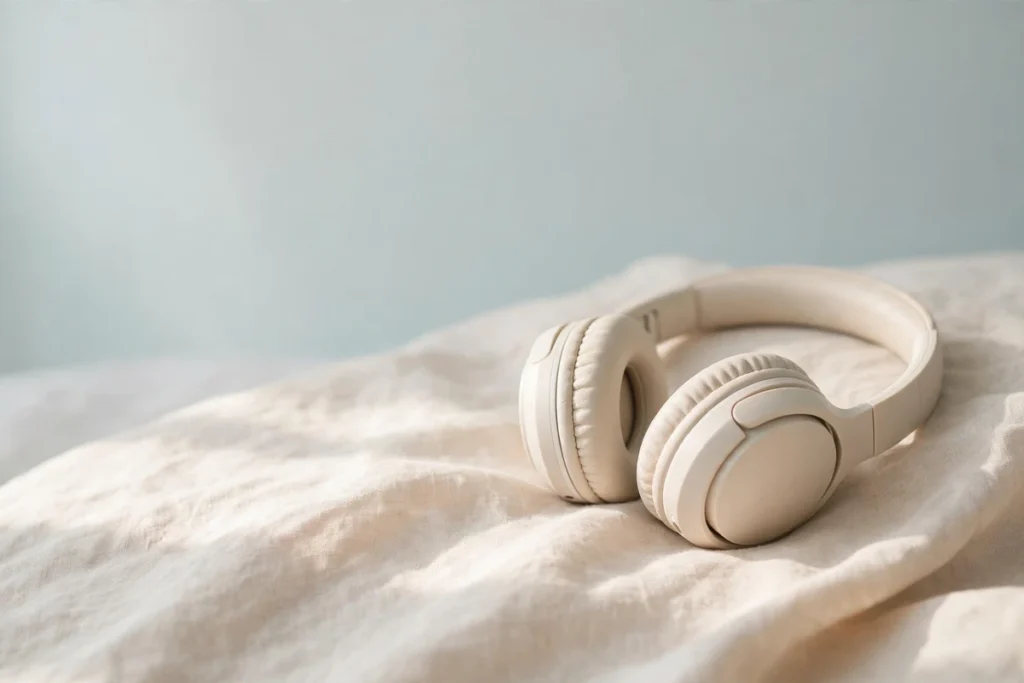
For a lot of people with sound sensitivity, the problem is not just the noise. It is the headphones themselves. A pair can block plenty of sound and still be unwearable because the headband squeezes, the earcups feel hot and shallow, the controls are fiddly, or switching them on triggers a loud voice prompt. If that sounds familiar, this guide was built differently: every pick below was chosen for how it feels to wear, not just how much noise it cancels.
SoundMavericks ranked these six options on comfort features you can check before buying: passive isolation that works with the electronics off, active noise cancelling (ANC) you can reduce or switch off, low clamping force, light weight, deep and soft earcups, simple physical controls where possible, and no sudden loud alerts. The list deliberately includes one fully passive option, because for some listeners the most comfortable headphone has no electronics in it at all. Nothing here is a medical product or promises any treatment effect — these are comfort features, plainly described, so you can choose the pair most likely to stay on your head.
Our Picks at a Glance
Best overall: Bose QuietComfort Headphones — the gentle-clamp benchmark, with plush cups, physical buttons, and cancelling you can dial down in the app.
Best lightweight pick: Sony WH-CH720N — Sony’s lightest noise cancelling headphone at 192 grams, with physical buttons and an ANC-off mode.
Best adjustable ANC: Sony WH-1000XM5 — strong cancelling with app-adjustable levels and a full off setting, in a light frame.
Best value with app control: Soundcore Space Q45 — adaptive ANC with selectable levels, long battery life, and a passive normal mode.
Best for teens: Puro Sound Labs PuroQuiet Plus — smaller fit, built-in 85dB volume limit, simple ANC on/off switch.
Best passive, no electronics: ProCase Hearing Protection Ear Muffs — rated SNR 33dB, with nothing to charge, pair, or switch on, and no alerts of any kind.
Quick Comparison
| Headphones | Best For | Noise Control | Weight | Controls | Buy |
|---|---|---|---|---|---|
| Bose QuietComfort Headphones | Best overall | ANC, adjustable in app, plus Aware mode | About 238g | Physical buttons | Check Price |
| Sony WH-CH720N | Lightest wear | ANC with full off mode | 192g | Physical buttons | Check Price |
| Sony WH-1000XM5 | Adjustable ANC | ANC with app levels and full off mode | 250g | Touch panel | Check Price |
| Soundcore Space Q45 | Value, long battery | Adaptive ANC, app levels, Normal (off) mode | About 292g | Physical buttons | Check Price |
| Puro Sound Labs PuroQuiet Plus | Teens, volume limit | ANC on/off switch, 85dB volume limit | Not stated by maker | Buttons and ANC switch | Check Price |
| ProCase Hearing Protection Ear Muffs | Passive, no electronics | Passive only, SNR 33dB rated | Not stated by maker | None — nothing to operate | Check Price |
One honest note: the ProCase rating (SNR) comes from hearing-protector testing. ANC headphones are not rated that way, so the figures do not compare directly across the rows.
What Makes a Headphone Comfortable for Sensory Sensitivity?
Passive isolation first, electronics second
A good seal from deep, soft earcups reduces sound before any electronics get involved, and it keeps working with ANC off or the battery flat. Passive isolation has no side effects: no powered sensation, no hiss, nothing to adjust. Our explainer on active noise cancellation vs passive isolation covers how the two differ, and our comparison of noise cancelling vs noise isolating covers when the simpler approach is better. Every ANC pick below also isolates passively, so turning the electronics down never leaves you unprotected.
Clamping force, weight, and earcup depth
Touch sensitivity is half of this purchase. Clamping force is how hard the headband squeezes to hold the seal; too much builds pressure at the jaw and temples over an hour. Weight works the same way — a lighter pair asks less of your head over a long day. Earcups should be deep enough that your ears sit inside without the driver pressing on them, and soft enough that glasses arms create no pressure point. Where a maker publishes a weight, we list it in the table; for clamping, we describe the fit as owners consistently report it.
Simple controls and no sudden sounds
Physical buttons beat touch panels for many sensitive listeners: they are findable without looking, they do not fire when you adjust the fit, and they respond the same way every time. Just as important is what a headphone does unprompted. Check its app for voice-prompt volume, notification tones, and auto-play behaviours, and turn off anything you do not need. The quietest option of all is the passive one at the end of this list, which makes no sounds at all.
Bose QuietComfort Headphones — Best Overall for Gentle, Low-Pressure Wear

The Bose QuietComfort Headphones are the pair we would hand to someone who has already given up on a tighter, heavier flagship. The QuietComfort line built its reputation on a gentle fit: plush, roomy earcups, a headband that spreads its pressure evenly, and a clamp owners consistently describe as relaxed rather than gripping. At about 238 grams it is not the lightest pick here, but the weight is carried comfortably on long, low-pressure wear.
The controls will suit readers who dislike touch panels: volume, playback, and mode selection are physical buttons — predictable and hard to trigger by accident. Noise control runs through Quiet mode for full cancelling and Aware mode for hearing your surroundings, and the Bose app lets you build custom modes with the cancelling level set lower — the setting to try first if full-strength ANC feels like too much. Battery life is rated at up to 24 hours, a wired connection is included for skipping Bluetooth entirely, and the sound is warm and easy at low volumes. If you mainly need a quieter headphone with the softest squeeze in its class, start here.
Sony WH-CH720N — Best Lightweight Pick for Pressure-Sensitive Heads

At 192 grams, the Sony WH-CH720N is the lightest noise cancelling headphone Sony makes, and that makes it the easiest recommendation here for anyone whose main complaint is pressure. There is simply less headphone to notice: a slim headband, soft cups, and a light clamp that reviewers single out for exactly this reason. When in doubt, less weight wins.
It is also a genuinely capable ANC headphone. Sony rates battery life at up to 35 hours with cancelling on, the cancelling can be switched fully off from the button or the app, and ambient levels are adjustable. Controls are physical buttons, so adjusting volume never means swiping a touch surface. The trade-offs are honest: the build is plastic and feels it, and the cancelling sits a step below the XM5 below. None of that changes the core appeal — for long sessions on a sensitive head, this is the pair most likely to be forgotten while wearing it.
Sony WH-1000XM5 — Best Adjustable ANC, With a Full Off Switch

The Sony WH-1000XM5 is the pick when outside noise is the main problem and you want control over how hard the cancelling works. Sony’s app offers adjustable cancelling behaviour, automatic adjustment you can disable if you prefer things to stay where you set them, and — critically for this guide — a straightforward way to turn ANC completely off and rely on the passive seal alone. At 250 grams with wide, soft-fit cups, it stays comfortable well beyond a single album.
Battery life is rated at up to 30 hours with ANC on, and the sound stays clear at modest volumes. Two honest caveats belong here. First, the XM5 uses a touch panel rather than buttons; readers who dislike touch controls should weigh the CH720N or the Bose above. Second, its stronger cancelling is more likely to produce the ear-pressure sensation described further down this page — which is why the adjustable levels and the off setting matter, and why we recommend starting low and short. Chosen with those settings in mind, it is the most capable all-rounder here.
Soundcore Space Q45 — Best Value With Selectable Cancelling Levels

The Soundcore Space Q45 makes its case on control per dollar. Its adaptive ANC adjusts to your environment, and the Soundcore app lets you choose the cancelling level yourself instead — the feature that matters most in this guide — alongside a Normal mode with ANC off and a Transparency mode for hearing what is around you. Physical buttons handle playback and volume, and battery life is a headline strength: up to 50 hours with ANC on, longer with it off, so charging is a rare event.
The trade-off is physical: at roughly 292 grams the Q45 is the heaviest headphone here. Its padding is generous, but readers who know weight bothers them should try the CH720N first. For everyone else — particularly anyone who wants flagship-style control over cancelling strength for less money, and who mostly listens seated — the Q45 is the sensible buy. Its app EQ is also useful for softening any high-frequency edge at low volumes.
Puro Sound Labs PuroQuiet Plus — Best for Teens, With a Built-In Volume Limit

Parents shopping for an older child or teenager, and adults with smaller heads, should look at the Puro Sound Labs PuroQuiet Plus. Its defining feature is a hardware volume limit capped at 85dB: whatever the connected device does, output stays within that ceiling, removing a whole category of worry about sudden loud playback. On top of that sit ANC with a simple on/off switch — no app required day to day — and Bluetooth for music, lessons, and calls.
The fit needs an honest description. The PuroQuiet Plus is an on-ear design: the pads rest on the ear itself rather than around it. Some listeners prefer that smaller footprint; others find any on-ear pressure uncomfortable within minutes, and no specification sheet can tell you which group you are in. The smaller sizing can also run small for larger heads. Treat it as a specialist pick: if a volume ceiling and a compact fit are your top requirements, it fills a niche nothing else here does.
ProCase Hearing Protection Ear Muffs — Best Passive Pick, Nothing Electronic

Sometimes the right answer is not a headphone at all. The ProCase Hearing Protection Ear Muffs are a purely passive design rated at SNR 33dB, lowering the level of surrounding sound evenly without electronics of any kind. There is nothing to charge, nothing to pair, no power-on chime, no voice prompt, no low-battery warning — and no ANC pressure sensation, because there is no ANC. For busy public spaces, events, and travel days, that simplicity is the entire point, and it is why passive muffs appear in almost every sensory-comfort roundup we reviewed.
The limits are equally plain. These muffs play no music — if you want audio, they pair naturally with ordinary earbuds worn underneath. The fit is firmer than the ANC headphones above, because a passive muff seals by pressure alone; the padded headband softens that, and stretching the band over a box overnight is a common owner tip for loosening a new pair. They fold for storage and suit larger children through adults. If powered cancelling has never felt right, this is the intended pick, not a compromise.
Why Does Noise Cancelling Feel Like Pressure — and How Do You Avoid It?
Some listeners feel a distinct fullness or suction sensation with ANC on, as if their ears need to pop. That feeling is commonly reported: our explainer on why noise cancelling headphones cause pressure covers what is happening, including how the sudden removal of low-frequency sound can be interpreted as a pressure change even though the air pressure has not moved. The sensation varies a lot between people and models, and for a minority of listeners it is reason enough to skip ANC entirely.
The practical ways around it: start with cancelling at its lowest setting; wear the headphones with ANC off for the first sessions and let the passive seal do the work; keep sessions short and build up gradually; alternate with a transparency mode, which lets some natural sound back in; and check the physical fit, because a tight seal and heavy clamp add real pressure on top of the electronic sensation. If the feeling persists across settings, that is useful information, not a failure — it means the passive route, like the ProCase muffs above, is likely your better option.
How Is This Guide Different From a Headphones-for-Autism List?
Readers who want a list focused specifically on autism can find ours in the related guide to the best noise cancelling headphones for autism. This page takes the broader view: sensory comfort is about sound, touch, and wearability together, for adults with sound sensitivity and parents choosing for teenagers alike. That is why passive-first options and fit details carry as much weight here as cancelling strength does.
How to Test a Pair in the First Week
Start short, in a calm place
Whatever you choose, treat the first sessions as a fit test. Begin with ten or fifteen minutes somewhere quiet and familiar, with any ANC at its lowest setting or off. Check three things separately: how the cups feel on your ears, how the headband feels across your head, and how the powered sensation feels if you turn cancelling on. Change one setting at a time, so you know what caused any discomfort, and keep the packaging until you are sure — fit is personal enough that a return window is a genuine part of buying well here.
Set the volume and the alerts once, properly
Before regular use, spend five minutes in the app: set a comfortable maximum volume, reduce or disable voice prompts and tones, and turn off automatic behaviours like auto-play if you prefer your equipment to do the same thing every time. Predictability is a comfort feature in itself.
Frequently Asked Questions
What are the best headphones for sensory issues?
The best headphones for sensory issues combine strong passive isolation, active noise cancelling you can reduce or switch off, low clamping force, light weight, and soft, deep earcups. In this guide, the Bose QuietComfort Headphones suit most people as a gentle all-rounder, the Sony WH-CH720N is the lightest option, and the ProCase ear muffs are the best choice if you want no electronics at all.
Can noise cancelling headphones be used with ANC turned off?
Yes. Every ANC pick in this guide can run with cancelling reduced or switched off, in which case the earcup seal still provides passive isolation. The Sony WH-CH720N and Sony WH-1000XM5 offer a full off mode, the Soundcore Space Q45 has a Normal mode with ANC off, and the Bose QuietComfort lets you lower the cancelling level in custom app modes.
Why do noise cancelling headphones feel like pressure in my ears?
Some listeners report a feeling of fullness or suction when ANC is on. It is commonly linked to how your ears interpret the sudden removal of low-frequency sound, rather than a real change in air pressure, and a tight physical seal can add to it. Lowering the ANC level, loosening the fit slightly, taking breaks, or using a passive option usually makes the sensation manageable or removes it.
Are passive ear muffs better than ANC headphones for sound sensitivity?
Neither is universally better; they suit different needs. Passive ear muffs such as the ProCase, rated SNR 33dB, reduce sound with no electronics, no alerts, and no ANC pressure sensation, but they cannot play music. ANC headphones add adjustable cancelling and audio playback, at the cost of charging, prompts, and a powered sensation some listeners dislike.
What should I look for if headphones usually hurt my head?
Prioritise low weight, a gentle clamping force, a wide padded headband, and deep earcups that do not press on your ears or glasses. Physical buttons are easier for many people than touch panels. Start with short sessions, adjust one setting at a time, and keep the return option in mind, because fit is personal and cannot be judged from specifications alone.
The Verdict
Most readers should start with the Bose QuietComfort Headphones: the softest squeeze in its class, calm physical controls, and cancelling you can soften in the app. If weight is your main trigger, go straight to the 192-gram Sony WH-CH720N. Choose the Sony WH-1000XM5 for the strongest adjustable cancelling, the Soundcore Space Q45 for similar control for less money, the PuroQuiet Plus when a teen needs a volume ceiling, and the ProCase ear muffs when the most comfortable technology is none at all.

I am the founder of Sound Mavericks, where I provide the polite truth about audio equipment. I started this site because consumer electronics reviews are often too technical. Instead of using a silent lab, I test headphones, earbuds, and Bluetooth speakers in the real world – like on a noisy subway or in a busy coffee shop.
To stay independent, I buy my own review units (mostly from the United States) rather than accepting free gifts from brands. Once I finish testing a product, I sell it locally to our community. My goal is to help you understand sound quality, active noise cancellation (ANC), and battery life without the marketing hype.