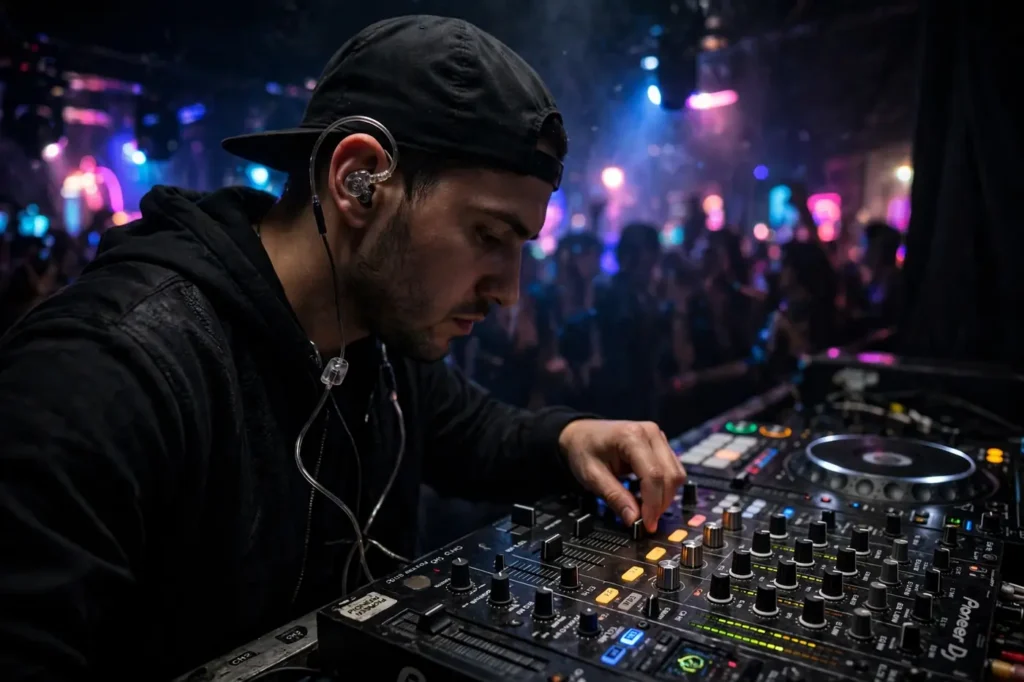
Cueing the next track in a loud booth is a completely different job from listening at home. The room is pushing back at you, the monitor is booming, and you still need to hear the kick, the hats, and the exact bar where your mix comes in. That is why the best earbuds for DJs are not consumer true wireless buds at all. They are wired in-ear monitors (IEMs) built for isolation, a secure over-ear fit, replaceable cables, and a clear, flat-ish tuning that does not hide the details you cue from.
Below, SoundMavericks rounds up five wired IEMs that genuinely suit DJ work, from a budget backup pair to a deep-isolation specialist, plus an honest look at when custom-fit monitors make sense. Every pick here is wired, routes its cable over the ear, and uses a detachable cable you can replace in minutes if it fails before a set.
Best Earbuds for DJs: Quick Picks
Best overall for DJs: Sennheiser IE 100 Pro — purpose-built for stage and booth monitoring, with a single 10mm dynamic driver, a secure ergonomic fit, and a detachable cable.
Best proven all-rounder: Shure SE215 Pro — the long-running booth and stage standard, with sound-isolating sleeves rated for up to 37 dB of isolation and a replaceable MMCX cable.
Best sound quality step-up: Sennheiser IE 200 — a 7mm TrueResponse driver with neutral, detailed tuning and a dual-position ear tip system that lets you adjust the bass.
Best isolation: Etymotic ER2XR — deep-insertion earphones rated for 35–42 dB of passive isolation, the strongest seal on this list for the loudest rooms.
Best budget pick: KZ ZS10 Pro — a five-driver hybrid (four balanced armature plus one dynamic per side) with a detachable 2-pin cable, ideal as a first pair or a gig-bag spare.
Can DJs use wireless earbuds?
For cueing, generally no — and latency is the reason. Beatmatching is a timing task measured in milliseconds. A wired connection delivers the cue signal to your ears with effectively zero delay, while Bluetooth adds latency that varies by codec and device, commonly well over 100 milliseconds on standard connections. That delay sits between the track playing in the room and the track in your ear, which makes tight manual beatmatching and fast cue work far harder than it needs to be.
Wireless brings two more booth problems. Batteries die, and a dead bud mid-set is a disaster a cable never causes. And most true wireless earbuds rely on fit and active noise cancelling rather than a deep passive seal, so they isolate less predictably than a properly fitted IEM. There is a place for wireless in a DJ’s life — travelling, listening back to recordings, checking a mix on the move — but the cue channel on a mixer is a wired output for good reason. Every pick in this guide plugs straight into it.
What to look for in earbuds for DJing
Passive isolation first
In a club, isolation is what lets you cue at a safe, controlled volume instead of cranking your headphones to fight the PA. Look for IEMs that seal the ear canal with silicone or foam tips and publish an isolation figure. Around 26 dB is a useful minimum for booth work; deep-insertion designs reach 35 dB and beyond. A good seal also anchors the low end, so tip fit affects both safety and sound. This is passive isolation doing the work — for how it differs from electronic cancellation, see our guide to IEMs vs headphones.
Detachable, replaceable cables
Cables are the part that fails. They get yanked, stepped on, wound too tight, and stuffed into bags hundreds of times. A detachable cable — MMCX or 2-pin — turns a dead pair of earphones into a five-minute repair instead of a replacement purchase. For working DJs, this single feature matters more than almost any spec on the box, and carrying a spare cable is cheap insurance.
Over-ear cable routing and secure fit
DJ IEMs route the cable up and over the ear, often with a mouldable ear hook. That keeps the earpieces seated when you move, look down at the mixer, or pull one side out to hear the room. Straight-down consumer earbuds work loose exactly when you are busiest.
Flat-ish tuning with clear mids
You cue from the kick and the hats, but you judge a blend in the mids. A heavily bass-boosted, V-shaped tuning can sound exciting and still make cueing worse, masking the vocal and synth details that tell you two tracks are clashing. A balanced or mildly warm tuning is the safer booth tool. If you also produce, our guide to the best headphones for mixing covers the same accuracy-first thinking for the studio.
1. Sennheiser IE 100 Pro — Best Overall for DJs

The IE 100 Pro is the pick that feels designed for this exact job, because it was. Sennheiser built the IE Pro line for live monitoring, and the 100 Pro pairs a single 10mm dynamic driver with a notably secure, low-profile housing that sits flat in the ear and stays put under movement. SoundMavericks rates its tuning highly for cueing: warm enough to follow the kick, clear enough in the mids to judge a blend, and free of the harsh top end that makes long sets fatiguing.
Sennheiser rates the IE 100 Pro for up to 26 dB of passive attenuation with the supplied tips, which include silicone in three sizes and a foam set for a tighter seal. The detachable cable uses Sennheiser’s reinforced connector and is easily swapped, and the earpieces themselves are light enough to wear across a long night without hotspots. For DJs moving from headphones to IEMs for the first time, this is the most natural landing spot in the range.
- Driver: 10mm dynamic, single driver per side
- Frequency response: 20 Hz – 18 kHz
- Impedance: 20 ohms — easy to drive from any mixer headphone output
- Cable: Detachable, 1.3 m, 3.5 mm plug
2. Shure SE215 Pro — Best Proven All-Rounder

If one IEM has earned the title of default recommendation, it is the SE215 Pro. It has been a fixture in DJ bags, on stages, and in broadcast trucks for years, and the reasons are practical rather than flashy. A single dynamic MicroDriver delivers clear sound with warm, present bass that makes following a four-on-the-floor kick straightforward, while Shure’s sound-isolating sleeves block up to 37 dB of outside noise when fitted correctly — comfortably ahead of most rivals here.
The build is the other half of the story. The cable detaches at each earpiece via MMCX, is reinforced where it matters, and routes over the ear with formable wire that holds its shape. The included fit kit covers foam and silicone sleeves in multiple sizes, so most ears can get a proper seal out of the box. Replacement cables and sleeves are sold everywhere, which matters when something fails the night before a gig. For a first serious DJ IEM, or a backup pair that will never embarrass you, the SE215 Pro remains very hard to argue with.
- Driver: Single dynamic MicroDriver
- Frequency response: 22 Hz – 17.5 kHz
- Isolation: Up to 37 dB with sound-isolating sleeves
- Cable: Detachable MMCX, over-ear fit with formable wire
3. Sennheiser IE 200 — Best Sound Quality Step-Up

The IE 200 comes from Sennheiser’s audiophile line rather than its stage line, and DJs who care about detail will hear why it belongs here anyway. Its 7mm TrueResponse driver delivers a neutral, articulate presentation — clean, agile bass, well-defined mids, and precise treble — that makes it the best critical listener in this roundup. If you check your own productions and edits through the same earphones you cue with, the IE 200 translates better than anything else on this list.
A clever detail suits DJ work specifically: the ear tips mount in two positions, and sliding between them adjusts the bass response, so you can run a leaner tuning for cueing clarity or a fuller one for listening. The braided cable detaches via gold-plated MMCX connectors, flexible ear hooks hold the fit, and silicone plus memory foam tips are included. Isolation is good rather than class-leading, so in the very loudest booths the Etymotic below still wins — but for sound quality per pair, the IE 200 is the step up worth taking. Readers comparing the wider market should also see our roundup of the best IEMs.
- Driver: 7mm TrueResponse dynamic
- Frequency response: 6 Hz – 20 kHz
- Impedance: 18 ohms
- Cable: Detachable braided cable, MMCX connectors, 3.5 mm plug
4. Etymotic ER2XR — Best Isolation

Some booths are simply louder than others, and that is where the ER2XR earns its place. Etymotic’s deep-insertion design seats much further into the ear canal than a typical IEM, and the company rates the range at 35–42 dB of passive isolation — the highest figures in this guide, and the closest thing to wearing proper earplugs that still play your cue feed. DJs who play next to big club systems, or who actively want to protect their hearing across a long career, should start here.
The tuning helps too. The XR in the name stands for Extended Response: Etymotic’s famously accurate, flat midrange and treble with a tasteful lift in the sub-bass and mid-bass, adding roughly 3–4 dB down low so the kick stays physical without turning the ER2XR into a bass-heavy earphone. A single dynamic driver keeps the anodised aluminium shells small and light, the cable is user-replaceable, and the low impedance means any mixer drives it easily. The honest caveat is comfort: the deep fit takes a few sessions to get used to, and some DJs never fully warm to it. If you adapt, nothing here isolates better.
- Driver: Single dynamic driver, anodised aluminium shells
- Frequency response: 20 Hz – 16 kHz
- Isolation: 35–42 dB passive attenuation
- Cable: Detachable, user-replaceable
5. KZ ZS10 Pro — Best Budget Pick

Every DJ should own a pair of IEMs they are not afraid to lose, and the ZS10 Pro is the budget pick that still does the job properly. Each side packs five drivers — four balanced armatures plus a 10mm dynamic driver — behind a stainless steel faceplate and resin shell, a specification that would have been unthinkable at budget level a few years ago. The tuning is lively and V-shaped, with strong bass and bright treble; that is less neutral than the Sennheisers above, but the low-end weight makes the kick easy to follow, and plenty of DJs happily cue on it.
Crucially, the budget was not saved on the cable: it detaches on a protected 0.75mm 2-pin connection, so the most failure-prone part is replaceable here too. Fit follows the same over-ear pattern as the pro picks. Think of the ZS10 Pro as a starter pair, a festival spare, or the set that lives permanently in the gig bag — roles where its combination of isolation, volume, and replaceable parts makes it far more useful than any similarly priced consumer earbud.
- Drivers: 4 balanced armature + 1 dynamic (10mm) per side
- Frequency response: 7 Hz – 40 kHz
- Sensitivity: 111 dB
- Cable: Detachable 0.75mm 2-pin, 3.5 mm plug
Best Earbuds for DJs Compared
Here is how the five picks stack up on the specs that actually decide booth performance — driver setup, isolation, and the cable you will eventually replace.
| Product | Driver | Isolation | Cable | Best For | Price |
|---|---|---|---|---|---|
| Sennheiser IE 100 Pro | 10mm dynamic | Up to 26 dB | Detachable, 1.3 m | Best overall | Check Price |
| Shure SE215 Pro | Single dynamic MicroDriver | Up to 37 dB | Detachable MMCX | Proven all-rounder | Check Price |
| Sennheiser IE 200 | 7mm TrueResponse dynamic | Passive, tip-dependent | Detachable braided MMCX | Sound quality step-up | Check Price |
| Etymotic ER2XR | Single dynamic | 35–42 dB | Detachable, replaceable | Loudest booths | Check Price |
| KZ ZS10 Pro | 4BA + 1DD hybrid | Passive, tip-dependent | Detachable 2-pin | Budget and backup | Check Price |
Universal fit vs custom fit: which do DJs need?
Every pick above is a universal-fit IEM: it seals with interchangeable silicone or foam tips, works for almost any ear, can be shared or resold, and can be replaced overnight if it is lost before a tour date. For the large majority of DJs, universal fit is the right answer, and it is where every DJ should start.
Custom-fit IEMs are moulded from impressions of your own ear canals, taken by an audiologist and built by specialist makers. The advantages are real: a perfect, repeatable seal, isolation at the top of the range, and comfort across very long sets with no tip fiddling. Touring DJs and full-time residents playing several loud nights a week are the audience they exist for. The trade-offs are equally real — customs cost far more, take weeks to make, cannot be shared with a back-to-back partner, lose their resale value, and are generally ordered through the maker’s own fitting process rather than a normal retail listing, which is why this guide discusses them without buy links. A sensible path is to work a season or two on a good universal pair like the SE215 Pro or IE 100 Pro first; if the fit or isolation ever becomes the thing limiting you, that is when customs have earned their place in the budget.
Getting the seal right
Whichever pair you choose, the seal decides everything. Try every tip size in the box — most people need a larger size than they expect, and foam tips usually isolate best in loud rooms at the cost of a slower fitting routine. The test is simple: with the IEMs in and nothing playing, the room should drop dramatically and your own voice should sound boomy in your head. If the bass vanishes when the music starts, the seal has gone, not the earphones. Keep spare tips and a spare cable in the bag, and clean the nozzles regularly; booth work is sweaty work, and a clogged filter quietly eats your top end.
Frequently asked questions
Do DJs use in-ear monitors?
Yes, increasingly. Many DJs now cue on wired IEMs because they isolate better than headphones in loud booths, stay secure while moving, pack down to almost nothing, and protect hearing by letting you cue at lower volumes. Others still prefer traditional DJ headphones for quick one-ear cueing — both approaches are common, and some DJs carry one of each.
Can DJs use wireless earbuds for cueing?
Not well. Bluetooth latency delays the cue signal by well over 100 milliseconds on typical connections, which fights against the precise timing beatmatching depends on. Wireless buds also depend on batteries and usually isolate less than a sealed wired IEM. For travelling and casual listening they are fine; for the cue channel, wired is the professional default.
Are IEMs better than headphones for DJing?
They are better at isolation, portability, and consistent fit, which is why they keep gaining ground in booths. Headphones are quicker to slip on and off for one-ear cueing and suit DJs who share monitoring during back-to-back sets. Neither is universally better — it depends on how you cue, how loud your rooms are, and how long your sets run.
How much isolation do DJs need?
Around 26 dB of passive isolation is a practical minimum for club cueing, letting you monitor at safer volumes over the PA. DJs in very loud booths or playing long residencies benefit from 35 dB or more, which is deep-fit territory. The right figure is the one that lets you cue clearly without pushing your headphone volume up through the night.
Why do DJ earbuds have detachable cables?
Because cables fail first. A detachable MMCX or 2-pin cable can be replaced in minutes for a fraction of the cost of new earphones, and a spare cable in the gig bag turns a potential disaster into a non-event. For any IEM bought for regular DJ work, a replaceable cable should be treated as non-negotiable.
Whichever route you take — a proven universal like the Shure SE215 Pro, the purpose-built Sennheiser IE 100 Pro, or the deep-isolating Etymotic ER2XR — the formula for DJ earbuds stays the same: wired, sealed, secure, and repairable. Get those four things right and the booth gets a lot quieter, and your cueing gets a lot easier.

I am the founder of Sound Mavericks, where I provide the polite truth about audio equipment. I started this site because consumer electronics reviews are often too technical. Instead of using a silent lab, I test headphones, earbuds, and Bluetooth speakers in the real world – like on a noisy subway or in a busy coffee shop.
To stay independent, I buy my own review units (mostly from the United States) rather than accepting free gifts from brands. Once I finish testing a product, I sell it locally to our community. My goal is to help you understand sound quality, active noise cancellation (ANC), and battery life without the marketing hype.