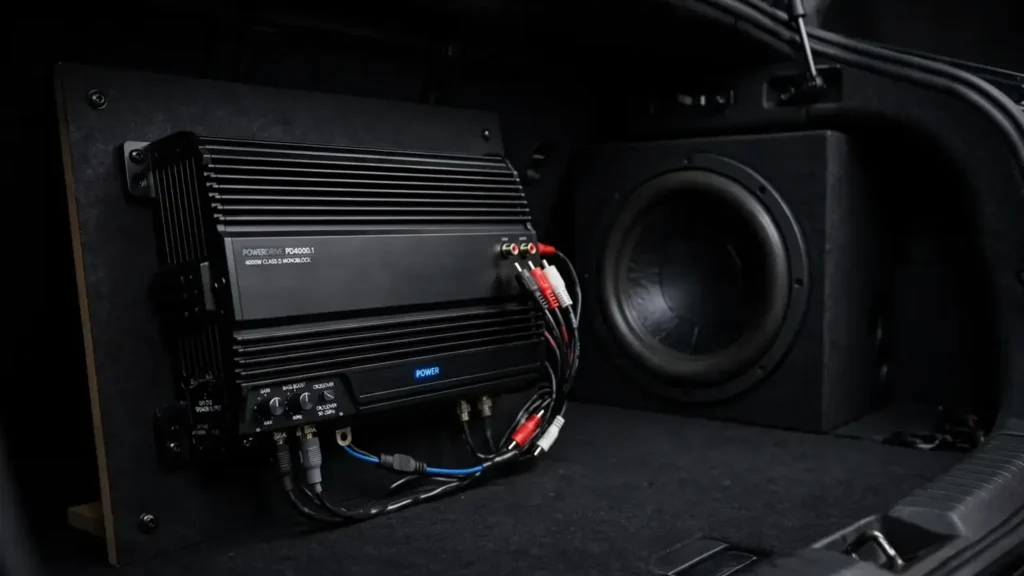
Finding the best car amplifier for your system comes down to one thing: matching the right amp to the speakers or subwoofers it will drive. Car amplifiers are nothing like the headphone amps you plug into a desk — these are high-current, 12-volt power plants that live in your trunk and decide whether your subwoofer pounds cleanly or clips itself into an early grave. We ranked the strongest car amplifier options of 2026 across the three categories that actually matter: mono amps for subwoofers, 4-channel amps for full-range speakers, and 5-channel amps that run an entire system from a single chassis.
This SoundMavericks ranking is editorial and independent. We compared manufacturer-rated RMS power (the only wattage figure worth trusting), impedance stability, crossover and tuning features, efficiency, and build quality — ignoring inflated “peak watt” claims — to shortlist six car amplifiers that cover every budget and system size.
Best Car Amplifier Picks at a Glance
| Rank | Amplifier | Type | RMS Power (Key Spec) | Best For |
|---|---|---|---|---|
| 1 | Skar Audio RP-1500.1D | Mono (subwoofer) | 1,500W RMS @ 1Ω | Maximum bass output |
| 2 | Rockford Fosgate R2-500X4 | 4-channel | 75W x 4 @ 4Ω | Powering full-range speakers |
| 3 | Rockford Fosgate R2-750X5 | 5-channel | 50W x 4 + 200W x 1 @ 4Ω | Entire system on one amp |
| 4 | Kicker 47KEY5001 KEY500.1 | Mono (subwoofer) | 500W RMS @ 1Ω | Compact installs, factory systems |
| 5 | BOSS Audio Systems R1100M | Mono (subwoofer) | 1,100W max @ 2Ω | Budget bass |
| 6 | Rockford Fosgate R2-1200X1 | Mono (subwoofer) | 1,200W RMS @ 1Ω | Serious subwoofer systems |
The 6 Best Car Amplifiers of 2026
1. Skar Audio RP-1500.1D — Best Car Amplifier for Bass

The Skar Audio RP-1500.1D earns the top spot as the best car amplifier for bass because it delivers an enormous amount of manufacturer-rated RMS power in a package aimed squarely at subwoofer duty. This is a Class D MOSFET monoblock rated at 1,500 watts RMS at 1 ohm, with 930 watts RMS at 2 ohms and 550 watts RMS at 4 ohms — real, impedance-stated figures, not marketing peak numbers (peak is 1,900 watts at 1 ohm). It is 1-ohm stable, so it handles aggressive subwoofer wiring configurations without complaint.
Key features: on-board bass EQ with a +6/+12 dB switch at 45 Hz, an included remote subwoofer level control (bass knob) for dash-side tuning, variable gain, low-pass and subsonic filters, 4-way protection circuitry, oversized 4-gauge power and ground terminals for maximum current flow, and a frequency response of 20 Hz – 250 Hz. Working voltage is 8.5V–14.4V.
Who it’s for: Bass enthusiasts running one or two demanding subwoofers who want the most RMS watts per dollar in a proven monoblock. This is the amp you buy when your goal is deep, loud, clean low end and nothing else.
Keep in mind: At this power level, proper electrical upgrades matter — big-gauge wiring and a solid ground are non-negotiable, and a professional install is strongly advised for high-current 1-ohm setups.
2. Rockford Fosgate R2-500X4 — Best 4 Channel Car Amplifier

If your goal is to wake up your door speakers rather than shake the trunk, the Rockford Fosgate R2-500X4 is our pick for the best 4 channel car amplifier. It delivers a CTA-2006-compliant 75 watts RMS x 4 at 4 ohms (155 watts x 4 at 2 ohms), and it bridges to 250 watts x 2 at 4 ohms if you want to run a component set up front and a subwoofer off the bridged pair. The full-range Class D topology keeps current draw and heat well below older Class AB designs.
Key features: C.L.E.A.N. (Calibrated Level Eliminates Audible Noise) gain-setup circuitry with clip indicators that help you set input levels cleanly, variable on-board Punch EQ (up to 3x the bass via equalization), fully adjustable 12 dB/octave high- and low-pass Butterworth crossovers (50–250 Hz), high-level input capability for factory head units, a defeatable auto turn-on circuit, balanced differential inputs with RCA pass-through outputs, and a cast aluminum heatsink. Chassis dimensions are 1.9″ x 6.8″ x 10.1″.
Who it’s for: Drivers upgrading front and rear speakers who want clean, efficient full-range power — or a flexible amp that can also drive a sub on two bridged channels. If you are pairing it with new door speakers, read our best car speakers guide and our 2-way vs 3-way speakers explainer to match speaker layouts to the four channels.
Keep in mind: Bridging two channels for a sub reduces the amp to stereo — plan your channel layout before wiring.
3. Rockford Fosgate R2-750X5 — Best 5 Channel Car Amplifier

The R2-750X5 is our pick for the best 5 channel car amplifier and the simplest answer to “I want my whole system on one amp.” It delivers 50 watts RMS x 4 plus 200 watts RMS x 1 at 4 ohms; at 2 ohms that climbs to 100 watts x 4 plus 350 watts x 1 — 750 watts total of CTA-2006-verified RMS power. Channels 1–4 run your front and rear speakers while the dedicated fifth channel drives a subwoofer, and the bridged configuration (200 watts x 2 at 4 ohms, sub channel not used in bridged mode) gives extra wiring flexibility.
Key features: full-range Class D efficiency, variable on-board Punch EQ (0–18 dB at 45 Hz), 12 dB/octave Butterworth high- and low-pass crossovers (50–250 Hz) plus a variable infrasonic filter (15–50 Hz) for the sub channel, C.L.E.A.N. gain setup, included remote level control for the sub channel, 2/4/5-channel input selection, high-level inputs, auto turn-on with defeat switch, cast aluminum heatsink, and short-circuit/over-current protection. Chassis is 1.9″ x 6.8″ x 11.3″.
Who it’s for: Anyone building a complete front/rear/sub system who wants one amplifier, one power wire run, and one installation — ideal for sedans, hatchbacks, and SUVs where space is limited.
Keep in mind: The sub channel at 200 watts RMS (4 ohms) suits a single moderate subwoofer. Pairing it with our best car speakers guide helps match the full-range channels to efficient speakers that make the most of 50 watts each.
4. Kicker 47KEY5001 KEY500.1 — Best Compact Car Amplifier

The Kicker KEY500.1 is the best compact car amplifier for modern installs: a smart mono amp that combines 500 watts RMS at 1 ohm (300 watts at 2 ohms, 150 watts at 4 ohms) with AI-driven DSP that auto-tunes itself to your vehicle. At roughly 8 inches long and under 2 inches tall, it fits under seats, behind panels, and in trunks where full-size monoblocks won’t go.
Key features: automatic DSP tuning that adjusts audio signals and corrects frequency response peaks, 24 dB subsonic and low-pass crossovers, bass boost and gain controls, 10 Hz – 160 Hz frequency response, over 90 dB signal-to-noise ratio, FIT 2+ input technology accepting signals up to 40 volts for compatibility with stock and aftermarket head units, selectable electronic crossovers, and compatibility with factory start/stop systems. A remote bass knob (Kicker 46CXARC) is available separately.
Who it’s for: Drivers with a factory head unit who want real subwoofer power without replacing the radio, and anyone working with a tight install space. The auto-tune DSP is a genuine advantage for non-expert installers — it takes much of the guesswork out of tuning.
Keep in mind: At 500 watts RMS it pairs best with single 10″–12″ subwoofers in the 300–500 watt RMS range rather than competition-grade drivers.
5. BOSS Audio Systems R1100M — Best Budget Car Amplifier

The BOSS Audio R1100M is our best budget car amplifier for first-time buyers who want to add bass on a tight spend. This Class A/B monoblock is rated at 1,100 watts max at 2 ohms (550 watts max at 4 ohms), with 2-ohm stability, a MOSFET power supply, and an included remote subwoofer control.
Key features: variable low-pass crossover (35–160 Hz), variable bass boost (0–18 dB), variable gain control, RCA and speaker-level inputs (so it works with factory head units), soft turn-on circuit, thermal, short, and overload protection circuits, power and protection LEDs, and a 6-year platinum online dealer warranty when purchased through Amazon.
Who it’s for: Beginners adding their first subwoofer to a modest system — an entry-level sub in the 200–400 watt range will pair well without stressing the amp.
Keep in mind: BOSS rates this amp by maximum wattage rather than RMS, and its real-world continuous output is well below the headline figure. Treat it as an entry-level amp for casual bass, not a competitor to the Class D monoblocks above — and set the gain conservatively.
6. Rockford Fosgate R2-1200X1 — Best Premium Mono Car Amplifier

The Rockford Fosgate R2-1200X1 is our premium mono pick: 1,200 watts RMS at 1 ohm (800 watts at 2 ohms, 400 watts at 4 ohms), CTA-2006 compliant with no inflated peak figures anywhere in the spec sheet. What separates it from cheaper high-wattage monos is precision tuning: a variable infrasonic filter (15–40 Hz), variable low-pass filter (50–250 Hz, 12 dB/octave), and variable Punch bass boost (0–18 dB at 45 Hz) let you dial the bass curve to your enclosure instead of fighting it.
Key features: full-range Class D efficiency, C.L.E.A.N. gain setup with clip indicators, P.O.W.E.R. supply that increases output as voltage rises, integrated Punch EQ, included wired remote Punch Level Control, auto remote turn-on, preamp and speaker-level inputs with RCA pass-through outputs, cast aluminum heatsink with MEHSA convection cooling, thermal/overload/short-circuit protection, and a 1-year warranty. Recommended: 4-gauge power and ground leads with a 100-amp fuse. Chassis is 1.9″ x 6.8″ x 11.3″.
Who it’s for: Serious enthusiasts who want 1,200 verified watts with proper tuning controls — pairs beautifully with a pair of 600-watt RMS subwoofers or a single 1,200-watt RMS driver.
Keep in mind: Max current draw approaches 121A at 13.8V, so check your vehicle’s alternator and battery before running this at full tilt.
Best Car Amplifier Buying Guide
Mono vs 4-Channel vs 5-Channel: Which Amp Do You Need?
A mono (1-channel) amplifier is built for one job: driving subwoofers. Its power supply and low-pass filtering are optimized for bass frequencies, and most quality monos are stable down to 1 ohm for maximum output from a single channel. Choose a mono amp when adding a subwoofer to an existing system or building a dedicated bass setup.
A 4-channel amplifier runs full-range audio — typically front and rear speakers — and can be bridged to fewer, more powerful channels when needed. Choose one when your door and deck speakers are the weak link and you want them properly powered.
A 5-channel amplifier combines both: four full-range channels plus a dedicated subwoofer channel in one chassis. Choose one when you’re building a complete system from scratch and want a single-amp install.
Match RMS Power, Not Peak Watts
The only wattage number that matters is RMS (continuous) power at a stated impedance. “Peak,” “max,” and “dynamic” watts are marketing figures measured under unrealistic conditions. Match the amp’s RMS output to your speakers’ or subwoofer’s RMS handling range: aim for the amp’s RMS rating to fall within 75–150% of the driver’s RMS rating. An amp slightly more powerful than the driver — with the gain set properly — is safer than an underpowered amp driven into clipping, which is what actually kills speakers.
Understand Impedance Before You Wire
Impedance (ohms) is the load your speakers present to the amp. Lower impedance lets the amp produce more power — notice how every amp above lists higher RMS figures at 2 ohms than at 4 ohms — but only if the amp is rated stable at that impedance. Wiring two 4-ohm dual-voice-coil subwoofers in parallel presents a 1-ohm load: brilliant on a 1-ohm-stable monoblock like the Skar RP-1500.1D, fatal on an amp only rated for 2 ohms. Always check both the amp’s minimum stable impedance and your drivers’ wiring configuration before connecting anything.
Class D vs Class A/B
Class D amplifiers (five of our six picks) convert power more efficiently, run cooler, and draw less current — a major advantage in a vehicle. Class A/B (like the budget BOSS R1100M) is an older topology that can sound marginally sweeter in full-range duty but wastes more energy as heat, which is why modern car audio is overwhelmingly Class D.
Wiring and Installation Basics
Use proper power wire gauge: 4-gauge power and ground leads are the standard recommendation for monoblocks in the 1,000-watt-plus class, with a fuse mounted within 18 inches of the battery. Keep the ground wire short (under 39 inches) and bolted to bare chassis metal. RCA signal cables should run down the opposite side of the car from the power wire to avoid noise pickup. If your head unit has no RCA preamp outputs, choose an amp with high-level (speaker-level) inputs — like the R2-500X4, R2-750X5, KEY500.1, or R1100M — and tap the factory speaker wiring. Professional installation is strongly recommended for any system drawing over 60 amps.
Best Car Amplifier FAQ
What is the best car amplifier for bass?
For pure subwoofer output, the Skar Audio RP-1500.1D is our top pick with 1,500 watts RMS at 1 ohm, a remote bass knob, and 1-ohm stability. For a premium alternative with more tuning control, the Rockford Fosgate R2-1200X1 delivers 1,200 watts RMS at 1 ohm with CTA-2006-verified ratings.
What is the best 4 channel car amplifier?
The Rockford Fosgate R2-500X4, delivering 75 watts RMS x 4 at 4 ohms with Class D efficiency, C.L.E.A.N. gain setup, and bridged mode for subwoofer duty. It is ideal for powering front and rear speakers in one install.
Do I need a mono amp or a 5-channel amp for my car?
Choose a mono amp if you only want to add a subwoofer to an existing system. Choose a 5-channel amp like the Rockford Fosgate R2-750X5 if you want one amplifier to run your front speakers, rear speakers, and a subwoofer together.
How many watts should my car amp be?
Match RMS watts, not peak watts. Your amp’s RMS output should fall within roughly 75–150% of your subwoofer’s or speakers’ RMS power handling. A slightly stronger amp with correctly set gain is safer than an underpowered amp pushed into clipping.
Can I install a car amplifier myself?
Experienced DIYers can install a modest amp with a proper wiring kit, but high-current systems (1,000+ watts) demand correct wire gauge, fusing, grounding, and electrical capacity. When in doubt, professional installation is the safe call — and BOSS even ties its extended warranty to proper installation through authorized dealers.

I am the founder of Sound Mavericks, where I provide the polite truth about audio equipment. I started this site because consumer electronics reviews are often too technical. Instead of using a silent lab, I test headphones, earbuds, and Bluetooth speakers in the real world – like on a noisy subway or in a busy coffee shop.
To stay independent, I buy my own review units (mostly from the United States) rather than accepting free gifts from brands. Once I finish testing a product, I sell it locally to our community. My goal is to help you understand sound quality, active noise cancellation (ANC), and battery life without the marketing hype.