The beats studio 3 vs solo 4 question is really a choice between eras: the Studio 3 is a 2017 over-ear with genuine noise cancelling, while the Solo 4 is a 2024 on-ear with no ANC at all. Same brand, two totally different jobs — and buying the wrong one for your use case is an expensive mistake.
Our verdict up front: pick the Beats Studio 3 if you need active noise cancelling and long-session over-ear comfort. Pick the Beats Solo 4 if you want a newer headphone with a 50-hour battery, Bluetooth 5.3, and lossless wired audio — and you’re fine without ANC. Below is the full evidence: sound, ANC, comfort, battery, and features, plus an honest look at whether the nine-year-old Studio 3 is still worth buying in 2026.

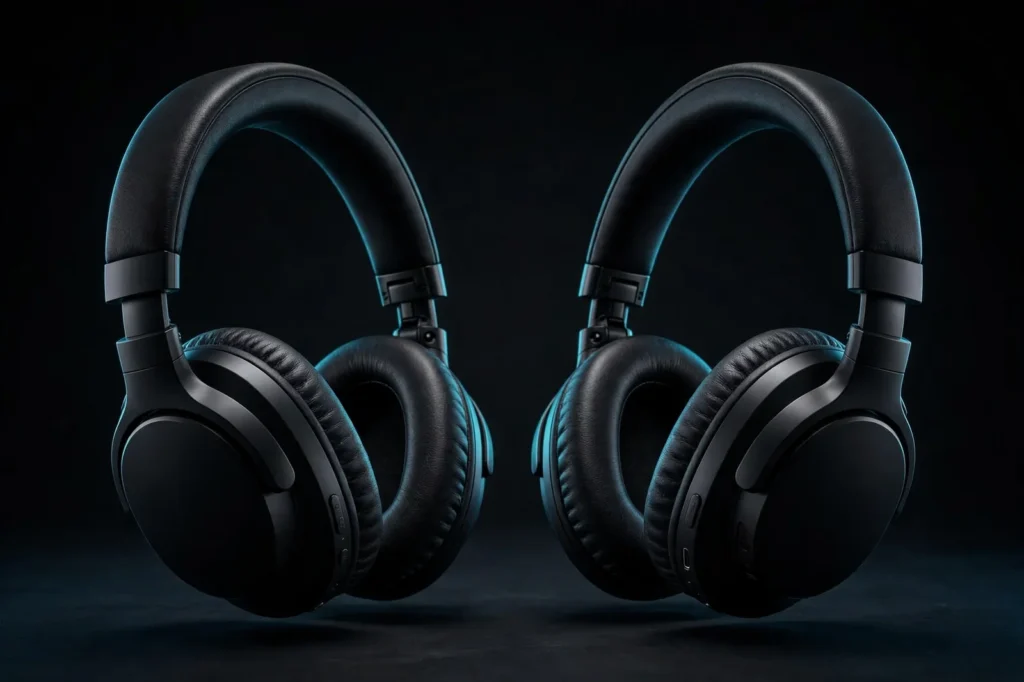
The only one here with noise cancelling, and a true over-ear fit for long listening sessions. Best bought renewed or on a deal — it’s a 2017 model.

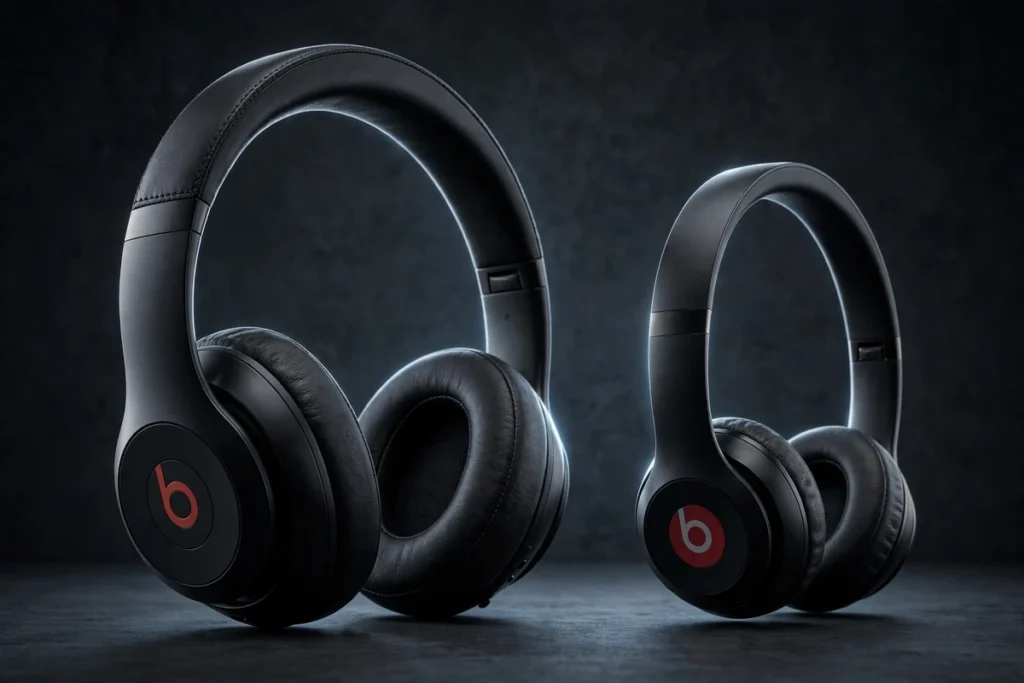
Newer 40 mm acoustic architecture, up to 50 hours of battery, Bluetooth 5.3, and lossless audio over USB-C. No ANC, but a much more modern package.
Side-by-side: specs and features compared
Here’s the comparison at a glance. Every figure below comes from Beats’ own listings and third-party spec checks — we don’t do invented numbers.
| Feature | Beats Studio 3 | Beats Solo 4 |
|---|---|---|
| Launch year | 2017 | 2024 |
| Form factor | Over-ear | On-ear |
| Noise cancelling | Yes — Pure Adaptive Noise Cancelling | None — passive isolation only |
| Sound signature | Classic bass-heavy Beats tuning, older driver tech | 40 mm custom transducers; balanced with a bass kick per reviewers |
| Battery life (claimed) | 22 h with ANC on; 40 h with ANC off | Up to 50 h |
| Fast charging | 10 minutes = ~3 h playback | 10 minutes = ~5 h playback |
| Bluetooth | Older generation via Apple W1 chip (Class 1) | 5.3, Class 1 range |
| Wired / lossless | 3.5 mm RemoteTalk cable; micro-USB charging | USB-C + 3.5 mm; lossless audio over both |
| Spatial audio | No | Personalized Spatial Audio with head tracking |
| Microphones / calls | Standard mic setup | Dual digital beam-forming mics with voice-learning algorithm |
| Weight | ~260 g | ~217 g |
| Foldable | Yes, with carry case | Yes, with carry case |
| Best for | Travel, offices, anyone who needs ANC cheaply | Commuters and casual listeners who don’t need ANC |
Do Beats Solo 4 have noise cancelling?
No — and this is the single biggest dividing line. The Beats Solo 4 do not have active noise cancelling; they rely entirely on passive isolation from the on-ear cushions. Beats says so plainly in its own product FAQ. If you fly, ride noisy trains, or work in a loud office, the Solo 4 cannot do what the Studio 3’s Pure Adaptive Noise Cancelling does: actively erase low-frequency drone.
The Studio 3’s ANC is a 2017 implementation, so keep expectations in check — it won’t match a modern flagship like the Sony WH-1000XM6 or Bose QC Ultra. But old ANC still beats no ANC. For commuting and travel, the Studio 3 is the only sensible pick of the two.
Which sounds better: the Studio 3 or the Solo 4?
Our read: the Solo 4 is the more refined headphone. It uses a new acoustic architecture with custom 40 mm transducers, and reviewers consistently describe the result as balanced Beats sound with a solid kick of bass that doesn’t smother vocals — Tom’s Guide and CNN Underscored both landed on that description. Android Central went further, calling the Solo 4 the sonic heir to the well-regarded Solo Pro with mature, technically accomplished tuning.
The Studio 3 is the classic bass-forward Beats signature — fun and punchy, but less refined in the mids and highs, and the hardware is seven years older. If pure sound quality is your priority and you don’t need ANC, the Solo 4 is the better-sounding headphone, full stop.
Which is more comfortable for long listening?
This one comes down to fit style. The Studio 3 is a true over-ear: the earcups go around your ears, so nothing presses on them. For multi-hour listening — flights, workdays, long gaming sessions — that makes it the more comfortable headphone, and it’s noticeably friendlier for glasses wearers, since on-ear pressure pushes temple arms into your head.
The Solo 4 is lighter (~217 g vs ~260 g) and easier to wear for short sessions, and Beats redesigned the headband (Flex-Grip) and cushions (UltraPlush) for the 2024 refresh. But it’s still an on-ear — the cushions press on your ears, and listeners with larger heads or sensitive ears tend to feel it after a couple of hours. Winner: Studio 3 for long wear, Solo 4 for portability and short sessions.
Battery life: 50 hours vs 22 hours
The Solo 4 wins battery life by a landslide. It claims up to 50 hours — among the longest endurance figures in the Beats lineup, and ahead of the Sony and Bose flagships on claimed numbers — with a 10-minute Fast Fuel charge giving about 5 hours of playback.
The Studio 3 claims 22 hours with ANC on and up to 40 hours with ANC off, with a 10-minute charge worth about 3 hours. Respectable for 2017, but if you want to charge and forget, the Solo 4 is in another league.
Bluetooth, USB-C, and lossless: the feature gap
Seven years of progress shows here. The Solo 4 runs Bluetooth 5.3, charges over USB-C, and — importantly — plays high-resolution lossless audio over both USB-C and the 3.5 mm cable. It also supports Personalized Spatial Audio with head tracking, dual beam-forming mics tuned with a voice-learning algorithm, and one-touch pairing for both iOS and Android.
The Studio 3 uses Apple’s W1 chip — great in its day for pairing and range — but it’s an older Bluetooth generation, charges over micro-USB, and has no spatial audio, no USB-C, and no lossless path. It does include a 3.5 mm RemoteTalk cable, so wired listening works fine; it’s just not audiophile-grade wired.
Can you use the Solo 4 with a dead battery?
Yes. The Solo 4 works passively over the included 3.5 mm cable with zero battery power — keep the cable in your bag and a dead headphone is still a headphone. The Studio 3 also includes a 3.5 mm RemoteTalk cable, so both survive a dead battery. The difference is the Solo 4 additionally offers USB-C lossless listening when you do have power.
Is the Beats Studio 3 still worth buying in 2026?
Honestly: only at the right terms. The Studio 3 launched in 2017, so buying one new in 2026 means paying for nine-year-old ANC, micro-USB charging, and an older Bluetooth stack. It remains listed on Amazon with a strong long-term review history, and renewed units regularly appear — a renewed Studio 3 is the sensible way to buy it, since you get the over-ear ANC experience for far less than a modern equivalent.
Also consider the successor: Beats launched the Studio Pro with modern ANC, USB-C lossless audio, and better sound. If your budget stretches there, read our Beats Studio 3 vs Studio Pro comparison before deciding. For a pure rundown of the older model itself, our Beats Studio3 Wireless review still holds up.
The verdict: Studio 3 or Solo 4?
There’s no single winner — but the choice is straightforward once you name your priority:
- Get the Beats Studio 3 if active noise cancelling is non-negotiable, you want an over-ear fit for long sessions or glasses, and you’re comfortable buying renewed or hunting a deal. It remains the only one of the two that can silence an airplane cabin.
- Get the Beats Solo 4 if you want the newer headphone: better-refined sound, 50-hour battery, Bluetooth 5.3, USB-C lossless, and spatial audio — and you don’t need ANC. It’s the better daily carry for commutes and casual listening.
SoundMavericks’ take: for most buyers in 2026, the Solo 4 is the safer recommendation — it’s current, better-sounding, and its battery life is genuinely excellent. But if ANC is the whole point of the purchase, an older Studio 3 bought renewed is still the cheapest ticket into over-ear Beats noise cancelling. Just don’t pay new flagship money for 2017 tech.
Still weighing your options? See our best Beats headphones roundup for the full current lineup, or compare across brands in Bose vs Beats headphones.
Frequently asked questions
Which is better, the Beats Studio 3 or the Solo 4?
The Studio 3 is better if you need noise cancelling and over-ear comfort; the Solo 4 is better for sound refinement, battery life (up to 50 hours), and modern features like Bluetooth 5.3 and lossless wired audio. There is no single winner — it depends on whether ANC matters to you.
Do Beats Solo 4 have noise cancelling?
No. The Beats Solo 4 do not have active noise cancelling and rely on passive isolation from their on-ear cushions. If you need ANC, the Studio 3 (or the newer Studio Pro) is the Beats pick, not the Solo 4.
Does the Beats Studio 3 have noise cancelling?
Yes. The Beats Studio 3 has Pure Adaptive Noise Cancelling (Pure ANC). It’s a 2017 implementation and won’t match a 2026 flagship, but it still works well against low-frequency drone like engines and air conditioning.
Can you use the Solo 4 with a dead battery?
Yes. The Solo 4 plays passively over the included 3.5 mm audio cable with zero battery power. For powered listening, USB-C and Bluetooth both work when charged.
Which is better for glasses wearers, the Studio 3 or the Solo 4?
The Studio 3. Its over-ear design doesn’t press on your ears or push glasses’ temple arms into your head. The Solo 4’s on-ear clamp is the weaker option for glasses wearers.
Should I buy the Studio 3 or the Studio Pro in 2026?
Unless you find a very cheap renewed Studio 3, the Studio Pro is the better buy: modern ANC, USB-C lossless audio, and a newer sound tuning. See our Beats Studio 3 vs Studio Pro comparison for the full breakdown.

I am the founder of Sound Mavericks, where I provide the polite truth about audio equipment. I started this site because consumer electronics reviews are often too technical. Instead of using a silent lab, I test headphones, earbuds, and Bluetooth speakers in the real world – like on a noisy subway or in a busy coffee shop.
To stay independent, I buy my own review units (mostly from the United States) rather than accepting free gifts from brands. Once I finish testing a product, I sell it locally to our community. My goal is to help you understand sound quality, active noise cancellation (ANC), and battery life without the marketing hype.