
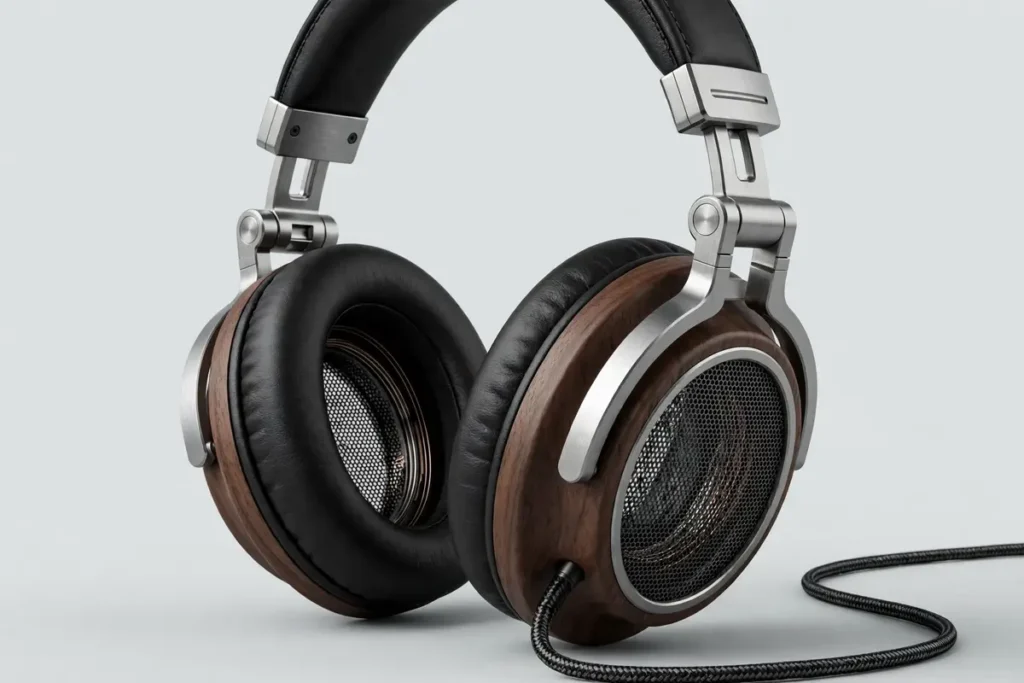
This audeze lcd 5 review covers the lightest and most technically ambitious headphone Audeze has put in its LCD line: a 90mm planar magnetic driver in an open-back frame that weighs 420 grams, tuned for accuracy above everything else. It is a studio-grade instrument rather than a lifestyle product, and this review treats it that way.
A note on method, and on buying. This review is research-based: the scores are our provisional assessment from specialist reviewers’ measurements and hands-on verdicts plus Audeze’s confirmed specifications. The buying point matters here. There is no verifiable Amazon US listing for the original LCD-5, so it is sold through Audeze directly and authorised dealers instead. The Amazon buttons in this article lead to a tagged search for the model rather than a product page, flagged openly rather than pointing you at a listing we cannot verify. A newer revised model, the LCD-5s, does surface on Amazon; it is a different headphone and not the subject of this review.
Audeze LCD-5 5.5/10
Why you: you mix, master or listen critically and want midrange accuracy you can trust. The LCD-5 presents voices and instruments with a neutrality and speed reviewers rank with the best headphones made, and at 420 grams it is the easiest Audeze flagship to wear.
Trade-off: the overall score is dragged down by what this headphone deliberately is not: no battery, no microphone, no noise cancelling, and an open back that leaks sound both ways. As a listening instrument it is elite; as an everyday headphone it refuses to be one.
90 mm planar magnetic · Open-back · 420 g · Wired · 14 ohms
Sound quality
Sound scores 9.4, and it is the whole story of this headphone. The 90mm planar magnetic driver uses Audeze’s Parallel Uniforce voice coil, Fluxor magnet array and Fazor waveguides to keep the diaphragm moving as one surface. The measured and heard result is a midrange that reviewers describe with the same words across outlets: accurate, fast and uncoloured. Voices carry texture without emphasis. Pianos and strings sit where the recording puts them. For mixing work, that neutrality is the point; the LCD-5 is widely used as a reference because it hides very little.
The caveats are real. Measurements show a dip in the upper treble region that softens the last degree of air and sparkle, and the bass, while extended and clean, is presented flat rather than lifted. Listeners who want impact will reach for equalization; the driver takes a low shelf boost well. It also belongs to the top group in our best planar magnetic headphones coverage on sound alone, alongside rivals that cost more and weigh more.
Imaging is the other half of the sound story. The LCD-5 places instruments with the precision mixing engineers need: a vocal sits dead centre and stays there, reverbs decay into identifiable spaces, and small panning decisions in a mix are easy to hear and easy to judge. The soundstage is not the widest in the class; it trades sheer width for placement accuracy. For pleasure listening that trade is a matter of taste. For production work it is the correct priority, and it is a large part of why this model ended up in professional rooms rather than only in audiophile ones.
What the score does and does not say
Three of the six bars need a sentence each, because the conventions matter. ANC scores 1.5 because the LCD-5 is open-back: it has no cancelling and no meaningful isolation, by design. Calls scores 3.0 because there is no microphone; this is a listening tool, not a headset. Battery sits at the neutral 5.0 placeholder we apply to wired models, since there is no battery to judge. Those three fixed scores halve the headline number for a headphone whose actual job it does near the top of the scale. Read the 9.4 for sound and the 7.2 for comfort as the review. The 5.5 overall is the cost of one scale for every headphone type.
The same convention applies across our database to every wired reference headphone, so the LCD-5 can still be compared fairly inside its own class: judge wired flagships against each other on sound, comfort and value, and treat the other three bars as fixed. On those three live categories the LCD-5 posts 9.4, 7.2 and 6.8, a set that very few headphones of any type match. The value figure reflects flagship pricing rather than any shortage of ability; cost-per-year looks different on a product built to be kept for a decade, but the sticker still decides who can consider it at all.
Design, build and comfort
Audeze rebuilt the flagship around weight. The carbon fibre headband, magnesium and acetate housing and slimmer yokes bring the LCD-5 to 420 grams, far below the older LCD-4 era flagships and light for a full-size planar. The weight distribution is the real achievement: the headband spreads the load across the top of the head and the pads are deep enough to keep the frame off the ears. Comfort scores 7.2, strong for the category, though the lightest dynamic flagships still win over very long sessions.
The open-back design means sound leaks out and room noise leaks in. This is a headphone for a quiet room, a treated studio or a desk away from other people. It appears in our best studio headphones coverage for exactly that use case, and it would be a poor choice for a shared office or a commute.
Amplification and cables
At 14 ohms and 90 dB/1mW sensitivity, the LCD-5 looks easy to drive on paper, and it does not need a huge amplifier. It does reward a good one. Specialist reviews consistently note that clean current delivery tightens the low end and opens the stage, while weak sources leave it sounding polite. A competent desktop DAC and amplifier combination is the sensible pairing; a phone or a basic dongle will understate what you paid for.
The comparison most buyers weigh is against Focal’s flagship, and our Focal Utopia review covers the other side of that argument: a dynamic driver with more treble sparkle and easier drive requirements, against the LCD-5’s midrange discipline and speed. Neither is the sensible choice for casual listening. Both are references for people who hear the difference and work with it.
Cabling follows Audeze’s established pattern: dual mini-XLR connectors at the cups and a detachable, replaceable cable. That matters for a product at this level. Cables are the part of a headphone most likely to wear out or get damaged, and a standard connector means replacements and balanced alternatives are easy to source from Audeze and third-party makers for the life of the headphone.
Living with an open-back reference
Ownership is the last thing to weigh, and it is different from owning a wireless headphone. There is nothing to charge, nothing to update and nothing to go obsolete on a product cycle; the LCD-5 asks only for a quiet room and a decent source. In return it gives you a tool that will still be a reference long after current Bluetooth flagships have been replaced twice over. Studios buy on that logic, and it holds for home listeners who keep gear for years.
The limits are domestic rather than technical. Anyone in the room will hear a clear, if quiet, version of your music, and you will hear the room: conversation, traffic, the washing machine. Sessions plan around that. Owners tend to describe the same routine, a door closed and an hour set aside, which is either a ritual or a faff depending on how you listen. If your listening is squeezed into shared, noisy spaces, the honest advice is to spend the money on a closed flagship and an everyday wireless pair instead, and leave the LCD-5 to the rooms it was built for.
Audeze LCD-5 specs
| Spec | Audeze LCD-5 |
|---|---|
| Driver | 90mm planar magnetic, Parallel Uniforce diaphragm, Fluxor magnets, Fazor waveguides |
| Design | Open-back, over-ear, wired |
| Impedance | 14 ohms |
| Sensitivity | 90 dB/1mW |
| Weight | 420 g |
| Noise cancelling | None (open-back) |
| Microphone | None |
| Availability | Audeze direct and authorised dealers; no verifiable Amazon US listing |
Verdict
Buy the LCD-5 if you need a reference you can mix on and listen through for hours: sound at 9.4, comfort that respects the category, and a build that will outlast several generations of wireless flagships. Buy it from a dealer who can support it, and budget for an amplifier that does it justice.
Skip it if your listening happens in shared spaces, on the move or on calls. The open back, the missing microphone and the flagship price all point the same way. This is a single-purpose instrument, and within that purpose it sits near the top of what headphones can do.
Frequently asked questions
Where can you buy the Audeze LCD-5?
Not through a standard Amazon listing. There is no verifiable Amazon US product page for the original LCD-5, so it is sold through Audeze directly and through authorised headphone dealers. Our Amazon links for this model point to a tagged search in case a listing appears; check the seller carefully before buying any flagship headphone on a marketplace.
Why does the LCD-5 score 5.5 overall when its sound scores 9.4?
Our overall score is the mean of six categories built for everyday headphones. A wired open-back flagship has no battery to rate (scored at the neutral 5.0 placeholder), no microphone for calls (3.0) and no noise cancelling (1.5 for an open-back design). Those three fixed scores pull the mean down. The 9.4 for sound is the number that describes this headphone.
Does the Audeze LCD-5 need a powerful amplifier?
It needs a decent one rather than a huge one. At 14 ohms with a sensitivity of 90 dB/1mW it is not a difficult load on paper, but it rewards a clean desktop amplifier with real current delivery. A phone dongle will make noise with it; it will not show what the driver can do.
Is the LCD-5 comfortable for long sessions?
It is the lightest of Audeze’s full-size flagships at 420 grams, with a carbon fibre headband that spreads the weight well. We score comfort at 7.2: good for a planar flagship, though lighter rivals stay easier over a full working day.
How does the LCD-5 differ from the LCD-5s?
The LCD-5s is a later, revised model with updated tuning, not a colour variant of the original. This review covers the original LCD-5 only. If you are shopping, confirm which of the two a listing describes before paying flagship money.

I am the founder of Sound Mavericks, where I provide the polite truth about audio equipment. I started this site because consumer electronics reviews are often too technical. Instead of using a silent lab, I test headphones, earbuds, and Bluetooth speakers in the real world – like on a noisy subway or in a busy coffee shop.
To stay independent, I buy my own review units (mostly from the United States) rather than accepting free gifts from brands. Once I finish testing a product, I sell it locally to our community. My goal is to help you understand sound quality, active noise cancellation (ANC), and battery life without the marketing hype.
