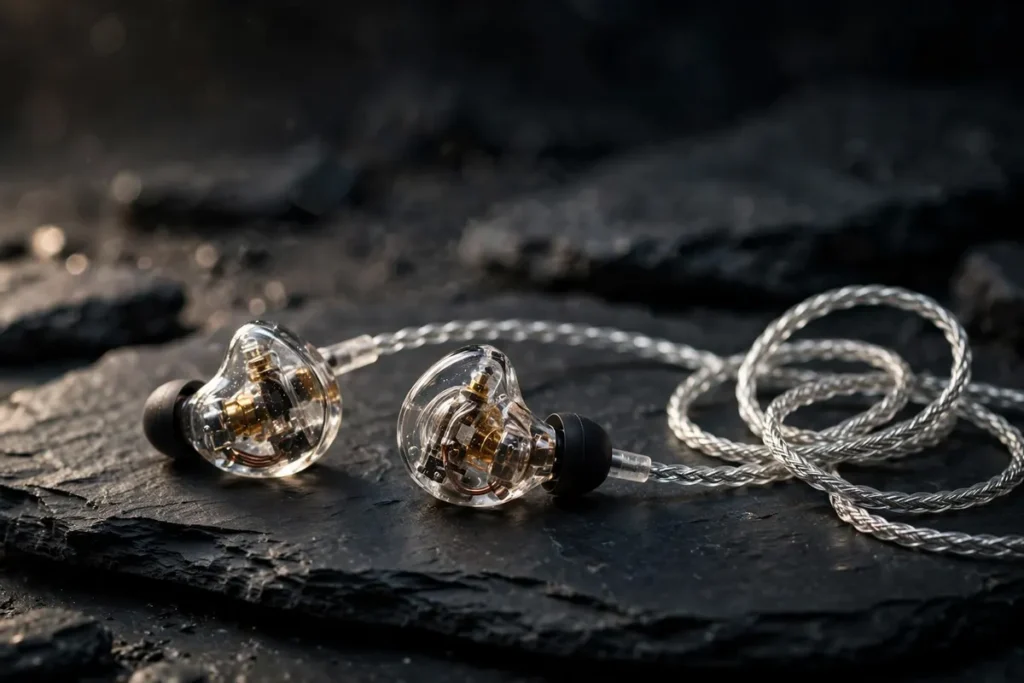
The AFUL Miracle One takes the opposite bet to most of the Chi-Fi market. Where rivals stack drivers, AFUL built this set around a single 6mm dynamic driver with a liquid silicone rubber diaphragm, then engineered the air around it: a dual-resonant chamber system inside a clear resin shell, governed by the company’s SEM system-level acoustic design. Announced on October 23, 2026, it went on sale on October 29.
This is a launch review, built from AFUL’s published specifications (carried in full on the HiFiGo listing and its launch coverage) and the first independent reviews. We have not listened to the Miracle One, and nothing here pretends otherwise. What follows is paper analysis: the hardware, the rivals, and who should buy now or wait. This page will be updated as measurements and further reviews appear.

AFUL Miracle One On sale now
What it is: a single-driver IEM: one 6mm wide-frequency dynamic driver with an LSR diaphragm, its sound shaped by AFUL’s SEM acoustic system and dual resonant chambers rather than a crossover.
Watch out: sensitivity is a modest 101dB, and early reviewers report it opens up with a stronger source behind it. A weak phone output may leave it sounding flat.
Single 6mm LSR DD · 18.5Ω · 101 dB · 0.78mm 2-pin · 3.5mm or 4.4mm
AFUL Miracle One quick facts
| Drivers | Single 6mm dynamic driver, liquid silicone rubber (LSR) diaphragm |
| Launch price | $199.99 |
| Status | On sale; announced October 23, 2026, sales began October 29, 2026 |
| Where to buy | HiFiGo |
| Amazon US | Not listed as of November 3, 2026 (checked). This page updates when it lists. |
| Tuning | Warm, full-bodied single-driver tune shaped by the SEM acoustic system |
What the Miracle One is
The driver is newly developed for this set: a 6mm wide-frequency unit with a liquid silicone rubber diaphragm. AFUL picked LSR for its elasticity, arguing it gives fast transient response and a wide dynamic range from a very small moving surface. The deeper claim is about coherence. One driver covering the whole range has no crossover and no handoff between driver types, so phase stays consistent and timbre stays of a piece. That is the classic single-driver argument, and AFUL is making it at a price where most rivals have gone hybrid.
The chambers do the work a crossover would normally do. AFUL’s SEM approach (Sound, Electricity, and Math) treats the driver, the electrical circuit and the internal acoustics as one system, designed together rather than tuned part by part. The physical result is a dual-resonant chamber layout: the front chamber uses a stepped acoustic path and a resonant microstructure to smooth peaks and extend the treble, while the rear chamber runs a resonance tube that tunes the sub-bass and mid-bass. The bass and treble are shaped by air and geometry before the signal ever reaches your ear.
Because the driver is tiny, the shells are too. The Miracle One’s transparent resin bodies are small enough that the circuit board and acoustic tubing stay visible through the shell, and early reviewers single out the fit: light, deep-seating and easy to forget over long sessions. The cable detaches on 0.78mm 2-pin connectors, and you pick the termination when you order, 3.5mm single-ended or 4.4mm balanced. Early unboxings list three eartip families in the box, named Balanced, Resolution and Spatial.
Where it sits against the rivals we have covered
The Miracle One’s natural comparison is the Moondrop Aria 2, the single dynamic driver pick in our best IEMs roundup: same one-driver idea, a warmer-neutral tune, a bigger 10mm diaphragm. The Kiwi Ears KE4 II is the step up in hardware, adding balanced armatures and a microplanar tweeter, and it carries a full score from its own review here. The 7Hz x Crinacle Zero: 2 is the budget benchmark for single-driver tuning. The Miracle One’s claim against all three is that acoustic engineering can substitute for driver count. The rivals below already carry scores; it has to earn its.
| Product | Drivers | Cable and plug | Check Price |
|---|---|---|---|
| AFUL Miracle One | Single 6mm DD (LSR diaphragm) | 0.78mm 2-pin, 3.5mm or 4.4mm termination | Check Price |
 Moondrop Aria 2 | 10mm single DD | 0.78mm 2-pin, swappable 3.5mm and 4.4mm plugs | Check Price |
 Kiwi Ears KE4 II | 1 DD + 2 BA + 1 microplanar | 0.78mm 2-pin detachable | Check Price |
 7Hz x Crinacle Zero: 2 | 10mm single DD | 0.78mm 2-pin detachable OFC cable | Check Price |
AFUL Miracle One specifications
| Product | AFUL Miracle One Check Price |
| Driver configuration | Single 6mm wide-frequency dynamic driver |
| Diaphragm | Liquid silicone rubber (LSR) |
| Acoustic design | SEM (Sound, Electricity, and Math) system-level architecture; dual-resonant acoustic chambers |
| Impedance | 18.5Ω |
| Sensitivity | 101 dB @ 1kHz |
| Frequency response | 5Hz to 35kHz |
| Shell | Transparent resin, ultra-compact |
| Connector | 0.78mm 2-pin |
| Cable | Detachable; 3.5mm single-ended or 4.4mm balanced termination, chosen at purchase |
| Launch price | $199.99 |
Tuning: warmth by design
AFUL describes the target plainly: keep the warmth and musicality people buy single dynamic drivers for, while the chamber system adds the treble extension, detail and stage width that small drivers usually lack. That is the manufacturer’s stated intent, not a measurement of ours.
The first independent reviews describe a warm-leaning, mildly U-shaped response: deep sub-bass with control, a somewhat restrained lower midrange, smooth vocals and a treble that favours control over sparkle. Two cautions repeat across those reviews. The tuning will not suit listeners who want maximum micro-detail at this price, and the set scales noticeably with source power, which matches its modest sensitivity figure on paper. Treat all of that as early reviewer consensus; the measurement picture is still filling in.
Early coverage
Independent coverage arrived fast. Head-Fi hosts several Miracle One reviews, and full written reviews appeared at Root-Nation and on Medium within days of the October 29 sale start. The shared threads are the tiny, comfortable shells and the controlled sub-bass; the recurring caveats are the warm tuning’s ceiling on fine detail and the appetite for a decent source. This section updates as measurements publish.
Should you buy, or wait?
The buy case is coherence and comfort. If you listen to a lot of acoustic, jazz, pop and live recordings, AFUL’s stated home turf, and you value a set that disappears in the ear, the Miracle One is the most interesting single-driver launch of the season on paper. Budget for a competent dongle DAC if your current source is a plain phone socket; the early reviews are consistent that it rewards one.
The wait case is about alternatives and proof. Hybrids on this shelf offer more driver hardware and, in the KE4 II’s case, a published score from us. The Miracle One’s chamber engineering is clever, but its long-term test is whether third-party measurements confirm the treble extension AFUL claims for a 6mm driver. Nothing suggests a limited run. Our read: single-driver loyalists can buy now with their eyes open; everyone else loses little by waiting for the measurement round.
Also consider
Three sets we have already covered and scored: the direct single-driver rival, a step up, and the budget benchmark.
The other single-driver route: a 10mm driver, warm-neutral tuning and metal shells, already scored in our best IEMs roundup.
Same shelf, opposite recipe: a dynamic driver, two balanced armatures and a microplanar tweeter in hand-finished resin shells.
Crinacle’s tune on a single 10mm driver. The budget benchmark in our best IEMs roundup, and the cheapest way into this style of tuning.
FAQ
When is the AFUL Miracle One released?
AFUL announced the Miracle One on October 23, 2026 through HiFiGo, and sales began on October 29, 2026. It is on sale now at HiFiGo.
How much does the AFUL Miracle One cost?
The launch price is in the quick facts box at the top of this page.
Where can I buy the AFUL Miracle One?
HiFiGo is the launch retailer. The button at the top of this page goes to the HiFiGo listing.
Is the AFUL Miracle One on Amazon?
Not yet. We checked Amazon US on November 3, 2026 and found no listing for the IEM; search results return unrelated products. This page will be updated when it lists.
What driver does the AFUL Miracle One use?
One per side: a 6mm wide-frequency dynamic driver with a liquid silicone rubber (LSR) diaphragm, shaped by AFUL’s SEM acoustic system and dual resonant chambers.
AFUL Miracle One vs Moondrop Aria 2: which should you buy?
Both are single dynamic driver IEMs with a warm lean. The Aria 2 is the proven pick: it scored 8.7 in our best IEMs roundup, with metal shells and swappable plugs. The Miracle One is the newer design, with a much smaller driver and shell and chamber tuning doing the work. Buy the Aria 2 for certainty, the Miracle One for the miniature engineering.

I am the founder of Sound Mavericks, where I provide the polite truth about audio equipment. I started this site because consumer electronics reviews are often too technical. Instead of using a silent lab, I test headphones, earbuds, and Bluetooth speakers in the real world – like on a noisy subway or in a busy coffee shop.
To stay independent, I buy my own review units (mostly from the United States) rather than accepting free gifts from brands. Once I finish testing a product, I sell it locally to our community. My goal is to help you understand sound quality, active noise cancellation (ANC), and battery life without the marketing hype.