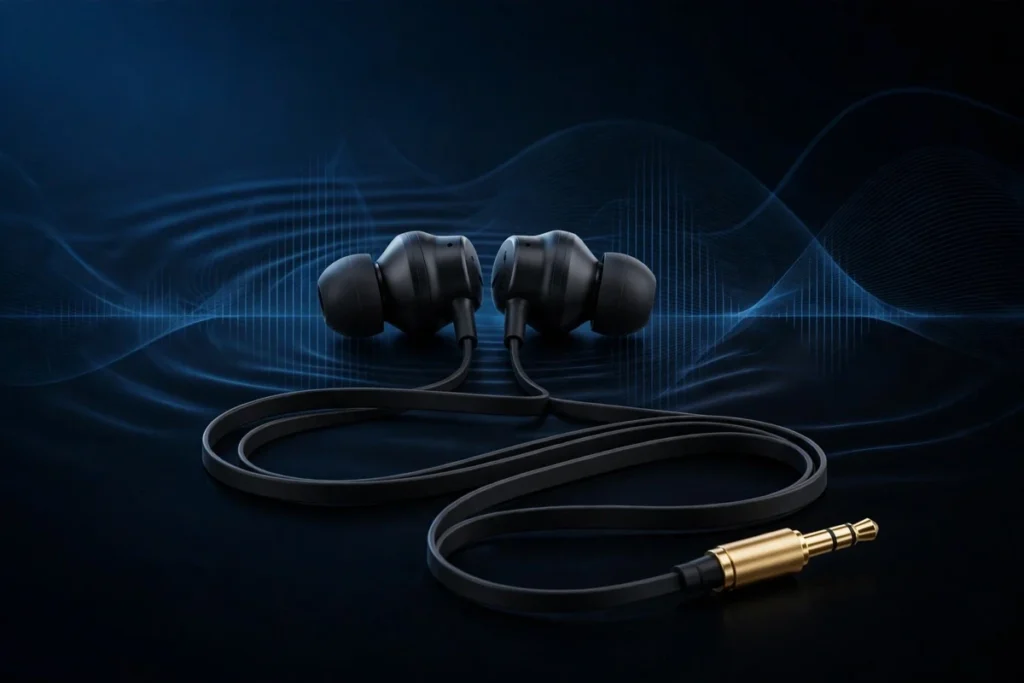
If you typed sony c55 review into the search box, the product you’re almost certainly looking for is the Sony MDR-XB55AP — Sony’s EXTRA BASS wired in-ear earbuds. Sony never sold a consumer headphone literally called the “C55”; the C55 shorthand stuck because it’s the distinctive part of the model number, the way owners abbreviate plenty of Sony models. (The only other “Sony C55” in existence is a 1970s studio condenser microphone — a completely different animal that has nothing to do with this review.)
This is SoundMavericks’ analysis of the Sony C55 (MDR-XB55AP) based on Sony’s official spec sheet and instruction manual plus thousands of verified owner reviews: 12mm neodymium drivers, Powered Bass Duct++ for deep low end, an inline microphone and remote, and a tangle-free cable — all in a package that weighs about 8 grams.
Our verdict: The Sony C55 remains one of the easiest recommendations in budget wired earbuds for bass lovers. It delivers exactly what the EXTRA BASS badge promises — big, physical low end — without collapsing on mids and highs, and the inline mic makes it a genuinely useful call headset for the money. Just know what you’re buying: a wired, bass-forward earbud with no app, no active noise cancelling, and no published water-resistance rating.
| Sound Quality | 8.4 |
| Bass Performance | 9.0 |
| Comfort & Design | 7.8 |
| Mic & Controls | 7.6 |
| Build Quality | 8.0 |
| Value | 8.8 |
Sony C55 (MDR-XB55AP) Specs at a Glance

| Specification | Sony C55 (MDR-XB55AP) |
|---|---|
| Full model name | Sony MDR-XB55AP EXTRA BASS in-ear headphones |
| Type | Closed, dynamic in-ear (wired) |
| Driver | 12mm dome type, CCAW voice coil, neodymium magnet |
| Frequency response | 4Hz – 24,000Hz |
| Impedance | 16 ohms (at 1kHz) |
| Sensitivity | 110dB/mW |
| Cable | Approx. 1.2m Litz wire, Y-type, serrated tangle-free design |
| Plug | L-shaped gold-plated 4-pole 3.5mm mini plug |
| Microphone | Electret condenser, omnidirectional (inline remote with multi-function button) |
| Weight | Approx. 8g (without cable) |
| In the box | Hybrid silicone earbuds in 4 sizes (SS/S/M/L) + carrying pouch |
| Colours | Black, Blue, Red, White |
Specs per Sony’s official MDR-XB55AP documentation. The “AP” in the model name denotes the inline microphone + remote version.
SoundMavericks Verdict: Who Should Buy the Sony C55?
Here’s our honest read after weighing Sony’s spec sheet against thousands of owner reviews. Buy the Sony C55 if: you listen to bass-driven music — hip-hop, EDM, pop, Bollywood bass drops — and you want that low end to feel physical rather than polite; you want a wired pair with zero charging, zero pairing, and zero Bluetooth latency for calls, classes, and mobile gaming; or you need a dependable backup/travel pair that survives being stuffed in a pocket.
Skip it if: you want a neutral, reference-style tuning for critical listening; you need active noise cancelling or a published sweat/water-resistance rating for workouts; or you’ve fully moved to phones without a headphone jack and don’t want to carry a USB-C or Lightning adapter. If wireless is non-negotiable, start with our best wired earbuds guide to see where the C55 sits — and our best bass headphones roundup for bass-first picks across every form factor.
Design & Build: Made for Pockets, Not Display Cases

The Sony C55 is unapologetically practical. The headline design feature is the serrated, tangle-free cable — a flat-ish ridged design that genuinely resists the pocket-knot problem that kills most cheap wired earbuds. The L-shaped gold-plated 3.5mm plug is another thoughtful touch: it sits flush against your phone or laptop so the cable exits sideways instead of sticking straight out and straining the jack.
At roughly 8 grams the earbuds themselves are light, though the housings are visibly chunky — that’s the price of fitting 12mm drivers in an in-ear shell. Build is mostly plastic, which keeps weight down but won’t impress anyone next to metal-shelled IEMs. Sony includes a carrying pouch in the box, a small but real plus at this end of the market. It comes in Black, Blue, Red, and White.
One honest caveat from owner feedback: while most buyers praise the build, a minority of long-term reviews report the inline mic failing after extended use. Buy from a reputable seller — counterfeit Sony earbuds are a documented problem in some markets, and fakes are where most “it broke in a month” stories come from.
Sound Quality: What EXTRA BASS Actually Means
Sony’s EXTRA BASS tuning plus Powered Bass Duct++ — an acoustic duct structure that reinforces low frequencies — is the entire reason the C55 exists, and on this front it delivers. The 12mm neodymium drivers move enough air to make kick drums and bass lines feel physical, and the rated 4Hz–24,000Hz frequency response (with usable output starting far lower than most budget earbuds) backs up the marketing.
What surprised us, reading across owner impressions, is that the mids and highs don’t get completely buried. Vocals stay intelligible and treble has reasonable crispness for the class — this isn’t the one-note mud machine the “bass earbud” label might suggest. The 110dB/mW sensitivity also means the C55 gets loud easily, even from weak phone or laptop outputs, with minimal distortion at high volumes per Sony’s design.
The honest limitation: this is a fun, V-shaped tuning, not an accurate one. If you listen to acoustic, classical, or jazz and want a flat response, the C55’s low-end emphasis will colour everything. A small EQ cut in the bass region tames it nicely if you ever want a more balanced profile.
Comfort & Fit: Four Tip Sizes Do the Heavy Lifting
Fit is where budget earbuds usually fail, and Sony handles it the old-fashioned way: four sizes of hybrid silicone tips (SS, S, M, L) in the box. Getting the seal right matters doubly here — a proper seal is what delivers both the deep bass and the passive noise isolation, since there’s no ANC to compensate for a leaky fit.
Most owners find the C55 comfortable for multi-hour sessions once they land on the right tip size. The one recurring complaint is the housing size: the 12mm driver needs room, so listeners with very small ear canals sometimes find the shells press uncomfortably. If that’s you, start with the SS tips — and check our best earbuds for small ears guide for alternatives designed around smaller shells.
Microphone & Inline Remote: Better Than Expected for Calls
The “AP” in MDR-XB55AP stands for the inline mic and remote, and it’s genuinely useful. The electret condenser microphone (omnidirectional) handles calls, voice chats, and voice assistants, while the single multi-function button covers answer/end call and play/pause with one press. iPhone users get more: double-press skips forward, triple-press skips back, and a long press summons Siri.
Owner consensus puts call quality at “good for the class” — clear in quiet rooms, serviceable on the street, and prone to wind noise outdoors like nearly every inline mic. It’s a real step up from earbuds with no mic at all, and for remote workers who want a cheap, reliable wired call headset, it’s one of the C55’s strongest arguments. See our take on how it compares with Sony’s wireless flagships in our Sony WH-1000XM4C review.
Sony C55 Pros and Cons
| Pros | Cons |
|---|---|
|
|
How the Sony C55 Compares to the Competition

The C55’s real competition is other budget wired earbuds — and its edge is the combination of genuine EXTRA BASS tuning, a mic-equipped remote, and Sony’s fit kit at a budget tier where most rivals give you two of the three. Neutral-tuned IEMs in the same bracket will beat it on accuracy and detail, but none of them are trying to be what the C55 is: maximum fun per dollar for bass-first listeners.
The bigger question most buyers face is wired versus wireless. If you can live with charging and Bluetooth, wireless earbuds add ANC, apps, and EQ — browse our best wired earbuds guide for the full landscape, or our best bass headphones roundup if low end is the whole point. But if you want the cheapest reliable way to get big Sony bass with a mic for calls, the C55’s wired simplicity is a feature, not a compromise: nothing to pair, nothing to charge, and no wireless latency in games or video.
Sony C55 Review: Frequently Asked Questions
Is the Sony C55 the same as the Sony MDR-XB55AP?
Yes. “Sony C55” is a common shorthand for the Sony MDR-XB55AP, Sony’s EXTRA BASS wired in-ear earbuds. There is no separate consumer headphone product officially named “Sony C55” — if a listing or review says C55 in the context of earbuds, it means the MDR-XB55AP.
Is the Sony C55 good for bass?
Yes — bass is its defining trait. The EXTRA BASS tuning with Powered Bass Duct++ and 12mm neodymium drivers produces deep, physical low end that owners consistently praise. It’s a fun, V-shaped sound rather than a neutral one, so purists may want to EQ the bass down slightly.
Does the Sony C55 have a microphone for calls?
Yes. The “AP” in MDR-XB55AP denotes the inline electret condenser microphone and remote. The multi-function button answers/ends calls and controls playback; on iPhone, double-press skips forward, triple-press skips back, and a long press activates Siri.
What comes in the box with the Sony C55?
Sony includes the earbuds, hybrid silicone ear tips in four sizes (SS, S, M, L), and a carrying pouch. The M-size tips come pre-attached.
Is the Sony C55 waterproof or sweatproof?
No. Sony publishes no water- or sweat-resistance rating for the MDR-XB55AP, so we don’t recommend it as a dedicated workout earbud. For gym use, look for earbuds with a published IPX rating instead.
Does the Sony C55 work with phones that have no headphone jack?
It works with any device that has a standard 3.5mm headphone jack — and the high 110dB/mW sensitivity means it gets plenty loud from weak outputs. For phones without a jack, you’ll need a USB-C or Lightning to 3.5mm adapter; note the 4-pole plug carries the mic signal, so use an adapter that supports headsets (TRRS) to keep the mic working.
The bottom line: the Sony C55 (MDR-XB55AP) knows exactly what it is — a budget wired earbud built to deliver big bass, survive your pocket, and handle your calls. It won’t replace a neutral IEM or a wireless ANC flagship, but as a bass-first daily driver or a bulletproof backup pair, it earns its long-running popularity.

I am the founder of Sound Mavericks, where I provide the polite truth about audio equipment. I started this site because consumer electronics reviews are often too technical. Instead of using a silent lab, I test headphones, earbuds, and Bluetooth speakers in the real world – like on a noisy subway or in a busy coffee shop.
To stay independent, I buy my own review units (mostly from the United States) rather than accepting free gifts from brands. Once I finish testing a product, I sell it locally to our community. My goal is to help you understand sound quality, active noise cancellation (ANC), and battery life without the marketing hype.