Updated October 2026
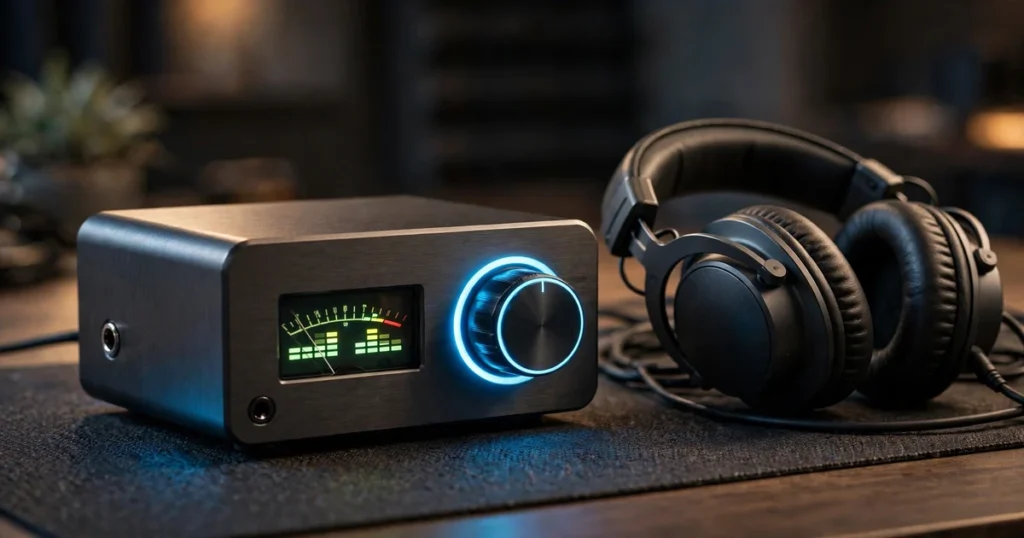
A headphone amp DAC combo does two jobs in one box: the DAC (digital-to-analog converter) turns your computer or phone’s digital audio into an analog signal, and the built-in headphone amplifier gives that signal enough power to drive your headphones properly. If your headphones sound thin, quiet, or lifeless plugged straight into a laptop or phone, a combo unit is the fix.
SoundMavericks compared the current desktop and portable DAC/amp combos — their DAC chips, output power, connectivity, and headphone outputs — and ranked the six strongest options below. Every pick below combines both functions in a single unit, so nothing here duplicates the products in our best headphone amps roundup (amp-only units) — this guide is strictly for one-box DAC+amp solutions.
Our Top Picks
- Best overall: FiiO K7 — dual AKM DACs, THX amp modules, and 2000mW of power. Check Price on Amazon
- Best for beginners: iFi ZEN DAC 3 — warm, musical sound with simple plug-and-play setup. Check Price on Amazon
- Best compact: TOPPING DX3 Pro+ — tiny footprint, Bluetooth LDAC, and a clean ESS-based signal path. Check Price on Amazon
Headphone Amp DAC Combos Compared
The quick side-by-side view: what each unit is built around, what it plugs into, and who it’s for.
| Combo Unit | DAC Architecture | Headphone Outputs | Standout Feature |
|---|---|---|---|
| FiiO K7 | Dual AK4493SEQ | 4.4mm balanced, 6.35mm, 3.5mm | 2000mW output power |
| iFi ZEN DAC 3 | Burr-Brown | 4.4mm balanced, 6.3mm | PowerMatch + XBass+ |
| TOPPING DX3 Pro+ | ES9038Q2M | 6.35mm, 3.5mm | Bluetooth 5.0 LDAC input |
| Fosi Audio K7 | AK4493S | 4.4mm balanced, 3.5mm | Mic input for gaming |
| FiiO K13 R2R | Proprietary 24-bit R2R | 4.4mm balanced, 6.35mm | NOS/OS modes, 10-band PEQ |
| iFi GO Link 2 | ESS (dongle) | 3.5mm S-Balanced | Pocket-sized USB portability |
Best Overall: FiiO K7

The FiiO K7 is the combo we’d recommend to most people. FiiO pairs two AKM AK4493SEQ DAC chips with dual THX AAA 788+ amplifier modules — the same THX amp architecture found in FiiO’s higher-end gear — and backs it with a rated 2000mW of output power, enough for everything from efficient IEMs to demanding full-size headphones.
Connectivity is where the K7 really earns its ranking: USB, optical, coaxial, and AUX inputs feed 4.4mm balanced, 6.35mm, and 3.5mm headphone outputs, with line-out for powered speakers. Two gain levels let you match sensitive IEMs or power-hungry planars, and the RGB indicator lights change with the incoming sample rate — a small touch, but a genuinely useful one when you’re confirming you’re actually getting hi-res audio.
Key specs:
- Dual AKM AK4493SEQ DAC chips + dual THX AAA 788+ amp modules
- 2000mW rated output power (balanced)
- Inputs: USB, optical, coaxial, AUX
- Outputs: 4.4mm balanced, 6.35mm and 3.5mm single-ended, RCA line-out
- 2 gain levels and 3 output levels
- RGB indicator displays sample-rate status
Pros: excellent power for the footprint; balanced output; wide input selection; THX amp pedigree.
Cons: larger than dongle-style options; no Bluetooth.
Best for Beginners: iFi ZEN DAC 3

The iFi ZEN DAC 3 is the unit we steer first-timers toward. It supports high-resolution formats up to PCM 768kHz and DSD512, connects over a single USB-C cable, and offers both 6.3mm single-ended and 4.4mm balanced headphone outputs with up to 390mW of power — plenty for most headphones short of the hardest-to-drive planars.
What sets it apart in our analysis is the tuning: iFi’s Burr-Brown-based signal path has a warmer, more musical character than the typical ESS presentation, and features like PowerMatch (switchable gain) and XBass+ (bass restoration for open-back headphones) solve real listening problems rather than adding gimmicks. RCA and 4.4mm outputs with variable/fixed volume also let it double as a preamp for active speakers.
Key specs:
- Supports PCM 768kHz, DSD512, and MQA
- Up to 390mW headphone output power
- Outputs: 6.3mm single-ended + 4.4mm balanced headphone; RCA + 4.4mm line out (variable/fixed)
- PowerMatch switchable gain; XBass+ bass enhancement
- Improved low-jitter GMT clock (20dB+ better per iFi)
- USB-C input; Windows driver available
Pros: plug-and-play simplicity; musical tuning; works as a speaker preamp; balanced output.
Cons: less raw power than the FiiO K7; no wireless input.
Best Compact: TOPPING DX3 Pro+

The TOPPING DX3 Pro+ is built around the ES9038Q2M DAC with TOPPING’s NFCA headphone amplifier stage, and its defining trait is flexibility: USB, optical, coaxial, and Bluetooth 5.0 inputs (via the QCC5125 chip, supporting LDAC, aptX HD, aptX LL, aptX, AAC, and SBC). Stream hi-res wirelessly from your phone, then switch to wired USB for critical listening.
It also works as a DAC + preamp: the RCA line output with digital volume control feeds powered speakers or a separate amp without channel imbalance. Our take: if your desk is cramped and your sources are mixed — phone, laptop, TV optical — the DX3 Pro+ covers all of them in a box barely bigger than a paperback.
Key specs:
- ES9038Q2M DAC with NFCA headphone amp stage
- Inputs: USB, optical, coaxial, Bluetooth 5.0
- Bluetooth codecs: LDAC, aptX HD, aptX LL, aptX, AAC, SBC (QCC5125)
- RCA line-out with digital preamp volume control
- OTG support for phones and portable media players
- 6.35mm + 3.5mm headphone outputs
Pros: LDAC Bluetooth input is rare in this class; compact; doubles as a preamp; OTG phone support.
Cons: no balanced headphone output; single-ended only.
Best for Gaming: Fosi Audio K7

The Fosi Audio K7 is built for the gaming desk. Under the hood it’s serious audio gear: an AKM AK4493S DAC, XMOS XU208 USB processor, and TPA6120 headphone amplifier chips decoding up to PCM 384kHz/32-bit and DSD256. But the headline for gamers is the 3.5mm microphone input — your boom mic plugs straight in, so voice chat and game audio run through one unit.
Connectivity is broad: USB-C, optical, coaxial, and Bluetooth (aptX HD/LL) inputs, with 4.4mm balanced, 3.5mm, and RCA outputs feeding headphones or speakers. The angled aluminum chassis with dual large knobs and shortcut buttons is designed for quick adjustments mid-game. Console players on PS5 or Switch get a proper DAC/amp instead of the controller’s headphone jack.
Key specs:
- AKM AK4493S DAC, XMOS XU208 processor, TPA6120 headphone amps
- PCM 384kHz/32-bit and DSD256 decoding
- Inputs: USB-C, optical, coaxial, Bluetooth (aptX HD/LL), 3.5mm mic
- Outputs: 4.4mm balanced, 3.5mm single-ended, RCA
- Angled aluminum chassis with dual control knobs and shortcut buttons
Pros: mic input is unique here; great console compatibility; balanced output; solid build.
Cons: gaming-focused design won’t suit minimalists; interface has a learning curve.
Best Premium (R2R): FiiO K13 R2R

The FiiO K13 R2R takes a different path from every other pick: instead of an off-the-shelf delta-sigma chip, FiiO built a fully differential 24-bit R2R DAC from 192 ultra-precise thin-film resistors. R2R designs are prized for a more natural, analog-like presentation, and the K13 adds NOS (non-oversampling) and OS (oversampling) modes so you can choose the sound character yourself.
It’s also the most feature-complete: XLR balanced and dual RCA line-outs, 4.4mm balanced and 6.35mm headphone outputs with a FiiO-rated 2400mW, Bluetooth 5.4 with LDAC, and a 10-band high-precision PEQ with auto-EQ controllable from the app. If you enjoy tuning your sound as much as listening to it, nothing else here offers this much to play with.
Key specs:
- FiiO self-developed fully differential 24-bit R2R DAC (192 precision resistors)
- NOS and OS dual modes
- Line-outs: XLR balanced + dual RCA; headphone outs: 4.4mm balanced + 6.35mm
- FiiO-rated 2400mW headphone output
- 10-band PEQ with auto EQ (app + web control)
- Bluetooth 5.4 with LDAC, AAC, SBC
Pros: unique R2R sound character; XLR outputs; deep PEQ customization; LDAC wireless.
Cons: the premium option here; complexity overkill for casual listeners.
Best Portable: iFi GO Link 2

The iFi GO Link 2 is the only portable pick in this guide — a dongle-style USB DAC and headphone amp for phones, tablets, and laptops. Its ESS DAC handles up to 32-bit/384kHz PCM and native DSD256, with iFi’s dynamic range enhancement and THD compensation tech carried over from their larger units.
The S-Balanced 3.5mm output halves crosstalk versus a standard single-ended jack, and the precision-milled aluminum body is 29% lighter and 8% smaller than its predecessor — genuinely pocketable. Custom filters via the iFi Nexis app let you shape the sound. For IEM listeners on the move, it’s the most practical way to get a real DAC and amp into your pocket. Pair it with picks from our best IEMs guide for the full portable setup.
Key specs:
- ESS DAC: up to 32-bit/384kHz PCM, native DSD256
- S-Balanced 3.5mm output (halved crosstalk)
- Dynamic range enhancement (+6dB); THD compensation
- USB dongle form factor — works with phones, tablets, laptops
- Aluminum body, 29% lighter than predecessor
- Custom filters via iFi Nexis mobile app
Pros: truly portable; strong IEM pairing; hi-res support; affordable entry point.
Cons: dongle power limits — not for hard-to-drive full-size headphones; single output only.
How to Choose a Headphone Amp DAC Combo
Desktop or portable? Desktop units (the first five picks) deliver far more power and connectivity; dongle-style units like the GO Link 2 trade power for pocketability. If your headphones are full-size or high-impedance, desktop is the answer — our explainer on headphone impedance and whether you need an amp covers the why.
How much power do you need? Match the unit to your headphones, not your aspirations. Efficient IEMs and most consumer headphones run fine on modest power; 300-ohm classics and planar magnetics need the kind of muscle the FiiO K7 or K13 R2R bring. More power than you need is harmless — too little is not.
Balanced or single-ended? A 4.4mm balanced output generally delivers more power and better channel separation. It’s not magic, but on the units here that offer both, balanced is the output we’d use for demanding headphones.
Inputs matter. Count your sources before you buy: USB for the PC, optical for the TV or console, Bluetooth for the phone, a mic input if you game. The right combo is the one that replaces the most boxes on your desk.
Wired USB or Bluetooth? A wired USB connection is always the reference path — it’s how every desktop pick here reaches its rated performance. Bluetooth inputs (LDAC on the DX3 Pro+ and K13 R2R, aptX on the Fosi K7) are a convenience feature for casual streaming from a phone, not a replacement for the wired signal path. Use wireless when convenience wins; use USB when quality matters.
Combo vs. separates. A combo puts DAC and amp in one chassis at one price. Separates (a standalone DAC plus a standalone amp) offer upgrade flexibility — see our best headphone amps roundup and our preamp vs. amp comparison for that route. For most listeners, a good combo is the simpler and smarter buy.
How SoundMavericks Scores
Scores above are SoundMavericks’ editorial analysis scores, based on our research of each unit’s DAC architecture, measured output power, connectivity, and feature set — not hands-on lab measurements. Third-party reviewers (SoundGuys, RTINGS, ASR) are referenced only where their published findings support a claim; our own analysis and verdicts lead.
Frequently Asked Questions
What is a DAC/amp combo, exactly?
A DAC/amp combo combines a digital-to-analog converter and a headphone amplifier in one unit. The DAC converts digital audio from your computer, phone, or streamer into an analog signal, and the amplifier section gives that signal enough power to drive your headphones. It’s the one-box alternative to buying a separate DAC and a separate amp.
Is a combo as good as separate DAC and amp units?
For most listeners, yes — a well-designed combo like the FiiO K7 performs at a level that makes separates unnecessary. Separates win on upgrade flexibility: you can swap the amp or DAC independently later. If you like tinkering and upgrading, go separates; if you want great sound with one purchase, a combo is the smarter buy.
How do I know if my headphones need a DAC/amp combo?
The telltale signs: you max out your laptop or phone volume and it’s still not loud enough, or the sound feels thin and flat compared to what reviews describe. High-impedance headphones (250-600 ohms) and many planar magnetics genuinely need extra power; efficient IEMs and most wireless headphones don’t. Our impedance explainer walks through the details.
Do DAC/amp combos work with phones?
Yes, with caveats. Dongle-style combos like the iFi GO Link 2 plug straight into a phone’s USB port. Desktop units generally need USB OTG support — the TOPPING DX3 Pro+ explicitly supports it — or you can connect wirelessly to units with Bluetooth input, like the DX3 Pro+ or FiiO K13 R2R with LDAC. For commuting, a portable unit is the practical choice.
Will a DAC/amp combo make my headphones sound better?
It depends on your bottleneck. If your headphones are underpowered by your current source, a combo can be transformative — more dynamics, tighter bass, better control. If your headphones are already well-driven, the improvement is subtler: cleaner background, better detail. The biggest gains go to demanding wired headphones; the smallest go to efficient IEMs already running off a decent dongle.
What does a balanced 4.4mm output actually do?
A balanced output drives each channel of your headphones with its own dedicated amplifier circuit, which typically delivers more power and reduces crosstalk between left and right channels. You’ll need headphones with a balanced cable (or a detachable-cable model you can re-cable) to use it. It’s a genuine advantage for hard-to-drive headphones, not a marketing gimmick — though the difference is smaller than moving from an underpowered source to a properly powered one.

I am the founder of Sound Mavericks, where I provide the polite truth about audio equipment. I started this site because consumer electronics reviews are often too technical. Instead of using a silent lab, I test headphones, earbuds, and Bluetooth speakers in the real world – like on a noisy subway or in a busy coffee shop.
To stay independent, I buy my own review units (mostly from the United States) rather than accepting free gifts from brands. Once I finish testing a product, I sell it locally to our community. My goal is to help you understand sound quality, active noise cancellation (ANC), and battery life without the marketing hype.