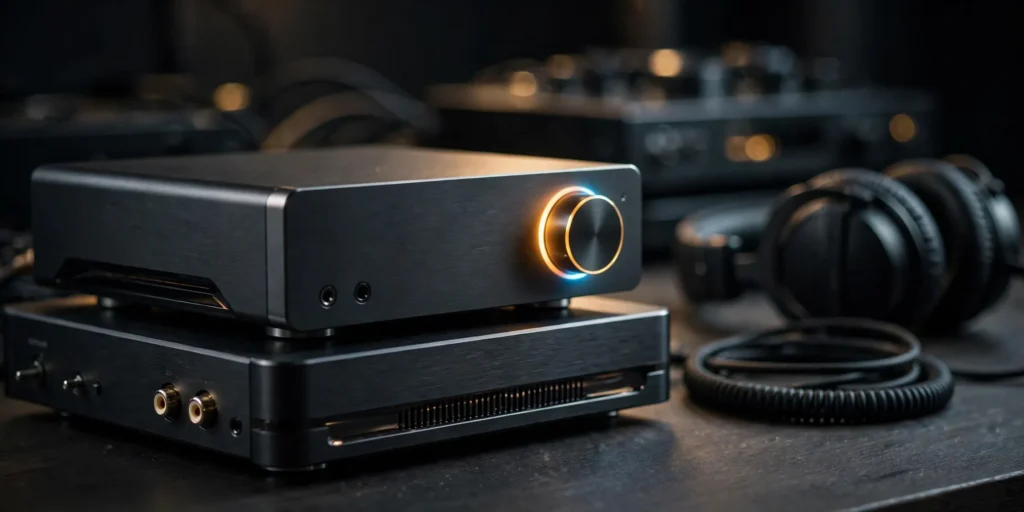
A DAC — a digital-to-analog converter — turns the ones and zeros of your music into the analog signal your headphones can play. Every phone and laptop has one built in, but those integrated DACs are built to a budget: noisy, low on power, and audibly limited with decent wired headphones or IEMs.
An external DAC bypasses that bottleneck: over USB, your device hands the digital signal to purpose-built hardware with cleaner output, more driving power, and support for high-resolution formats your stock adapter can’t decode.
We compared published specs, professional reviews, and long-term owner feedback on the most recommended models from Chord, iFi Audio, FiiO, and Schiit to find the seven DACs worth your money in 2026: four portable picks and three desktop units, plus a buying guide covering architectures, sample rates, outputs, and what actually matters.
Best DACs at a Glance
| Pick | Best for | Type | Key spec |
|---|---|---|---|
| Chord Mojo 2 | Best portable overall | Portable | Custom FPGA DAC, up to 768kHz PCM, 4.4mm balanced |
| iFi hip-dac 3 | Best portable all-rounder | Portable | 400mW output, 384kHz / DSD256 / MQA, up to 12-hr battery |
| FiiO KA13 | Best balanced portable | Portable dongle | Dual CS43198 chips, 3.5mm + 4.4mm, 550mW |
| FiiO KA11 | Best budget dongle | Portable dongle | CS43131 chip, 384kHz, 245mW at 16 ohms |
| Schiit Modi+ | Best desktop entry | Desktop | USB / coaxial / optical in, RCA out, 24-bit/192kHz |
| FiiO K11 | Best desktop all-in-one | Desktop | 1400mW, 4.4mm balanced, 384kHz / DSD256 |
| FiiO K11 R2R | Best R2R desktop | Desktop | 24-bit R2R ladder DAC, NOS/OS modes, 1300mW |
How to Choose a DAC: What Actually Matters
The DAC architecture. Most DACs here use delta-sigma conversion chips from ESS or Cirrus Logic — a mature, low-noise approach that measures superbly. Two alternatives recur in enthusiast discussion: R2R (resistor ladder) DACs, which convert without oversampling tricks and are often described as sounding more natural or “analog,” and Chord’s proprietary FPGA design, which does the conversion in custom code rather than an off-the-shelf chip. Neither is objectively “better” — they’re different engineering philosophies.
Portable vs. desktop. Portable DACs split into pocketable DAC/amps with their own battery (Mojo 2, hip-dac 3) and USB dongles that draw power from your phone (KA11, KA13). Dongles are the cheapest way to upgrade phone audio; battery-powered units drive harder-to-drive headphones and double as desktop units. Desktop DACs trade portability for more inputs, line-level outputs for speakers or amps, and generally more power.
Inputs and outputs. Match the DAC to your gear: USB-C (or Lightning for older iPhones) for phones; USB plus optical and coaxial for computers, TVs, and streamers. On the output side, 3.5mm handles most headphones, 4.4mm balanced gives more power and channel separation with compatible cables, and RCA line-outs feed powered speakers or a separate amplifier. If you’re also shopping for amplification, our best headphone amps guide covers dedicated amp stages to pair with a DAC-only unit.
Sample rates and formats. Every worthwhile DAC now handles at least 24-bit/192kHz PCM, covering the vast majority of high-resolution music. Support for 32-bit/384kHz and DSD (up to DSD256 on most picks here) matters mainly if you keep a library of those files — our FLAC vs MP3 breakdown covers whether hi-res files are worth it. MQA decoding appears on a few models, but it’s increasingly legacy: major streaming services have moved away from MQA, so we wouldn’t make it a deciding factor in 2026.
Power and headphone matching. A DAC’s built-in amp section determines which headphones it can drive. Dongles in the 200–550mW range handle IEMs and efficient headphones easily; full-size planars and high-impedance dynamics want the 1W-plus output of a desktop unit. Our explainer on headphone impedance and whether you need an amp walks through the matching math.
Best Portable DACs
1. Chord Mojo 2 — Best Portable DAC Overall

Our verdict: the Mojo 2 is the portable DAC we’d recommend to someone who wants one device that does everything at a reference level. Chord runs conversion on a custom-coded FPGA processor rather than an off-the-shelf chip, and the measured performance — 125dB of dynamic range, vanishingly low distortion — backs up the approach. Current production carries 3.5mm and 4.4mm balanced headphone outputs, with USB-C, micro-USB, optical, and coaxial inputs covering phones, laptops, and TVs.
What keeps it on top is flexibility: lossless UHD DSP gives transparent tone control and crossfeed without degrading the signal, and desktop mode lets it run plugged in indefinitely as a full-time desk DAC. Up to 8 hours of battery, 768kHz PCM, and DSD256 via DoP mean there’s little it can’t play, and it’s a four-time What Hi-Fi? Best DAC award winner (2022–2025, per Chord). Caveats: at 185g it’s the heaviest “portable” here, the sphere controls take a weekend to learn, and it’s firmly enthusiast territory. But as the complete package, nothing else portable we’ve researched matches it.
| Sound Quality | 9.6 |
| Features & Flexibility | 9.5 |
| Build Quality | 9.4 |
| Portability | 8.5 |
| Value | 8.6 |
- DAC: custom-coded FPGA (no off-the-shelf chip)
- Max format: 768kHz / 32-bit PCM, DSD256 via DoP
- Outputs: 3.5mm + 4.4mm balanced headphone jacks
- Inputs: USB-C, micro-USB, optical, coaxial
- Power: 600mW at 30 ohms, 90mW at 300 ohms; up to 8-hr battery
2. iFi hip-dac 3 — Best Portable DAC All-Rounder

Our verdict: if the Mojo 2 is overkill, the hip-dac 3 is the sweet spot: a true-balanced circuit with 400mW of output — enough for all but the most demanding full-size headphones — in a distinctive flask-shaped aluminum chassis. It decodes PCM up to 384kHz, DSD256, and MQA, and dual USB-C ports (one for audio, one for charging) solve the single-port compromise of older portables.
Daily-use features are where it shines: XBass analog bass enhancement, PowerMatch gain switching for IEMs versus full-size cans, iEMatch to kill hiss with ultra-sensitive in-ears, and a battery rated up to 12 hours. Use the 4.4mm balanced output when you have the cable; the 3.5mm S-Balanced jack still beats a standard single-ended output. It won’t match the Mojo 2’s ultimate resolution, but for commuting, office, and travel duty, the hip-dac 3 is the most complete package below the flagship tier.
| Sound Quality | 9.0 |
| Features & Flexibility | 9.2 |
| Build Quality | 8.8 |
| Portability | 8.7 |
| Value | 9.0 |
- DAC: true-balanced DAC/amp circuit (bit-perfect processing)
- Max format: 384kHz PCM, DSD256, MQA
- Outputs: 4.4mm balanced + 3.5mm S-Balanced
- Power: 400mW; PowerMatch / iEMatch gain modes; XBass
- Battery: up to 12 hours
3. FiiO KA13 — Best Portable DAC With Balanced Output

Our verdict: the KA13 is the dongle for listeners who own — or plan to buy — balanced 4.4mm cables. Dual Cirrus Logic CS43198 DAC chips (one per channel) sit in a USB-C dongle with 3.5mm single-ended and 4.4mm balanced outputs and a rated 550mW of power. That balanced output is the real story: more voltage swing, better channel separation, and enough drive for moderately demanding headphones from something the size of a thumb drive.
Format support is generous: 32-bit/384kHz PCM and DSD256, driver-free across Android, iOS, Windows, and Mac, with filter and gain tweaks via FiiO’s app. The trade-offs are inherent to the form factor — it sips phone battery on long sessions and can’t match a battery-powered unit’s headroom with truly hard-to-drive planars. But as a pocket upgrade adding balanced drive to any phone, the KA13 is the strongest dongle we’ve researched.
| Sound Quality | 8.6 |
| Features & Flexibility | 8.8 |
| Build Quality | 8.5 |
| Portability | 9.2 |
| Value | 9.0 |
- DAC: dual Cirrus Logic CS43198 (one per channel)
- Max format: 32-bit/384kHz PCM, DSD256
- Outputs: 3.5mm single-ended + 4.4mm balanced
- Power: 550mW; USB-C, driver-free
- Compatibility: Android, iOS, Windows, Mac
4. FiiO KA11 — Best Budget Dongle DAC

Our verdict: the KA11 is the easiest recommendation on this list: a USB-C to 3.5mm dongle barely larger than a paperclip, built around a Cirrus Logic CS43131 DAC, delivering 245mW at 16 ohms — several times the output of the basic adapters most phones ship with. For IEMs and efficient headphones, that’s the difference between thin, strained sound and properly driven audio.
The spec sheet punches above the category: 32-bit/384kHz decoding, 125dB signal-to-noise ratio, THD+N under 0.0006%, in USB-C and Lightning variants, driver-free across Android, iOS, Windows, and Mac, with filter settings and a UAC 1.0 console mode via FiiO’s app. It won’t drive power-hungry full-size headphones and has no balanced output — that’s what the KA13 above is for. But as the first upgrade for any phone listener, the KA11 paired with good wired earbuds is the best value in portable audio we’ve found.
| Sound Quality | 8.4 |
| Features & Flexibility | 8.0 |
| Build Quality | 8.6 |
| Portability | 9.6 |
| Value | 9.6 |
- DAC: Cirrus Logic CS43131
- Max format: 32-bit/384kHz PCM
- Output: 3.5mm single-ended
- Power: 245mW at 16 ohms, 200mW at 32 ohms
- Variants: USB-C and Lightning connectors
Best Desktop DACs
5. Schiit Modi+ — Best Desktop DAC for Beginners

Our verdict: the Modi+ is the DAC we’d hand to someone building their first serious desk setup. Schiit designs and builds it in Texas, and the pitch is refreshingly honest: one small aluminum box taking USB, coaxial, or optical input and outputting clean analog over RCA — no drivers, no apps, no menus. It handles 16-bit/44.1kHz up to 24-bit/192kHz on all three inputs, covering every mainstream streaming service and the vast majority of music libraries.
What we like most is what it doesn’t try to do: no built-in headphone amp stage, just a pure DAC feeding powered speakers, a speaker amp, or a dedicated headphone amplifier. The front-panel input toggle makes switching between a computer, TV, or CD player trivial. If you want a headphone output and more power in one box, the FiiO K11 below is the alternative — but for a clean, simple digital front end, the Modi+ is the benchmark entry-level desktop DAC.
| Sound Quality | 9.0 |
| Features & Flexibility | 8.4 |
| Build Quality | 9.0 |
| Ease of Use | 9.4 |
| Value | 9.3 |
- Inputs: USB, coaxial SPDIF, optical TOSLINK
- Output: single-ended RCA line-out (no headphone jack)
- Max format: 24-bit/192kHz on all inputs
- Design: designed and built in the USA; stacks with Schiit’s amp line
6. FiiO K11 — Best Desktop DAC/Amp All-in-One

Our verdict: the K11 is the one-box answer for a desk. Where the Modi+ is a pure DAC, the K11 combines a Cirrus Logic CS43198 DAC with a genuinely powerful balanced headphone amplifier — a rated 1400mW — plus USB, coaxial, and optical inputs and RCA line-outs for powered speakers. It drives everything from sensitive IEMs to demanding full-size headphones and doubles as the digital front end for a speaker setup, no second box required.
Details are well thought through: 6.35mm and 4.4mm headphone outputs, three gain levels for sensitive versus hard-to-drive headphones, a clear front display, and 24-bit/384kHz PCM plus DSD256. Reviewers consistently call it a standout value in the entry-level desktop category, and our research agrees — this combination of power, inputs, and format support in one unit is hard to beat. If your desk has room for exactly one audio box, make it this one. For how DACs, preamps, and amps fit together, see our preamp vs amp explainer.
| Sound Quality | 9.0 |
| Features & Flexibility | 9.3 |
| Build Quality | 8.8 |
| Ease of Use | 9.0 |
| Value | 9.4 |
- DAC: Cirrus Logic CS43198
- Max format: 24-bit/384kHz PCM, DSD256
- Headphone outputs: 6.35mm single-ended + 4.4mm balanced; RCA line-out
- Power: up to 1400mW; three gain levels
- Inputs: USB, coaxial, optical
7. FiiO K11 R2R — Best Desktop DAC for Natural Sound

Our verdict: the K11 R2R takes everything good about the K11’s chassis and amp section and swaps the delta-sigma chip for a fully differential 24-bit R2R resistor-ladder DAC — 192 precision resistors converting the signal the old-school way. R2R designs are prized for a presentation often described as more natural and less “digital” than chip-based conversion, and this is the most affordable way to hear what the fuss is about. Our R2R DAC explainer goes deeper into how ladder conversion differs.
You get both worlds in one box: NOS (non-oversampling) mode keeps the original sample rate for the classic R2R character, while OS (oversampling) mode upsamples to 384kHz for a more detailed, modern presentation. The amp section is no afterthought — 1300mW, 6.35mm and 4.4mm jacks, three gain levels, USB/coaxial/optical inputs with RCA line-outs. Curious about R2R sound without giving up modern connectivity and power? This is the pick.
| Sound Quality | 9.3 |
| Features & Flexibility | 9.0 |
| Build Quality | 8.9 |
| Ease of Use | 8.8 |
| Value | 9.2 |
- DAC: fully differential 24-bit R2R ladder (192 precision resistors)
- Modes: NOS (non-oversampling) and OS (oversampling to 384kHz)
- Max format: 24-bit/384kHz PCM, DSD256
- Headphone outputs: 6.35mm single-ended + 4.4mm balanced; RCA line-out
- Power: up to 1300mW; three gain levels
Best DACs: Frequently Asked Questions
What does a DAC do?
A DAC (digital-to-analog converter) converts the digital data in your music files and streams into the analog electrical signal your headphones or speakers need to produce sound. Every digital device has one — an external DAC simply does the job with better components, cleaner power, and lower noise than the tiny built-in chip in your phone or laptop.
Do I need an external DAC if my phone already has one?
You don’t need one, but you’ll likely hear the difference with decent wired headphones or IEMs. Built-in DACs are designed for minimum cost and power draw; an external DAC typically delivers a blacker background, better detail retrieval, and — crucially — more output power to drive your headphones properly.
What’s the difference between a portable and a desktop DAC?
Portable DACs are compact units — either battery-powered DAC/amps like the Chord Mojo 2 and iFi hip-dac 3, or USB dongles like the FiiO KA11 and KA13 — designed for phones and laptops on the move. Desktop DACs are larger, mains- or USB-powered units with more inputs (USB, optical, coaxial), line-level outputs for speakers or amplifiers, and generally more headphone-driving power.
What’s the difference between a DAC and a headphone amplifier?
A DAC converts the digital signal to analog; a headphone amplifier takes that analog signal and boosts it with enough power and control to drive headphones properly. Many products on this list (the FiiO K11, Chord Mojo 2, iFi hip-dac 3) combine both in one box, while pure DACs like the Schiit Modi+ are designed to feed a separate amp. Our preamp vs amp guide explains how each stage fits into a full audio chain.
Do I need DSD or MQA support in a DAC?
Only if your music library demands it. DSD support (up to DSD256 on most of our picks) matters if you keep a collection of DSD files; for streaming and standard FLAC libraries it’s irrelevant. MQA decoding is increasingly legacy — the major streaming services have moved away from MQA — so we don’t consider it a deciding factor in 2026.
Will a DAC make Spotify or Apple Music sound better?
Yes — even compressed streams benefit from cleaner conversion and better amplification than your phone’s built-in audio path provides. The gains are biggest with lossless tiers (Apple Music Lossless, Tidal, Amazon Music HD), where a DAC that decodes the full-resolution stream makes the most audible difference. For more on squeezing the best sound from what you have, see our guide on getting the best sound quality from your headphones.
The Bottom Line
Our overall pick is the Chord Mojo 2 — no other portable DAC we’ve researched combines reference-level conversion, balanced and single-ended outputs, lossless tone control, and true desktop versatility in one device. But most listeners needn’t go that far: the iFi hip-dac 3 covers nearly every real-world use case, the FiiO KA11 is the obvious first upgrade for any phone listener, and on the desk, the FiiO K11 is the one-box value king while the Schiit Modi+ is the purest entry point into serious desktop audio.
Whichever you choose, the principle is the same: bypass the compromised audio path in your source device, give your headphones the clean signal and power they deserve, and the music takes care of the rest.

I am the founder of Sound Mavericks, where I provide the polite truth about audio equipment. I started this site because consumer electronics reviews are often too technical. Instead of using a silent lab, I test headphones, earbuds, and Bluetooth speakers in the real world – like on a noisy subway or in a busy coffee shop.
To stay independent, I buy my own review units (mostly from the United States) rather than accepting free gifts from brands. Once I finish testing a product, I sell it locally to our community. My goal is to help you understand sound quality, active noise cancellation (ANC), and battery life without the marketing hype.