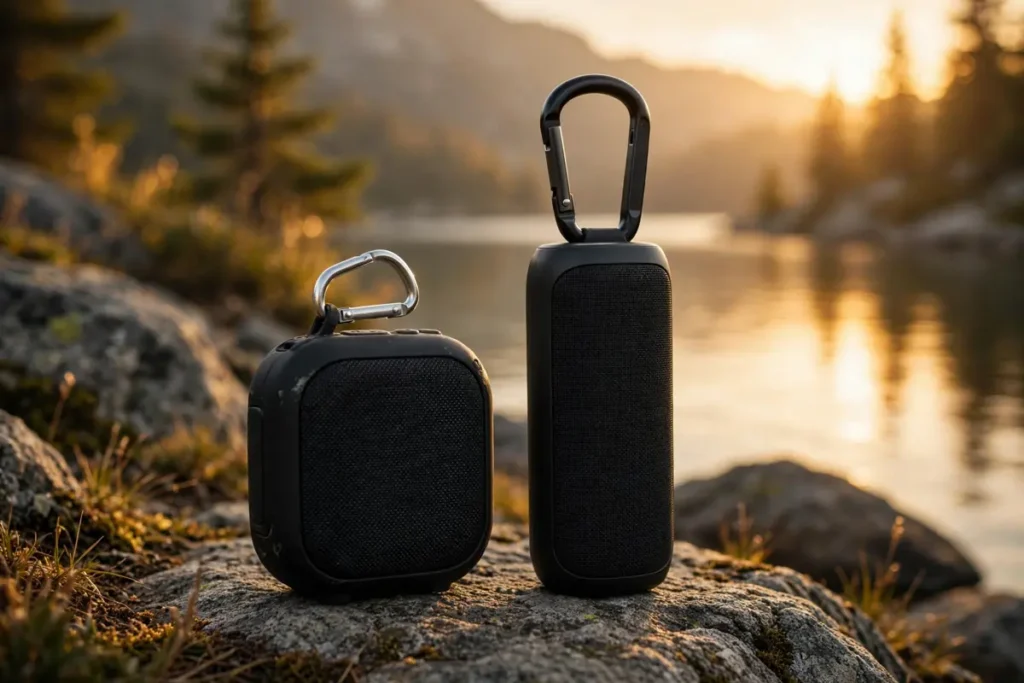
The JBL Clip line owns the “clip it to your bag and go” corner of the portable speaker world — and the Clip 5 is the biggest generational jump the series has seen in years. The Clip 4 has been the default recommendation for hikers, cyclists, and shower singers for a long stretch, but its successor finally changes the math: more power, more battery, a redesigned carabiner, stereo pairing, and app-based EQ.
So should you grab the newer Clip 5, or is the older Clip 4 still the smarter buy? Our verdict: for first-time buyers, the Clip 5 wins decisively — the upgrades touch almost everything that matters on a speaker this small. But the Clip 4 remains a perfectly good ultra-portable if you already own one or find it at a clearance deal. Below is SoundMavericks’ full side-by-side breakdown so you can decide for yourself.
The Key Differences at a Glance
- Sound: The Clip 5’s larger 45 mm driver and 7 W amp play louder with deeper bass than the Clip 4’s 40 mm driver and 5 W.
- Battery: 12 hours on the Clip 5 versus 10 on the Clip 4 — plus Playtime Boost for up to 3 extra hours on the newer model.
- Connectivity: Bluetooth 5.3, stereo pairing, and Auracast on the Clip 5; Bluetooth 5.1 and no multi-speaker linking on the Clip 4.
- Customization: The Clip 5 works with the JBL Portable app for EQ and updates; the Clip 4 has no app support.
- Design: Redesigned wider carabiner with a bigger opening on the Clip 5, improved rubber feet, and a slightly taller body.
- Same on both: IP67 waterproof and dustproof rating, USB-C charging, integrated carabiner concept, and no built-in microphone.
JBL Clip 4 vs Clip 5: Side-by-Side Specs
| Feature | JBL Clip 4 | JBL Clip 5 |
|---|---|---|
| Driver | 40 mm dynamic driver | 45 mm dynamic driver + passive radiator |
| Output power | 5 W RMS | 7 W RMS |
| Frequency response | 100 Hz – 20 kHz | 95 Hz – 20 kHz |
| Bluetooth version | Bluetooth 5.1 | Bluetooth 5.3 |
| Battery life | Up to 10 hours | Up to 12 hours (+3 hours with Playtime Boost) |
| Water/dust rating | IP67 | IP67 |
| Stereo pairing | No | Yes (two Clip 5s) + Auracast |
| App EQ | No app support | Yes, via JBL Portable app |
| Carabiner | Integrated carabiner | Redesigned, wider carabiner with bigger opening |
| Dimensions | 8.6 × 13.5 × 4.6 cm | 8.6 × 13.5 × 4.6 cm |
| Weight | ~239 g | ~285 g |
| Charging | USB-C | USB-C |
| Built-in mic / calls | No | No |
Design and Build: The Carabiner Gets a Real Upgrade
At a glance the two speakers look nearly identical — same rounded rectangle, same fabric grille, same rubberized ends. The Clip 5 is a touch taller overall because of its new carabiner, which is the single most meaningful physical change: it is wider, opens further, and clips onto thicker straps and bars than the Clip 4’s narrower version ever could.
Flip them over and the Clip 5 shows three improved rubber feet instead of the Clip 4’s eight smaller strips — a small detail that matters for a speaker that spends its life on wet shower floors, car roofs, and camp tables. Both speakers carry the same IP67 rating, so dust and full water submersion are non-issues on either model. If you are cross-shopping JBL’s bigger portables instead, see our JBL Flip 5 vs Flip 6 comparison and the roundup of the best large Bluetooth speakers.
Sound Quality: The Clip 5’s Biggest Win
This is where the generational gap is widest. The Clip 5 moves from a 40 mm driver and 5 W of output to a 45 mm driver with a passive radiator and 7 W — and on a speaker this small, that jump is immediately audible. In our estimation, the Clip 5 plays noticeably louder with deeper, punchier bass and a clearer midrange, while the Clip 4’s smaller amp starts to sound thin and strained when pushed.
Frequency response tells the same story on paper: 95 Hz – 20 kHz on the Clip 5 versus 100 Hz – 20 kHz on the Clip 4. Neither speaker is a bass monster — physics still applies — but the Clip 5 digs a little deeper and stays composed at higher volumes, which is exactly what you want on a trail or in a noisy kitchen.
The second sound-related upgrade is software: the Clip 5 works with the JBL Portable app, giving you an EQ to shape the sound. The Clip 4 has no app support at all — what you hear is what you get. If you care about how Bluetooth codecs and wireless audio quality work under the hood, our Bluetooth audio codecs guide breaks it down.
Battery Life: 10 Hours vs 12 (+3) Hours
The Clip 4 is rated for up to 10 hours of playtime. The Clip 5 stretches that to up to 12 hours — and its Playtime Boost feature, toggled in the JBL Portable app, squeezes out up to 3 additional hours by trimming bass output. Independent testing has the Clip 5 landing just under 11 hours in real-world use, which is in line with JBL’s claim and a genuine step up from the Clip 4.
Playtime Boost is a trade-off: you gain endurance but lose some of that improved bass response. For long hikes and multi-day trips where charging is scarce, it is a genuinely useful trick; for backyard listening, leave it off. Both speakers charge over USB-C, with the Clip 5 taking around 3 hours for a full charge.
Connectivity: Bluetooth 5.3, Stereo Pairing, and Auracast
The connectivity story heavily favors the Clip 5:
- Bluetooth 5.3 vs 5.1: the Clip 5’s newer radio means a more stable connection, better power efficiency, and a modern platform for future features.
- Stereo pairing: link two Clip 5s together for true left-right stereo — impossible on the Clip 4, which has no multi-speaker linking at all.
- Auracast: the Clip 5 can broadcast and receive Auracast streams, letting it join a whole ecosystem of Auracast-enabled JBL speakers for bigger, room-filling sound. Curious what Auracast actually does? Our Auracast explainer covers it, and our best Auracast headphones roundup shows how wide the ecosystem is getting.
- JBL Portable app: EQ, Playtime Boost, and firmware updates on the Clip 5; nothing on the Clip 4.
Neither speaker has a microphone, so neither works as a speakerphone — if hands-free calls matter to you, look at JBL’s headphone line instead, like the JBL Live 770NC or the JBL Tune 720BT.
JBL Clip 4: Who Should Still Buy It

The Clip 4 is not obsolete — it is simply outclassed. It is still IP67 waterproof, still clips anywhere, and still delivers that classic JBL tuning in a pocketable package. If you already own one and it works, there is no urgency to upgrade: the sound signature you like is still there, just smaller and quieter than the new model.
The Clip 4’s real remaining argument is value. As the older model it routinely shows up at clearance-level deals, and at a steep discount it remains one of the most rugged ultra-portables you can buy. Just know what you are giving up: no stereo pairing, no app EQ, shorter battery, and the older Bluetooth radio.
JBL Clip 5: Who Should Buy It

The Clip 5 is the better speaker in nearly every category that matters: louder and fuller sound, longer battery with Playtime Boost, Bluetooth 5.3, stereo pairing, Auracast, app EQ, and a genuinely improved carabiner. For anyone buying a Clip for the first time, this is the one to get — the improvements are not cosmetic, they change how the speaker performs day to day.
The trade-offs are minor: it is slightly heavier (~285 g vs ~239 g) and it still lacks a microphone, so it cannot double as a speakerphone. The wider carabiner is a strict improvement with no real downside. For outdoor use — hiking, cycling, camping, kayaking — the Clip 5 is now the default recommendation in this size class.
SoundMavericks’ Verdict: Clip 5 for New Buyers, Clip 4 Only on Deep Discount
After weighing every difference, our verdict is straightforward:
- Buy the JBL Clip 5 if you are shopping for your first Clip-style speaker. The louder 7W output, longer battery, stereo pairing, Auracast, and app EQ make it the clearly better product — this is a real generational upgrade, not a refresh.
- Keep the JBL Clip 4 if you already own one. It is still rugged, waterproof, and sounds good; nothing about the Clip 5 makes the 4 stop working.
- Consider the Clip 4 only at a steep discount. As a clearance buy it remains a solid ultra-portable — but do not pay anywhere near the Clip 5’s price for the older model, because the newer one outclasses it at every turn.
If you are building out a portable audio setup beyond a single clip speaker, our best car speakers guide covers the bigger end of the spectrum.
Frequently Asked Questions
Is the JBL Clip 5 worth upgrading from the Clip 4?
If you already own a Clip 4 that works fine, the upgrade is a nice-to-have rather than a must. The Clip 5 brings louder 7W output, a 12-hour battery with Playtime Boost, Bluetooth 5.3, stereo pairing, and app EQ — meaningful upgrades, but the core sound signature and rugged IP67 build are familiar. It is a much clearer upgrade if you are buying your first Clip.
Which sounds better, the JBL Clip 4 or Clip 5?
The Clip 5 sounds better. Its 7W amplifier delivers noticeably more volume and deeper, punchier bass than the 5W Clip 4, and the JBL Portable app’s EQ lets you tune the sound to your taste — something the Clip 4 cannot do.
Can you pair two JBL Clip 4s or two Clip 5s for stereo?
The JBL Clip 5 supports stereo pairing when you connect two Clip 5 units together, plus Auracast broadcast linking with other Auracast-enabled JBL speakers. The Clip 4 does not support stereo pairing.
Are both the JBL Clip 4 and Clip 5 waterproof?
Yes. Both the JBL Clip 4 and JBL Clip 5 carry an IP67 rating, meaning they are dustproof and can survive submersion in up to 1 meter of fresh water for 30 minutes. Both are equally safe around pools, beaches, and showers.
What is Playtime Boost on the JBL Clip 5?
Playtime Boost is a Clip 5 feature that extends battery life by up to 3 extra hours, for a total of up to 15 hours. It works by reducing bass output to save power and is enabled through the JBL Portable app. The Clip 4 has no equivalent feature.

I am the founder of Sound Mavericks, where I provide the polite truth about audio equipment. I started this site because consumer electronics reviews are often too technical. Instead of using a silent lab, I test headphones, earbuds, and Bluetooth speakers in the real world – like on a noisy subway or in a busy coffee shop.
To stay independent, I buy my own review units (mostly from the United States) rather than accepting free gifts from brands. Once I finish testing a product, I sell it locally to our community. My goal is to help you understand sound quality, active noise cancellation (ANC), and battery life without the marketing hype.