
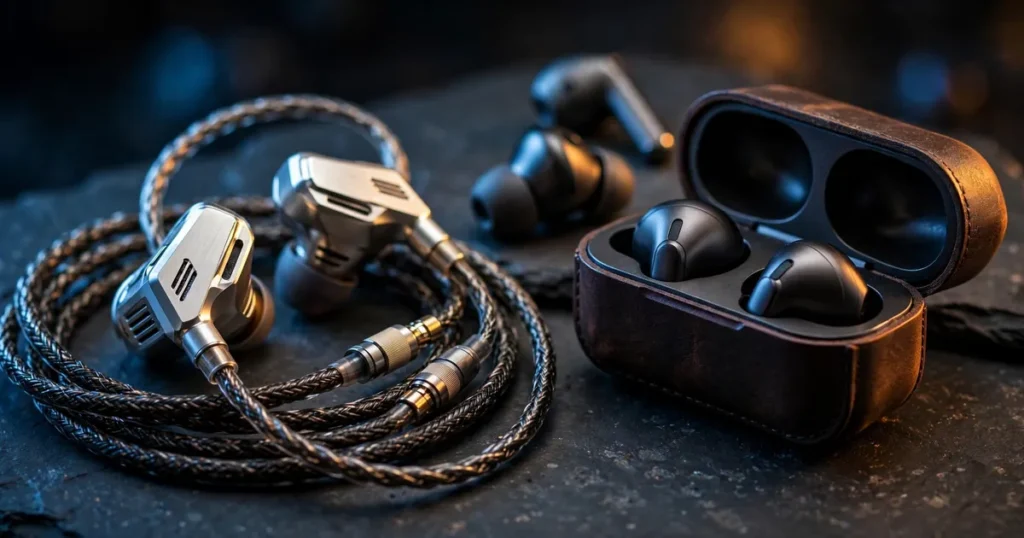
The jump from good earbuds to audiophile-grade earbuds is not about louder bass or fancier branding. It is about hearing things you never noticed: the decay of a cymbal, the breath between phrases, the placement of each instrument across an imaginary stage. This guide rounds up the five earbuds that deliver that experience best in 2026 — flagship wired in-ear monitors for purists, plus the two wireless sets that earn a place in an audiophile rotation.
This is the high-end tier of our earphone coverage. For the broader field of great IEMs at every tier, see our best in-ear monitors guide; for budget standouts, our best budget in-ear monitors guide. Everything here sits above both: premium engineering, flagship tuning, and technical ability that rewards a good source.
What “audiophile-grade” actually means for earbuds
Every earbud on this list earns its place through the same four pillars. These are the criteria SoundMavericks evaluates, and they are what separate a flagship set from a merely expensive one.
Tuning intent. Audiophile earbuds are tuned with a deliberate philosophy — either reference-flat neutrality that reveals the recording as it is, or a refined musical signature that enriches without masking. What they never do is crank the bass to win a five-second store demo. Tuning is the personality of an earbud, and in this tier, that personality is coherent across every genre.
Technicalities. Resolution (the fine detail you can actually hear), imaging (how precisely instruments are placed), and soundstage (how wide and deep that image feels) are what audiophiles mean by “technical performance.” A flagship IEM like the Sennheiser IE 900 — our full review can layer an orchestra without smearing; a lesser set turns the same passage into mush.
Driver engineering. The picks below are not just “bigger drivers.” They use balanced-armature arrays with dedicated crossovers, TrueResponse dynamic transducers with acoustic chamber design, or magnetic-fluid diaphragms — engineering aimed at lower distortion and flatter response, not marketing spec sheets.
The source chain. Audiophile earbuds scale with what feeds them. A lossless stream, a clean DAC, or even just a codec like LDAC or aptX Lossless over Bluetooth audibly changes what these sets are capable of. We have kept our score cards honest about which picks reward good source gear — and which ones sound superb straight from a phone.
Fit and seal. No tuning survives a broken seal. Every pick here ships with multiple tip sizes and styles, and the wired models include memory foam options. If finding a secure fit is your main struggle, see our guide to earbuds for small ears.
How SoundMavericks picked these five
We built this list from manufacturer specification data, published measurement-backed expert consensus, and verified Amazon US availability for every pick — each product link was checked against the live listing on the day this guide was written. We do not dress up spec sheets as listening impressions, and we do not award points for brand names. What follows is our own analysis of which sets offer the most complete audiophile package in 2026, wired and wireless.
The best audiophile earbuds at a glance
| Earbud | Type | Driver tech | Best for |
|---|---|---|---|
| Sennheiser IE 900 | Wired | 7mm TrueResponse dynamic (X3R) | Ultimate high-end sound |
| Technics EAH-AZ100 | Wireless | 10mm magnetic fluid dynamic | Best wireless sound |
| Sennheiser IE 600 | Wired | 7mm TrueResponse dynamic (dual-chamber absorber) | Reference-neutral listening |
| Sennheiser Momentum True Wireless 4 | Wireless | TrueResponse dynamic | Audiophile sound + features |
| Shure SE535 | Wired | Triple balanced-armature | Midrange and studio use |
1. Sennheiser IE 900 — Best high-end audiophile earbuds

The IE 900 is Sennheiser’s statement piece: a single 7mm TrueResponse dynamic driver built around the company’s X3R transducer technology, housed in a precision-milled aluminum shell, made in Germany. Instead of stacking multiple drivers, Sennheiser engineered one exceptional one — a triple-chamber absorber system and acoustic vortex clean up midrange masking so the driver delivers a spacious, natural presentation with essentially no distortion. It is the wired flagship that everything else in this guide gets measured against.
What sets it apart for critical listening is how effortless it sounds: detail emerges without fatigue, and the soundstage stays wide and open rather than compressed between your ears. The package backs up the engineering — Fidelity+ MMCX detachable cables with 3.5mm unbalanced plus 2.5mm and 4.4mm balanced terminations, para-aramid reinforced cabling, and a signed presentation case.
Key specs: 7mm TrueResponse dynamic driver with X3R technology; 5Hz–48kHz frequency response; 16Ω impedance; THD under 0.05%; single-piece aluminum housing; detachable Fidelity+ MMCX cable (3.5mm / 2.5mm / 4.4mm included); 2-year warranty.
Our take: If you want the most resolving, most naturally spacious wired earbud you can buy and are ready to feed it quality source gear, this is the destination, not a stepping stone. Read our dedicated Sennheiser IE 900 review for the full breakdown.
Pros: reference-grade resolution and staging; exquisite build and included balanced cables; scales beautifully with good amplification. Cons: demands a quality source to justify itself; premium flagship tier.
| Sound Quality | 9.8 |
| Detail & Resolution | 9.8 |
| Build & Craft | 9.6 |
| Comfort & Isolation | 9.0 |
| Value | 8.2 |
2. Technics EAH-AZ100 — Best wireless audiophile earbuds
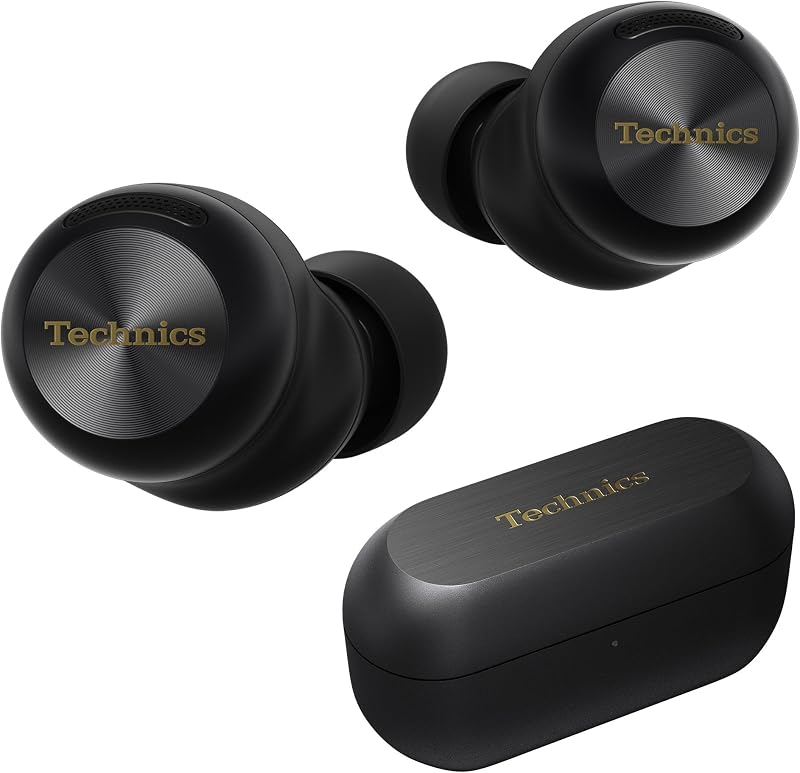
Technics built the AZ100 to answer the question of whether true wireless can satisfy a critical listener — and our analysis says it is the closest thing to a yes on the market. The heart of it is a 10mm free-edge magnetic fluid driver, a genuinely exotic transducer that uses magnetic fluid to center the diaphragm and reduce distortion. The result is a clean, neutral, highly detailed presentation that feels closer to a wired monitor than to typical consumer buds.
The tech sheet reads like a flagship checklist: LDAC for hi-res wireless, Bluetooth 5.3 with three-device multipoint, Dolby Atmos with head tracking, adaptive hybrid noise cancelling, and 10 hours of playback per charge (28 hours with the case). The Technics Audio Connect app adds an 8-band EQ, and the compact fit suits long sessions.
Key specs: 10mm magnetic fluid dynamic driver; LDAC + LC3 codec support; Bluetooth 5.3; Dolby Atmos with head tracking; adaptive hybrid ANC; 10hr earbuds + 28hr total (AAC); 3-device multipoint; IPX4; Qi wireless charging.
Our take: The best-sounding wireless earbud we would hand to a wired purist. It does not replace the IE 900 at the top of the wired mountain, but for commuters, travelers, and anyone who wants one pair that does everything, this is SoundMavericks’ wireless pick.
Pros: superbly clean, detailed wireless sound; excellent ANC and call quality; long battery with multipoint. Cons: LDAC battery life is shorter than AAC; no wired fallback option.
| Sound Quality | 9.4 |
| ANC & Features | 9.4 |
| Comfort & Fit | 9.0 |
| Battery Life | 9.0 |
| Value | 8.6 |
3. Sennheiser IE 600 — Best neutral-tuned audiophile earbuds

The IE 600 is the IE 900’s younger sibling with a mission of its own: exquisitely neutral sound. It uses the same 7mm TrueResponse dynamic driver philosophy, but pairs it with a unique dual-chamber absorber system that removes the masking resonances responsible for harshness and smeared treble. The housings are 3D-printed from ZR01 amorphous zirconium — three times harder and more bend-resistant than steel — and shrug off corrosion and scratches. If you want the IE series’ mid-tier entry point instead, our Sennheiser IE 300 review covers the smaller sibling.
Tonally, this is the monitor for listeners who want the recording, not an editorial: refined, true-to-life, with tight bass that never bleeds and a top end that stays smooth where many “detailed” IEMs turn strident. A 4.4mm balanced cable comes in the box alongside the standard 3.5mm. Compared with the IE 900, it trades the last degree of spaciousness for neutrality — many critical listeners actually prefer it.
Key specs: 7mm TrueResponse dynamic driver; 4Hz–46.5kHz frequency response; 18Ω impedance; dual-chamber absorber system; amorphous zirconium ZR01 housings; detachable Fidelity+ MMCX cable (3.5mm + 4.4mm balanced included); ~6g per earpiece.
Our take: The smart-money flagship for the neutral-listening crowd. If the IE 900 is a showcase, the IE 600 is a studio tool you can take anywhere — and the tougher build makes it the better travel companion.
Pros: genuinely neutral, non-fatiguing tuning; outstanding build materials; balanced cable included. Cons: no 2.5mm cable in the box; bass is controlled rather than fun.
| Sound Quality | 9.4 |
| Detail & Resolution | 9.3 |
| Build & Craft | 9.2 |
| Comfort & Isolation | 8.8 |
| Value | 8.4 |
4. Sennheiser Momentum True Wireless 4 — Best audiophile wireless all-rounder

If the Technics AZ100 is the purist’s wireless, the Momentum True Wireless 4 is the audiophile’s wireless workhorse. Sennheiser’s TrueResponse transducer delivers the brand’s signature rich, detailed sound, and the MTW4 adds the two technologies that matter most for wireless fidelity: aptX Lossless and aptX Adaptive, on top of Bluetooth 5.4.
The feature set is deep without getting in the way: adaptive ANC, transparency mode, sound personalization, LE Audio and Auracast for future-proofing, and 30 hours of total battery life with a quick-charge case. The Black Copper finish and fabric-textured case keep the premium feel consistent.
Key specs: TrueResponse dynamic transducer; aptX Lossless + aptX Adaptive; Bluetooth 5.4; adaptive ANC with transparency mode; 30hr total battery life; LE Audio and Auracast; personalized sound tuning.
Our take: The wireless pick for listeners who want audiophile sound quality plus every modern convenience. If you will only own one pair of premium earbuds and need them to do calls, travel, and serious listening, start here.
Pros: superb wireless sound with lossless codecs; deep feature set; excellent battery and comfort. Cons: ANC trails the absolute best; case is on the large side.
| Sound Quality | 9.3 |
| ANC & Features | 9.0 |
| Comfort & Fit | 9.0 |
| Battery Life | 9.2 |
| Value | 8.7 |
5. Shure SE535 — Best audiophile earbuds for midrange and studio use

The SE535 is the veteran of this list — and proof that great engineering ages well. Three balanced-armature drivers with a dedicated three-way crossover handle lows, mids, and highs separately, delivering the spacious, mid-forward sound that made Shure a stage standard. If vocals, acoustic instruments, and clarity through dense mixes are what you listen for, this triple-driver design still stands with the best single dynamics on this list in its own territory.
It is also the most practical wired pick here. The sound-isolating design blocks up to 37dB of ambient noise — no batteries, no processing — and secure over-ear routing keeps the earpieces planted on commutes and long sessions. The detachable MMCX cable system supports wired, Bluetooth, USB-C, and Lightning cables. For the full story, see our Shure SE535 review.
Key specs: triple balanced-armature drivers (three-way crossover); 18Hz–19kHz frequency response; 36Ω impedance; 119dB SPL/mW sensitivity; up to 37dB sound isolation; gold-plated MMCX detachable cable; fit kit included; 2-year warranty.
Our take: The pick for vocal lovers, musicians, and anyone who values a proven stage monitor over flagship flair. In a list of dynamic-driver showcases, the SE535’s balanced-armature midrange is a refreshing — and genuinely different — flavor.
Pros: outstanding midrange clarity; superb passive isolation; modular cable ecosystem; stage-proven durability. Cons: treble extension trails the Sennheiser flagships; older design language.
| Sound Quality | 9.2 |
| Detail & Resolution | 8.8 |
| Build & Craft | 9.0 |
| Comfort & Isolation | 9.0 |
| Value | 8.3 |
Wired or wireless: which path should an audiophile take?
Honest answer: wired still wins the last few percent. A wired connection skips the entire Bluetooth codec negotiation, so a flagship IEM fed by a decent DAC gets every bit of the recording. If your listening happens mostly at a desk or in a dedicated chair, the IE 900, IE 600, or SE535 will reward you more than any wireless set can.
But the gap has shrunk dramatically. LDAC and aptX Lossless preserve the audible benefits of hi-res files, and the Technics AZ100 and Momentum True Wireless 4 implement them well. For commuters, travelers, and anyone who will listen more because the pair is convenient, wireless is now a legitimate audiophile choice. Our rule: wired for the ultimate listening station, wireless for the pair you will live with daily — many serious listeners end up owning one of each.
Source pairing: the step most buyers skip
Flagship earbuds are only half the equation. A phone’s built-in DAC will drive all five picks here to perfectly enjoyable levels — but the wired three in particular were engineered with headroom in mind. Pairing the IE 900 or IE 600 with a portable DAC/amp or a quality balanced source tightens the bass, opens the staging, and lowers the noise floor audibly.
For wireless listeners, the lever is simpler: use a lossless streaming tier and enable the best codec your phone supports. LDAC on the AZ100 and aptX Lossless on the Momentum True Wireless 4 both need to be switched on in your phone’s Bluetooth settings — they do not always engage by default. Both Sennheiser wired picks also ship with 4.4mm balanced cables, so a balanced-capable portable source is a worthwhile future upgrade.
Final verdict
For the absolute best wired sound money can buy in an earbud, the Sennheiser IE 900 stands alone at the top of this list. For wireless, the Technics EAH-AZ100 is our pick for pure sound quality, while the Sennheiser Momentum True Wireless 4 wins on the complete feature package. The IE 600 is the neutrality lover’s smart choice, and the Shure SE535 remains the midrange and stage-monitoring benchmark. Whichever direction you go, pair it with a good source — these earbuds were built to scale.
Frequently asked questions
Are wired earbuds better than wireless for audiophile listening?
Technically, yes — wired avoids Bluetooth compression entirely, which gives flagship IEMs like the IE 900 the cleanest possible signal path. But the gap is small now: wireless sets with LDAC or aptX Lossless, like our top two wireless picks, preserve enough detail to satisfy most critical listeners. Choose based on where and how you listen.
Do I need a DAC or headphone amp with audiophile earbuds?
Not strictly — all five picks play loudly and cleanly straight from a phone. But the wired flagships were designed with headroom: a quality portable DAC or balanced source audibly improves bass control, staging, and background blackness. Think of it as unlocking the last 10–15% the earbuds were engineered to deliver.
What is the difference between audiophile earbuds and regular IEMs?
It comes down to tuning intent, driver engineering, and technical performance — resolution, imaging, and soundstage — rather than just build or brand. Our best IEMs guide covers the full range, while this guide focuses on the flagship tier where those technicalities are maximized. Our budget IEM guide shows how far the mid-tier has come if the flagships here are more than you need.
Are balanced cables worth it for IEMs?
Balanced cables (2.5mm or 4.4mm) deliver more power with less crosstalk than single-ended 3.5mm, which benefits harder-to-drive sets and lowers the noise floor on clean sources. Both Sennheiser picks here include balanced cables in the box, so you can try them the moment your source supports it — no aftermarket purchase required.
Can audiophile earbuds double as everyday earbuds?
The wireless picks absolutely can: the Technics AZ100 and Momentum True Wireless 4 both have strong ANC, quality microphones, and all-day comfort. The wired models are pure listening instruments — superb on a commute thanks to excellent passive isolation, but they have no microphones, no ANC, and no battery. Match the pick to the job.

I am the founder of Sound Mavericks, where I provide the polite truth about audio equipment. I started this site because consumer electronics reviews are often too technical. Instead of using a silent lab, I test headphones, earbuds, and Bluetooth speakers in the real world – like on a noisy subway or in a busy coffee shop.
To stay independent, I buy my own review units (mostly from the United States) rather than accepting free gifts from brands. Once I finish testing a product, I sell it locally to our community. My goal is to help you understand sound quality, active noise cancellation (ANC), and battery life without the marketing hype.

