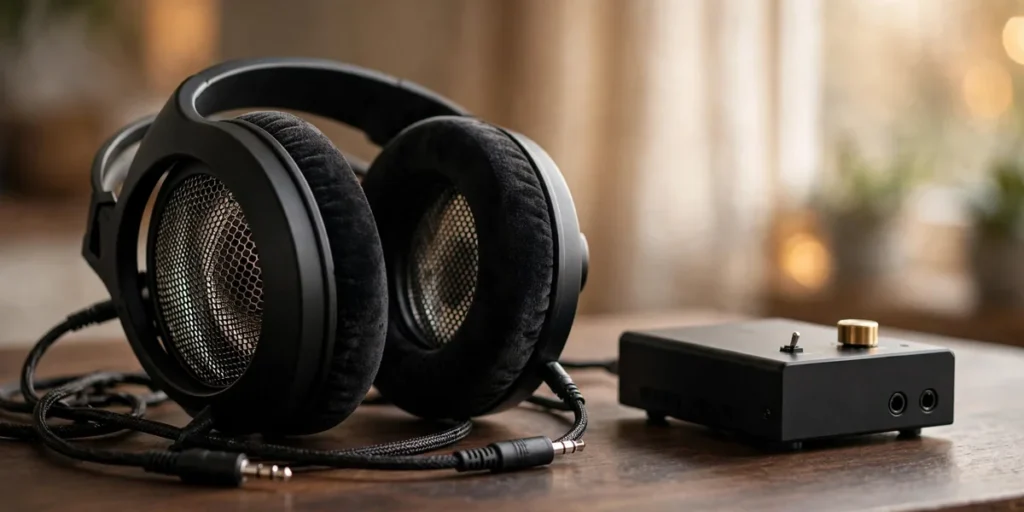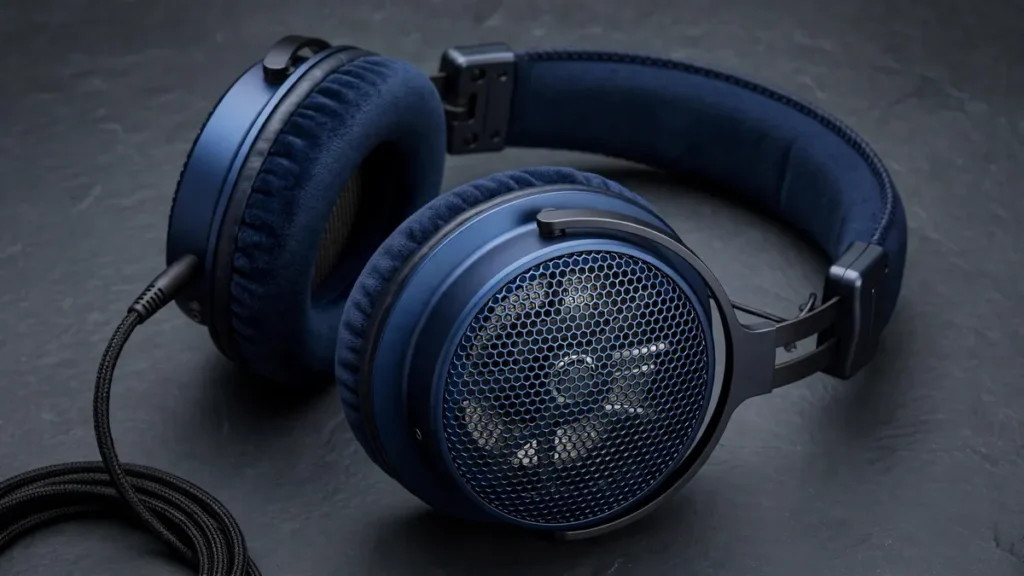
The bottom line: The Sennheiser HD6XX is essentially an HD650 in midnight blue — the same drivers, the same beloved vocal-forward tuning, and the same 300-ohm appetite for amplification, sold through Drop at a fraction of the HD650’s price. For desk listening, it’s one of the best values in wired audio. The trade-offs are real, though: no Bluetooth, no noise cancelling, rolled-off sub-bass, and you’ll want a decent DAC/amp to hear what it can really do.

| Sound | 9.5 |
| Comfort | 8.5 |
| Build | 8.5 |
| Value | 9.5 |
Sennheiser HD6XX — Key Specifications
| Spec | Detail |
|---|---|
| Model | Drop x Sennheiser HD6XX (Massdrop collaboration) |
| Based on | Sennheiser HD650 — same drivers and tuning |
| Transducer | Dynamic, open-back |
| Frequency response | 10 Hz – 41 kHz (per Amazon listing) |
| Nominal impedance | 300 ohm |
| THD | < 0.05% |
| Cable | Detachable, 6 ft (1.8 m), 3.5 mm plug |
| Weight | 260 g (9.2 oz) without cable |
| Color | Midnight blue |
| Connectivity | Wired only — no Bluetooth, no ANC, no microphone |
| Warranty | 2-year limited warranty |
What Is the Sennheiser HD6XX?
The HD6XX is the result of a collaboration between Sennheiser and Drop (formerly Massdrop), the community-driven retailer. Drop took the legendary HD650 — Sennheiser’s reference headphone from 2003 to 2009 and still a benchmark for natural sound — and reissued it with a dark midnight-blue finish, a shorter and more practical 6-foot detachable cable with a standard 3.5 mm plug, and a price far below the original.
Everything that matters acoustically is unchanged: the same drivers, the same tuning, the same open-back design. Independent measurements from labs like unheardlab confirm the HD6XX measures like an HD650. You’re not buying a budget imitation — you’re buying the real HD650 platform, restyled and repriced for the enthusiast community.
Sound Quality: The Famous Midrange
The HD6XX’s reputation rests on one thing: a midrange that reviewers have praised for two decades. Vocals sound startlingly lifelike, acoustic instruments carry realistic weight and texture, and the overall presentation is smooth and non-fatiguing. The treble is deliberately relaxed — detailed enough to resolve fine textures like a saxophone reed or bow on strings, but never harsh or sibilant. It’s the opposite of the bright, aggressive tuning found on many modern headphones.
Bass is the known compromise. The low end rolls off below about 80 Hz, so you won’t get deep sub-bass rumble or the physical thump of a closed-back or planar design. There’s a gentle warmth in the upper bass that keeps music from sounding thin, but bassheads should look elsewhere. What the HD6XX does instead is resolution: instruments separate cleanly, vocal doubles and room details surface in familiar recordings, and the presentation stays coherent across genres from jazz and soul to rock and classical.
The soundstage is good but not class-leading for an open-back — wide enough to feel like sitting in front of studio monitors, though some competitors stretch wider. Imaging is precise, which is why the HD6XX remains a favorite for critical listening and mixing reference work.
Design, Build & Comfort
Visually, the HD6XX trades the HD650’s gray-and-titanium look for a deep midnight-blue finish that looks more modern on a desk. The build is classic Sennheiser 6-series: lightweight plastic construction that feels less premium than it is, but it’s a deliberate trade — at 260 grams the headphone stays comfortable for hours, and nearly every part (earpads, headband padding, cables) is user-replaceable, which is why these headphones routinely last a decade or more.
Comfort is a strong point with one caveat: the clamping force is firm out of the box. Most owners report it loosens up after a week or two of use, after which the HD6XX becomes an all-day headphone. The velour earpads breathe well, a real advantage over leatherette pads during long sessions.
The cable deserves a mention. Drop shortened it to 6 feet and terminated it in a 3.5 mm plug (the HD650’s original 10-foot cable ended in a bulky 1/4-inch jack), which makes the HD6XX far more practical for laptop and desktop use. It’s detachable via the standard Sennheiser two-pin connectors shared with the HD600 and HD650, so balanced cables and replacements are widely available.
You’ll Want a DAC/Amp
With 300-ohm impedance, the HD6XX is harder to drive than most consumer headphones. It will produce sound from a phone or laptop — but quietly, and without the dynamics and control that make it special. A dedicated DAC/amp (even an affordable USB dongle DAC) transforms it: tighter bass, better separation, and proper volume headroom.
This is the hidden cost of the HD6XX’s value proposition. Budget for amplification alongside the headphone itself. The upside of going wired is that you sidestep Bluetooth compression entirely — see our Bluetooth audio codecs explained guide for why a wired connection still sets the reference for pure sound quality.
Important: This Is Not a Noise-Cancelling Headphone
Let’s be clear about what the HD6XX is for. It’s an open-back headphone: sound leaks out, and noise leaks in. There is no active noise cancelling, no isolation to speak of, and no microphone. On a plane, a train, or in an open office, you’ll hear everything around you — and everyone around you will hear your music.
The HD6XX is a stay-at-home headphone for quiet rooms. If your priority is silence on the move, start with our roundup of the best noise-cancelling headphones instead, or our best noise-cancelling headphones for travel if flights are the use case. If you want wireless convenience with strong ANC at a comparable outlay, our Sony WH-1000XM4C review covers a compelling alternative. And if your budget is tighter, our budget noise-cancelling picks round up the best affordable ANC options.
Pros & Cons
Pros:
- HD650 drivers and tuning at a fraction of the original’s price
- Superb, lifelike midrange — exceptional for vocals and acoustic music
- Smooth, non-fatiguing treble; great for long sessions
- Lightweight and comfortable once the headband breaks in
- Detachable cable with standard Sennheiser connectors; every part replaceable
- Responds well to EQ for those who want to tune the bass
Cons:
- Needs a DAC/amp to sound its best (300-ohm impedance)
- Sub-bass rolls off — not for bassheads
- Zero isolation: open-back design leaks sound in both directions
- No Bluetooth, no ANC, no microphone
- Primarily sold through Drop; Amazon availability runs through third-party sellers
Final Verdict
The Sennheiser HD6XX is the easiest recommendation in wired audio for one specific listener: someone with a quiet room, a DAC/amp (or the willingness to buy one), and a love of vocals, jazz, rock, classical, or anything where midrange realism matters. It delivers the HD650 experience — a headphone that has anchored reference listening for over twenty years — without the flagship cost.
It’s the wrong headphone if you commute, travel, take calls, or want wireless convenience. For those jobs, modern ANC flagships are simply better tools. But as a pure listening instrument at a desk, the HD6XX remains nearly unbeatable value, and its replaceable-parts design means it’s a purchase you can keep for a decade.
Frequently Asked Questions
Is the Sennheiser HD6XX the same as the HD650?
Effectively, yes. The HD6XX is a Drop x Sennheiser collaboration that uses the same drivers and tuning as the HD650 — independent measurements confirm they sound the same. The differences are cosmetic and practical: a midnight-blue finish instead of gray, a shorter 6-foot detachable cable with a 3.5 mm plug, and a lower price.
Does the HD6XX need a headphone amp?
Strongly recommended. At 300 ohms, the HD6XX plays quietly and flat straight from a phone or laptop. Even an affordable USB DAC/amp unlocks proper volume, dynamics, and bass control — it’s the single biggest upgrade you can make to this headphone.
Is the HD6XX wireless or noise cancelling?
Neither. The HD6XX is wired-only with no Bluetooth, no active noise cancelling, and no microphone. Its open-back design provides no isolation at all, so it’s strictly a quiet-room headphone — not for commuting, flights, or offices.
What’s the difference between the HD6XX, HD600, and HD650?
The HD6XX is a restyled HD650: same drivers, same warm, vocal-forward tuning. The HD600 is the brighter, more neutral sibling with a marble finish — better treble extension and a leaner bass, preferred by some for classical and analytical listening. All three share the 300-ohm impedance and detachable-cable design.
Where can I buy the Sennheiser HD6XX?
The HD6XX is sold primarily through Drop.com, which runs it as a standing product rather than a limited drop these days. It also appears on Amazon through third-party sellers — availability and sellers vary, so check the current listing before ordering.
Is the HD6XX cable detachable? Can I use a balanced cable?
Yes. The cable detaches via the standard Sennheiser two-pin connectors shared with the HD600 and HD650, so replacement, upgraded, and balanced (e.g. 4.4 mm or XLR) cables are widely available from third parties.
Research method: This is a research-based review — we did not test the HD6XX hands-on. Specifications come from the verified Amazon product listing and Drop/Sennheiser product data; sound impressions synthesize independent lab measurements and expert reviews. We never invent specs or imply testing we didn’t do.

I am the founder of Sound Mavericks, where I provide the polite truth about audio equipment. I started this site because consumer electronics reviews are often too technical. Instead of using a silent lab, I test headphones, earbuds, and Bluetooth speakers in the real world – like on a noisy subway or in a busy coffee shop.
To stay independent, I buy my own review units (mostly from the United States) rather than accepting free gifts from brands. Once I finish testing a product, I sell it locally to our community. My goal is to help you understand sound quality, active noise cancellation (ANC), and battery life without the marketing hype.