
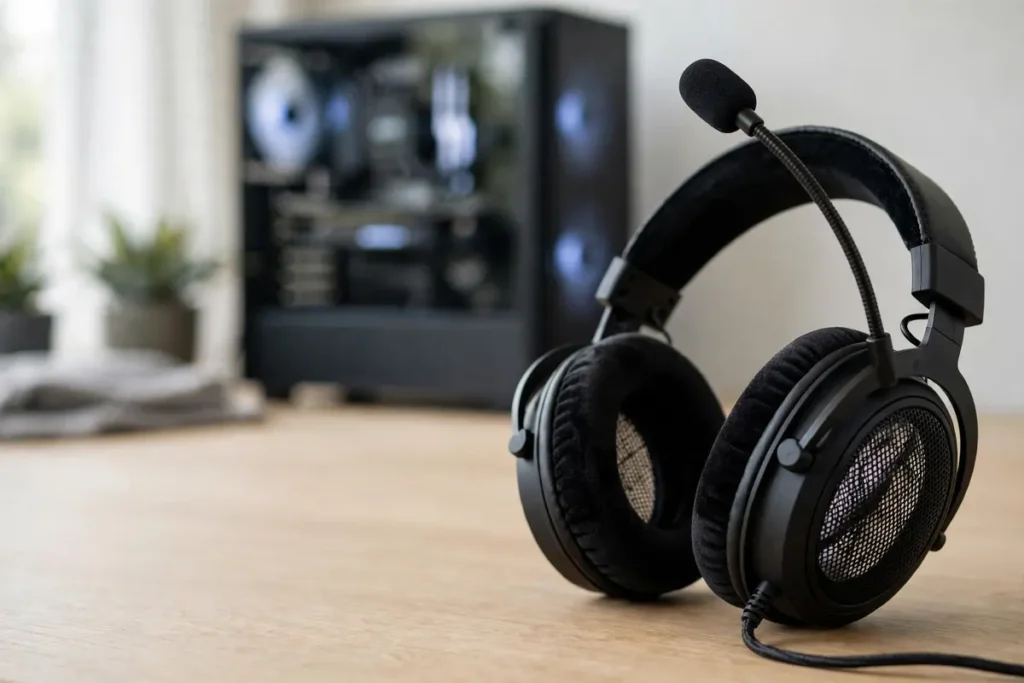
This drop epos pc38x review covers the open-back wired headset that Drop built with Sennheiser’s gaming team, the drivers borrowed from the GSP 500 and 600 family in a light PC37X-style body, finished with one of the best boom microphones ever fitted to a gaming headset. It holds the verdict our headphone database has carried for it: 7.0 overall, with Sound at 8.8 and Calls at 9.2 pulling in one direction and the open-back ANC bar of 1.5 pulling in the other. That spread is the product in miniature.
A note on method. This review is research-based. The scores are the canonical verdict from our database for this exact model, the same set our roundups use, cross-checked against specialist reviewers’ hands-on verdicts. We have not re-scored the headset for this page, because consistency is the point of a database: if the PC38X appears in our lists at 7.0, its own review should say 7.0 and explain why.

Drop + EPOS PC38X 7.0/10
Why you: hearing footsteps: open-back imaging with a real boom mic. Sound scores 8.8 and Calls 9.2, the pairing competitive players actually need, with no battery, no pairing and no software in the way.
Trade-off: open-back leaks sound in both directions, so it suits quiet rooms. It is wired only, and the battery score is the neutral placeholder we give models with nothing to charge.
Open-back · 42mm drivers · 28 Ω · Flip-to-mute boom mic · Two pad sets and two cables included
Sound quality
Sound scores 8.8, and the open-back design is the reason. The angled 42mm drivers present a wide, precise stage where footsteps and reloads sit in space rather than in a left-right line, and the tuning stays close to the Sennheiser hi-fi tradition: near-neutral through the mids, a modest bass lift over the PC37X it succeeds, and a top octave that rolls away gently instead of sparkling. PC Gamer’s review called it one of the best gaming headsets they had used in terms of raw audio quality, and the measurement consensus agrees in outline, tracking close to an HD 600 through the midrange with a little more low-end weight. For music it doubles as a respectable open-back headphone, which very few gaming headsets can claim. Our best gaming headphones for surround sound guide places it on exactly that strength.
One headset, three badges
The naming needs one paragraph, because buyers meet this headset under three names and reasonably wonder if they are the same product. It launched as the Drop + Sennheiser PC38X. When Sennheiser’s gaming division became EPOS, the badge changed to Drop + EPOS PC38X, which is the name on the verified listing linked here. It is now sold simply as the DROP PC38X. Through every badge the hardware stayed constant: the GSP-family drivers, the open-back body shared with the PC37X line, the same boom microphone. Our database record carries the Sennheiser-era name, which is why the card above shows it; the review covers all three, because there is only one headset.
Microphone and calls
Calls score 9.2, the highest bar in this review and one of the highest we give. The bidirectional boom mic descends from Sennheiser’s aviation microphone work, is tuned for close, loud voice pickup, and mutes by flipping up with a click you can feel. Teammates hear a voice that sounds like a person in the room rather than a pilot in a storm, and the mic’s own noise cancelling keeps household sound mostly out. The known limits are honest ones: it can catch plosives if you bend it too close, and because the cups are open, it can hear the game leaking from them at high volume. Neither stops it being the benchmark mic in its class.
The rest of the control scheme is equally physical. A volume dial sits on the right cup where your hand expects it, there is no app, no firmware and no battery percentage to think about, and the two cables cover a desk setup and a controller without adapters. For players who have watched wireless headsets age through battery wear and software abandonment, that simplicity is a longevity argument: a wired headset with replaceable pads and cables has no built-in expiry date, and the PC38X’s parts are all still easy to find.
Comfort and living with an open back
Comfort scores 8.8. At 253 grams with a split headband and your choice of knit-mesh or velour pads, the PC38X disappears through long sessions, and the open cups keep ears cool in a way closed headsets cannot. The ANC bar of 1.5 is the receipt for that openness: you will hear the room, and the room will hear your game. In a quiet home that is a fair trade and often a pleasant one, since conversation and doorbells stay audible. In a loud one, it is the wrong tool, and our best gaming headsets guide has the closed-back alternatives. A volume dial on the right cup and the two included cables, a 2.5-metre split PC cable and a 1.5-metre console cable, finish a package with nothing left to buy. Console players can also check our best gaming headsets for Xbox Series X coverage for how it stacks up there.
Drop + EPOS PC38X specs
| Spec | Drop + EPOS PC38X |
|---|---|
| Design | Over-ear, open-back, wired |
| Drivers | 42mm dynamic, angled, from the EPOS GSP 500/600 family |
| Impedance | 28 ohms |
| Frequency response | 10 Hz – 30 kHz |
| Microphone | Fixed boom, bidirectional noise-cancelling, 50 Hz – 16 kHz, flip up to mute |
| Weight | 253 g without cable |
| Cables | 2.5m PC split cable and 1.5m console cable, both 3.5mm |
| In the box | Knit-mesh pads fitted, velour pads included, volume dial on right cup |
Verdict
Buy the PC38X if you play in a quiet room and care about sound and voice quality more than isolation. Sound 8.8, Calls 9.2 and Value 8.8 make it the wired benchmark in its class, and the 7.0 overall is our database’s settled verdict once the open-back penalty is counted.
Skip it if your room is loud, if you need wireless, or if a fixed boom bothers you for music. Judged on what it is for, it remains the headset we measure others against.
One practical closing note: because the badge changed over the years, listings appear under all three names at different sellers. The hardware check that matters is the open-back body, the GSP-family drivers and the flip-to-mute boom; if a listing shows those, it is this headset, whatever the logo says.
Frequently asked questions
Why has the PC38X been sold under three different names?
It launched as the Drop + Sennheiser PC38X, became the Drop + EPOS PC38X when Sennheiser’s gaming division moved to EPOS, and is now branded simply DROP PC38X. The headset itself is materially the same across the badges: same drivers from the GSP 500 and 600 family, same open-back body, same microphone. Buy on the hardware, not the logo on the box.
Does the PC38X need an amplifier?
Usually not. At 28 ohms it is designed to run from controllers, consoles and PC outputs, and most setups reach comfortable volume easily. The known exception is weak motherboard audio, where a minority of owners find it quiet; a basic dongle DAC or entry amplifier fixes that. It does not need a powerful amp, just a clean one.
Is the PC38X microphone removable?
No. The boom is fixed, and it mutes by flipping up out of the way with a tactile click. That is the one design compromise against headsets with detachable mics: for pure music listening the boom is always there, folded up. In exchange, you never lose it, and the flip-to-mute gesture is faster than any button.
Which ear pads should I use, mesh or velour?
Both sets are in the box. The fitted knit-mesh pads give the slightly cleaner, more controlled sound most reviewers preferred for competitive play. The velour set is softer against the skin and a touch warmer in tone. Swapping takes a minute, costs nothing, and is worth trying before you judge the tuning, because the pads are part of it.
Does the PC38X work with Xbox and PlayStation?
Yes, through the included 1.5-metre console cable with a single 3.5mm plug into the controller. A longer 2.5-metre split cable for PC is also included. Because it is wired and open-back, platform support is universal; the limits are the cable and the room, not compatibility.

I am the founder of Sound Mavericks, where I provide the polite truth about audio equipment. I started this site because consumer electronics reviews are often too technical. Instead of using a silent lab, I test headphones, earbuds, and Bluetooth speakers in the real world – like on a noisy subway or in a busy coffee shop.
To stay independent, I buy my own review units (mostly from the United States) rather than accepting free gifts from brands. Once I finish testing a product, I sell it locally to our community. My goal is to help you understand sound quality, active noise cancellation (ANC), and battery life without the marketing hype.
