
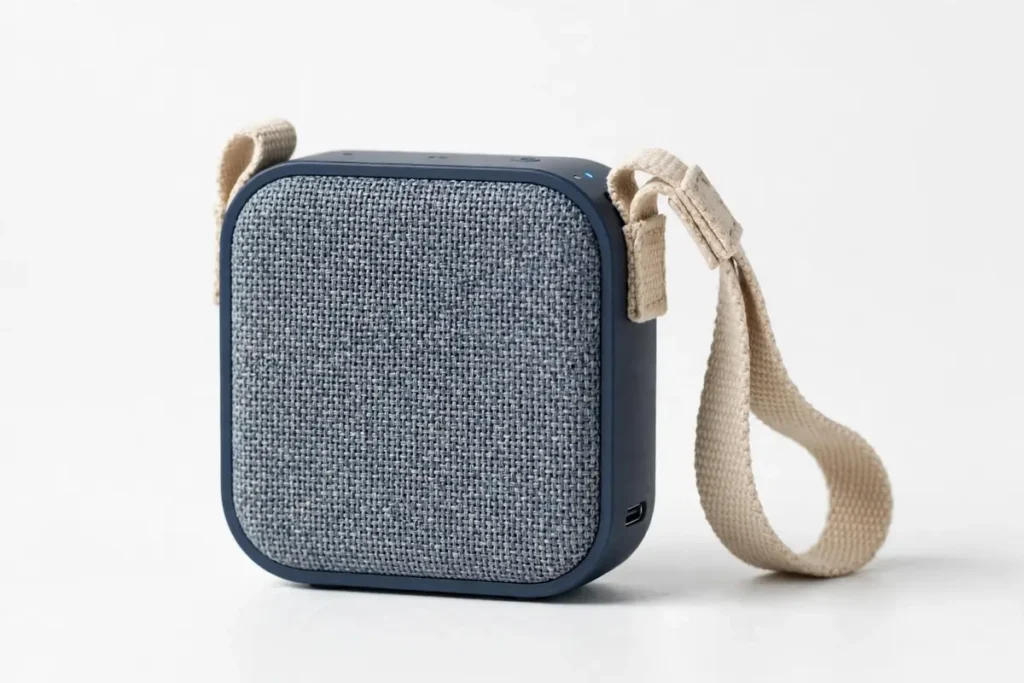
This tribit stormbox micro 2 review covers Tribit’s pocket-sized portable speaker in its verified Amazon US listing, ASIN B09Q59321N: a 10W speaker in a square body about 100 mm across, with IP67 dust and water sealing, up to 12 hours of battery, an integrated strap for a bike frame or backpack, and a USB-C port that can charge a phone in an emergency. This review covers the Micro 2 specifically, the current model with Bluetooth 5.3 and the larger battery. Listings for the original StormBox Micro are a different, older product, and they are not what is covered or linked here.
A note on method. This is a research review, built from Tribit’s published specifications, the verified Amazon US listing for this exact model, and independent coverage. We have not had a unit on the desk, so nothing here claims hands-on testing, and speaker products on this site carry no scores.
The StormBox Micro 2 is the rare pocket speaker that earns its place on the bike or the bag strap rather than in a drawer. The integrated strap mounts it securely, the IP67 body takes rain, mud and a dunking, and the 4,700 mAh battery is large for the class, giving a rated 12 hours and doubling as an emergency phone charger over USB-C. Sound from the single 48 mm driver is lively and clear for podcasts, pop and ride-along music, with XBass adding weight at moderate volume. The limits are physical: one small driver cannot fill a noisy room or produce deep bass, and there is no aux input. As a personal, mounted speaker it is one of the strongest picks in our best Bluetooth speaker coverage. Check Price on Amazon

Why you: A 10W pocket speaker with IP67 sealing, a strap that mounts it to a bike or bag, 12 hours of battery and USB-C phone charging in an emergency.
Trade-off: A single 48 mm driver limits bass depth and room-filling volume, there is no aux input, and every phone charge comes out of the music battery.
Tribit StormBox Micro 2 specifications
| Spec | Tribit StormBox Micro 2 |
|---|---|
| Product | Tribit StormBox Micro 2, pocket portable speaker, Black finish |
| Power | 10W from a 48 mm neodymium driver with passive radiators and XBass processing |
| Battery | 4,700 mAh cell; up to 12 hours at medium volume; USB-C charging, about 3 hours to full; USB-C output for emergency phone charging |
| Connectivity | Bluetooth 5.3 with up to 120 ft (36 m) claimed range; stereo pairing with a second Micro 2; Tribit app with custom EQ; no aux input |
| Waterproofing | IP67 dustproof and waterproof: immersion in up to 1 m of water for 30 minutes; the speaker does not float |
| Size and weight | 99.8 x 99.8 x 42.9 mm; about 315 g, with integrated mounting strap |
Built around the strap
The Micro 2 is a square puck, roughly 100 mm on each side and 43 mm thick, wrapped in fabric with a rubber base and a flexible strap fixed to the back. That strap is the design’s centre of gravity. It wraps a bicycle handlebar, a backpack shoulder strap, a belt or a shower rail and holds the speaker flat and firm, so it plays outward instead of swinging from a loop. Plenty of small speakers can be clipped somewhere. This one is meant to live mounted, and the difference shows in how it gets used: riders and hikers actually bring it, because carrying it asks nothing of them.
Controls sit on the front face, with volume, play and pairing handled by buttons that can be found by feel, and the Tribit app adds a custom EQ and settings beyond the hardware. The body feels dense at about 315 g, heavier than the original Micro, and the extra weight is mostly battery, which is the right trade for a speaker that spends its life away from chargers.
Sound from a single small driver
Inside is one 48 mm neodymium driver working with passive radiators, rated at 10W, a step up from the original Micro’s 9W. Tribit’s XBass processing pushes the low end, and for a speaker that fits in a jacket pocket the result is genuinely engaging: vocals are forward and clear, pop and acoustic tracks have body, and podcasts stay intelligible outdoors, which is harder than it sounds over wind and traffic.
The honest limits need stating, because pocket speakers attract inflated claims. Bass is reinforced, not deep; the lowest notes of electronic and hip-hop tracks are implied by their harmonics rather than reproduced. Volume is enough for the rider, the campsite chair circle and the bathroom, and not enough for a group spread across a beach or a noisy room, where independent reviewers also found it working at its ceiling. Judged as a personal speaker it is well tuned. Judged as a party speaker it is simply the wrong tool, and the larger models in our best outdoor speakers coverage exist for that job. Pairing a second Micro 2 for true stereo is the neatest upgrade path: two mounted speakers give real separation and more headroom, at a combined size still smaller than one mid-size cylinder.
IP67, a big battery and a useful party trick
IP67 means the body is sealed against dust and can be immersed in a metre of water for 30 minutes, as our guide to understanding IP ratings sets out. Rain, trail mud and a drop in a stream are non-events. It does not float, so around deep water the strap earns its keep again: mounted, it cannot sink.
The 4,700 mAh battery is close to double the original Micro’s capacity, and Tribit rates playback at up to 12 hours at medium volume. Loud outdoor use shortens that, as it does on every speaker, but the reserve is real. The USB-C port works in both directions. It charges the speaker in about 3 hours, and it can push charge out to a phone. Output is modest and every phone charge is music time spent, so treat it as an emergency reserve that gets a dying phone back to navigation and messages, not as a power bank replacement. On a bike tour or a festival weekend, that reserve is worth more than another hour of playback.
Micro 2 or something bigger?
The choice is about where the speaker lives. If it lives on a bike, a bag or a belt, the Micro 2 has no direct rival at its size; the clip-on speakers in our JBL Clip 5 review mount by carabiner instead and sound thinner. If it lives on a desk or a kitchen counter, the strap buys nothing and a larger speaker at similar money gives fuller sound, like the compact cylinder in our Sony SRS-XB100 review. And against the original Micro, the second generation is the one to buy: more power, Bluetooth 5.3, half again the battery and the two-way USB-C port, in a body only slightly larger.
Who should buy the Tribit StormBox Micro 2
Buy it if you ride, hike or commute and want music and podcasts mounted to the bike or the bag, with weather sealing you never have to think about and a battery that can rescue your phone. It is also a strong shower and travel speaker for the same reasons.
Skip it if you want one speaker to fill rooms or play for a group outdoors. A single 48 mm driver has a ceiling, and no EQ setting moves it.
Frequently asked questions
Is the Tribit StormBox Micro 2 waterproof?
Yes. It is rated IP67, so it is dustproof and can be immersed in up to a metre of water for 30 minutes. It does not float, so keep it strapped or tethered around deep water.
How long does the StormBox Micro 2 battery last?
Tribit rates it at up to 12 hours at medium volume from its 4,700 mAh battery. Loud playback shortens that figure. Charging over USB-C takes about 3 hours.
Can the StormBox Micro 2 charge a phone?
Yes. Its USB-C port works in both directions and can charge a phone in an emergency. The output is modest and it drains the speaker’s own battery, so treat it as a reserve rather than a full power bank.
Can you pair two StormBox Micro 2 speakers?
Yes. Two Micro 2 units can pair for true wireless stereo, which adds separation and headroom. The pairing is with a second Micro 2, not with the original StormBox Micro.
What is the difference between the StormBox Micro 2 and the original Micro?
The Micro 2 raises output to 10W, moves to Bluetooth 5.3, grows the battery from 2,600 mAh to 4,700 mAh for a rated 12 hours instead of 8, and adds USB-C phone charging. The body is slightly larger and heavier as a result.

I am the founder of Sound Mavericks, where I provide the polite truth about audio equipment. I started this site because consumer electronics reviews are often too technical. Instead of using a silent lab, I test headphones, earbuds, and Bluetooth speakers in the real world – like on a noisy subway or in a busy coffee shop.
To stay independent, I buy my own review units (mostly from the United States) rather than accepting free gifts from brands. Once I finish testing a product, I sell it locally to our community. My goal is to help you understand sound quality, active noise cancellation (ANC), and battery life without the marketing hype.

