
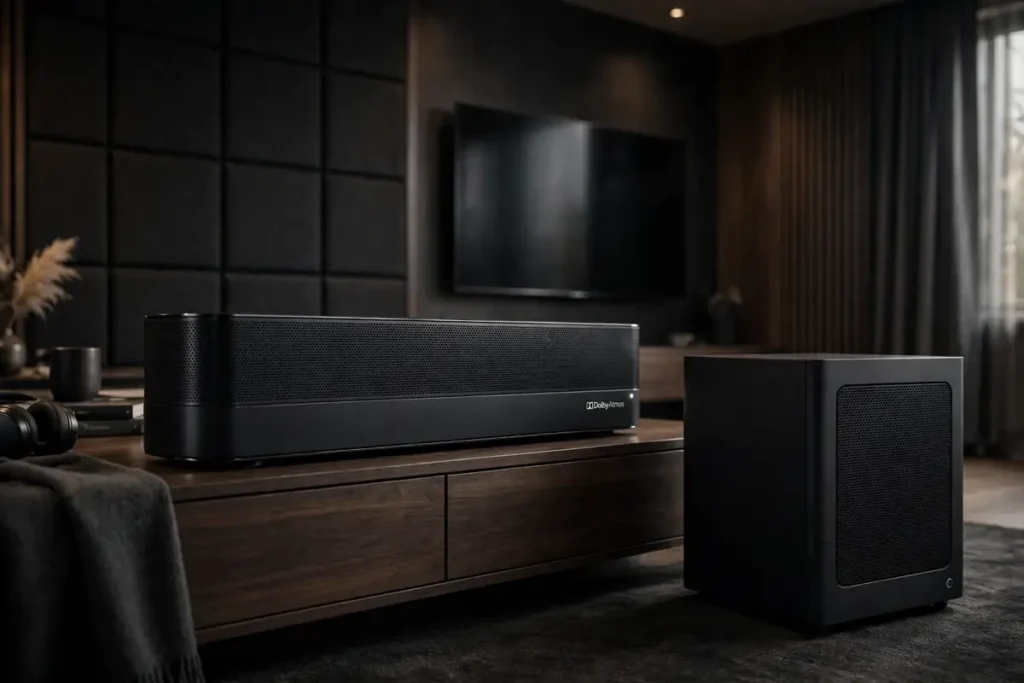
This samsung hw-q800d review covers the HW-Q800D specifically, the Q800 generation that sits between the Q800C and the current model in our Samsung HW-Q800F review. The three share a design and a name, which is exactly why each gets its own review: the listing you buy has to match the generation you researched. The verified listing used here is ASIN B0CTKRV7Z2, model HW-Q800D/ZA, the D exactly, not the C and not the F. What the D offers is the mature version of the Q800 formula: true 5.1.2-channel Dolby Atmos and DTS:X, an 8-inch wireless subwoofer, Wireless Dolby Atmos, Q-Symphony, SpaceFit Sound Pro calibration, and control through the SmartThings app, in a bar and sub package with no rear speakers to place.
A note on method. This is a research review, built from Samsung’s published specifications, the verified Amazon US listing for this exact model, and independent coverage. We have not had a unit on the desk, so nothing here claims hands-on testing, and speaker products on this site carry no scores.
The Q800D is the Q800 design in its settled form. The bar carries front, centre, side-firing and up-firing drivers for real 5.1.2 channels, the wireless subwoofer supplies the low end a bar cannot, and Samsung’s software stack does the polish: SpaceFit Sound Pro measures the room, Adaptive Sound follows the content, and Q-Symphony brings a compatible Samsung TV’s speakers into the system. Bluetooth moves to 5.2 on this generation and the SmartThings app makes setup and adjustment easier than the remote alone. The honest caveats are shared with the whole line: height effects from a bar alone stay moderate, rear speakers cost extra, and the HDMI passthrough is built for film sources rather than high-refresh gaming. In our best Dolby Atmos soundbar coverage, the D is the middle generation worth pricing against both neighbours. Check Price on Amazon

Why you: True 5.1.2 Dolby Atmos and DTS:X with an 8-inch wireless subwoofer, SpaceFit Sound Pro room calibration and Q-Symphony for Samsung TVs.
Trade-off: Changes over the Q800C are incremental, rear speakers are a separate purchase, and passthrough suits film sources more than fast gaming.
Samsung HW-Q800D specifications
| Spec | Samsung HW-Q800D |
|---|---|
| Product | Samsung HW-Q800D, soundbar with wireless subwoofer, model HW-Q800D/ZA |
| Channels | 5.1.2 channel, with centre, side-firing and up-firing drivers in the bar |
| Power | 360W total system power |
| Subwoofer | Wireless subwoofer with 8-inch side-firing driver |
| Formats | Dolby Atmos, DTS:X; Wireless Dolby Atmos over Wi-Fi with compatible Samsung TVs |
| Sound features | Q-Symphony, SpaceFit Sound Pro, Adaptive Sound, Active Voice Amplifier, Game Mode Pro, Night mode |
| Connectivity | HDMI input and HDMI eARC output with 4K HDR passthrough, optical, Bluetooth 5.2, Wi-Fi, AirPlay 2, Chromecast built in, Alexa built in, SmartThings app |
| Size | Bar about 1110 x 60 x 120 mm |
Sound: the Q800 formula, refined
Start with what the D shares with its neighbours, because that is most of the product. The 5.1.2 layout is physical, not virtual: a centre channel for dialogue, front and side-firing drivers for width, up-firing drivers for height, and a separate subwoofer for bass. Films get a wide front soundstage with effects that track across it, dialogue stays locked to the screen, and the subwoofer gives action scenes the weight that makes a soundbar system feel like a system.
SpaceFit Sound Pro is the feature that makes the D easy to live with. A microphone in the bar listens to the room and adjusts the response, including the subwoofer’s contribution, so a bar pushed against a wall or a sub tucked in a corner does not boom the way uncalibrated systems do. Adaptive Sound then works scene by scene, and Active Voice Amplifier raises dialogue when the mix or the room gets noisy. Together they suit the way most people actually watch: varied content, imperfect rooms, volume kept sensible at night.
Music holds up better than on most film-first bars. Stereo tracks get a balanced presentation with a clear midrange, and the subwoofer fills the bottom without dragging attention to itself once calibrated. It will not replace a good pair of stereo speakers for focused listening, but for everyday music through AirPlay 2, Chromecast or Bluetooth it is convincing.
What the D changes, and what it does not
Being plain about this generation matters, because the step from the C to the D is an incremental one. The channel count, total power, subwoofer and headline features carry over. The D’s updates sit in the details: Bluetooth 5.2 for a steadier wireless link, the current Q-Symphony implementation for newer Samsung TVs, and a setup flow built around the SmartThings app, which also handles settings that are fiddly on a remote. Buyers cross-shopping the two should let the actual listing prices decide, since the listening experience is close.
What no Q800 generation does from the bar alone is full surround. Height effects reflect off the ceiling and read as a layer above the front stage, and nothing arrives from behind the seats. Samsung’s answer is the optional SWA-9500S wireless rear kit, which adds rear and rear height channels for a 7.1.4 system. If rears are part of the plan from the start, compare the total against the flagship in our Samsung HW-Q990F review, where they are included.
Gamers should note the passthrough limit. The bar passes 4K HDR video, but high-refresh console gaming belongs on a direct TV connection with audio returned over eARC, where Game Mode Pro still applies its placement processing to the sound.
Setup, placement and daily control
The bar is about 111 cm wide, so it pairs naturally with larger TVs and needs a stand that can take its width. Height is modest, and most screens on their own stands clear it without the bar blocking the picture or the remote sensor. The subwoofer connects wirelessly and needs only a power socket, which makes placement a listening decision rather than a cable decision. Start with it along the front wall, run SpaceFit Sound Pro, and move it only if the bass gathers in one seat. Corners add output and boom in equal measure, and the calibration can only trim so much of that.
Daily control is a strength of this generation. The SmartThings app handles setup, input switching, sound modes and the equaliser from the sofa, and it is also where firmware updates land. The supplied remote covers the basics for anyone who prefers buttons. With a Samsung TV using Q-Symphony, the TV and bar behave like one system, including Wireless Dolby Atmos over Wi-Fi, which removes the HDMI cable from the audio path entirely on compatible sets. On other TVs the bar is a conventional eARC system and loses nothing except that pairing trick.
One practical note on the room itself: up-firing drivers need a ceiling that can reflect sound, flat and not too high, with nothing absorbent in the path. Vaulted or very high ceilings soften the height effect on every bar of this type, the D included. In those rooms the optional rear kit matters more, because its height drivers sit closer to the listening position and depend less on a long reflection.
Who should buy the Samsung HW-Q800D
Buy it if you want the Q800 system’s sound with this generation’s connectivity and app control, particularly alongside a Samsung TV that supports Q-Symphony and Wireless Dolby Atmos. It fits medium and larger rooms and mixed film, sport and music use.
Skip it if the Q800C is listed far lower and you do not need the newer Bluetooth or TV pairing, because the sound is close, or if you want rear speakers and the longest feature life in one box. Our best soundbars guide lines those options up side by side.
Frequently asked questions
Which generation is the Samsung HW-Q800D?
The Q800D is the generation between the Q800C and the current Q800F. This review covers the D. The three models share the 5.1.2 design but are separate products with separate listings, so check the model suffix before buying.
Does the HW-Q800D support Dolby Atmos and DTS:X?
Yes. It decodes Dolby Atmos and DTS:X through its up-firing drivers, and with a compatible Samsung TV it can receive Wireless Dolby Atmos over Wi-Fi without an HDMI cable carrying the audio.
Does the Q800D include rear speakers?
No. The box contains the bar and the wireless subwoofer. The optional Samsung SWA-9500S kit adds wireless rear speakers with their own height drivers, expanding the system to 7.1.4.
What does SpaceFit Sound Pro do on the Q800D?
It uses a microphone built into the bar to measure how the room shapes the sound, then adjusts the bar and subwoofer response to suit the space. Run it after placing the system, and again if you move the subwoofer.
Is the Q800D good for gaming?
For sound, yes: Game Mode Pro sharpens placement and the system handles film and game audio over eARC. For video, connect high-refresh consoles to the TV directly, since the bar’s passthrough is aimed at 4K HDR film sources rather than high-refresh play.

I am the founder of Sound Mavericks, where I provide the polite truth about audio equipment. I started this site because consumer electronics reviews are often too technical. Instead of using a silent lab, I test headphones, earbuds, and Bluetooth speakers in the real world – like on a noisy subway or in a busy coffee shop.
To stay independent, I buy my own review units (mostly from the United States) rather than accepting free gifts from brands. Once I finish testing a product, I sell it locally to our community. My goal is to help you understand sound quality, active noise cancellation (ANC), and battery life without the marketing hype.

