
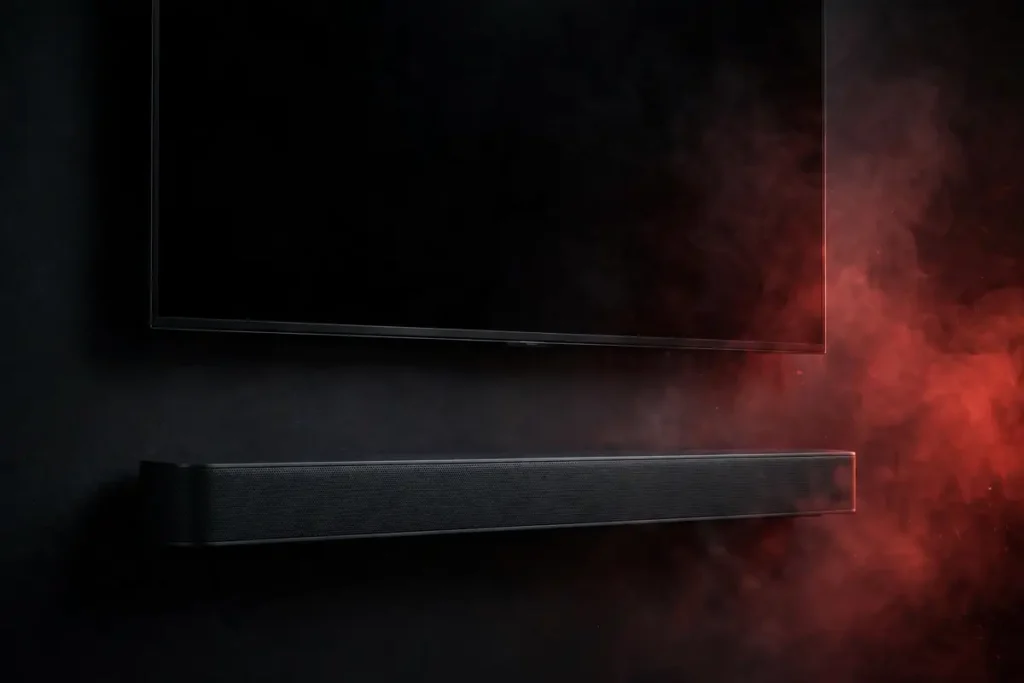
This KEF XIO review covers KEF’s first soundbar, the XIO (pronounced zee-oh), in its Slate Black listing on Amazon US, ASIN B0FHWTQ44W: a 5.1.2 Dolby Atmos and DTS:X bar with twelve drivers, including six Uni-Q MX coaxial drivers and four P185 racetrack bass drivers, driven by 820W of Class D amplification. It is a flagship one-box system with streaming built in and an optional subwoofer output, and this review judges it on the questions flagship money raises: film immersion, music quality, bass without a sub, and whether the connectivity keeps up with the price.
A note on method. This is a research review, built from the manufacturer’s published specifications, the verified Amazon US listing for this exact model, and independent coverage. We have not had a unit on the desk, so nothing here claims hands-on testing, and speaker products on this site carry no scores.
The XIO is the soundbar for buyers who listen to music as much as films. Reviewers across the hi-fi and home cinema press land in the same place: dialogue clarity and musical detail are a step beyond most bars, the four bass drivers give it low-end weight that genuinely removes the need for a subwoofer in most rooms, and Atmos effects convince when the room suits them. The shortfalls are practical. One HDMI eARC port and an optical input are the whole wired story, there is no passthrough for games consoles, and the price overlaps full surround systems. In our best soundbars coverage it is the premium one-bar pick for music-first rooms. Check Price on Amazon

Why you: Twelve drivers including six Uni-Q MX coaxial units and four racetrack bass drivers, 820W of Class D amplification, and bass deep enough to skip a separate subwoofer.
Trade-off: It is priced against complete surround packages, offers a single HDMI eARC connection with no passthrough inputs, and its app and remote stay basic for the money.
KEF XIO specifications
| Spec | KEF XIO |
|---|---|
| Product | KEF XIO, Slate Black finish (Silver Grey also sold) |
| Channels | 5.1.2 with Dolby Atmos and DTS:X decoding |
| Drivers | Six 50mm Uni-Q MX coaxial drivers, two 50mm full-range drivers, four P185 (50 x 180mm) racetrack bass drivers |
| Amplification | Twelve Class D amplifiers, 820W total peak power |
| Output | Maximum 102dB; frequency response 34Hz to 20kHz as published by KEF |
| Inputs | HDMI eARC, optical; subwoofer output (wired, or wireless via the optional KEF KW2 receiver) |
| Streaming | Wi-Fi with AirPlay and Google Cast, Bluetooth 5.3, KEF Connect app with Intelligent Placement Technology room adaptation |
| Size and weight | 1210 x 70 x 165mm approx., 10.5 kg; tabletop or wall-mounted (orientation sensed automatically) |
Sound for film: clarity first, then scale
The Uni-Q idea, a tweeter at the centre of a midrange cone, is KEF’s signature in loudspeakers, and the miniaturised Uni-Q MX drivers carry it into a bar. The audible result reviewers keep reporting is focus: voices lock to the screen, dialogue stays intelligible at low volume, and effects place precisely rather than smearing across the front. A dedicated Dialogue mode helps further on quiet late-night viewing.
Bass is the surprise. Four racetrack drivers, two firing forward and two back, in force-cancelling pairs give the XIO low-end extension and control that one-bar systems rarely manage, and testers found film effects carrying the weight usually assigned to a separate subwoofer. Deep effects still cannot move air like a large standalone sub, and KEF provides a subwoofer output for owners who want one, but most rooms will not need it. Maximum output of 102dB fills a typical living room without strain.
Atmos height and surround effects are good rather than class-leading. The up-firing and side-spreading drivers build a convincing bubble in a regular room with a flat ceiling, and reviewers placed the XIO close to the best one-bar rivals for immersion while rating its tonal quality higher. Dedicated rear speakers still win for envelopment, which is the standing trade of every one-bar system, this one included.
Sound for music: where the XIO pulls ahead
Most soundbars treat music as a secondary input. The XIO treats it as a headline feature, with high-resolution streaming over Wi-Fi, AirPlay and Cast for multiroom grouping with other speakers, and a Direct mode that steps processing out of the way. Reviewers who tested it as a music system rated it the best they had heard from a soundbar, with the separation, timing and tonal balance of a decent pair of compact hi-fi speakers.
That matters because a soundbar at this level replaces a hi-fi in many homes. If the bar under your TV is also your main music system, the XIO’s premium buys daily returns rather than film-night-only gains. Buyers who already own a good stereo system should weigh that overlap honestly before spending flagship money twice.
Setup, app and the connectivity ceiling
Setup is one HDMI eARC cable to the TV, power, and the KEF Connect app. Intelligent Placement Technology senses whether the bar sits on a stand or hangs on a wall and which drivers should handle the centre channel in each orientation, then adjusts for nearby surfaces. The app adds EQ, bass and treble trim, and sound profiles for movie, music and dialogue. A small remote is included, and TV remote control over HDMI CEC covers daily volume.
The limits deserve plain words. There is a single HDMI input, the eARC port itself, with no passthrough, so consoles and disc players connect to the TV and the TV must pass their audio formats on. A few test reports described eARC and CEC handshake quirks with particular TVs, so buy with a returns window and test your exact set early. Expansion has grown through firmware since launch, including wireless surround options using KEF speakers and the KW2 receiver, but at launch the bar stood alone, and a full expansion adds serious cost on top of a flagship price.
Against the Sonos Arc Ultra and the Sennheiser Ambeo Soundbar Max, the XIO’s case is tonal quality and bass from one box. The Sonos counters with a mature multiroom ecosystem and the Sennheiser with sheer scale. Our best Dolby Atmos soundbar guide sets the three side by side.
Who should buy the KEF XIO
Buy it if you want one elegant bar that handles films properly and doubles as your main music system, with no subwoofer box on the floor. The sound quality per box is the best argument in the category.
Skip it if you need several HDMI sources plugged into the bar, plan a full wireless surround build on a budget, or want the deepest sub-bass a separate subwoofer gives. Each is better served elsewhere for this money.
Finish and placement deserve a line for a bar this size. At 1.21 metres wide it suits larger televisions, the fabric wrap in Slate Black or Silver Grey keeps it visually quiet under a screen, and the top surface carries only a small control area, so the bar reads as furniture rather than equipment. Check your TV unit depth before ordering: at 165mm deep it overhangs shallow shelves, and wall mounting needs the same care with cable routing for the eARC lead and power.
Frequently asked questions
Does the KEF XIO need a subwoofer?
For most rooms, no. Its four racetrack bass drivers reach a published 34Hz and reviewers found film bass convincing without one. A subwoofer output is provided, wired or via the optional KW2 wireless receiver, for owners who want more.
What does XIO mean and how is it pronounced?
XIO is the model’s name, pronounced zee-oh. It is KEF’s first soundbar, built around miniaturised Uni-Q MX coaxial drivers from its loudspeaker range.
Can the KEF XIO connect a games console or Blu-ray player?
Not directly. The XIO has one HDMI eARC port for the TV and an optical input, with no HDMI passthrough. Connect sources to the TV and let the TV pass audio to the bar over eARC.
Does the KEF XIO stream music?
Yes. It streams over Wi-Fi with AirPlay and Google Cast support, plus Bluetooth 5.3, controlled through the KEF Connect app. Reviewers rate its music playback as the strongest of any soundbar they have tested.
Can the XIO be wall mounted?
Yes. It works on a TV stand or flipped up for wall mounting, and its Intelligent Placement Technology senses the orientation and adjusts which drivers handle the centre channel and how the sound is tuned.

I am the founder of Sound Mavericks, where I provide the polite truth about audio equipment. I started this site because consumer electronics reviews are often too technical. Instead of using a silent lab, I test headphones, earbuds, and Bluetooth speakers in the real world – like on a noisy subway or in a busy coffee shop.
To stay independent, I buy my own review units (mostly from the United States) rather than accepting free gifts from brands. Once I finish testing a product, I sell it locally to our community. My goal is to help you understand sound quality, active noise cancellation (ANC), and battery life without the marketing hype.

