

This sony ult tower 7 review covers Sony’s current flagship party speaker, the SRS-ULT700, the tower that sits at the top of the ULT Power Sound line. It is a four-way system rated at 420W: a 280mm circular woofer for the low end, twin midrange drivers and four tweeters arranged to fire front and rear for what Sony calls 360-degree Party Sound. Around the drivers sits an event toolkit: XLR input and output, RCA in, microphone input, party lighting, wheels and handles, and a battery rated for up to 30 hours. This review judges it against the tower it replaces in spirit, the older Sony ULT Field 7 class of portable, and against JBL’s PartyBox flagships.
A note on method. This is a research review, built from the manufacturer’s published specifications, the verified Amazon US listing for this exact model, and independent coverage. We have not had a unit on the desk, so nothing here claims hands-on testing, and speaker products on this site carry no scores.
The ULT Tower 7 is Sony’s most complete party speaker, and completeness is the right word. The sound is genuinely omnidirectional, so the party hears the same balance from every side of the tower, the ULT modes let you choose between deep and punchy bass characters, and the input set, XLR in and out above all, lets the tower work as small event PA, not just a Bluetooth box. Tom’s Guide and StereoGuide both land on the same summary: bass authority with real room for nuance in the app EQ. For buyers choosing a flagship in our best Bluetooth speaker party coverage, this is the Sony to beat. It is also a genuine step over the XP700 generation it succeeds, with better battery life, the newer Auracast chaining and a lighting show that covers more of the cabinet. Check Price on Amazon
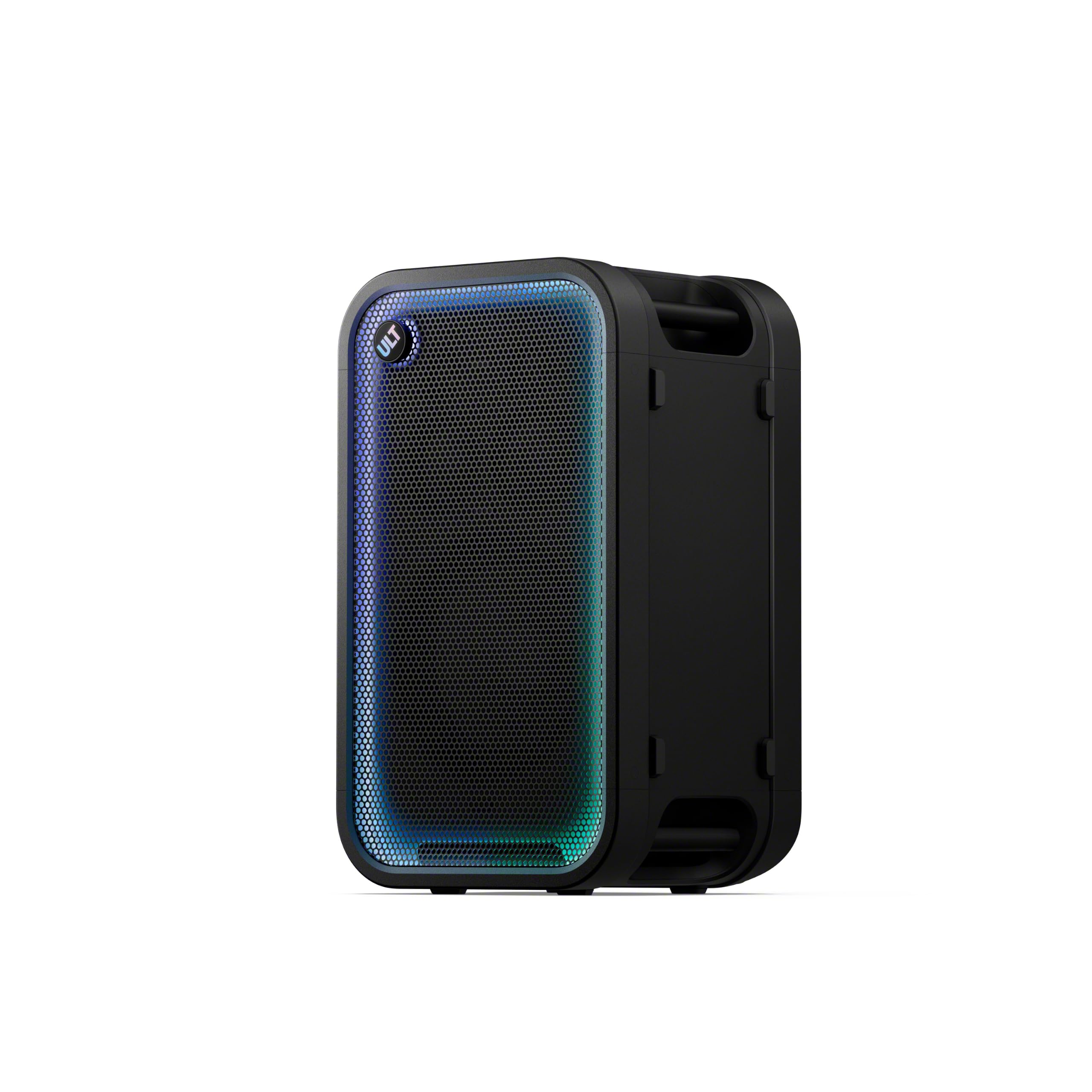
Why you: Sony’s current flagship party speaker: a 420W four-way system with a 280mm woofer, 360-degree sound, XLR input and output for chaining and events, plus up to 30 hours of battery.
Trade-off: At 22.8 kg it is a two-hands move despite the wheels and handles, its weather sealing is IPX4 splash resistance only, and Auracast chaining does not work with Sony’s older Party Connect speakers.
Sony ULT Tower 7 specifications
| Spec | Sony ULT Tower 7 |
|---|---|
| Product | Sony ULT Tower 7, flagship party speaker, model SRS-ULT700 |
| Output | 420W maximum; four-way system with 280mm woofer, 2 x 120mm midrange, 4 tweeters (front and rear) |
| Battery | Up to 30 hours with lighting off; about 15 hours with lighting on; 10-minute charge gives about 180 minutes of playback |
| Inputs | XLR input and output, RCA input, 6.3mm microphone input, USB-A and USB-C |
| Connectivity | Bluetooth 5.3 with SBC, AAC and LDAC; Auracast Party Chain links up to 100 compatible speakers |
| Sound modes | ULT1 deep bass, ULT2 powerful sound, FLAT and LIVE; 10-band EQ in the Sony Sound Connect app |
| Build | IPX4 splash resistant upright; 421 x 710 x 347mm; 22.8 kg; wheels and four handles |
Sound: everywhere, in both senses
The ULT Tower 7’s party trick is literal. Tweeters fire from the front and rear of the cabinet, so the sound wraps the tower and guests get a similar balance wherever they stand, which matters more at a real party than any spec on the box. The 280mm woofer delivers the low-end weight the ULT name promises, and the two ULT bass modes give it two characters: ULT1 digs deep for electronic music, ULT2 goes punchy and hard for impact, with FLAT and LIVE modes for everything else.
The consistent note in measured reviews is treble: the top end can turn sharp at high volume, and the fix lives in the Sony Sound Connect app’s 10-band EQ, where a small pullback on the highest band settles it. Bass gets the praise in every account, controlled for its size rather than boomy, and the system holds together at party volume in a way smaller towers cannot match. It is not a hi-fi speaker and does not pretend to be; it is a room-and-garden instrument.
Inputs and chaining: the event angle
Here is where the Tower 7 separates itself from the party-speaker pack. The XLR input takes a mixer, a DJ controller or a microphone properly, and the XLR output chains the feed to a second tower or a PA speaker, which makes a pair of Towers a genuine small-venue rig. RCA, USB and a 6.3mm microphone input cover the rest of the likely sources, karaoke included.
For wireless chaining, Auracast Party Chain links up to 100 compatible speakers, and Sony’s wording matters: compatible means the current Auracast generation. The older Party Connect speakers, including the previous XP700 generation, do not join, which is the one ecosystem complaint in owner coverage. Buyers building a multi-tower setup should check model compatibility before assuming a mixed Sony fleet will chain. The same generational split applies against JBL’s line, as our JBL PartyBox 710 review covers: ecosystems do not mix.
Living with 22.8 kg
The Tower 7 weighs 22.8 kg and stands 710mm tall. Sony’s answers are wheels and four handles, and they work: one person can roll it across a venue or a garden, and two people can lift it into a vehicle without drama. What it is not is portable in the casual sense. This is a speaker you bring out for an event and put away after, not one that rides along on a picnic.
Battery life is rated at up to 30 hours with the party lights off, closer to 15 hours with them on, and a 10-minute charge returns about three hours of playback, which rescues a forgotten charge before guests arrive. IPX4 sealing is upright-only splash resistance, fine for poolside placement and light rain, not a licence to leave it out in a storm.
Lighting, app and the details that matter at events
The party lighting runs the height of the cabinet and syncs patterns to the music, and at an evening event it does real work: the tower becomes the visual centre of the gathering, not just the audible one. The Sony Sound Connect app controls the lights, the EQ, the sound modes and the Auracast chain from one place, and a DJ or host can run the whole show from a phone.
Practical details hold up under scrutiny. The wheels roll well on hard floors and short grass, the handles are placed for a two-person vehicle lift, and the top panel keeps the main controls reachable when the tower stands among guests. The IPX4 rating asks for sense in bad weather, and the sheer size asks for storage space between events. Those are the terms of flagship party speakers generally; the Tower 7 simply delivers more for accepting them than most.
Who should buy the Sony ULT Tower 7
Buy it if you host parties and events regularly and want flagship output with sound that fills every direction, proper XLR inputs for DJs and microphones, chaining for bigger setups, and a battery that outlasts any single event.
Skip it if you need a speaker one person carries casually, if you already own older Party Connect towers you expect it to chain with, or if your gatherings are small enough that a mid-size party speaker covers them for far less money and weight.
Frequently asked questions
How long does the Sony ULT Tower 7 battery last?
Up to 30 hours with the party lighting off, and around 15 hours with the lighting on, depending on volume. A 10-minute charge adds roughly 180 minutes of playback.
Can the ULT Tower 7 connect to other speakers?
Yes, in two ways. Auracast Party Chain links up to 100 compatible current-generation Sony speakers, and the XLR output passes audio to another tower or PA speaker by cable. Older Party Connect models are not compatible with Auracast chaining.
Does the ULT Tower 7 have a microphone input?
Yes. It has a 6.3mm microphone input for karaoke and announcements, alongside an XLR input for mixers and microphones, RCA input and USB connections.
Is the Sony ULT Tower 7 waterproof?
It is IPX4 splash resistant when standing upright, so poolside splashes and light rain are fine. It is not rated for immersion or for use lying down in wet conditions.
What is the difference between ULT1 and ULT2?
ULT1 is Sony’s deep bass mode, emphasising low extension for electronic and bass-heavy music. ULT2 is the powerful sound mode, a punchier, harder-hitting character. FLAT and LIVE modes are also available, and a 10-band EQ in the app refines any of them.

I am the founder of Sound Mavericks, where I provide the polite truth about audio equipment. I started this site because consumer electronics reviews are often too technical. Instead of using a silent lab, I test headphones, earbuds, and Bluetooth speakers in the real world – like on a noisy subway or in a busy coffee shop.
To stay independent, I buy my own review units (mostly from the United States) rather than accepting free gifts from brands. Once I finish testing a product, I sell it locally to our community. My goal is to help you understand sound quality, active noise cancellation (ANC), and battery life without the marketing hype.

