
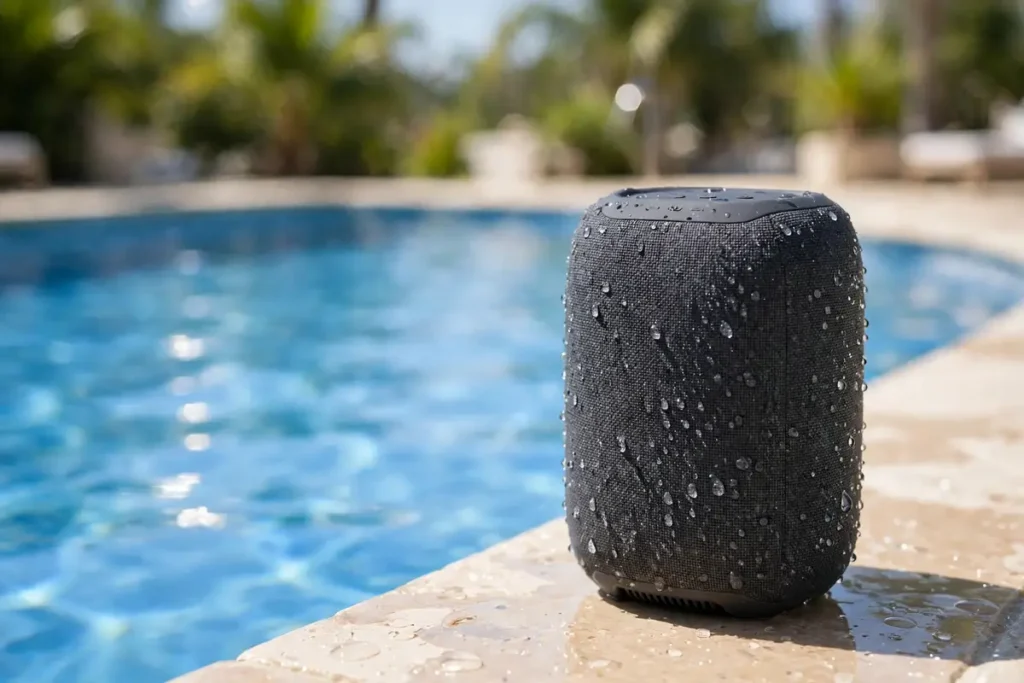
This jbl charge 5 review covers the original powerbank speaker, the Black variant of the model that made a phone-charging output a standard feature in portable speakers. The Charge 5 pairs a racetrack woofer and a separate tweeter for 30W RMS, seals the body to IP67, and runs up to 20 hours while topping up a phone from its USB port. It has since been succeeded by the model in our JBL Charge 6 review, and the two are compared head to head in our JBL Charge 5 vs Charge 6 comparison. This review judges the Charge 5 on its own merits, and on who should still buy it.
A note on method. This is a research review, built from the manufacturer’s published specifications, the verified Amazon US listing for this exact model, and independent coverage. We have not had a unit on the desk, so nothing here claims hands-on testing, and speaker products on this site carry no scores.
The Charge 5 remains an easy speaker to recommend because its formula has no weak leg. The sound is the classic JBL portable character: full, punchy and louder than the body suggests, with the separate tweeter keeping detail that single-driver rivals smear. IP67 sealing covers dust as well as dunks, the 20-hour battery is honest at real-world volumes, and the powerbank output has rescued more phones than any spec in this class. It earns its long-running place in our best Bluetooth speaker coverage, with one clear caveat about pairing generations covered below. It has also held its value in a way few portable speakers manage, because the design got the fundamentals right the first time: nothing about the sealing, the battery or the driver layout feels dated next to newer rivals. Check Price on Amazon

Why you: The model that defined its class: 30W of JBL sound, IP67 sealing, 20 hours of battery and a USB output that charges your phone, in a 0.96 kg body that still anchors JBL’s portable line.
Trade-off: It has been succeeded by the Charge 6, which adds a carry strap, longer rated battery and newer Auracast pairing the Charge 5’s PartyBoost cannot join, and it has no 3.5mm aux input.
JBL Charge 5 specifications
| Spec | JBL Charge 5 |
|---|---|
| Product | JBL Charge 5, portable waterproof speaker in Black |
| Output | 30W RMS: 20W racetrack woofer plus 10W tweeter, with dual passive radiators |
| Battery | Up to 20 hours (7500mAh); USB-C charging; USB-A powerbank output for phones |
| Waterproofing | IP67 dustproof and waterproof, immersion to 1 metre for 30 minutes |
| Connectivity | Bluetooth 5.1; PartyBoost stereo and multi-speaker pairing; no 3.5mm aux input |
| Weight | 0.96 kg |
Sound: the formula that defined the class
Two active drivers are the Charge 5’s advantage over the crowd of single-driver tubes. The racetrack woofer handles lows and mids while a dedicated 10W tweeter covers the top, and the dual passive radiators help the bass keep pace. The result is the sound this class is judged by: energetic, clear at distance outdoors, and composed at volumes where smaller speakers start to shout. Owners upgrading from the smaller JBL Flip 6 class get the same character with a clear step up in weight and stamina.
It is not a subtle speaker. The tuning favours presence and punch over flat accuracy, quiet acoustic detail is not its stage, and there is no app EQ to reshape it. Within its brief, music for a group outdoors, that tuning is the right call, and it is why the Charge line keeps its reputation.
Battery, powerbank and the IP67 brief
Twenty hours is the rated figure and, unusually for the category, a realistic one at moderate volume. The 7500mAh cell doubles as a powerbank through the USB-A output, which remains the Charge line’s signature: the speaker that keeps the music going also keeps the phone that feeds it alive. Charging is over USB-C, and the port layout keeps the powerbank output separate so both jobs can run at once.
IP67 is the complete rating: dust-tight as well as waterproof to a metre for half an hour. That combination is what makes the Charge 5 a genuine beach and worksite speaker rather than a splash-proof one. Sand, dust and a drop in the pool are all survivable, with the usual advice to rinse salt water off and dry the ports before charging.
Charge 5 or Charge 6: the pairing catch
The successor is better in the ways sequels usually are: the Charge 6 adds a removable carry strap, a longer rated battery life, faster charging and slightly more output. None of that makes the Charge 5 a bad buy, especially where street prices separate them, and our comparison works through the full split. The one difference that should steer a decision is pairing.
The Charge 5 pairs through PartyBoost, JBL’s older system. The Charge 6 moved to Auracast, and the two systems do not connect to each other. If your friends already run PartyBoost speakers, the Charge 5 joins them and the newer model cannot. If you are starting fresh, the Charge 6 is the future-proof choice. Everything else about the Charge 5, sound, sealing, battery and powerbank, still does the job it was bought for.
Durability and ownership notes
The Charge line’s reputation rests on surviving real use, and the Charge 5’s build supports it: a fabric-wrapped body that shrugs off scuffs, rubberised ends that take the knocks, and sealing that keeps dust out of the ports as well as water. Owners report the battery holding up over years of cycles, and the 7500mAh cell’s second job as a powerbank is the feature former owners mention most when they upgrade.
Two ownership details are worth knowing. The Charge 5 charges over USB-C but ships its value in the speaker, not the accessories, so keep a capable USB-C charger handy for faster top-ups. And because there is no aux input, a wired backup for a flat phone battery is not an option; the powerbank output is the intended answer to that problem, and in practice it works.
Pricing context matters for this model more than most. The Charge 5 launched as a premium portable and now sits below its successor in JBL’s own line, which means discounts appear often and the gap to the Charge 6 widens and narrows by the week. Judged at its launch price against the Charge 6, the newer model wins on features. Judged at the street prices the Charge 5 commonly reaches, the older speaker’s sound, sealing and battery make it the value pick of the pair, which is exactly the calculation our comparison article lays out.
Who should buy the JBL Charge 5
Buy it if you want the proven portable formula, strong sound, full IP67 sealing, a 20-hour battery and a phone-charging output, especially at a street price below its successor, or if your pairing group already runs PartyBoost speakers.
Skip it if you are starting a new JBL pairing setup, because Auracast models are the ones that will chain together going forward, or if you want a carry strap, the longest battery and the newest feature set, which is the Charge 6’s pitch.
Frequently asked questions
Is the JBL Charge 5 waterproof?
Yes. It is rated IP67, so it is dust-tight and survives immersion in up to a metre of water for 30 minutes. Rinse off salt water and sand, and let the ports dry fully before charging.
How long does the Charge 5 battery last?
Up to 20 hours of playtime from its 7500mAh battery, depending on volume. The battery also works as a powerbank: the USB-A output charges a phone while the music plays.
Can the Charge 5 pair with a Charge 6?
No. The Charge 5 uses JBL PartyBoost for stereo and multi-speaker pairing, while the Charge 6 uses Auracast. The two systems are not compatible, so pair Charge 5s with other PartyBoost models such as the Flip 6.
Does the JBL Charge 5 have an aux input?
No. The Charge 5 is Bluetooth-only for audio input, with USB-C for charging and a USB-A output for charging other devices. There is no 3.5mm input.
Is the Charge 5 still worth buying over the Charge 6?
For many buyers, yes. It offers the same class of sound, full IP67 sealing and a powerbank output, often at a lower street price. The Charge 6 adds a strap, longer rated battery and Auracast pairing, so new pairing setups should start there instead.

I am the founder of Sound Mavericks, where I provide the polite truth about audio equipment. I started this site because consumer electronics reviews are often too technical. Instead of using a silent lab, I test headphones, earbuds, and Bluetooth speakers in the real world – like on a noisy subway or in a busy coffee shop.
To stay independent, I buy my own review units (mostly from the United States) rather than accepting free gifts from brands. Once I finish testing a product, I sell it locally to our community. My goal is to help you understand sound quality, active noise cancellation (ANC), and battery life without the marketing hype.

