
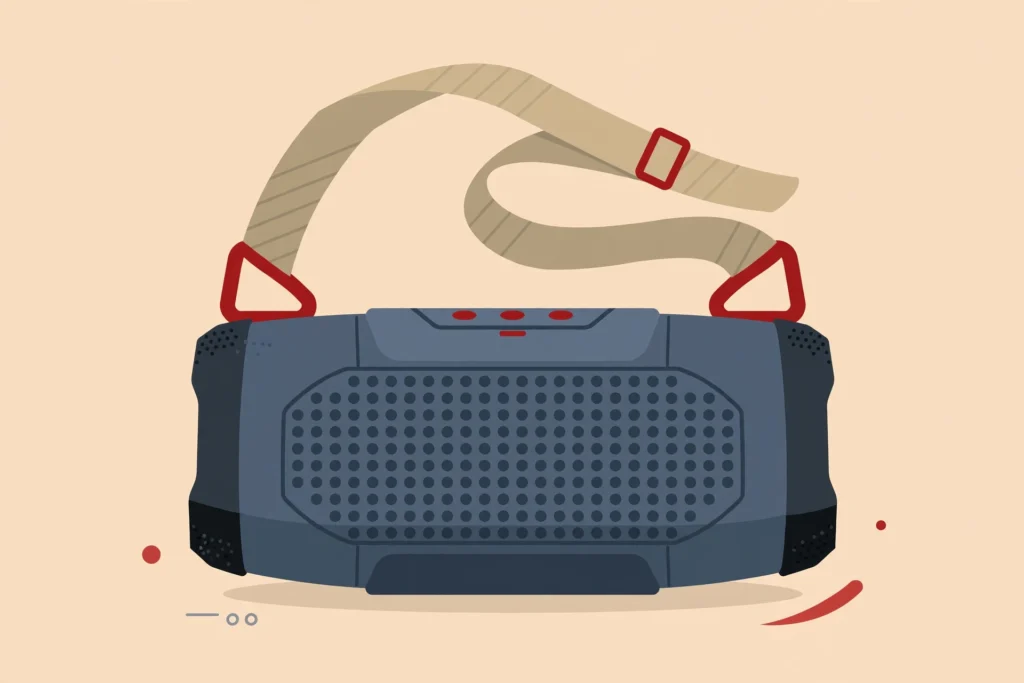
This JBL Xtreme 3 review covers the older generation of JBL’s largest personal portable: a 100W RMS speaker with four drivers, IP67 sealing, up to 15 hours of battery, and the shoulder strap that defines the Xtreme line. The range has moved on, and our reviews of the Xtreme 4 and Xtreme 5 cover the current models. The Xtreme 3 remains on sale and remains the value route into this size class, so the useful question is narrower than which is newest: what the older generation still does well, and what a buyer gives up by choosing it.
A note on method. This is a research review, built from JBL’s published specifications, the verified Amazon US listing for this exact model, and independent coverage. We have not had a unit on the desk, so nothing here claims hands-on testing, and speaker products on this site carry no scores. Battery and output figures are JBL’s published claims.
The Xtreme 3 is the point where JBL’s portables stop being pocketable and start being equipment: 100W RMS across four drivers, a cabinet sealed to IP67, and a strap that makes its 2.39 kg a shoulder carry instead of a hand carry. It plays louder and lower than the Charge class below it and asks far less carrying effort than the Boombox class above it. The compromises are generational. Bluetooth 5.1 and the feature set belong to its era, and the newer models in our JBL Xtreme 4 review and JBL Xtreme 5 review carry the updates. None of that erases the core case: while the Xtreme 3 stays in stock at older-generation money, it is the most output this line offers per unit of price. Check Price on Amazon

Why you: 100W RMS across two woofers and two tweeters, IP67 waterproofing and dustproofing, up to 15 hours of battery, and a shoulder strap that makes the size class practical to move.
Trade-off: It is an older generation: Bluetooth 5.1, no newer-model refinements, and a 2.39 kg carry that is a commitment compared with the Charge class below it.
JBL Xtreme 3 specifications
| Spec | JBL Xtreme 3 |
|---|---|
| Product | JBL Xtreme 3 portable Bluetooth speaker in black |
| Output power | 100W RMS total (2 x 25W woofers + 2 x 25W tweeters) |
| Drivers | Four drivers with dual passive radiators |
| Battery life | Up to 15 hours |
| Connections | Bluetooth 5.1, PartyBoost pairing, powerbank out |
| Extras | Carry strap with built-in bottle opener |
| Water rating | IP67 waterproof and dustproof |
| Weight | 2.39 kg (5.3 lb) |
The Xtreme shape is a wide cylinder with metal ends and a strap across the top. It is built to be slung over a shoulder, set down on grass or concrete, and left to play for a group.
Sound: the step up from the Charge class
The Xtreme 3 runs four drivers, two 25W woofers and two 25W tweeters, with passive radiators at the ends. Against the smaller Charge class in our JBL Charge 6 review, the gains are scale and headroom: more low-end weight, more volume before the sound strains, and a wider spread for a group spread out on a beach or a terrace.
It is still a portable, and the tuning still serves outdoor listening rather than a listening chair. Bass is present and confident, detail is good for the class, and no part of the presentation pretends to be a home speaker. Buyers who want this output with a calmer indoor balance should be looking at a different shelf of products entirely.
Battery, strap and the carry question
Up to 15 hours of battery covers a full day out with margin at realistic volumes, and the powerbank output tops up a phone from the same charge. The defining feature is the strap: 2.39 kg is heavy in a hand and ordinary on a shoulder, and the strap, complete with its bottle opener, is what makes this size class a take-anywhere speaker rather than a car-boot speaker.
PartyBoost pairing links the Xtreme 3 with other PartyBoost JBL models, including a second Xtreme for stereo. As with the rest of the line, pairing stays within the PartyBoost family.
Where it sits in the JBL line
The Xtreme class exists because of a gap in the range. Below it, the Charge speakers are one-hand portables built for a small group; above it, the Boombox models are handled boxes built for a crowd. The Xtreme is the largest speaker one person carries without thinking of it as equipment, and the strap is the feature that makes that true. Sound follows the same middle position: clearly more scale than a Charge, clearly less than a Boombox, and enough for the groups a day out actually gathers.
That middle position is why the model keeps selling across generations. Buyers who try a smaller portable and find it thin outdoors land here; buyers who price a Boombox and find it more than the job needs land here too. For how the class compares with the wider outdoor field, our best outdoor speakers guide lays the sizes and ratings side by side.
IP67: sealed against the day
IP67 means the cabinet is dustproof and survives immersion in a metre of water for half an hour. Rain, pool edges, sand and a knock into the shallow end are all inside the rating. The working habits are the standard ones for sealed speakers: rinse off salt water and sand, dry the cabinet before charging, and keep the port covers closed around water. The dust side of the rating earns its keep too, on sandy ground and dusty work sites where an open speaker slowly fills with grit.
The older-generation question
The Xtreme 4 and Xtreme 5 exist, they are covered on this site, and they carry the newer hardware and feature set. Nothing in this review argues the 3 is the better speaker in absolute terms. The case for it is arithmetic and availability: it is the older model, it sells for older-model money while stock lasts, and the fundamentals, output, sealing and battery, were already right in this generation. A buyer who wants the newest version of the line should buy it with a clear head; a buyer who wants the most speaker for the spend should check what the Xtreme 3 is selling for first. The whole range sits in our best JBL speakers roundup.
Who should buy the JBL Xtreme 3
Buy it if you want a big portable for groups, gardens and beach days, and the older generation’s pricing is in effect: the output, sealing and strap carry the same practical case they always did. Buy it if you will use the shoulder strap, because the carry system is half the design.
Skip it if you want the current model and its newer features, if 2.39 kg is more than you will carry, or if most of your listening is indoors at low volume, where the Charge class does the job for less and takes up less room.
Frequently asked questions
Is the JBL Xtreme 3 waterproof?
Yes. It is rated IP67, so the cabinet is dustproof and survives immersion in a metre of water for up to 30 minutes. Rinse off salt water and sand after outdoor use and dry it before charging.
How long does the Xtreme 3 battery last?
Up to 15 hours on JBL’s published figures. Sustained high volume lands below that, and charging a phone from the powerbank output draws from the same battery.
Should I buy the Xtreme 3 or the Xtreme 4?
The Xtreme 4 is the newer model with the updated feature set, and our Xtreme 4 review covers it. The Xtreme 3 makes its case on price while stock lasts: its output, IP67 sealing and battery were already the strong points of the line. Choose on whether the newer features are worth the difference to you.
Can the Xtreme 3 charge a phone?
Yes. The powerbank output charges a phone or similar device from the speaker’s battery, which is part of why the Xtreme class suits full days away from a socket.
Can the Xtreme 3 pair with other JBL speakers?
Yes, through PartyBoost, which links it with other PartyBoost JBL speakers, including a second Xtreme 3 for stereo. PartyBoost does not pair with speakers from other brands or with JBL’s older Connect systems.

I am the founder of Sound Mavericks, where I provide the polite truth about audio equipment. I started this site because consumer electronics reviews are often too technical. Instead of using a silent lab, I test headphones, earbuds, and Bluetooth speakers in the real world – like on a noisy subway or in a busy coffee shop.
To stay independent, I buy my own review units (mostly from the United States) rather than accepting free gifts from brands. Once I finish testing a product, I sell it locally to our community. My goal is to help you understand sound quality, active noise cancellation (ANC), and battery life without the marketing hype.

