
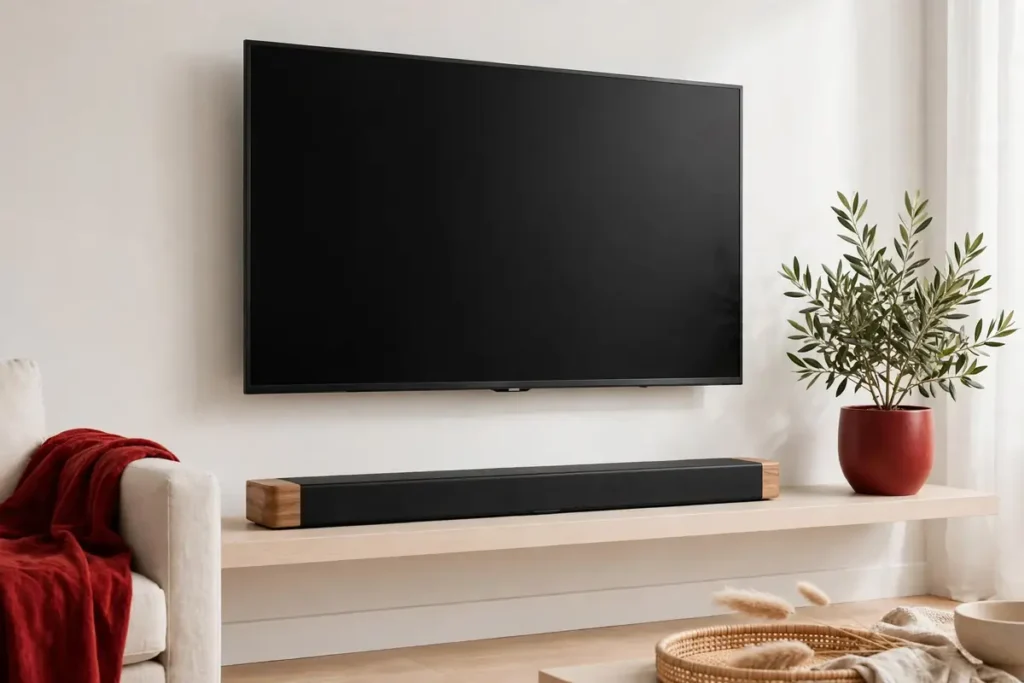
This Klipsch Flexus Core 100 review covers the entry soundbar in Klipsch’s Flexus line: a compact 28-inch bar with a 2.1-channel layout, two subwoofers built into the cabinet, virtualized Dolby Atmos and an expansion path that lets it grow into a surround system over time. The Flexus bars run on electronics engineered with Onkyo, and the Core 100 is the smallest of them, sized for smaller rooms, bedrooms and secondary TVs as much as for a main set. This review covers the bar-only Black listing on Amazon US under ASIN B0CV5ZMDYY. Klipsch also sells a bundle with a separate subwoofer under a different listing; that bundle is not the product covered here.
A note on method. This is a research review, built from Klipsch’s published specifications, the verified Amazon US listing for this exact model, and independent coverage. We have not had a unit on the desk, so nothing here claims hands-on testing, and speaker products on this site carry no scores.
The Core 100 is the soundbar for buyers who want a small bar now and a bigger system later. Its dual built-in subwoofers give it more low-end weight than most compact bars manage, the virtualized Atmos adds height and width cues to film and TV sound, and Flexus subwoofers and surround speakers can join it later. The limits follow from its size: built-in rather than separate-sub bass, processed rather than true height effects, and no Wi-Fi streaming. As a first step into the Flexus system it earns its place in our best soundbars coverage. Check Price on Amazon

Why you: A 28-inch bar with two 4-inch subwoofers built in, virtualized Dolby Atmos and Onkyo-engineered electronics, plus a wireless path to add Flexus subwoofers and surrounds later.
Trade-off: The Atmos effect is virtualized rather than produced by height drivers, and there is no Wi-Fi, so music streaming runs through the TV or Bluetooth.
Klipsch Flexus Core 100 specifications
| Spec | Klipsch Flexus Core 100 |
|---|---|
| Product | Klipsch Flexus Core 100, bar only, Black finish |
| Channels | 2.1 with virtualized Dolby Atmos |
| Drivers | 2x 2.25-inch aluminum cone drivers plus dual 4-inch built-in subwoofers |
| Power | 100W RMS system power (Klipsch specification, Onkyo-engineered) |
| Max acoustic output | 96.4 dB |
| Frequency response | 45 Hz – 20 kHz |
| Connections | HDMI eARC, optical, USB-C, Bluetooth; Klipsch Transport expansion for Flexus Sub 100/200 and Surr 100; no Wi-Fi |
| Dimensions | 28 x 3 x 5 in (711 x 76 x 127 mm) |
| Weight | 10 lb (4.54 kg) per Klipsch specification |
One honest footnote on the numbers. The Amazon listing for this bar states 150W maximum output power and a weight of 11 lb. Klipsch’s own specification sheet says 100W RMS and 10 lb, and the brand figures are the ones used in this review: a maximum-output figure and an RMS figure are not the same measurement, and the maker’s sheet is the safer source for both.
Two drivers and two subwoofers in one cabinet
Most compact bars put small full-range drivers in a slim cabinet and leave the bass to suggestion. The Core 100 splits the work properly. Two 2.25-inch aluminum cone drivers handle dialogue and the midrange, and two 4-inch subwoofers built into the same cabinet handle the low end, which is how Klipsch reaches a rated response down to 45 Hz without a separate subwoofer box on the floor.
The practical result is a bar that can sit under a smaller TV in a bedroom or a compact living room and still give film soundtracks some physical weight. It will not move air the way a separate subwoofer does, and Klipsch’s own expansion options exist precisely for owners who outgrow the built-in bass. As a one-box starting point, though, the driver layout is more serious than the size suggests.
Virtualized Atmos: what it can and cannot do
The Core 100 carries a 2.1 layout, so its Dolby Atmos is virtualized: processing widens the soundstage and adds height cues from the front drivers rather than bouncing sound off the ceiling from dedicated up-firing units. On film and TV material the effect is real but modest. Scenes gain width and a sense of space that plain stereo bars flatten, and dialogue stays anchored where it belongs.
Set expectations by the physics. A bar with true height channels and separate rear speakers, like the full systems in our JBL Bar 1300X review, places effects overhead and behind you in a way processing alone cannot copy. The Core 100’s version is an improvement on basic TV sound and standard stereo bars, not a substitute for a multi-speaker Atmos layout. Judged on what it actually is, the virtualization earns its place rather than overselling itself.
Bass, output and room size
Klipsch rates the bar at 96.4 dB maximum acoustic output, which is healthy headroom for the small and medium rooms this bar is built for. Dialogue clarity is the daily win: the dedicated driver layout and Klipsch’s horn-loaded design heritage both push voices forward, so late-night viewing at low volume still resolves speech without riding the remote.
Room size draws the honest boundary. In a large open-plan space, a 28-inch bar of any make is working against the room, and the Flexus answer is to add a Sub 200 and surrounds rather than to turn this bar up harder. In the rooms it is sized for, output is not the limiting factor.
The growth path: Flexus subs and surrounds
The Core 100’s strongest argument is what it can become. Through Klipsch Transport, the bar connects wirelessly to the Flexus Sub 100 and Sub 200 subwoofers and to Flexus Surr 100 surround speakers, so the system can grow in stages: bar first, subwoofer when the bass itch starts, surrounds when the room allows. Each addition is a separate purchase, which cuts both ways: the entry cost stays low, and the finished system costs more than buying a fixed bundle would have.
That staged path is the real difference between the Core 100 and a closed one-box bar. Buyers who know they will never add speakers should compare it against finished packages instead, including the compact Sony BRAVIA Theater Bar 6, which ships with its subwoofer in the box. Buyers who like upgrading in steps get a bar that does not become obsolete when they do.
Connections and controls
HDMI eARC is the main connection and the right one: it carries the full TV audio feed and lets the TV remote run the bar’s volume. Optical covers older sets, USB-C and Bluetooth handle direct sources and phone playback. What is missing is Wi-Fi, so there is no built-in streaming platform or multiroom audio; music reaches the bar through the TV’s apps or a Bluetooth connection from a phone.
The Core 100 sits below the Core 200 and Core 300 in the Flexus range, which add size and output above it. The step-up question is mostly about room size and how far you plan to take the expansion path. For a smaller room that will grow a subwoofer and maybe surrounds later, the entry bar is the rational start of the same system.
Who should buy the Klipsch Flexus Core 100
Buy it if your TV sits in a small or medium room, you want a clear step up from TV speakers today, and you like the option of adding a subwoofer and surrounds later without replacing the bar. It suits bedroom and second-TV setups especially well, where its 28-inch width fits stands that full-size bars overhang.
Skip it if you want true height-channel Atmos from day one, if built-in Wi-Fi streaming matters to you, or if you would rather buy one finished system with its subwoofer included and never think about expansion again.
Frequently asked questions
Does the Klipsch Flexus Core 100 have a subwoofer?
Yes, two of them, built into the bar: dual 4-inch subwoofers sit alongside the two 2.25-inch main drivers, which is how the bar reaches a rated 45 Hz low end without a separate box. If you want more, the Flexus Sub 100 and Sub 200 wireless subwoofers can be added later.
Does the Klipsch Flexus Core 100 support Dolby Atmos?
It plays Dolby Atmos content with virtualized processing from its 2.1 layout, widening the sound and adding height cues. It has no dedicated height drivers, so the effect is an enhancement over stereo rather than the overhead placement a system with up-firing or ceiling speakers produces.
Can you add surround speakers to the Flexus Core 100 later?
Yes. Through Klipsch Transport, the bar connects wirelessly to Flexus Surr 100 surround speakers and to the Flexus Sub 100 and Sub 200 subwoofers, so the system can grow from a single bar into a surround setup in stages.
Does the Klipsch Flexus Core 100 have Wi-Fi?
No. Its connections are HDMI eARC, optical, USB-C and Bluetooth. Music streaming runs through the TV’s apps over eARC or from a phone over Bluetooth.
What size TVs and rooms does the Core 100 suit?
At 28 inches wide and rated at 96.4 dB maximum output, it suits smaller TVs and small to medium rooms: bedrooms, dens and compact living rooms. Large open-plan spaces will want the Flexus subwoofer and surrounds added, or a bigger bar.

I am the founder of Sound Mavericks, where I provide the polite truth about audio equipment. I started this site because consumer electronics reviews are often too technical. Instead of using a silent lab, I test headphones, earbuds, and Bluetooth speakers in the real world – like on a noisy subway or in a busy coffee shop.
To stay independent, I buy my own review units (mostly from the United States) rather than accepting free gifts from brands. Once I finish testing a product, I sell it locally to our community. My goal is to help you understand sound quality, active noise cancellation (ANC), and battery life without the marketing hype.

