
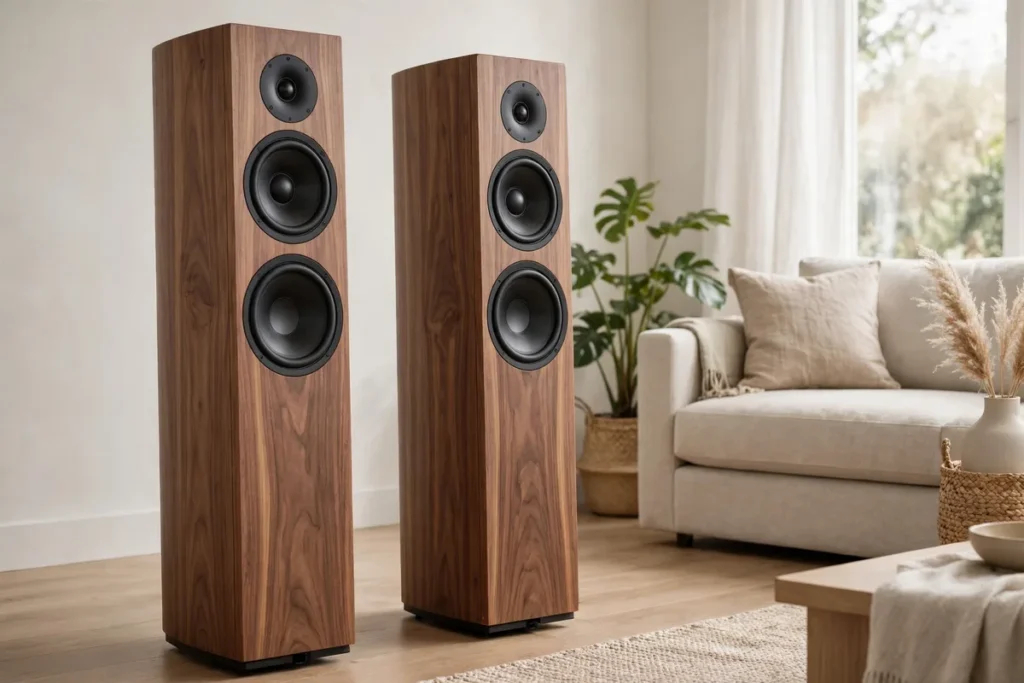
The best floorstanding speakers fill a room in a way no bookshelf model on stands quite matches: more cabinet volume, more drivers working in their comfort zones, and bass that reaches down without a subwoofer doing rescue work. This guide ranks seven towers across the roles people actually buy them for, from a sensitive Klipsch that plays loud on modest amplification to a budget ELAC that punches well past its size. Every pick below is a current model with a verified Amazon US listing.
One warning before the picks, because it catches more buyers than any spec does. Nearly every tower speaker is sold as a single speaker, not as a pair, and every pick in this list follows that rule. The listing you open buys one cabinet. Stereo means ordering two, and a home theater front stage means two towers plus a matching center. Each pick below states its unit basis in plain words so the real cost of a pair is never a surprise at checkout.
Best overall: Klipsch Reference Premiere RP-6000F II (sold as a single speaker): the horn-loaded tower that plays loud on almost any amplifier and handles music and film with the same energy. Check Price on Amazon
Best premium all-rounder: SVS Prime Pinnacle (sold as a single speaker): a three-way tower with triple woofers and a dedicated midrange, the smoothest and most even-handed sound in this list. Check Price on Amazon
Best for large rooms: Polk Monitor XT70 (sold as a single speaker): the biggest Polk in the XT line, with dual passive radiators that give big rooms real low-end weight. Check Price on Amazon
Best affordable home-theater tower: Polk Monitor XT60 (sold as a single speaker): the XT70’s smaller sibling, built to anchor a surround system without swallowing the room. Check Price on Amazon
Best budget pick: ELAC Debut 2.0 F5.2 (sold as a single speaker, listed as Each): three aramid woofers and a calm, accurate balance that hi-fi reviewers keep recommending. Check Price on Amazon
Best entry hi-res tower: Sony SS-CS3M2 (sold as a single speaker): a three-way, four-driver tower with hi-res certification, the easy starter for a Sony-based stereo or surround setup. Check Price on Amazon
Best starter tower: Polk T50 (sold as a single speaker): the long-running entry point to tower speakers, simple to drive and simple to place. Check Price on Amazon
How the seven compare
| Pick | Best for | Driver layout | Sold as |
|---|---|---|---|
| Klipsch RP-6000F II | Best overall | Horn tweeter, dual 6.5in woofers | Single speaker |
| SVS Prime Pinnacle | Premium all-rounder | Three-way, triple 6.5in woofers | Single speaker |
| Polk Monitor XT70 | Large rooms | Woofer plus dual 8in passive radiators | Single speaker |
| Polk Monitor XT60 | Home theater value | Woofer plus dual passive radiators | Single speaker |
| ELAC Debut 2.0 F5.2 | Budget hi-fi | Triple 5.25in aramid woofers | Single speaker (Each) |
| Sony SS-CS3M2 | Entry hi-res | Three-way, four drivers | Single speaker |
| Polk T50 | Starter tower | Woofer plus dual passive radiators | Single speaker |
What actually separates one tower from another
Three things decide whether a floorstanding speaker suits your room. The first is sensitivity. A sensitive design like the Klipsch reaches serious volume on the modest power of an entry AV receiver or a small stereo amp, while a less sensitive tower asks for more watts to reach the same level. If your amplifier is small, sensitivity is not a footnote, it is the shortlist filter.
The second is how the bass is made. Dedicated woofers in a ported cabinet, the Klipsch and ELAC route, give one kind of low end. Passive radiators, the Polk route, use unpowered cones moved by air pressure inside the cabinet, which extends bass from a smaller box and removes port noise. Neither is automatically better. Radiators tend to sound full at moderate volume, while big ported woofers keep their composure when a film soundtrack gets loud.
The third is the midrange. Three-way towers like the SVS and the Sony hand voices and instruments to a dedicated driver instead of asking a woofer to cover them, and dialogue clarity is usually where that shows. Two-way designs lean on careful crossover work to do the same job. For placement and amplification basics across the whole category, our best speakers guide covers the wider field, and our best soundbars guide is the honest alternative if floor space is the real constraint.
The best floorstanding speakers, pick by pick
Klipsch Reference Premiere RP-6000F II: best overall

Why you: The horn-loaded tweeter and dual 6.5-inch woofers make this the easiest tower here to drive loud, and its lively balance suits film soundtracks and rock as well as it suits acoustic music.
Trade-off: Sold as a single speaker, so budget for two. The forward, energetic top end is the Klipsch signature, and listeners who prefer a laid-back sound should look at the SVS or the ELAC first.
The second-generation Reference Premiere line fixed the old Klipsch complaint, a top end that could turn hard at volume, with a revised horn and vented tweeter that keep the energy and lose the edge. What remains is the reason people buy the brand: dynamics that make a modest receiver sound bigger than it is, and dialogue that stays forward in a mix.
Two 6.5-inch spun-copper woofers give it enough low end for music without a subwoofer in most rooms, and the rear port rewards a little distance from the wall behind it. Give it that space, toe it in slightly, and it anchors a stereo pair or the front of a surround system with equal confidence.
SVS Prime Pinnacle: best premium all-rounder

Why you: A true three-way design with a dedicated midrange driver and three 6.5-inch woofers delivers the most even, controlled sound in this list, with bass that stays tidy at volume.
Trade-off: Sold as a single speaker at the premium end of this list, and it wants a capable amplifier and some room to breathe behind its three rear ports.
SVS built the Prime Pinnacle as the flagship of its Prime line, and the engineering shows in the details: each woofer sits in its own sub-enclosure with its own port, so the three drivers do not fight each other, and the midrange driver handles voices without woofer duties muddying them. The result is a tower that measures flat and sounds composed, the pick for listeners who want accuracy over excitement.
It is also the most demanding speaker here. The ports need clearance from the wall, and the sensitivity is average, so a small amp will run out of headroom before the speaker does. Feed it properly and it covers music-first stereo and a full home theater front stage without a weak area.
Polk Monitor XT70: best for large rooms and home theater value

Why you: The largest tower in Polk’s XT line pairs its woofer with two 8-inch passive radiators, producing the kind of low-end weight that fills a big living room or an open-plan space.
Trade-off: Sold as a single speaker, and it is physically the biggest cabinet here. Small rooms will find it overpowering where the XT60 behaves.
Passive radiators are the XT70’s party trick. The two big unpowered cones move with the air pressure the woofer creates, extending the bass well below what the cabinet size suggests and doing it without the chuffing a hard-worked port can make. In a large room that translates to film soundtracks with real physical presence, no subwoofer required for a satisfying first system.
Polk voices the XT line a step calmer than Klipsch, which makes long film sessions easy to live with, and the matching XT center and bookshelf models make expanding into a full surround system straightforward. This is the value route to a big-room front stage.
Polk Monitor XT60: best affordable home-theater tower

Why you: The XT70 recipe in a slimmer cabinet: a 6.5-inch woofer with dual passive radiators and the same hi-res certified tweeter, sized for ordinary rooms and ordinary budgets.
Trade-off: Sold as a single speaker. Bass depth and output step down from the XT70, so very large rooms should step up rather than push these harder.
Most tower buyers have a normal-sized room, and the XT60 is the Polk built for exactly that. It keeps the family’s easygoing balance and radiator-assisted bass, trades away the XT70’s sheer output, and fits beside a TV stand without crowding it. As the front pair of a first surround system, matched with the XT center channel, it is hard to fault.
Music listeners get the same calm voicing, which flatters long sessions and older recordings. Anyone choosing between the two Polks should measure the room honestly: the XT60 is the right answer until the seating gets far from the speakers.
ELAC Debut 2.0 F5.2: best budget pick

Why you: Three 5.25-inch aramid-fiber woofers and a silk-dome tweeter deliver a balanced, accurate sound that budget roundups from What Hi-Fi onward keep singling out.
Trade-off: Sold as a single speaker (the listing states Each). Sensitivity is modest, so it prefers a real amplifier over a bargain receiver run at its limit, and the finish is plain.
The Debut line exists because a respected designer set out to prove how much accuracy a modest cabinet can hold, and the F5.2 is the floorstanding proof. Nothing about its presentation shouts. The balance is even, the soundstage is tidy, and recordings sound like themselves, which is exactly what a first serious stereo system should teach your ears.
The cabinet is braced properly for its class, and the three smaller woofers keep bass tight rather than boomy in smaller rooms. Pair it with a competent integrated amplifier and it will embarrass systems assembled with less care at higher cost.
Sony SS-CS3M2: best entry hi-res tower

Why you: A three-way, four-driver layout with a super tweeter for hi-res playback, in the current SS-CS3M2 generation, makes this the natural first tower for a Sony receiver-based system.
Trade-off: Sold as a single speaker. Bass is tidy rather than deep, so film-first setups will want a subwoofer sooner than with the big Polks.
Sony’s Core Series has been the default starter range for years, and this M2 generation carries the formula forward: a woofer, a midrange driver, a tweeter and a super tweeter that extends the top end for hi-res sources. The four-driver layout keeps dialogue clear at low volume, which matters in the apartment-sized rooms this speaker is aimed at.
It is voiced to pair with Sony’s own receivers and the rest of the Core Series, so building out to a full surround package later is a matching exercise rather than a research project. Buy it as the front pair of a growing system, not as a bass statement.
Polk T50: best starter tower

Why you: A 6.5-inch woofer with two passive radiators in a slim, easy-going cabinet: the simplest route from a soundbar or TV speakers to a real front stage.
Trade-off: Sold as a single speaker, and it is the oldest design in this list. Refinement and output both step up noticeably at the XT60, so buy the T50 for simplicity, not headroom.
The T50 has introduced more people to component audio than almost any tower of its era, and the reasons still hold. It is undemanding about amplification, forgiving about placement, and voiced warm enough that television and streamed music both sound pleasant straight away. The matching T-series center and bookshelves complete a surround system at the lowest sensible cost.
Its limits are equally clear. The cabinet and drivers are a generation behind the XT line, and critical music listening shows it. As a starter that will later move to surround duty when the fronts get upgraded, it remains a sensible buy.
Buying notes before you order two of anything
Every pick above is one speaker. A stereo pair is two orders, a front stage is two towers plus a voice-matched center, and the center matters more than the towers for film dialogue. Match the center to the tower brand and line wherever one exists, as timbre differences across the front three speakers are easy to hear and hard to fix later.
Leave room in the plan for the unglamorous parts: speaker cable, a few degrees of toe-in, and clearance behind rear-ported cabinets. None of the towers here needs exotic amplification, but the SVS and the ELAC both reward a receiver or amp with honest power. The Klipsch is the pick when the amplifier is fixed and small, because its sensitivity turns limited watts into real volume.
Frequently asked questions
Are floorstanding speakers sold in pairs?
Almost never at this level. Every pick in this guide is sold as a single speaker, and the ELAC listing states that plainly with the word Each. A stereo setup needs two, so multiply the listing by two before comparing against pair-priced alternatives.
Do floorstanding speakers need a subwoofer?
For music, most of these towers reach low enough to stand alone, and the Polk XT70 and SVS Prime Pinnacle are the strongest without help. For film, a subwoofer still adds the deepest effects channel content that no tower here reproduces at full level. Many owners start without one and add it later.
How much amplifier power do tower speakers need?
It depends on sensitivity more than on the speaker’s maximum rating. The Klipsch RP-6000F II plays loud on modest power thanks to its horn-loaded design. The ELAC F5.2 and SVS Prime Pinnacle are less sensitive and sound their best on a receiver or amplifier with solid, honest output.
How far from the wall should floorstanding speakers sit?
Rear-ported models like the Klipsch and the SVS sound best with roughly a foot or more of clearance behind them, pulled out until the bass tightens. Front-ported and radiator designs are more forgiving of near-wall placement, which is one reason the Polks suit tighter rooms.
Are towers better than bookshelf speakers on stands?
Towers give you more bass extension and output for the same footprint a stand already occupies, and they need no separate stand purchase. Bookshelf models can image beautifully in small rooms and cost less per pair. The room and the seating distance decide, not a rule.

I am the founder of Sound Mavericks, where I provide the polite truth about audio equipment. I started this site because consumer electronics reviews are often too technical. Instead of using a silent lab, I test headphones, earbuds, and Bluetooth speakers in the real world – like on a noisy subway or in a busy coffee shop.
To stay independent, I buy my own review units (mostly from the United States) rather than accepting free gifts from brands. Once I finish testing a product, I sell it locally to our community. My goal is to help you understand sound quality, active noise cancellation (ANC), and battery life without the marketing hype.

