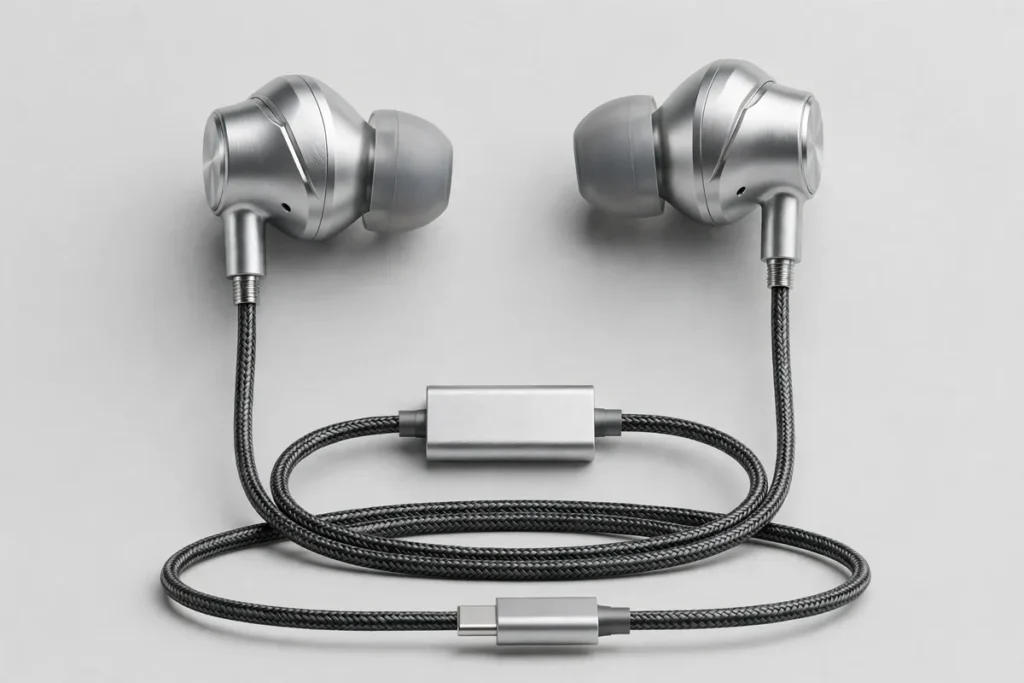
The Moondrop Position is a wired gaming in-ear monitor with its processing on the cable, not in the shells. A USB-C sound card module sits inline, carrying a DAC, DSP, stored EQ profiles and HRTF tuning, plus an AI noise-cancelling mic for team chat. Under that sits a single 10mm dynamic driver per side. This Moondrop Position review covers its specifications, release details and where to buy it. It launched on November 8 and is listed on Amazon US.
This is a research review: launch coverage built from Moondrop’s published specifications and retailer listings. We have not used a set ourselves, so there is no hands-on verdict and no score from us. Tuning and latency claims below are the brand’s.

Launch briefing On Amazon US
Why you: the DSP lives on the cable, so EQ profiles and HRTF tuning travel with the set between PCs, and the AI mic cleans up callouts. Wired: no battery, no wireless lag.
Trade-off: the processing only works over USB-C. On the 3.5mm plug it is a regular wired IEM with a mic, voiced for positional cues, not relaxed music listening.
10mm Al-Mg dynamic driverUSB-C DSP sound cardAI noise-cancelling mic
Moondrop Position quick facts
| Product | Moondrop Position wired gaming in-ear monitor |
| Price | $34.99 |
| Release status | Launched November 8; on sale now |
| Amazon US | Listed on Amazon US (silver and black versions) |
| Driver | 10mm aluminium-magnesium alloy dome composite dynamic driver |
| Sound card | Inline USB-C module, 24-bit decoding, second-generation DSP, stored EQ |
| Microphone | AI noise cancelling, running on an embedded NPU (Moondrop’s description) |
What the Position is
Moondrop already sells a gaming IEM, the Rays, built with a hybrid driver setup. The Position is the entry model in that gaming range: one dynamic driver per side, a detachable 0.78mm two-pin cable, and the processing moved into an inline module. The shells end in a standard 3.5mm four-pole CTIA plug with a microphone, and the USB-C sound card module adapts that cable for PCs, phones and handhelds with a USB-C port.
The driver is a 10mm unit with an aluminium-magnesium alloy dome and a composite surround. At 18 ohms with 119 dB/Vrms sensitivity it will run loudly from anything, which matters for a set aimed at controllers, handhelds and laptop sockets as much as desktop PCs.
The sound card on the cable
The module is the product. It carries a DAC that decodes 24-bit audio and a second-generation interactive DSP that applies Moondrop’s EQ profiles on the cable itself, with the settings stored on the module. Plug into a different machine and your tuning comes with you, with no software to install and no settings to rebuild.
Moondrop says the profiles were tuned with professional esports players and include per-game variants, with named profiles for titles such as Delta Force, Valorant, Apex Legends and CS:GO. The HRTF processing is meant to place footsteps and reloads around the player rather than flat inside the head. The microphone runs AI noise cancellation on an embedded NPU, aimed at stripping keyboard and room noise out of voice chat, and Moondrop rates wired latency at under 5 ms. Those are the brand’s claims for a launch-week product; independent reviews will test them, and this page will link them as they appear.
Tuning and target sound
Moondrop’s stated target here is positional accuracy first. The Position is tuned for competitive play, where the useful information sits in footsteps, weapon handling and ability cues, and the HRTF layer does the spatial work that a plain stereo IEM cannot. That is a different brief from the house VDSF tuning on Moondrop’s music IEMs, and buyers should expect a gaming voicing rather than a relaxed all-rounder. For pure music listening at this money, the sets in the Also consider section below are the safer reads.
Moondrop Position full specifications
| Product | Moondrop Position |
| Price | $34.99 |
| Driver | 10mm aluminium-magnesium alloy dome composite diaphragm dynamic driver |
| Impedance | 18 ohms ±15% at 1 kHz |
| Sensitivity | 119 dB/Vrms at 1 kHz |
| Frequency response | 15 Hz to 38 kHz; effective 20 Hz to 20 kHz |
| THD | 0.5% or less at 1 kHz, 94 dB |
| Connector | 0.78mm two-pin, detachable cable |
| Interface | 3.5mm four-pole CTIA with mic, plus USB-C DSP sound card module |
| Sound card | 24-bit decoding; second-generation interactive DSP; onboard EQ memory; HRTF profiles |
| Microphone | AI noise cancelling on an embedded NPU (brand claim) |
| Latency | Under 5 ms wired (brand claim) |
| Colours | Silver; black |
Also consider
Three wired sets we have already reviewed and scored, each with its published SoundMavericks score from its own review. They are music-first IEMs, which is exactly the contrast: pick the Position for gaming features, or one of these for listening.

A balanced, honest tuning in a 4-gram shell you can wear all day, with two bass tunings from its dual-position ear tips. No microphone, though, so it is a listening set, not a gaming one.

One driver done properly, in stainless steel shells with swappable tuning nozzles. Moondrop has discontinued it, so remaining stock is marketplace supply; read it as the tuning benchmark in this family.

A 2DD + 4BA hybrid tuned close to a reference target, with imaging rated above its class. The shells are large and the low end is lean, and there is no mic on the stock cable.
Who the Position is for
Buy the Position if you play competitive titles on PC or handheld and want positional tuning and a clean mic without a full headset. It sits naturally inside our best IEMs for gaming coverage, and readers following the Chi-Fi launch lane can compare it with our Tanchjim Kasier review for a music-first launch at a higher price point.
Skip it if music is the main job: the gaming voicing and the DSP profiles are built for cues, and the music-first rivals above will serve a mixed library better. Skip it if your main device only has a 3.5mm socket, because the sound card module needs USB-C to do its work. And skip it if you want wireless; this is a wired set by design, with the battery-free trade that comes with that.
Where to buy the Position
The Position is on sale now. Amazon US lists both the silver version linked here and a black version, and specialist Chi-Fi retailers carry it as well.
Moondrop Position FAQ
When was the Moondrop Position released?
It launched on November 8 and is on sale now, including on Amazon US in silver and black versions.
How much does the Moondrop Position cost?
The US figure is in the quick facts box at the top of this page, and the Amazon listing shows live pricing.
How does the DSP sound card work?
The module sits inline on the cable and connects over USB-C. It decodes 24-bit audio and applies Moondrop’s EQ profiles and HRTF tuning on the module itself, with settings stored onboard, so the tuning travels with the set between devices.
Does the Moondrop Position have a microphone?
Yes. The cable carries a microphone with AI noise cancellation, which Moondrop says runs on an embedded NPU to clean up voice chat. It works on the 3.5mm plug as a standard CTIA mic and through the USB-C module.
Does the Position work with phones and consoles?
The USB-C module suits PCs, phones and handhelds with a USB-C port. The plain 3.5mm CTIA plug covers controllers and devices with a headphone socket, though the DSP features only run through the USB-C module.

I am the founder of Sound Mavericks, where I provide the polite truth about audio equipment. I started this site because consumer electronics reviews are often too technical. Instead of using a silent lab, I test headphones, earbuds, and Bluetooth speakers in the real world – like on a noisy subway or in a busy coffee shop.
To stay independent, I buy my own review units (mostly from the United States) rather than accepting free gifts from brands. Once I finish testing a product, I sell it locally to our community. My goal is to help you understand sound quality, active noise cancellation (ANC), and battery life without the marketing hype.