
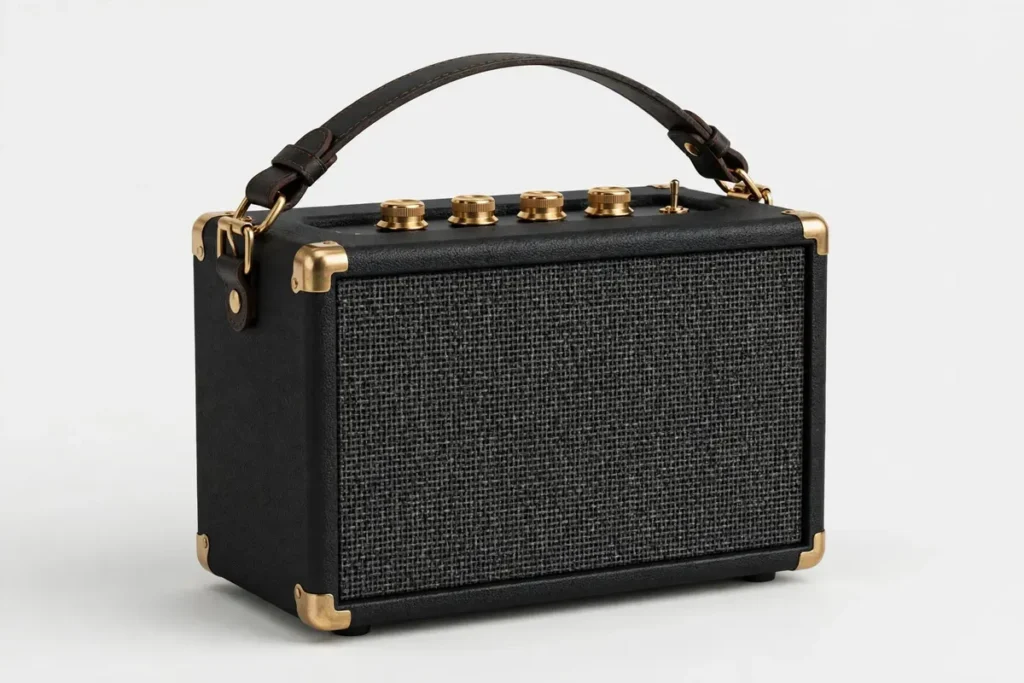
This Marshall Kilburn III review looks at the speaker Marshall clearly built for patios, kitchens and long weekends rather than for pockets. It is a mid-size portable with a 4-inch woofer and two full-range drivers, a claimed battery life past 50 hours, an IP54 dust and splash rating, and the full amp wardrobe: vinyl wrap, woven grille cloth, brass knobs and a guitar-style carrying strap. The Kilburn line has always sold the look first. The useful question is whether the third generation fixed the practical gaps that held the earlier models back: ordinary battery life, no weather rating worth the name, and a battery you could not replace. On the published specifications, it fixes all three. This review covers the Black and Brass finish, listed on Amazon US under ASIN B0F96FWCDF.
A note on method. This is a research review, built from Marshall’s published specifications, the verified Amazon US listing for this exact model, and independent coverage. We have not had a unit on the desk, so nothing here claims hands-on testing, and speaker products on this site carry no scores. Where a figure comes from Marshall’s own claims, such as the 50-plus-hour playtime, the article says so rather than presenting it as a measured result.
Buy the Marshall Kilburn III if you want one speaker that lives at home, moves to the patio, and survives a weekend away without a charger. The battery claim past 50 hours is the headline, backed by details owners actually feel: a user-replaceable battery, quick charging that returns about 8 hours from a 20-minute plug-in, physical knobs for volume, bass and treble, and sound that fires around the room instead of only forward. The trade-offs are size and sealing. At 2.8 kg it is a carry-to-a-spot speaker, and IP54 covers splashes, not a dunk in the pool. If your speaker needs to swim, look at the waterproof portables in our best Bluetooth speaker roundup. If it needs to fill a home and a garden with the amp look intact, this is the Kilburn that finally does the whole job. Check Price on Amazon

Why you: The battery runs past 50 hours on Marshall’s figures and can be replaced when it eventually fades, the 360-degree driver layout spreads sound around a room or patio, and the knobs on top adjust volume, bass and treble without opening an app.
Trade-off: IP54 is splash protection, not waterproofing, and at 2.8 kg with a strap it is built for carrying between rooms and into the garden, not for hanging off a backpack all day.
Marshall Kilburn III specifications
| Spec | Marshall Kilburn III |
|---|---|
| Product | Marshall Kilburn III, Black and Brass finish |
| Drivers | 1 x 4-inch woofer, 2 x 2-inch full-range drivers |
| Amplifiers | 30W Class D for the woofer, 2 x 10W Class D for the full-range drivers, 50W total |
| Frequency range | 45 Hz to 20 kHz |
| Battery life | 50+ hours, user-replaceable Li-ion battery |
| Charging | USB-C PD, about 3 hours to full, 20-minute quick charge gives about 8 hours, USB-C charge-out for phones |
| Water and dust rating | IP54, dust protected and splash resistant |
| Bluetooth | 5.3 with Auracast multi-speaker connection |
| Controls | Physical knobs for volume, bass and treble, Bluetooth pairing button, battery indicator |
| Dimensions | 273 x 169 x 150 mm (W x H x D) |
| Weight | 2.8 kg |
The Kilburn III also comes in Cream and Brown finishes. Every finish shares the same drivers, battery and controls, so the choice is purely about which one suits the room. The strap is fixed to the cabinet, and the top panel carries the brass control plate that gives the speaker its amp identity.
Design: the amp look, done properly
Marshall speakers live or die on whether the guitar-amp styling reads as craft or as costume. The Kilburn III is the convincing version. The cabinet is wrapped and stitched like an amp, the grille is a woven cloth rather than a stamped panel, the logo is a brass script badge, and the control plate on top uses knurled metal knobs that turn with real resistance. It looks like equipment, not like a toy wearing a costume.
The size matters for how it gets used. At 273 mm wide and 2.8 kg, this is roughly the footprint of a small guitar practice amp. The strap makes it easy to carry from a kitchen counter to a patio table, and that is the journey it is designed for. Nobody is clipping this to a bike bag; buyers who want that should look at the pocket-size models in our best Bluetooth speaker guide.
The control layout deserves credit. Volume, bass and treble each get a dedicated knob, so the two adjustments people actually make at a gathering, louder and more bass, happen on the speaker itself. There is no need to hand your phone to a guest or dig through an app beside the grill. A battery indicator on the top panel shows charge at a glance, which matters more on a speaker that runs for days between charges, because nobody remembers when they last plugged it in.
Sound: 360-degree spread from a three-driver layout
The Kilburn III uses what Marshall calls True Stereophonic sound. A 4-inch woofer handles the low end with its own 30W Class D amplifier, and two 2-inch full-range drivers, each on a 10W amplifier, are angled to spread the midrange and treble around the cabinet rather than firing it in one direction. The quoted frequency range starts at 45 Hz, which is a believable floor for a cabinet this size: bass guitar and kick drum have real weight, while the deepest electronic sub-bass sits beyond what a box of this volume can move.
The practical effect of the angled drivers is placement freedom. Most portable speakers sound best from one seat, directly in front of the grille. The Kilburn III is built to sit in the middle of a table or on a patio step and sound reasonably even from every side. That suits its job. This is a speaker for rooms and gatherings, where listeners move around, rather than a speaker for one person at a desk.
Marshall also includes Dynamic Loudness, which adjusts the low and high frequency balance as volume changes, so quiet evening listening keeps some body instead of thinning out. At the top end, 50W of total output fills a medium room or a patio without strain. It is not a party speaker for a field, and Marshall sells bigger boxes for that. Buyers comparing it with home-first speakers will find more candidates in our best wireless speakers roundup. For a single box that moves between the kitchen and the garden, the output is well judged.
Battery: the headline, and it holds up
The claim is more than 50 hours of playtime from a charge. Treat that the way you should treat every battery claim: it is measured at moderate volume with sensible settings, and loud outdoor use will take a share of it. Even allowing for that, the margin over the Kilburn II is the story. The older model managed just over 20 hours. The third generation more than doubles it, which changes the habit from charging after every long day out to charging when you happen to remember.
Two supporting features matter as much as the headline number. The battery is user-replaceable, so when the pack eventually fades after years of cycles, the speaker is not finished. That is a genuine ownership advantage over sealed rivals of a similar age, and it is still rare in this category. And charging is quick by portable standards: about 3 hours to full over USB-C PD, with a 20-minute top-up returning roughly 8 hours of playtime. The same USB-C port works in reverse as a powerbank output, so the speaker can rescue a dying phone at a campsite or a festival.
IP54: splash protection, stated plainly
The Kilburn III carries an IP54 rating. The 5 means dust gets in only in amounts that do not affect operation, and the 4 means splashing water from any direction is fine. Rain at a garden party, spray from a hose, a splash from the pool edge: all covered. Submersion is not. Drop it in the pool and the rating will not save it. Our guide to IP ratings breaks down what each digit promises if you are comparing it against IP67 rivals.
This is the one clear step down from the rugged end of Marshall’s own range. The Middleton II in the same family is rated IP67 and can survive a dunk. The Kilburn III trades that sealing for a bigger cabinet, longer battery life and the home-and-patio brief. As long as it is bought for that brief, the trade is sensible. As a beach speaker that will sit in wet sand and take waves, it is the wrong tool.
Connections and Auracast
Bluetooth 5.3 handles the wireless link, and the speaker supports Auracast, the broadcast standard that lets compatible speakers join the same stream. Our explainer on what Auracast is covers how it differs from classic stereo pairing. In practice it means the Kilburn III can join a multi-speaker setup with other Auracast models rather than being limited to a matched pair.
There is no Wi-Fi here, no voice assistant and no multiroom system. The Kilburn III is a Bluetooth speaker in the traditional sense: pair a phone, a tablet or a laptop and play. Buyers who want a speaker that joins a whole-home system should look at the Wi-Fi ranges instead. Buyers who want a speaker that works anywhere a phone works, including a field with no router for miles, are exactly who this design serves.
Kilburn III vs Kilburn II: what actually changed
The generational gap is unusually wide. Playtime rises from just over 20 hours to more than 50. The older model had only basic splash resistance with no formal rating worth quoting; the Kilburn III carries IP54. The battery becomes user-replaceable, charging moves to USB-C PD with a powerbank function and a 20-minute quick charge, and the driver layout adopts the 360-degree True Stereophonic arrangement with Dynamic Loudness. The cabinet keeps the same identity and roughly the same footprint, so an owner of the older model is upgrading the ownership experience, battery, durability and longevity, more than the styling.
For a new buyer the comparison is simpler. The Kilburn II still appears in listings at the budget end of Marshall’s range, but the third generation is the better buy in every practical respect. The price gap buys the battery, the sealing and the replaceable pack, and those are the things that decide whether a portable speaker is still in use in five years.
Who should buy the Marshall Kilburn III
Buy it if you want one good-looking speaker that covers a home and a garden, runs for days between charges, and can be maintained rather than replaced when the battery ages. It suits kitchens, patios, workshops, holiday rentals and anyone who hosts outdoors and dislikes running a cable across the floor.
Skip it if the speaker will live at the beach or poolside, where IP67 sealing matters more than battery life, or if you need Wi-Fi multiroom and voice control. Skip it also if portability means a jacket pocket. At 2.8 kg this is a speaker you carry to a place, then enjoy. Within that brief, it is the most complete Kilburn Marshall has made.
Frequently asked questions
How long does the Marshall Kilburn III battery last?
Marshall claims more than 50 hours of playtime from a full charge at moderate volume. Loud outdoor listening will reduce that figure. A full recharge over USB-C PD takes about 3 hours, and a 20-minute quick charge returns roughly 8 hours of playtime.
Is the Marshall Kilburn III waterproof?
It is rated IP54, which means it is protected against dust in working amounts and against splashing water from any direction. Rain and splashes are fine. It is not rated for submersion, so it should not be dropped in a pool or used in the shower.
Can you replace the Marshall Kilburn III battery?
Yes. The Li-ion battery is user-replaceable, which extends the working life of the speaker well beyond the point where a sealed battery would fade. The USB-C port also works in reverse, so the speaker can charge a phone in a pinch.
What is the difference between the Kilburn III and Kilburn II?
Playtime more than doubles, from just over 20 hours to 50-plus. The Kilburn III adds a formal IP54 rating, a user-replaceable battery, USB-C PD charging with a powerbank function and quick charge, plus the 360-degree True Stereophonic driver layout and Dynamic Loudness.
Does the Marshall Kilburn III have Wi-Fi or a voice assistant?
No. It is a Bluetooth 5.3 speaker with Auracast multi-speaker support. There is no Wi-Fi, no multiroom system and no voice assistant. It pairs with a phone, tablet or laptop and plays, including well away from any network.

I am the founder of Sound Mavericks, where I provide the polite truth about audio equipment. I started this site because consumer electronics reviews are often too technical. Instead of using a silent lab, I test headphones, earbuds, and Bluetooth speakers in the real world – like on a noisy subway or in a busy coffee shop.
To stay independent, I buy my own review units (mostly from the United States) rather than accepting free gifts from brands. Once I finish testing a product, I sell it locally to our community. My goal is to help you understand sound quality, active noise cancellation (ANC), and battery life without the marketing hype.

