

This JBL Go 5 review covers the smallest speaker in JBL’s portable range: a palm-sized Bluetooth speaker built around a single 45 mm driver, now sealed to IP68, drop-proof, and fitted with a USB-C port that plays lossless audio as well as charging the battery. It replaces the Go 4, and the upgrade list is longer than the size suggests. Output rises, Bluetooth moves to 6.0, stereo pairing gets a tap-to-pair shortcut, and the app gains AI-assisted tuning.
A note on method. This is a research review, built from JBL’s published specifications, the verified Amazon US listing and independent coverage of the Go 5. We have not had a unit in hand, so nothing on this page claims hands-on testing, and there is no score. Speaker verdicts here are in prose, based on the published hardware and how speakers of this size behave.
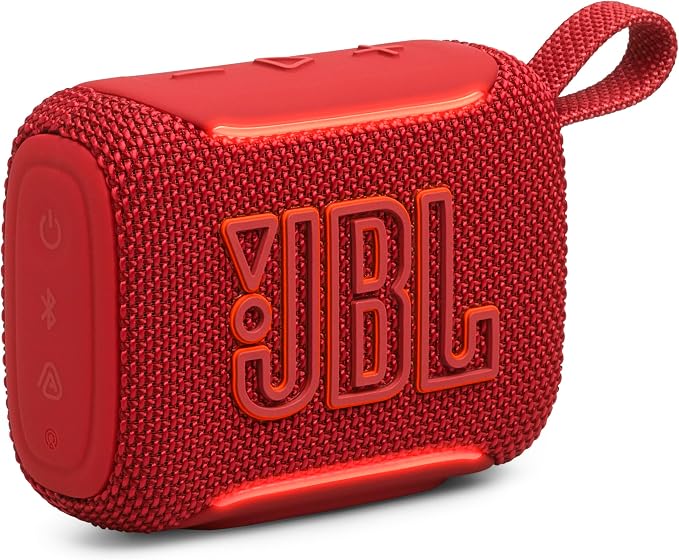
Why you: It is the toughest pocket speaker JBL makes. IP68 sealing covers dust and full submersion and the body is drop-proof, Bluetooth 6.0 brings Auracast and multipoint, and the USB-C port now plays lossless wired audio from a phone or laptop, which no earlier Go could do. Two speakers link in stereo with a tap.
Trade-off: One 45 mm driver sets the ceiling. The response starts at 87 Hz, so bass is a suggestion rather than a physical presence, and 8 hours of battery is a day out, not a weekend. It is a personal speaker, not a party speaker.
The short verdict: the Go 5 is the pocket speaker to buy when the speaker has to survive being dropped, soaked and stuffed into a bag. It sounds tidy at arm’s length, pairs in stereo with a tap, and the wired USB-C mode is a real step up for laptop and travel listening. Buy it for personal listening anywhere. Skip it if you need bass weight, group volume or multi-day battery.
JBL Go 5 specifications
| Product | JBL Go 5 ultra-portable Bluetooth speaker (Red) |
| Transducer | 45 mm full-range driver |
| Output power | 4.8 W RMS |
| Frequency response | 87 Hz to 20 kHz (-6 dB) |
| Rating | IP68 waterproof and dustproof, with a drop-proof build |
| Bluetooth | Version 6.0, A2DP 1.4 and AVRCP 1.6 profiles, Auracast multi-speaker connection and multipoint |
| Battery | Up to 8 hours of playtime, plus up to 2 more hours with Playtime Boost |
| Charging and wired audio | USB-C, about 3 hours for a full charge. The same port plays lossless wired audio through a built-in DAC |
| Dimensions | 101 x 77.4 x 43 mm |
| Weight | 0.23 kg |
| App | JBL Portable app: SmartEQ tuning, 7-band equalizer, settings and updates |
| Pairing | AirTouch tap-to-pair stereo with a second Go 5; Google Fast Pair on Android |
| Materials | Made in part with recycled plastic and recycled fabric |
| Where to buy | JBL Go 5 on Amazon US |
Design: a little bigger, a lot tougher
The Go 5 keeps the squarish pocket format of the Go line and grows slightly to pay for its tougher shell. At 101 x 77.4 x 43 mm and 230 grams it is a touch larger and about 40 grams heavier than the Go 4, and still small enough to disappear into a jacket pocket or a bag’s side pouch. The body uses recycled plastic with a fabric wrap, and an ambient light runs along the edge with selectable themes, so the speaker signals pairing and battery state with light as well as sound.
The important change is the protection. The Go 4 was IP67. The Go 5 moves to IP68 and adds drop-proofing, which suits how these speakers actually live: knocked off bathroom shelves, dropped on trails, left out in rain. Controls stay on the body, charging is over USB-C, and there is still no 3.5 mm socket. Wireless is the main route in, with one wired exception covered below.
Sound: honest output from one small driver
JBL rates the Go 5 at 4.8 W RMS from the same 45 mm driver size the Go 4 used, up from 4.2 W. The frequency response starts at 87 Hz, and that figure deserves the same honest reading as before: a driver this size in a sealed pocket enclosure cannot produce deep bass. What it can do is keep vocals clear, give acoustic music and podcasts a tidy, forward balance, and add a tight suggestion of low end rather than boom.
Volume suits a desk, a tent, a bathroom or a small group sitting close. It will not cover a garden party, and no speaker in this class will. The tuning tools are better this time. The JBL Portable app adds SmartEQ, which adjusts the sound automatically, alongside a 7-band equalizer for manual shaping. That is a wider set of controls than the Go 4 offered, and it lets you pull the treble back for spoken content or add presence for music played outdoors.
The USB-C port now plays music
The quiet headline feature is wired audio. On the Go 4, the USB-C port only charged the battery. On the Go 5, the same port accepts lossless audio from a phone, tablet or laptop through a built-in DAC. Wired playback sidesteps Bluetooth compression entirely, holds a stable connection on a plane or at a desk, and keeps playing while the battery charges.
For a speaker this small, that changes the use cases. It becomes a credible laptop speaker for calls and video, a travel speaker that works in airplane mode with a cable, and a backup for phones whose Bluetooth is busy elsewhere. The Go 5 also works with JBL’s EasySing Mic Mini, if karaoke from a pocket speaker is on your list.
Battery: 8 hours, plus 2 with Playtime Boost
JBL rates the Go 5 at up to 8 hours of playtime, up from about 7 hours on the Go 4. Playtime Boost adds up to 2 more hours by retuning the output for efficiency, giving a ceiling of about 10 hours. A full charge over USB-C takes about 3 hours from the same chargers and power banks you already carry for a phone.
That is a full day out, a long shift or an evening at a campsite. It is not a weekend off-grid, and the size of the cabinet is the reason. Buyers who need two or three days between charges should look at the larger Clip 5 or step up the range, and our roundup of the best Bluetooth speakers shows where the battery figures go from here.
IP68: what the rating covers
IP68 is the strongest sealing the Go line has carried. The 6 means the enclosure is fully dust-tight. The 8 means submersion protection beyond the IP67 level, at a depth and duration set by the manufacturer. Rain, sand, a drop in the sink and poolside splashes are all routine for it. Our guide to IP ratings explains each level in plain terms.
The drop-proof build matters as much as the water rating at this size, because pocket speakers fall. Two care notes still apply: rinse salt water and chlorine off with fresh water after swimming, and let the USB-C port dry fully before charging or playing over a cable.
Auracast, AirTouch and stereo pairing
Bluetooth 6.0 brings two pairing upgrades. AirTouch links two Go 5 speakers in stereo with a tap, one taking the left channel and one the right, which widens the sound far more than a second mono speaker placed nearby. Auracast handles the bigger setups, letting the Go 5 join other Auracast JBL speakers for combined playback. Our explainer on what Auracast is covers how the system works. Multipoint is also on board, so the speaker can stay connected to a phone and a laptop at once, and Google Fast Pair speeds up the first connection on Android.
Stereo pairing remains the smart upgrade path for this line. One Go 5 is a personal speaker. Two become a small travel stereo that still splits into two pocket speakers the rest of the time.
Go 5 vs Go 4 vs Clip 5
The Go 5 replaces the Go 4, which we covered in our JBL Go 4 review. The Clip 5 is the next step up in the family, with a carabiner and a bigger battery, and our Go 4 vs Clip 5 comparison works through that end of the range.
| Model | Output | Battery | Bluetooth | Weight |
| JBL Go 5 | 4.8 W RMS | 8 h, +2 h with Playtime Boost | 6.0 with Auracast | 230 g |
| JBL Go 4 | 4.2 W RMS | 7 h, +2 h with Playtime Boost | 5.3 with Auracast | 190 g |
| JBL Clip 5 | 7 W RMS | 12 h, +3 h with Playtime Boost | 5.3 with Auracast | 285 g |
Against the Go 4, the Go 5 wins on output, sealing, Bluetooth version and wired audio, and gives back about 40 grams and a little pocket space. Against the Clip 5, the Go 5 is the smaller carry. The Clip 5 plays louder, lasts half a day longer and clips straight onto a bag strap. Pick the Go 5 for a pocket. Pick the Clip 5 for a backpack.
What the Go 5 cannot do
Three limits are worth knowing. First, the sound is mono from a single small driver, so there is no stereo image and no deep bass from one unit. Second, the battery is a one-day battery; multi-day trips need a power bank. Third, there is no analogue input, so older players without Bluetooth or a USB-C audio output cannot connect.
None of these are faults at this size. They are the physics of a sealed 230 gram speaker, and they only matter if your use case runs into them.
Who should buy the JBL Go 5
Buy it if your speaker needs to live in a pocket or a small bag and survive drops, rain and the bottom of a gym kit. It suits travellers, shower and bathroom listening, desk use in small rooms, and laptop audio over a cable. The stereo pairing option makes it a sensible first half of a travel stereo.
Skip it if you host groups outdoors or want bass you can feel in your chest. Step up to the Clip 5 for more output and battery in a still-small body, or to one of the larger JBL portables if the speaker has to cover a room or a garden.
Frequently asked questions
Is the JBL Go 5 waterproof?
Yes. The Go 5 is rated IP68, which means it is fully dust-tight and protected against submersion beyond the IP67 level. It is also drop-proof. Let the USB-C port dry fully before charging after it gets wet.
How long does the JBL Go 5 battery last?
JBL rates the Go 5 at up to 8 hours of playtime on a charge. Playtime Boost adds up to 2 more hours, for a ceiling of about 10 hours. A full recharge over USB-C takes about 3 hours.
Can you pair two JBL Go 5 speakers together?
Yes. AirTouch links two Go 5 speakers in stereo with a tap, and Auracast lets a Go 5 join other Auracast JBL speakers for combined playback. Stereo pairing needs two speakers of the same model.
Can the JBL Go 5 play audio over USB-C?
Yes. The USB-C port accepts lossless wired audio from a phone, tablet or laptop through a built-in DAC, as well as charging the battery. Earlier Go models could only charge over the port.
What is the difference between the JBL Go 5 and Go 4?
The Go 5 raises output from 4.2 W to 4.8 W, improves sealing from IP67 to IP68 with drop-proofing, moves Bluetooth from 5.3 to 6.0, adds tap-to-pair stereo and SmartEQ, and gains lossless USB-C audio. It is slightly larger and heavier than the Go 4.
The Go 5 takes the pocket speaker formula and hardens it: stronger sealing, drop protection, modern Bluetooth and a USB-C port that finally plays music as well as charging. For personal listening on the move, it is the most complete Go yet. Check Price on Amazon

I am the founder of Sound Mavericks, where I provide the polite truth about audio equipment. I started this site because consumer electronics reviews are often too technical. Instead of using a silent lab, I test headphones, earbuds, and Bluetooth speakers in the real world – like on a noisy subway or in a busy coffee shop.
To stay independent, I buy my own review units (mostly from the United States) rather than accepting free gifts from brands. Once I finish testing a product, I sell it locally to our community. My goal is to help you understand sound quality, active noise cancellation (ANC), and battery life without the marketing hype.

