
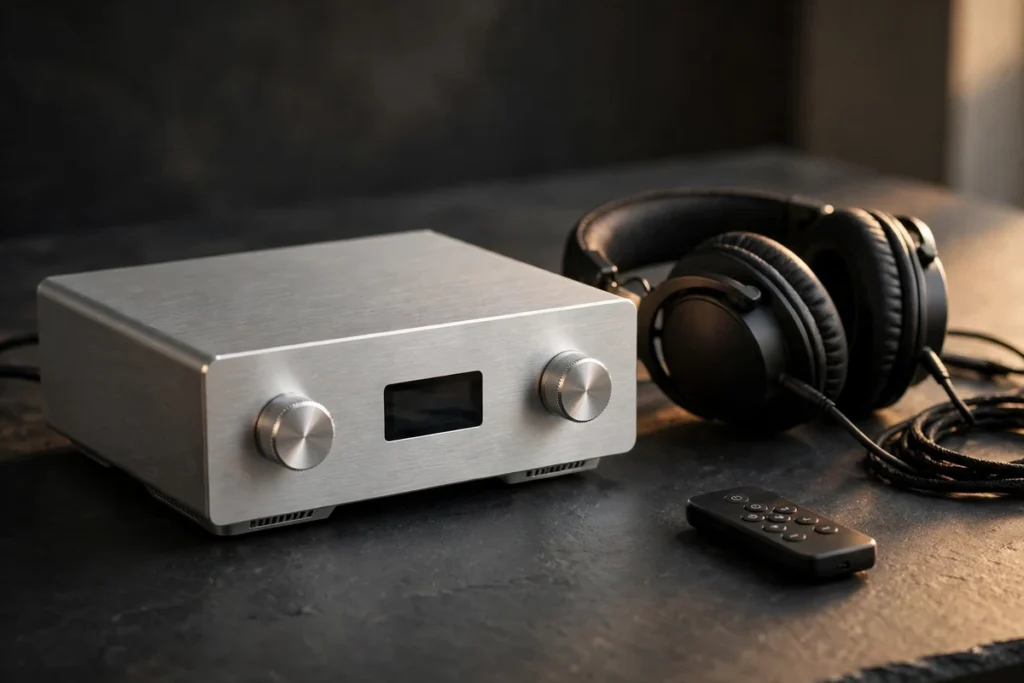
The Audiolab M-DAC+ is a desktop DAC, digital preamplifier and headphone amplifier that launched in 2016 as the bigger, better-equipped successor to the original M-DAC, one of the most awarded DACs of its decade. It is built around ESS’s Sabre32 9018 converter chip, takes seven digital inputs including an AES/EBU socket you rarely see at home level, and drives a power amp or active speakers from balanced XLR outputs, and feeds headphones too. Audiolab has since discontinued it, but new and used units still sell.
This review is built from Audiolab’s published specifications and the model’s long review record, including What Hi-Fi?’s five-star test and Alpha Audio’s measured group test, rather than our own bench time. The scores are provisional, research-based, and marked against the current desktop field, not the field of 2016.

Audiolab M-DAC+ 8.9/10 provisional
Why you: you want one compact box that converts, controls volume and feeds headphones or a power amp, with a measured, organised sound and a connection list most modern rivals still do not match.
Trade-off: it is a discontinued 2016 design. There is no Bluetooth, no streaming and no MQA, US stock is marketplace-only, and the last degree of attack trails the best current DACs.
ESS Sabre32 9018 · 32-bit/384kHz and DSD256 over USB · 7 digital inputs · Balanced XLR preamp outputs
What the M-DAC+ is
The original M-DAC arrived in 2011 and collected Product of the Year awards from What Hi-Fi?, Hi-Fi Choice and EISA. Audiolab calls it arguably the most critically acclaimed DAC component ever made; the award shelf behind the claim is real. The M-DAC+ followed in 2016 with a clear brief: keep the converter and the character, fix the limits. The chassis grew in every direction, the power supply moved inside the case, and the input list, output list and format support all expanded.
That makes the M-DAC+ three products sharing one front panel. It is a DAC for up to seven digital sources. It is a digital preamplifier whose volume control can drive a power amplifier or active speakers directly, its output switchable to fixed level if you already own a preamp. And it is a headphone amplifier with a 6.35mm socket on the front. The M-DAC+ was doing the full set before the category settled.
Sound: what the review record says
What Hi-Fi? gave the M-DAC+ five stars in 2016 and kept the verdict intact in its February 2025 update. Their listening notes return to the same strengths: a wide and believable soundstage, explicit placement of instruments, fine timbral detail and natural timing. It proved forgiving of low-bitrate files without softening hi-res material. Their one reservation is consistent too: a touch more drive and attack would complete the picture.
In Alpha Audio’s multi-DAC test, the M-DAC+ posted strong dynamic range, low noise and excellent channel separation, with a relaxed, neutral balance and a slightly leaner bass than the heaviest-hitting rivals. Its jitter figures trailed the best-measuring unit in that test. Read together, the record describes a DAC that organises music rather than exciting it, fractionally polite when a recording wants aggression. Our Sound Quality score of 9.2 reflects that record, held back from the top of our scale by the attack reservation and the jitter note.
The converter and the eleven filters
Audiolab kept the ESS Sabre32 9018 chip from the original and spent the development budget around it: a proprietary discrete master clock for jitter control, extensive time-domain isolation, and a JFET Class A analogue output stage after conversion. The supporting numbers still hold up. Total harmonic distortion is under 0.002%, signal-to-noise ratio is better than 115dB on RCA and 120dB balanced, and crosstalk beats 120dB single-ended and 130dB balanced.
Seven filters serve PCM files and four more serve DSD, eleven in total, each making small but real changes to the presentation. What Hi-Fi? settled on Optimal Transient XD for its balance of timing and organisation, with Minimum Phase as the tighter, punchier alternative.
Preamp mode and the headphone output
The preamp side is a genuine system component, not a bonus feature. Balanced XLR outputs deliver 4.5V RMS and the RCA outputs 2.25V RMS, both at low output impedance, so the M-DAC+ can sit between your digital sources and a power amp directly. Volume is controlled in the digital domain from the front knob or the remote, and a fixed-output mode hands level control back to an existing preamp or integrated amplifier. Our explainer on preamp vs amp covers when a source component like this can replace a separate preamp.
The headphone socket shares the Class A output stage, and What Hi-Fi? found the staging and detail retrieval even more apparent through capable wired headphones. Audiolab never published a power rating for the headphone output, so we score it on review evidence rather than a wattage figure. Owners run everything from sensitive IEMs to full-size planars from it, but demanding low-sensitivity planars are where a dedicated amplifier still earns its place.
Connections: the 2016 list, for better and worse
Few current desktop DACs match the input count. There are two coaxial and two optical inputs, an AES/EBU balanced digital input of the kind usually reserved for studio gear, a USB-B socket for a computer, and a USB-A socket that took a direct digital feed from iPhones and iPads of the era. Coaxial and optical digital outputs pass the signal onward. Format support peaks at 32-bit/384kHz PCM and DSD256 over USB, with 24-bit/192kHz on the S/PDIF and AES inputs.
The gaps are the era showing. There is no Bluetooth input, no network streaming, no MQA decoding and no app control. If you need wireless or streaming built in, treat that as a hard filter and look at the current field in our best DACs guide instead.
Build, display and remote
The case is a 247mm-wide slab of metal weighing 3.7kg, styled to match Audiolab’s 8300 series, with a central OLED display and two rotary knobs. What Hi-Fi? praised the build and finish at launch, and surviving units justify it: machined, weighty hardware from before streaming features started eating the component budget. A compact remote handles volume, input and filter selection from the chair. Black and silver finishes were offered; the US listing we verified is the silver version.
How it compares
Two products from our best DACs guide frame the M-DAC+ today. The FiiO K11 R2R is the modern desktop all-in-one: a resistor-ladder DAC with a far stronger headphone stage and a 9.1 overall score with us, but no preamp-grade balanced outputs and a third of the input count. Our R2R DAC explainer covers its conversion approach. The Schiit Modi+ is the minimalist alternative: a DAC and nothing else, scoring 8.9 on simplicity and value. The M-DAC+ sits between them in score and outside both in scope: neither rival can run a power amp, switch seven sources or filter-tune its output.
| Product | Type | Max format | Headphone output | Our score | Check Price |
|---|---|---|---|---|---|
| Audiolab M-DAC+ | DAC, preamp and headphone amp | 32-bit/384kHz, DSD256 | 6.35mm | 8.9 | Check Price |
 FiiO K11 R2R | DAC and headphone amp | 24-bit/384kHz, DSD256 | 6.35mm and 4.4mm | 9.1 | Check Price |
 Schiit Modi+ | DAC only | 24-bit/192kHz | None | 8.9 | Check Price |
Pick the M-DAC+ for system control: many sources, balanced preamp outputs and a remote. Pick the K11 R2R for headphone-first listening and ladder-DAC character with a warranty behind it. Pick the Modi+ if your system already has volume control and amplification covered. More one-box options sit in our headphone amp DAC combos guide.
Audiolab M-DAC+ specifications
| Product | Audiolab M-DAC+ Check Price |
| Type | Desktop DAC, digital preamplifier and headphone amplifier |
| DAC chip | ESS Sabre32 9018 |
| Maximum sample rates | 32-bit/384kHz PCM over USB; 24-bit/192kHz over coaxial, optical and AES/EBU; DSD64, DSD128 and DSD256 over USB |
| Digital inputs | 2 x coaxial, 2 x Toslink optical, 1 x AES/EBU, 1 x USB-B (computer), 1 x USB-A (iPod, iPhone, iPad) |
| Digital outputs | 1 x coaxial, 1 x Toslink optical |
| Analogue outputs | Balanced XLR at 4.5V RMS, unbalanced RCA at 2.25V RMS; variable or fixed level |
| Headphone output | 6.35mm socket on the front panel; Audiolab publishes no power rating for it |
| Output stage | JFET Class A, with a proprietary discrete master clock |
| Filters | 11 in total: 7 for PCM, 4 for DSD |
| THD | Under 0.002% (1kHz, 0dB, A-weighted) |
| Frequency response | 20Hz to 20kHz, ±0.2dB |
| Signal-to-noise ratio | Better than 115dB (RCA), better than 120dB (XLR) |
| Dynamic range | Better than 115dB (RCA), better than 120dB (XLR) |
| Crosstalk | Better than 120dB (RCA), better than 130dB (XLR) |
| Controls | Front-panel knobs and OLED display; remote control included |
| Finishes | Black or silver |
| Dimensions | 247 x 292 x 114mm (W x D x H) |
| Weight | 3.7kg |
Buying one now
Audiolab lists the M-DAC+ as discontinued, and that shapes the purchase. In the US it sells through marketplace listings rather than a dealer network; the Amazon listing behind the buttons here is the genuine M-DAC+ in silver, verified against the exact model on November 4, 2026, but stock through such listings comes and goes. Check the seller’s history, the returns terms and what warranty, if any, stands behind a discontinued unit before paying. UK availability of new old stock is steadier. None of that changes what the box does on your desk; it changes how carefully you should shop, and it is priced into our Value score.
A note on the scores
These marks are provisional and research-based, translated from Audiolab’s published figures, What Hi-Fi?’s five-star verdicts in 2016 and 2025, and Alpha Audio’s measured group test, on the same category scale as our best DACs guide. Features & Flexibility scores highest because the connection and preamp scope still outguns most of the current field. Value scores lowest for availability rather than performance: a discontinued model bought through marketplace sellers carries shopping risk that a current rival with a factory warranty does not. Fresh bench measurements would move these marks.
FAQ
Is the Audiolab M-DAC+ still worth buying?
Yes, if you buy it as what it is: a discontinued flagship-grade DAC and preamp whose sound and measurements still hold up, sold at used and old-stock prices. The performance case is strong. The shopping case needs care, because US availability is marketplace-only and warranty cover varies by seller. If you want Bluetooth, streaming or a factory warranty, buy a current model instead.
What is the difference between the M-DAC+ and the original M-DAC?
The M-DAC+ is bigger, with the power supply built into the chassis instead of hanging off a wall adapter. It adds DSD playback up to DSD256, raises USB support to 32-bit/384kHz, adds an AES/EBU input and a USB-A input for iPhones and iPads, and expands the filter bank from seven settings to eleven. The ESS Sabre32 9018 converter chip and the Class A output stage carry over from the original.
Can the M-DAC+ work as a preamp for a power amp or active speakers?
Yes. It is a digital preamplifier with volume control, balanced XLR outputs at 4.5V RMS and RCA outputs at 2.25V RMS, which is enough drive for power amplifiers and active speakers. The outputs can also be set to fixed level if you would rather use a separate preamp or an integrated amplifier’s volume control.
Does the M-DAC+ have a good headphone output?
The review record says yes. The 6.35mm socket runs off the same JFET Class A output stage as the line outputs, and What Hi-Fi? found the unit’s staging and detail even more apparent through capable wired headphones. Audiolab never published a power figure for the socket, so very demanding low-sensitivity planar headphones remain the case for adding a dedicated headphone amplifier later.
What file formats and sample rates does the M-DAC+ support?
Over USB it handles PCM up to 32-bit/384kHz and DSD at DSD64, DSD128 and DSD256 rates. The coaxial, optical and AES/EBU inputs accept PCM up to 24-bit/192kHz. There is no MQA decoding and no Bluetooth or network input, so hi-res streaming services reach it through a computer, phone or streamer connected by cable.
Is the Audiolab M-DAC+ discontinued?
Yes. Audiolab lists the model as discontinued, and What Hi-Fi?’s updated review notes the same. It remains on sale through marketplace listings in the US and new old stock in the UK, and the second-hand market is active. Budget for the possibility that a used unit has no warranty, and factor the seller’s returns policy into the purchase.
Verdict
The M-DAC+ is the rare decade-old component that does not need nostalgia to justify itself. The conversion is clean, the sound organised and spacious in a way reviewers kept confirming for ten years, and the box does three jobs, DAC, preamp and headphone amp, with an input list that shames most of the current field. What dates it is everything around the audio: no wireless input, no streaming, no app, and a discontinued badge that turns buying one into an exercise in seller-checking. As a desktop control centre for digital sources, it still earns its place. Our provisional score is 8.9 out of 10, with Sound Quality at 9.2.

I am the founder of Sound Mavericks, where I provide the polite truth about audio equipment. I started this site because consumer electronics reviews are often too technical. Instead of using a silent lab, I test headphones, earbuds, and Bluetooth speakers in the real world – like on a noisy subway or in a busy coffee shop.
To stay independent, I buy my own review units (mostly from the United States) rather than accepting free gifts from brands. Once I finish testing a product, I sell it locally to our community. My goal is to help you understand sound quality, active noise cancellation (ANC), and battery life without the marketing hype.

