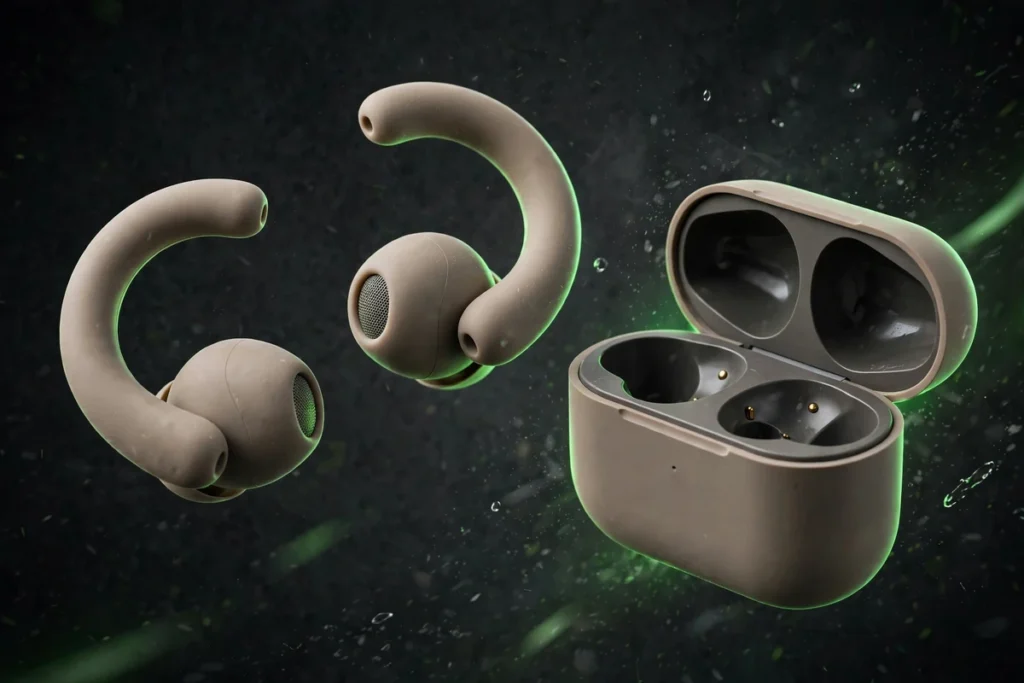
Bose has rebooted a name it retired years ago. The Bose Sport Open Earbuds that went on sale in the US on October 1, 2026 are not a reissue of the 2021 original — they are a ground-up redesign that swaps the old over-ear hook for a clip-on C-arm cuff, the same open-ear format Bose refined with its Ultra Open line. Announced on September 17, 2026, the new model is Bose’s fitness-first open-ear play: soft silicone cuffs, physical buttons, IP54 sealing and full situational awareness for runners and cyclists who refuse to seal their ears shut.
The distinction matters, because the two generations share a name and almost nothing else. The discontinued 2021 model — the one in our review of the original Bose Sport Open Earbuds — wrapped a rigid hook over the ear at 14 grams a side. The 2026 model clips on with a flexible cuff at roughly 5.9 grams a side. Same badge, different earbud.
Our Early Verdict
Bose has taken the open-ear design it proved on the Ultra Open and rebuilt it for training: lighter, tougher, sweat-sealed, with real buttons you can find mid-stride and a case that finally carries its own battery. The trade-offs are the honest ones the format demands — no noise cancelling and bass with a physical ceiling. For outdoor athletes, that trade is the entire point.
| Sound Quality (for open-ear) | 8.3 |
| Comfort & Fit | 8.8 |
| Battery Life | 8.0 |
| Call Quality | 8.2 |
| Features & App | 8.1 |
| Value | 8.2 |

How we are reviewing this one: the Sport Open Earbuds (2026) launched on October 1, 2026, and independent lab reviews are still emerging. This is a research-based launch review built from Bose’s published specifications and product documentation, launch coverage from Engadget, Notebookcheck and the5krunner, and the earliest owner reports. We have not trained in them, and we will not pretend otherwise. Our 8.4/10 is provisional — a spec-and-consensus score — and we will revisit it as long-term testing lands.
Bose Sport Open Earbuds (2026) Specifications
| Product | Bose Sport Open Earbuds (2026) |
| Design | Clip-on open-ear cuff (C-arm), soft silicone finish; polycarbonate and silicone construction |
| Audio technology | Bose OpenAudio with custom-designed drivers; no ear-canal seal |
| Noise cancelling | None — open-ear by design |
| Battery life | Up to 7 hours per charge; up to 29 hours total with the case (3.9 hours / 18.6 hours with Auto Volume on) |
| Charging | USB-C; wireless charging case; 10-minute quick charge adds up to 1.8 hours; full charge about 1 hour |
| Water and dust resistance | IP54 (sweat, splashes and dust; not for swimming) |
| Bluetooth | Bluetooth 5.4 with multipoint; Google Fast Pair; Google Find Hub support |
| Controls | Textured physical button on each bud (playback, calls, volume, shortcut); customizable in the Bose app |
| Microphones | 2 microphones with SpeechClarity voice isolation |
| App | Bose app — adjustable EQ (bass, midrange, treble), control customization, battery monitoring |
| Weight | Approx. 5.9g per bud; approx. 59g with case |
| Colors | Black, White Smoke, Eucalyptus Green (limited edition) |
| In the box | 2 earbuds, charging case, quick start guide, safety sheet |
| Buy | Check Price on Amazon |
Design and Fit: The Cuff Replaces the Hook
The 2021 original hung off the ear with a rigid loop. The 2026 model takes the format Bose proved with the Ultra Open Earbuds and makes it sportier: a flexible C-arm band curves around the outer ear and gently clips in place, with the driver barrel sitting outside the ear canal and a soft matte silicone finish over a polycarbonate core. At roughly 5.9 grams per bud it is less than half the weight of the 2021 hook design, and because nothing enters or seals the ear canal, there is no tip pressure, no plugged-ear feeling and none of the sweat-trap discomfort that makes sealed buds miserable on a long run.
Security is the whole design brief, and Bose is confident about it — the company says the cuff stays put through head shakes and fast, violent movement, up to and including cartwheels. The rounder hinge is shaped to grip harder than the fashion-led Ultra Open cuff during high-intensity work. Early owner reports largely back that up: runners describe the buds staying anchored through long runs, with a minority noting the cuff feels noticeable for the first session or two before they stop thinking about it. That short adjustment period is worth knowing about, but it is a very different complaint from buds that bounce loose mid-interval.
The fit also solves a problem sealed buds and hooks both struggle with: other gear. Because the cuff attaches to a part of the ear away from where glasses arms sit, Bose explicitly rates the design as compatible with most glasses, hats and piercings — a genuine practical win for runners who train in sunglasses and cyclists who wear both glasses and a helmet. Open-ear listeners who have bounced off hook designs for exactly this reason finally have a Bose option that works around their eyewear instead of fighting it.
Sound: OpenAudio, With Honest Expectations
The Sport Open uses Bose’s OpenAudio technology — the same approach as the Ultra Open line — with custom-designed drivers that fire sound toward the ear canal without sealing it. There is no bone conduction and no ear tip; the audio is directional air-conducted sound, and Bose directs it to keep leakage low, so at normal listening levels people nearby hear little to nothing. Early listening impressions from launch coverage and first owners converge on the same description: clear, balanced and surprisingly full for an open design, with vocals and podcasts cutting through cleanly outdoors.
Now the honest part, because open-ear physics does not negotiate. Without a seal, sub-bass has nowhere to build pressure, so the deep low end of a sealed sport bud is simply not available here — you get present, tidy bass rather than thump. Your music also competes with your environment by design: traffic, wind on a bike descent and a loud gym all share the channel with your playlist. Bose’s Auto Volume feature fights back by raising the level as ambient noise rises, and it works — but as the battery section shows, it costs you dearly in playtime. There are also no spatial or Immersive Audio modes on the Sport model, a deliberate omission that keeps the battery honest but separates it from the pricier Ultra Open (2nd Gen).
Judged inside its category rather than against sealed buds, though, the package is strong: Bose’s tuning pedigree is exactly what open-ear audio usually lacks, the adjustable EQ in the Bose app (bass, midrange, treble) lets you bias the signature toward podcasts or music, and the consensus so far is that this is among the cleaner-sounding open-ear implementations at this level. Buy it expecting the best version of open-ear sound, not an escape from its limits, and you will not be disappointed.
Battery, IP54 and Controls Built for Movement
Battery life is rated at up to 7 hours from the buds, and the wireless charging case adds a further 22 hours for up to 29 hours in total — a major generational jump, because the 2021 model’s carry case held no charge at all. Read the fine print before a long training block, though: with Auto Volume switched on, Bose’s own figures drop to 3.9 hours per charge and 18.6 hours total. The quick-charge numbers are genuinely useful for athletes — 10 minutes in the case returns up to 1.8 hours of playback — and a full bud charge takes about an hour over USB-C. The case itself has a translucent, textured lid designed to be grippable with sweaty hands.
The IP54 rating splits into dust protection (the 5) and resistance to water splashes from any direction (the 4). In practice that means sweat, rain and gym grime are non-events, and it is a step up from the 2021 model’s IPX4. What it does not mean is swimming: these are not waterproof earbuds, and they should stay out of the pool and the shower.
Controls deserve special praise because Bose made the unfashionable, correct choice: physical buttons. Each bud carries a textured button on top of the barrel, findable by touch with gloves or sweaty fingers, handling play, pause, track skip, calls and volume (a press followed by a press-and-hold ramps volume down on the left bud, up on the right). Anyone who has jabbed at a touch panel mid-run knows why this matters. Calls run through two microphones with SpeechClarity voice isolation, and early owner feedback rates call clarity highly. Bluetooth 5.4 with multipoint lets the buds hold a phone and a watch or laptop at once, Google Fast Pair speeds up Android setup, and Find Hub support helps if a bud goes missing.
2026 vs 2021: What Actually Changed
Because the name is identical, the generational gap is easy to undersell. It is not a refresh — nearly every line of the specification moved:
| Sport Open Earbuds (2026) | Sport Open Earbuds (2021) | |
|---|---|---|
| Fit design | Clip-on C-arm cuff around the outer ear | Rigid hook over the top of the ear |
| Weight per bud | Approx. 5.9g | 14g |
| Water resistance | IP54 (dust and splashes) | IPX4 (splashes only) |
| Battery | Up to 7 hours; up to 29 hours total with charging case | Up to 8 hours; carry case held no battery (charging base) |
| Bluetooth | 5.4 with multipoint | 5.1, single-device |
| Case charging | USB-C and wireless charging | Charging base |
| Buy | Check Price on Amazon | Discontinued — see our 2021 review for the full record |
The one line that moved backwards is single-charge playtime — 7 hours against the old model’s 8 — and it is the right trade: the 2021 buds needed their charging base to refuel at all, while the 2026 case carries more than three full recharges in your gym bag. Add multipoint, a higher ingress rating, glasses-friendly fit and less than half the weight, and the reboot earns its name.
Who the Sport Open Earbuds (2026) Are For
Buy them if you run or ride outdoors and treat awareness as a safety feature, not a compromise. Hearing traffic, other riders and your training partners while your music plays is the entire case for this product, and the cuff fit, IP54 sealing and real buttons make it the most training-focused open-ear bud Bose has built. Our roundup of the best running headphones is where it now has to be measured — on launch evidence, it belongs in that conversation. Glasses wearers, hat wearers and anyone whose ears hate silicone tips are also squarely in the target audience.
Buy sealed buds instead if your listening happens on planes, trains or loud commutes, where an open design’s awareness becomes a liability and its sound gets drowned out. The same goes for bass-first listeners: no open-ear bud, Bose included, will give you the low-end pressure of a sealed sport bud with ANC. And if you love the open-ear idea but want it as an all-day lifestyle product — spatial audio, cinema modes, a more premium finish — Bose’s own Ultra Open Earbuds (2nd Gen) are the step-up in the same family, with the Sport model the leaner, tougher, training-specific tool.
Bose Sport Open Earbuds (2026) FAQ
Are the 2026 Bose Sport Open Earbuds the same as the 2021 model?
No. Despite sharing a name, the 2026 model is a complete redesign. The 2021 original used a rigid hook over the top of the ear, weighed 14g per bud, carried an IPX4 rating and shipped with a carry case that held no battery. The 2026 model clips on with a flexible C-arm cuff at about 5.9g per bud, is rated IP54, adds multipoint Bluetooth 5.4, and its case carries the total battery to up to 29 hours.
Do the Bose Sport Open Earbuds (2026) have noise cancelling?
No, and that is deliberate. They are open-ear earbuds: nothing seals your ear canal, so you hear traffic, training partners and your surroundings alongside your music. There is no ANC and no transparency mode, because your ears are simply open. If you need isolation for flights or commuting, choose a sealed noise cancelling model instead.
How long does the battery last?
Up to 7 hours per charge, and up to 29 hours in total with the wireless charging case. One catch: with Auto Volume enabled, Bose rates the buds at 3.9 hours per charge and 18.6 hours total. A 10-minute quick charge adds up to 1.8 hours of playback.
Can I wear them with glasses or a helmet?
Yes. The cuff clips to a part of the ear that sits clear of where most glasses arms rest, and Bose states the design does not interfere with most glasses, hats or piercings. That makes them unusually practical for runners who train in sunglasses and for cyclists wearing glasses under a helmet.
Can I swim or shower with them?
No. The IP54 rating protects against sweat, rain and splashes, and dust — it is not a waterproof rating. Keep them out of the pool and the shower, and look at a dedicated waterproof model if your training is in the water.
Do they work well for phone calls?
They are built for it: two microphones with SpeechClarity voice isolation are designed to keep your voice clear while you are moving, and the physical buttons make answering, declining and ending calls easy mid-workout. Early owner reports rate call quality as a strength.
The Bottom Line
The 2021 Sport Open Earbuds were an interesting idea executed awkwardly — heavy, hooky and stranded without a charging case. The 2026 reboot fixes every one of those complaints and adds the things five years of open-ear development taught the industry: a lighter clip-on cuff, IP54 sealing, multipoint, a wireless charging case and buttons that work at mile nine. What it cannot fix is physics, and Bose does not pretend otherwise: no ANC, no sub-bass pressure, sound that shares the road with you. Our provisional 8.4/10 reflects the strongest sport-specific open-ear package Bose has made — pending the long-term testing that will confirm whether the cuff stays this comfortable at marathon distance.

I am the founder of Sound Mavericks, where I provide the polite truth about audio equipment. I started this site because consumer electronics reviews are often too technical. Instead of using a silent lab, I test headphones, earbuds, and Bluetooth speakers in the real world – like on a noisy subway or in a busy coffee shop.
To stay independent, I buy my own review units (mostly from the United States) rather than accepting free gifts from brands. Once I finish testing a product, I sell it locally to our community. My goal is to help you understand sound quality, active noise cancellation (ANC), and battery life without the marketing hype.