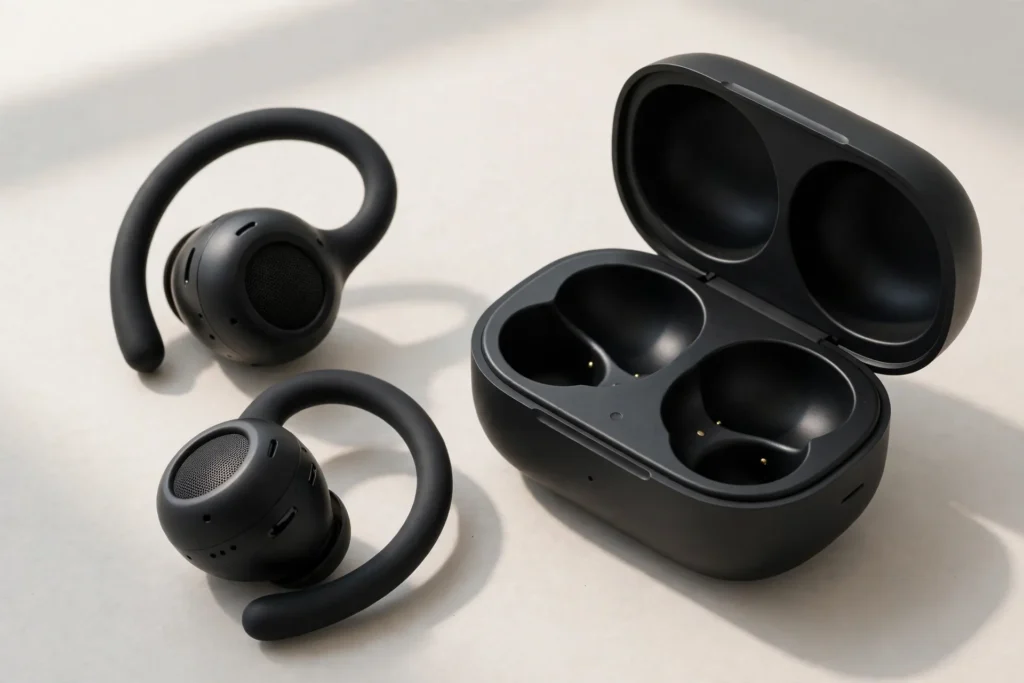
The Bose Sport Open Earbuds were one of the most unusual running earbuds Bose ever made. Instead of sealing inside your ear canal like ordinary earbuds, each bud hooks over your ear and hovers just above it, firing sound down into your ear while leaving the canal completely open. You hear your music, your training partner, and the traffic behind you, all at the same time. For runners and cyclists who refuse to train deaf to the world, that idea still makes a lot of sense.
But any honest review in 2026 has to start with the availability reality. Bose discontinued the Sport Open Earbuds, and you can no longer buy them new from Bose as a current retail product. What remains on Amazon is limited surviving stock and third-party listings, which changes the buying advice completely. This is therefore part review, part reality check: what the Sport Open Earbuds were, what they still do better than almost anything else, who should still hunt down a pair, and who should simply buy Bose’s current open-ear successor instead.
Our assessment is research-based, built from Bose’s specifications, launch documentation, and the long tail of owner experience. The short version: the concept was ahead of its time, the execution had real quirks, and in 2026 the smarter money usually goes elsewhere.
The Bose Sport Open Earbuds remain a clever, comfortable way to run with total situational awareness, and the ear-hook fit is still one of the most secure Bose has made. But they are discontinued, the case holds no charge of its own, there is no app EQ, and bass is thin by design. Buy a surviving pair only if you specifically want the hook fit and the price is right. Most buyers should get the Bose Ultra Open Earbuds instead: the same open-ear idea, modernised, with a charging case that actually charges.
| Sound Quality | 7.5 |
| Awareness & Safety | 9.5 |
| Comfort & Design | 8.5 |
| Battery Life | 7.8 |
| Call Quality | 7.5 |
| Value | 6.5 |
Bose Sport Open Earbuds: Specifications
| Product | Bose Sport Open Earbuds | Check Price |
|---|---|---|
| Driver / Design | Open-ear ear-hook design; dipole transducer with Bose OpenAudio technology, sits above the ear canal | |
| ANC | None — open by design for full situational awareness | |
| Battery Life | Up to 8 hours per charge; carry case holds no extra charge, charging base included | |
| Bluetooth / Codecs | Bluetooth 5.1; SBC and AAC | |
| Weight | 14 g per earbud | |
| Water Resistance | IPX4 (sweat and splash resistant) | |
| Key Features | Physical button controls, voice assistant access, advanced mic system for calls, quick charge (30 min for up to 3 hours) | |
What the Sport Open Earbuds Actually Are
Bose launched the Sport Open Earbuds in January 2021 as a clean-sheet answer to a specific complaint: runners and cyclists wanted music without giving up their hearing. Transparency modes only approximate openness by piping the world in through microphones; Bose’s answer was mechanical, not electronic. Each bud uses a contoured ear hook that wraps over your ear, suspending a small enclosure above the ear canal. Nothing goes in the ear, nothing seals it, nothing covers it.
Inside that enclosure sits a tiny dipole transducer running Bose’s OpenAudio technology. The driver is positioned to project sound precisely toward your ear canal while cancelling much of it out everywhere else, so people nearby hear surprisingly little of what you’re playing. It’s air conduction, not bone conduction — if you’re curious how that differs, our explainer on how bone conduction works covers the competing approach in depth.
The rest of the package is deliberately simple. There are physical buttons rather than touch controls — the left bud summons your phone’s voice assistant, the right handles power, playback and calls — and Bose rates the buds for up to eight hours of listening with an IPX4 sweat and splash rating. At 14 grams per bud, they’re light, though the hook design makes them visually larger than typical earbuds.
Fit and Comfort: The Hook Is the Whole Point
Fit is where the Sport Open Earbuds either win you over completely or rule themselves out — our analysis of owner feedback shows little middle ground. The hook distributes weight around the ear rather than relying on a tip wedged in the canal, so there’s no ear fatigue and none of the plugged feeling some runners hate. Glasses wearers share hook space with glasses arms, which most owners manage fine after a day or two.
Security is excellent. Because the bud is mechanically hooked rather than friction-fit, it doesn’t work loose over a long run the way smooth, stem-style buds can. That reliability is a large part of why the model kept a loyal following in our best wireless sport earbuds research even after it left production. The caveat is adjustability: the hook is a fixed shape, so if your ears don’t match Bose’s mould, there’s no alternative tip or fin to rescue the fit. Try-before-you-commit matters more here than with almost any other earbud — one more reason to buy through a listing with a solid return window.
Sound Quality: Clear, Open, and Honest About Bass
Set expectations correctly and the Sport Open Earbuds sound genuinely good. Vocals and spoken word are the strength: podcasts, audiobooks and call audio come through with a clarity that sealed earbuds sometimes smother, and midrange detail is clean because the driver isn’t fighting a sealed ear canal. Bose’s dipole arrangement keeps the soundstage feeling like it’s happening around you rather than inside your skull, which suits outdoor listening well.
The limitation is physics. With no seal, low frequencies escape instead of pressurising the ear, so bass is present but lean, and bass-heavy playlists lose their thump. In noisy environments the open design also lets competing sound in, masking detail. There’s no adjustable EQ to compensate — Bose never gave this model meaningful app-based sound customisation. Judge them as an awareness tool that plays music well, not a hi-fi purchase, and they deliver.
Awareness and Safety: No ANC, on Purpose
It needs saying plainly, because the product name confuses people: the Sport Open Earbuds have no active noise cancelling whatsoever, and that’s the design working as intended. Your ears stay completely open, so you hear traffic, cyclists calling a pass, a training partner’s warning, or your own footstrike and breathing, naturally and without microphone lag or artefacts. In our assessment, genuine acoustic openness still beats the best transparency mode for outdoor safety, because there’s no processing between you and a sound your brain needs to localise instantly.
The flip side is that these are the wrong tool anywhere you actually want isolation. On a plane, in a loud office, or in a gym that blasts its own music, the Sport Open Earbuds will not protect your listening — or your hearing, if you compensate with volume. Buyers who split time between roads and flights are better served by a sealed, cancelling pair for travel and open ears only for training, which is exactly how Bose positions its own current range against rivals in our Bose vs Beats earbuds comparison.
Battery Life and the Charging Quirk
Bose rates the Sport Open Earbuds at up to eight hours of playback from a single charge, and that figure held up well in long-term owner reports — enough for a marathon block of training without thinking about the charger. A 30-minute quick charge returns up to three hours, which rescues forgotten-charge mornings before a run.
The quirk, and for many owners the dealbreaker, is the case: it’s protective storage only, with no battery inside, so charging happens on a separate stationary base at home. Your total away-from-a-socket endurance is eight hours, full stop — no case top-ups across a training weekend. Modern rivals, including Bose’s own Ultra Open, treat a charging case as standard. If your routine is train, home, charge, it never bites; if you travel to races, it will.
Calls and Controls
Bose fitted an advanced microphone system designed to isolate your voice from wind and background noise, and call quality is respectable outdoors for an open design — callers hear you clearly in moderate wind, though truly gusty conditions challenge any microphone that sits outside the ear. Because your ears are open, calls also feel natural: no booming occlusion effect from your own voice.
Controls are physical buttons, a choice we still applaud for sport use: sweaty fingers and touch panels don’t mix, while a clicky button works mid-stride, every time. The right bud’s button handles power, playback, track skipping and calls through press combinations; the left is dedicated to your voice assistant. There’s a learning curve, but once learned they’re more reliable than swipe gestures.
Buying the Sport Open Earbuds in 2026: The Availability Reality
Here is what a purchase actually looks like today. Bose no longer sells the Sport Open Earbuds as a current product, and Amazon availability for this model comes and goes — surviving stock and third-party sellers rather than a current Bose retail line, with condition and pricing that vary by listing. That has three practical consequences. First, check the exact listing condition (new old stock, renewed or used), the seller, and the return terms before ordering, because condition on a discontinued model is not guaranteed. Second, warranty cover on discontinued units can be thinner than on a current model, so the saving has to be meaningful to justify it. Third, availability is finite: when the renewed stock dries up, this model is simply gone.
Our buying advice follows from that. If you find a pair at a sensible price and you specifically want the over-ear hook fit — the one thing the newer cuff-style open earbuds don’t replicate — the Sport Open Earbuds are still a satisfying, well-made tool for road training. If the price creeps anywhere near Bose’s current open-ear model, stop: the successor below is the rational purchase, with a real charging case, newer Bluetooth, Immersive Audio and a full warranty.
Bose Sport Open vs Bose Ultra Open Earbuds
The Bose Ultra Open Earbuds are the Sport Open’s spiritual successor: the same OpenAudio philosophy, re-engineered as a clip-on cuff that grips the outer ear instead of hooking over it. They add Immersive Audio, Bluetooth 5.3 with Snapdragon Sound support on compatible Android phones, and a case that extends total playtime to up to 48 hours. Here’s how the two generations compare:
| Feature | Bose Sport Open Earbuds | Bose Ultra Open Earbuds |
|---|---|---|
| Design | Over-ear hook, sits above canal | Clip-on cuff on outer ear |
| Battery | Up to 8 hours; case holds no charge | Up to 7.5 hours; up to 48 hours total with case |
| Bluetooth | 5.1 | 5.3 |
| Water Resistance | IPX4 | IPX4 |
| Extras | Physical buttons; no EQ | Immersive Audio; app EQ; multipoint |
| Availability | Discontinued — limited / third-party stock only | Current Bose model |
| Buy | Check Price | Check Price |
Who Should Buy the Sport Open Earbuds — and Who Shouldn’t
Buy them if: you’re a road runner or cyclist who puts awareness above everything; you hate anything inside your ear canal; you love a mechanical hook fit and physical buttons; and you find a pair at a price that reflects its discontinued status. Home-based chargers who train and dock daily will never feel the case limitation.
Skip them if: you want noise cancelling for travel or office work; you need case top-ups for multi-day trips; bass drives your training playlists; or the renewed price is close to a current model. In every one of those cases, the Ultra Open Earbuds or a sealed sport bud will serve you better, with a warranty behind it.
Alternatives Worth Considering
Bose Ultra Open Earbuds — the direct successor and our default recommendation. Same open-ear awareness, better case, newer connectivity, Immersive Audio, and current-product support.
Shokz OpenRun — the bone conduction alternative. Instead of projecting sound through air, the OpenRun sends vibrations through your cheekbones, leaving your ears entirely uncovered. It’s lighter on bass than even the Sport Open, but it’s a current product with an IP67 rating, up to eight hours of battery and a huge following among runners and cyclists.
Frequently Asked Questions
Are the Bose Sport Open Earbuds discontinued?
Yes. Bose discontinued the Sport Open Earbuds and no longer sells them as a current retail product. In 2026 they surface only as remaining stock on Amazon and through third-party sellers, so check the listing’s condition and return terms before buying. Bose’s current open-ear model is the Ultra Open Earbuds.
Do the Bose Sport Open Earbuds have noise cancelling?
No — deliberately. The Sport Open Earbuds are an open-ear design that leaves your ear canal completely uncovered, so you hear traffic and your surroundings naturally. There is no ANC and no sealed isolation, which makes them a safety tool for outdoor training rather than a travel headphone.
How long does the battery last on the Bose Sport Open Earbuds?
Bose rates them for up to eight hours of playback on a single charge, and a 30-minute quick charge adds up to three hours. Note that the carry case holds no battery and cannot recharge the buds — charging is done on the included charging base.
Are the Bose Sport Open Earbuds good for running?
They’re one of the best fits ever made for road running: the ear hook stays secure, the IPX4 rating shrugs off sweat and light rain, and your ears stay open to traffic. The trade-offs are lean bass, no noise cancelling for gym use, and no charging case for race weekends.
What replaced the Bose Sport Open Earbuds?
Bose’s Ultra Open Earbuds carry the concept forward with a clip-on cuff design, Immersive Audio, Bluetooth 5.3 and a charging case that takes total playtime to up to 48 hours. For most buyers in 2026, they are the version of this idea to buy.
Final Verdict
The Bose Sport Open Earbuds were a genuinely original product with a few 2021-era compromises — a charge-free case, no EQ, and bass physics wouldn’t allow. If the hook fit suits your training and the price is honest, they’re still a pleasure to run in. For everyone else, Bose has already built the sequel, and it wears our recommendation.

I am the founder of Sound Mavericks, where I provide the polite truth about audio equipment. I started this site because consumer electronics reviews are often too technical. Instead of using a silent lab, I test headphones, earbuds, and Bluetooth speakers in the real world – like on a noisy subway or in a busy coffee shop.
To stay independent, I buy my own review units (mostly from the United States) rather than accepting free gifts from brands. Once I finish testing a product, I sell it locally to our community. My goal is to help you understand sound quality, active noise cancellation (ANC), and battery life without the marketing hype.