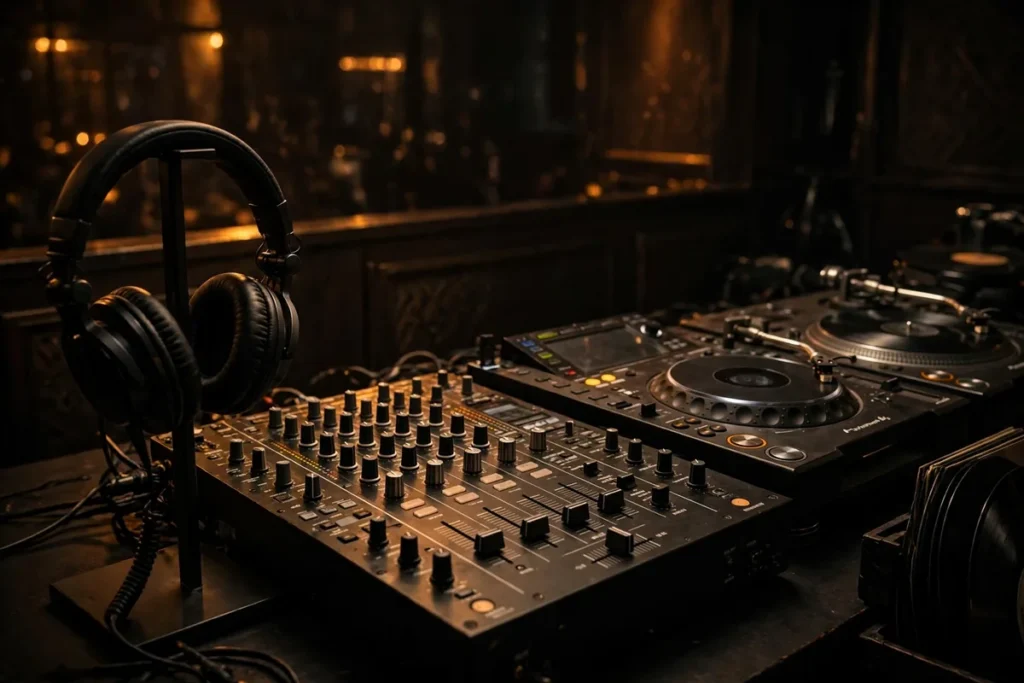
Search for noise cancelling DJ headphones and you mostly find two categories shuffled together: travel-style ANC headphones never built for a booth, and classic DJ headphones with no active noise cancelling at all. That matters, because DJ monitoring is a specific job — in a loud club you must hear a cue mix clearly enough to beatmatch against the PA, and how a headphone blocks that noise matters as much as how it sounds.
The honest picture: true ANC DJ headphones are genuinely rare. Korg’s NC-Q1 is the one purpose-built example — active cancelling, Smart Monitoring that feeds outside sound into one ear for cueing — but it sells through pro-audio dealers, not mainstream US retail. Almost every headphone working DJs rely on uses passive isolation: a tight closed-back seal, high output, swivelling cups. This guide covers the genuine ANC option you can buy today, benchmarked against the passive designs DJs trust — every pick clearly labelled.
Our verdict for DJ monitoring
True ANC with a wired booth mode: the OneOdio Focus A10. What most working DJs use: the Sennheiser HD 25. Bluetooth for prep, wired for the set: the Pioneer DJ HDJ-CUE1BT and Audio-Technica ATH-M50xBT2.
ANC vs passive isolation in the booth: what actually works
Active noise cancelling uses microphones and phase-inverted sound to erase noise electronically. It is brilliant against steady, low-frequency rumble — air conditioning, a club’s sub-bass wash bleeding through walls, an aircraft cabin. It is much less effective against the sharp, changing sounds of a live room, and it comes with trade-offs a DJ feels immediately: ANC headphones need power, the processing can subtly change the sound, and nearly all of them are designed for listeners, not for being yanked on and off one ear forty times a night. If you want the full technical breakdown, our guide to active noise cancellation vs passive isolation walks through where each approach wins.
Passive isolation is simpler and, for cueing, often better. A closed cup, a firm clamp and a good seal physically block mid and high frequencies — exactly the range where a crowd and a PA compete with your cue. Passive DJ headphones also play loud without distortion, survive on zero battery, and are built around the physical act of DJing: a cup that rotates so you can hold it to one ear, a coiled cable that stretches without snagging, and parts you can replace in minutes when something breaks mid-tour.
One rule sits above all of this: Bluetooth is not for live cueing. Even low-latency Bluetooth adds a delay between the mixer and your ears, and beatmatching against a delayed cue while the room hears the real signal is a recipe for trainwrecks. Every wireless pick in this guide earns its place because it also works wired — plug in for the set, use Bluetooth for track prep, travel and everyday listening. Treat wireless as the bonus feature, never the booth connection.
| Headphone | Isolation type | Cueing strength | Link |
|---|---|---|---|
| OneOdio Focus A10 | Hybrid ANC + passive | Wired mode with ANC for noisy booths | Check Price |
| Sennheiser HD 25 | Passive (on-ear seal) | Rotatable capsule, one-ear listening | Check Price |
| Pioneer DJ HDJ-CUE1BT | Passive (closed on-ear) | 90-degree swivel cups, coiled cable | Check Price |
| Audio-Technica ATH-M50xBT2 | Passive (closed over-ear) | 90-degree swivel, deep isolating seal | Check Price |
1. OneOdio Focus A10 — the genuine ANC option (ANC)

Isolation type: hybrid active noise cancelling, plus passive isolation from the closed over-ear cups. The Focus A10 is the one headphone in this guide that does what the search query literally asks for. OneOdio built its name on DJ headphones, and the A10 takes that foldable, wired-friendly DNA and adds hybrid ANC with dual noise-detecting microphones, 40mm drivers with Hi-Res Audio support, Bluetooth multipoint, and a wired 3.5mm mode for the booth. In a loud environment, the ANC earns its keep against the constant low-end wash — the booth rumble and PA bleed that passive cups handle least well — while the closed over-ear seal handles the rest.
Used honestly, though, this is an ANC headphone that can work for DJ monitoring, not a dedicated DJ tool that happens to have ANC. The cueing practicality is a step behind the pro benchmarks below: the cups fold for transport rather than being shaped around constant one-ear work, and there is no coiled DJ cable or 6.35mm booth-ready lead in the box — you will run it on its AUX cable in wired mode, which is exactly how you should use it for a set, since Bluetooth latency rules wireless cueing out. Battery life is a genuine strength for long days, rated at up to 62 hours, and the fold-flat design travels well between gigs.
Our take: if your booth is exceptionally loud, you play long sets where low-frequency fatigue builds up, or you want one headphone that covers monitoring, travel and daily listening, the A10 is the most sensible true-ANC route in. Purist DJs who live on one-ear cueing will still prefer the HD 25 below — and we would not argue with them.
2. Sennheiser HD 25 — the passive benchmark DJs actually use (Passive)

Isolation type: passive only — no ANC, no Bluetooth, no battery. And yet the HD 25 is the headphone you will see in more professional booths than everything else in this guide combined. Sennheiser describes it as the industry standard for DJ monitoring, and decades of working DJs back that up. The closed on-ear design presses a firm seal against the ear, the drivers handle very high sound pressure levels without breaking up, and at around 140g it disappears on your head during a long set in a way no ANC over-ear can match.
For cueing, the design is close to perfect. One capsule rotates for one-ear listening, the split headband stays put when you are moving, and the single-sided detachable cable keeps the booth tidy. Durability is the other half of the legend: virtually every part — cable, ear pads, headband, capsules — is user-replaceable, so an HD 25 is a tool you maintain for years rather than a gadget you replace. The trade-offs are real: the on-ear clamp is firm enough that some people find it tiring, and the sound is a monitoring tool’s sound — direct and punchy rather than lush. But if the question is “what do DJs use to monitor in loud rooms,” this passive design, not an ANC travel headphone, is still the honest answer.
3. Pioneer DJ HDJ-CUE1BT — DJ-shaped, wireless for prep, wired for the set (Passive)

Isolation type: passive — Pioneer DJ lists sound isolation, not active noise cancelling, and Amazon’s own spec for this model lists no ANC. What the HDJ-CUE1BT does offer is the correct DJ shape with everyday wireless on top. It inherits its tuning and design language from Pioneer’s pro HDJ-X range: 40mm drivers voiced so the kick and bassline stay clear in a loud room, ear cups that swivel a full 90 degrees for one-ear monitoring, and a lightweight 250g folding frame with metal sliders in the headband for reliability.
The booth details are right. The detachable 1.2m coiled cable stretches to 1.8m and locks in with a bayonet connector so it cannot yank out mid-set, and Bluetooth is there for everything outside the booth — prepping sets, listening on the way to the gig, taking calls — at up to 30 hours per charge. That division of labour is exactly how a wireless DJ headphone should be used, and Pioneer DJ, to its credit, markets it that way rather than pretending Bluetooth belongs in live cueing. For new and working DJs who want one affordable pair that behaves properly in the booth and conveniently everywhere else, this is the balanced pick — just go in knowing the isolation is a good passive seal, not ANC.
4. Audio-Technica ATH-M50xBT2 — studio isolation that doubles in the booth (Passive)

Isolation type: passive sound isolation from the closed-back circumaural design — the M50xBT2 has no active noise cancelling, despite often appearing in ANC searches. What it has is one of the most proven monitoring platforms in audio. The 45mm drivers deliver the deep, accurate bass and clarity the M50x line is known for, the ear cups contour around the ear for strong isolation in loud environments, and the 90-degree swivelling cups support one-ear monitoring — which is why the wired M50x has been a fixture in studios and booths for years.
The BT2 version adds Bluetooth 5.0 with a low-latency mode, multipoint pairing and up to 50 hours of battery for production work, prep and listening away from the decks — then plugs straight into your mixer with the included cable when it is time to perform, which remains the only latency-free way to cue. The collapsible frame and detachable cable keep it practical to transport and maintain. Choose it if your DJing overlaps with producing and studio monitoring and you want one headphone fluent in both worlds; choose the HD 25 if you want the lighter, more booth-specialised tool. DJ-producer crossover is also why in-ear options get a look-in for some performers — see our roundup of the best earbuds for DJs if that route interests you.
How to choose: a booth-first checklist
Decide what you are actually blocking. If your problem is constant low-frequency wash in a very loud booth, ANC like the Focus A10’s genuinely helps. If your problem is hearing a cue over a changing, full-range PA, a strong passive seal and high clean output matter more — which is why the passive benchmarks above still dominate professional booths. Our wider guide to the best noise cancelling headphones covers the travel-style ANC flagships if your priority is flying rather than mixing.
Check the cueing mechanics before the spec sheet. You want cups that swivel or rotate for one-ear monitoring, a cable that will not fight you — coiled and detachable is the DJ standard — and a headband that stays in place when one cup is off your ear. Then check the ownership details: replaceable cables and pads, a folding design that survives a gig bag, and a wired mode that works with the battery flat. Every pick in this guide was chosen against that checklist first and its noise-cancelling label second, and we would suggest you shop the same way.
Frequently asked questions
Do DJs use noise cancelling headphones?
Most professional DJs do not. The booth standard is passive isolation — a tight closed-back seal, high output and swivelling cups — because it needs no battery, adds no processing and survives one-ear cueing all night. True ANC DJ headphones exist but are rare: Korg’s NC-Q1 is the purpose-built example, and hybrid ANC models like the OneOdio Focus A10 can work for monitoring when used wired.
Is Bluetooth OK for DJing?
Not for live cueing. Bluetooth adds latency between the mixer and your ears, which makes beatmatching against what the room hears unreliable. Wireless DJ headphones are still useful — for track prep, travel and everyday listening — but plug the cable in for the set itself. That is how every wireless pick in this guide is designed to be used.
Why do most DJ headphones not have ANC?
Because the job does not reward it. ANC is best against steady low-frequency noise, while a booth throws changing, full-range sound at you; a firm passive seal handles that better, plays louder without strain, and keeps working with a flat battery. ANC also adds weight, cost and electronics to a tool that gets dropped, stood on and rebuilt from spare parts.
Is ANC or passive isolation better for DJ monitoring?
For most DJs, passive. It is instant, reliable and strong in the mid and high frequencies where crowd and PA noise compete with your cue. ANC pulls ahead in one scenario: very loud booths with heavy constant low-end, where electronic cancelling reduces fatigue over a long set. Some DJs therefore keep an ANC model for the loudest rooms and a passive benchmark for everything else.
Can I DJ in regular travel ANC headphones?
You can monitor with them wired in a pinch, and many bedroom DJs start that way, but they are not built for the job: the cups rarely swivel properly for one-ear cueing, the cables are short and straight, and replacement parts are scarce. If you play out regularly, a DJ-shaped design — even a passive one — will serve you better and last longer.

I am the founder of Sound Mavericks, where I provide the polite truth about audio equipment. I started this site because consumer electronics reviews are often too technical. Instead of using a silent lab, I test headphones, earbuds, and Bluetooth speakers in the real world – like on a noisy subway or in a busy coffee shop.
To stay independent, I buy my own review units (mostly from the United States) rather than accepting free gifts from brands. Once I finish testing a product, I sell it locally to our community. My goal is to help you understand sound quality, active noise cancellation (ANC), and battery life without the marketing hype.