Most replacement-cable disappointment has nothing to do with quality. It happens because a cable that looks right does not actually fit: a dual 3.5mm cable bought for a headphone that needs mini-XLR, a Sennheiser 2-pin cable bought for an HD 800, or a balanced 4.4mm cable bought for an amplifier that only has a single-ended output. The best headphone replacement cables are therefore not the most exotic ones. They are the ones whose headphone-side connector, amplifier-side termination and length match the system you already own.
This guide works in that order: identify your connector first, because that single check eliminates most wrong purchases, then choose from picks organised by connector family — Sennheiser HD 600-series 2-pin, Audeze mini-XLR, dual 3.5mm for Focal and HiFiMan, single-entry mini-XLR for AKG and Beyerdynamic Pro, and Audio-Technica’s locking 2.5mm system. Every compatibility claim below is taken from the product’s own Amazon listing title.
Quick picks — start here
- Best for Sennheiser HD 600 series, single-ended: NewFantasia replacement cable for HD650, HD600, HD580, HD58X, HD660S, HD660S2 and HD6XX — the straightforward like-for-like swap.
- Best balanced pick for Sennheiser: NewFantasia 4.4mm balanced cable for the HD 600 series — for amplifiers and players with a 4.4mm balanced output.
- Best for Audeze LCD: NewFantasia 4.4mm balanced cable for LCD-2, LCD-3, LCD-4, LCD-X, LCD-XC and MM-500 — dual mini-XLR at the earcups.
- Best for Focal and HiFiMan: NewFantasia dual 3.5mm cable for Focal Elear, Denon AH-D series and Meze 99 Classics — one cable family, several dual-entry headphones.
Not sure which connector you have? Read the identification section below before ordering anything — it takes two minutes and prevents the most common returns.
Do Replacement Cables Change the Sound?
Plainly: a properly made replacement cable does not meaningfully change how a headphone sounds. SoundMavericks’ position, supported by basic electrical measurements, is that conductor marketing — silver versus copper, strand counts, cryogenic treatments — produces no audible tonal change in a short headphone run. A cable can absolutely ruin sound when it is faulty: an intermittent connection that crackles or drops a channel, corroded contacts, or an unusually high-resistance cable paired with a low-impedance headphone can all be audible. Those are defects and edge cases, not a reason to expect a healthy cable to add bass, widen soundstage or smooth treble.
The real reasons to upgrade are practical. Durability comes first: stock cables often fail at the strain relief or Y-split, and a braided aftermarket cable usually outlasts the original. Length is second — more reach for a desktop setup, far less pooling cable for portable use. Microphonics matter too: stiff stock cables transmit rustling into the earcups when they brush clothing, and a softer, lighter cable fixes that. Ergonomics — weight, flexibility, tangle behaviour — decide whether you enjoy the headphone daily. Finally, a replacement cable is the clean way to use a balanced amplifier output. Buy for those reasons and you will be satisfied; buy expecting a tonal transformation and you will not.
How to Identify Your Headphone Connector
Ignore the amplifier end for a moment. The headphone end decides compatibility, and only a handful of families are in common use. Find yours here before looking at any listing. If your headphone is not listed, do not assume a similar-looking cable fits — check the manufacturer’s specification.
Dual 3.5mm — HiFiMan, Focal and many others
Two separate 3.5mm plugs, one per earcup — the family used by most current HiFiMan models (Sundara, Ananda, Arya, HE400SE, Edition XS), Focal’s Elear, Clear, Elegia and Stellia lines, Denon AH-D series and Meze models. It looks universal, but older HiFiMan models used different connectors, and some headphones need longer or collared plugs to seat in recessed sockets. The listing title is your safeguard: buy a cable whose title names your headphone, not one whose plugs merely look the same in a photo.
Mini-XLR, single entry — AKG and Beyerdynamic Pro
A single cable entering one earcup, ending in a small 3-pin mini-XLR plug that clicks and locks. AKG’s K240 family, K702, K712 Pro and Q701 use it, and so do Beyerdynamic’s detachable Pro models such as the DT 1770 Pro and DT 1990 Pro and the Pro X line. Because the cable carries both channels through one plug, these cables are not interchangeable with dual-entry cables at all. The locking mechanism is the attraction for studio use: the cable stays put when you move, and releases with a button press rather than a tug.
Sennheiser HD 600-series 2-pin
Sennheiser’s HD 600 family — HD 600, HD 650, HD 580, HD 660S, HD 660S2, Drop HD 6XX and HD 58X — uses a proprietary two-pin plug at each earcup, with different-sized pins so it inserts one way only. It is one of the best-supported connectors in the aftermarket. Do not confuse it with the HD 800 series connectors or the HD 500-series locking 2.5mm system; none are interchangeable. If you own one of these headphones, our HD 6XX review and roundup of the best Sennheiser headphones cover the models themselves in more depth.
Audeze mini-XLR — the LCD series
Audeze’s LCD headphones use a 4-pin mini-XLR at each earcup — dual entry and locking. LCD-2, LCD-3, LCD-4, LCD-X, LCD-XC and MM-500 share this system, which also appears on Meze’s Empyrean and Elite and on ZMF headphones. The similar name causes real confusion: Audeze needs dual 4-pin mini-XLR, AKG and Beyerdynamic Pro need single 3-pin mini-XLR, and a cable built for one group does not fit the other.
Single 3.5mm and locking 2.5mm — one earcup, one plug
Many portable and studio headphones take a single plug in one earcup. The simplest version is a plain 3.5mm socket — as on Focal’s Hadenys and many consumer models — where any slim 3.5mm cable works if the plug housing fits the recess. The trickier version is Audio-Technica’s M-series system: the ATH-M50x, M40x and M70x use a 2.5mm twist-lock plug, so a generic cable will not stay seated. Buy a cable whose listing names the M-series explicitly, as the pick below does.
Balanced vs Single-Ended: Choosing the Amplifier End
Once the headphone end is right, choose the plug that matches your amplifier. Single-ended terminations are the familiar 3.5mm and 6.35mm (1/4-inch) plugs, with a shared ground; they work with virtually every phone dongle, laptop and desktop amplifier. Balanced terminations — 2.5mm, 4.4mm, and 4-pin XLR for desktop amplifiers — keep the left and right grounds separate and are required to use an amplifier’s balanced output, which on many designs delivers more power. That power difference is the honest benefit, and it matters most for harder-to-drive headphones; our guides to headphone amplifiers and impedance and whether you need an amp explain when it is worth having. For the underlying wiring differences, see our explainer on balanced vs unbalanced audio cables.
Two rules keep you safe. First, never adapt a balanced cable down to a single-ended output with a simple adapter plug — shorting a balanced output can damage some amplifiers. Second, a balanced cable does not make a headphone balanced by itself; the headphone must be wired for it, which every family above is. Choose the termination matching the output you use most, and add a second cable later if your setup grows.
The Best Headphone Replacement Cables by Connector
1. NewFantasia Replacement Cable for Sennheiser HD 600 Series — Best Single-Ended Staple
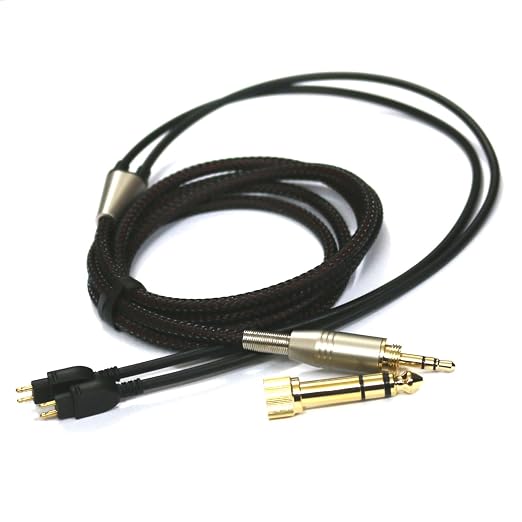
This NewFantasia cable is listed for the Sennheiser HD650, HD600, HD580, HD58X, HD660S, HD660S2 and Massdrop HD6XX, at 1.2 metres. That is the sensible default for HD 600-family owners whose stock cable has failed: the length keeps excess cable off the floor, the braided jacket resists tangling, and the 2-pin plugs follow Sennheiser’s own pattern. A like-for-like replacement with better day-to-day handling, not a sonic upgrade — exactly what most HD 600 owners need.
2. NewFantasia 4.4mm Balanced Cable for Sennheiser HD 600 Series — Best Balanced Pick for Sennheiser

Listed for the same HD 600 family — HD600, HD650, HD580, HD660S, HD58X, HD660S2 and HD6XX — this version terminates in a 4.4mm balanced plug for the growing number of portable players, dongles and desktop amplifiers that offer that output. If your amplifier’s balanced output is its stronger output, this is the clean way to use it with an HD 600-series headphone, with no adapters in the chain. Check your amplifier actually has a 4.4mm socket before ordering; if it offers 2.5mm or 4-pin XLR instead, match the cable to that socket instead.
3. NewFantasia 4.4mm Balanced Cable for Audeze LCD — Best for LCD Owners Going Balanced
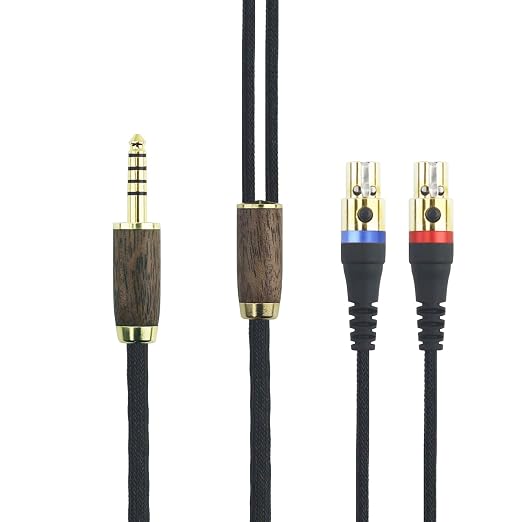
Audeze’s stock LCD cables are functional but stiff, and the LCD line is where a swap improves daily handling most. This NewFantasia cable is listed for the LCD-2, LCD-4, LCD-3, LCD-X, LCD-XC and MM-500, runs 6.6 feet, and uses the correct dual 4-pin mini-XLR earcup connectors with a 4.4mm balanced termination. The length suits a desktop amplifier beside a listening chair, and the braid drapes better than the ribbon-style stock cable. This listing names Audeze models only, so check any cross-brand use against a listing that names your headphone.
4. NewFantasia Dual 3.5mm Cable for Focal Elear, Denon and Meze 99 — Best Dual-Entry All-Rounder

For single-ended dual-entry headphones, this NewFantasia cable is listed for the Denon AH-D600, AH-D7200, AH-D7100, AH-D9200 and AH-D5200, the Meze 99 Classics, and the Focal Elear. A useful spare for listeners who own more than one dual 3.5mm headphone and drive them from a standard output — and Focal owners will appreciate a more flexible alternative to the stiff stock cables. Confirm your exact model appears in the listing for the length variant you select; the listing names the Elear specifically, not the whole Focal range.
5. NewFantasia 4-Pin XLR Balanced Cable for HiFiMan — Best for Desktop Balanced Amps

Desktop listeners with a balanced amplifier should look at this NewFantasia cable, listed for the HiFiMan Ananda, Sundara, Arya, HE400SE, HE4XX and HE-400i, at 10 feet, terminating in a 4-pin XLR. The 4-pin XLR is the standard balanced socket on desktop amplifiers, and the length reaches comfortably from a side rack. One caution applies to this whole family: these HiFiMan models use dual 3.5mm earcup plugs in their current versions, while older HiFiMan versions with different earcup connectors need different cables — another reason the exact model list in the title matters.
6. Youkamoo 4.4mm Balanced Cable for HiFiMan — Best Portable Balanced Pick

For the same dual 3.5mm HiFiMan family in a shorter, portable-friendly form, this Youkamoo cable is listed for the Sundara, Ananda, Arya, HE400SE, HE4XX, HE-400i and Edition XS, at 4 feet with a 4.4mm balanced plug and a braided, silver-plated construction. Four feet suits a player or dongle on a desk or in a pocket, where the 10-foot desktop cable above would be a nuisance. The pairing with the XLR pick above is deliberate: same headphones, same earcup plugs, different amplifier ends.
7. NewFantasia Mini-XLR Cable for AKG — Best for Studio Single-Entry Headphones

AKG’s detachable studio headphones are cable-swap veterans, and this NewFantasia cable is listed for the AKG K240, K240S, K240MK II, Q701, K702, K141, K171, K181, K271s, K271 MKII and M220, plus the Pioneer HDJ-2000, at 1.2 metres in this variant. It uses the single 3-pin mini-XLR connector those models share — also the family Beyerdynamic uses on detachable Pro models, though this listing names AKG and Pioneer, so Beyerdynamic owners should choose a listing naming their model. For K240 and K702 owners, this is the low-cost way to keep a working studio headphone in service.
8. NewFantasia Cable for Audio-Technica ATH-M50x — Best for the M-Series Locking System

The ATH-M50x family proves why connector identification matters: its 2.5mm twist-lock plug looks like a detail until a generic cable falls out mid-session. This NewFantasia cable is listed for the Audio-Technica ATH-M50x, ATH-M40x and ATH-M70x at 1.2 metres, built for that locking system. The shorter length suits the portable and desk use these closed-back headphones mostly see. If you need more reach, the same listing family offers longer variants — select the length on the product page and re-check the model list before buying.
All Picks at a Glance
| Cable | Headphone connector | Listed compatibility | Amplifier end | Check |
|---|---|---|---|---|
| NewFantasia HD 600-series cable | Sennheiser 2-pin, dual | HD600, HD650, HD580, HD58X, HD660S, HD660S2, HD6XX | Single-ended | Check Price |
| NewFantasia HD 600-series 4.4mm balanced | Sennheiser 2-pin, dual | HD600, HD650, HD580, HD660S, HD58X, HD660S2, HD6XX | 4.4mm balanced | Check Price |
| NewFantasia Audeze LCD 4.4mm balanced | 4-pin mini-XLR, dual | LCD-2, LCD-3, LCD-4, LCD-X, LCD-XC, MM-500 | 4.4mm balanced | Check Price |
| NewFantasia dual 3.5mm for Focal / Denon / Meze | 3.5mm, dual | Focal Elear, Denon AH-D series, Meze 99 Classics | Single-ended | Check Price |
| NewFantasia HiFiMan 4-pin XLR balanced | 3.5mm, dual | Ananda, Sundara, Arya, HE400SE, HE4XX, HE-400i | 4-pin XLR balanced | Check Price |
| Youkamoo HiFiMan 4.4mm balanced | 3.5mm, dual | Sundara, Ananda, Arya, HE400SE, HE4XX, HE-400i, Edition XS | 4.4mm balanced | Check Price |
| NewFantasia AKG mini-XLR cable | 3-pin mini-XLR, single | AKG K240 series, Q701, K702, K141, K171, K181, K271, M220; Pioneer HDJ-2000 | Single-ended | Check Price |
| NewFantasia ATH-M50x cable | Locking 2.5mm, single | ATH-M50x, ATH-M40x, ATH-M70x | Single-ended | Check Price |
Before You Buy: A 60-Second Checklist
Five checks, and you will almost never return a cable. One: name your headphone-side connector — dual 3.5mm, 3-pin or 4-pin mini-XLR, Sennheiser 2-pin, single 3.5mm, or locking 2.5mm. Two: confirm your exact model appears in the listing title, including version notes such as HiFiMan’s 2 x 3.5mm versions. Three: match the amplifier end to a socket you own — 3.5mm or 6.35mm single-ended, or 2.5mm, 4.4mm or 4-pin XLR balanced. Four: pick length for the room — about 1.2 metres for desk and portable use, 2 metres or more for a lounge or rack. Five: prioritise braiding, strain relief and a soft jacket over conductor claims; those decide how long a cable lasts and how little noise it makes against clothing. Listeners building a wider wired setup will also find our guide to the best headphones for audiophiles useful for pairing choices.
Frequently Asked Questions
Will an aftermarket cable make my headphones sound better?
No, not in any meaningful tonal sense, provided the cable is properly made and not faulty. Replacement cables are worth buying for durability, length, lower microphonics, better ergonomics and access to a balanced amplifier output. A damaged or intermittent stock cable can degrade sound, and replacing it restores normal performance — that is repair, not enhancement.
How do I know which connector my headphones use?
Look at how the cable attaches. Two plugs, one per earcup, suggests dual entry: 3.5mm on HiFiMan and Focal, 4-pin mini-XLR on Audeze LCD models, or Sennheiser’s 2-pin plugs on the HD 600 family. One plug suggests single entry: 3-pin mini-XLR on AKG and Beyerdynamic Pro models, a plain 3.5mm on many portables, or Audio-Technica’s locking 2.5mm on the M-series. Then confirm your exact model is named in the cable’s listing title.
Can I use a balanced cable with a single-ended amplifier?
Not with a simple adapter plug. A balanced headphone cable needs a balanced output — 2.5mm, 4.4mm or 4-pin XLR — and adapting it down to a single-ended 3.5mm or 6.35mm socket can short a balanced amplifier’s outputs. If you listen from both kinds of output, the practical answer is two cables, one per termination, which detachable-cable headphones make easy.
Are HiFiMan and Focal cables interchangeable?
Often, but not automatically. Both brands use dual 3.5mm earcup plugs on many current models, and some listings explicitly cover headphones from both families. Recessed sockets, plug length and collar differences can still prevent a full seat on some models, so only treat a cable as interchangeable when its listing names your headphone, and test that both plugs click or seat fully when it arrives.
What length of headphone cable should I buy?
About 1.2 metres suits a desk, laptop or portable player, with little excess to coil or catch. Around 2 metres suits a desktop amplifier beside a chair or a small rack. Longer cables add weight, tangles and trip hazards without any benefit, so buy the shortest length that reaches comfortably with a little slack for movement.
Does a mini-XLR cable for AKG fit Beyerdynamic headphones?
AKG and Beyerdynamic’s detachable Pro models share the single 3-pin mini-XLR connector family, and in practice many cables serve both. SoundMavericks still recommends buying a listing that names your Beyerdynamic model — DT 1770 Pro, DT 1990 Pro or the Pro X line — because plug housings and socket depth vary, and a named listing is the compatibility guarantee you can return against.

I am the founder of Sound Mavericks, where I provide the polite truth about audio equipment. I started this site because consumer electronics reviews are often too technical. Instead of using a silent lab, I test headphones, earbuds, and Bluetooth speakers in the real world – like on a noisy subway or in a busy coffee shop.
To stay independent, I buy my own review units (mostly from the United States) rather than accepting free gifts from brands. Once I finish testing a product, I sell it locally to our community. My goal is to help you understand sound quality, active noise cancellation (ANC), and battery life without the marketing hype.