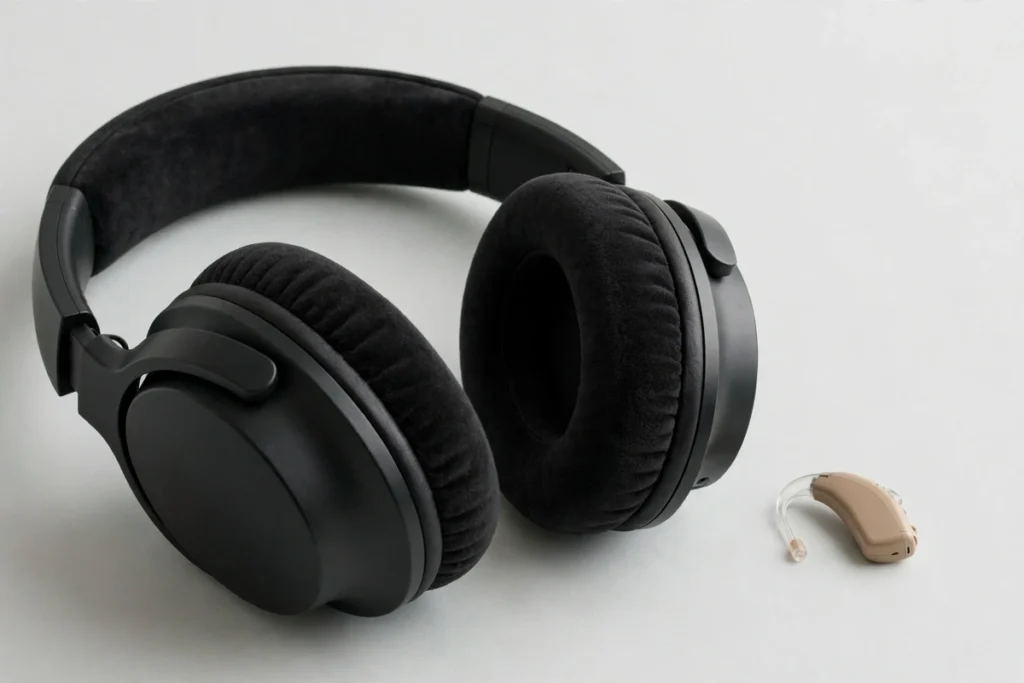
If you wear behind-the-ear (BTE) or receiver-in-canal (RIC) hearing aids, most headphones fail for a simple physical reason: the earcup is too shallow, too tight, or both. It presses on the aid behind your ear, pushes the microphone out of position, and you get discomfort, a dislodged aid, or that familiar high-pitched feedback whistle. Sound quality is rarely the first problem. Fit is.
The good news is that the right over-ear headphones solve most of this. You want a deep, roomy cup that clears the aid entirely, a gentle clamping force, and enough clean volume headroom for the times you take your aids out. Every pick below was chosen on those fit criteria first, and on sound and battery life second.
Below, SoundMavericks breaks down five over-ear models that give BTE and RIC users the most space and least pressure, why feedback happens and how to minimise it, and when streaming to your aids, a telecoil neckloop, or bone conduction makes more sense than headphones at all.
Our verdict: the best headphones for hearing aids
Best overall for BTE and RIC aids: Bose QuietComfort Headphones — deep, plush cups, a gentle fit, and strong noise cancelling that lets you listen at a lower volume with your aids in.
Best lightweight pick: Sony WH-1000XM5 — one of the lightest premium over-ears available, with soft-fit cups and very low pressure for long sessions.
Best for TV without your aids: Sennheiser RS 195 — a dedicated wireless TV system with manufacturer hearing-boost presets and its own volume control.
Can you wear headphones with hearing aids?
Yes — in most cases you can, and over-ear headphones are usually the easiest style to pair with hearing aids. The answer depends far more on the type of aid you wear than on the brand of headphone, so it helps to start there.
Behind-the-ear (BTE) and receiver-in-canal (RIC) aids
These are the styles this guide is really about. The body of the aid — including its microphones — sits behind your ear, exactly where a headphone cushion wants to land. A roomy over-ear cup that fully encloses your ear and the aid, without touching either, is the setup that works. Shallow cups and tight headbands are the ones to avoid: they press the aid into your head and are the most common cause of feedback and soreness.
In-the-ear (ITE), in-the-canal and completely-in-canal (CIC) aids
If your aids sit inside your ear or canal, you have a much easier time. There is nothing behind the ear for a cushion to press on, so most over-ear headphones — including every pick below — work fine over ITE and CIC aids. Earbuds are a different conversation, because they compete for the same space in the canal, but over-ears rarely cause trouble here.
Why headphones can cause feedback — and how to minimise it
Feedback is that whistling sound that happens when amplified sound from your hearing aid leaks out, reaches the aid’s own microphone again, and gets amplified a second time in a loop. A headphone cup can trigger it by pressing the aid so its position shifts, or by reflecting sound straight back into a microphone sitting right underneath the cushion.
Modern hearing aids have feedback-cancellation processing, which is why many wearers use over-ear headphones with no whistle at all. You can stack the odds further:
- Choose cup depth over cup padding claims. The aid needs actual air space inside the cup. A deep cup that clears the top of your ear is worth more than extra-soft foam on a shallow one.
- Put the headphones on carefully. Seat the cups from front to back and make sure the cushion surrounds the aid rather than sitting on top of it.
- Try small position shifts. Moving the cup slightly forward, or extending the headband a notch, often moves the cushion off the microphone and stops a whistle completely.
- Turn the aids down a notch. If feedback only appears with headphones on, lowering the aid volume slightly — or asking your audiologist about a dedicated headphone program — can break the loop.
- Consider noise cancelling. Good ANC reduces the background noise your aids amplify under the cup, so you can run both at lower levels — and lower levels mean less feedback.
- Accept that some combinations will whistle. Aid size, ear shape and cup geometry are personal. If a model whistles however you position it, that is a fit mismatch, not a fault — try a roomier model.
Our explainer on in-ear vs earbuds vs over-ear headphone styles is worth a read if you are still deciding which form factor suits your aids.
Best headphones for hearing aids at a glance
| Headphone | Best for | Connection | Battery | Check |
|---|---|---|---|---|
| Bose QuietComfort Headphones | Best overall over BTE/RIC aids | Bluetooth, 3.5mm | Up to 24 hours | Check Price |
| Sony WH-1000XM5 | Best lightweight, low pressure | Bluetooth, 3.5mm | Up to 30 hours (ANC on) | Check Price |
| Sennheiser Momentum 4 Wireless | Best battery and personalised sound | Bluetooth, 3.5mm, USB-C | Up to 60 hours | Check Price |
| Sennheiser RS 195 | Best for TV at home | RF wireless to TV transmitter | Up to 18 hours | Check Price |
| Sony WH-CH720N | Best lighter-budget, lightest fit | Bluetooth, 3.5mm | Up to 35 hours (ANC on) | Check Price |
1. Bose QuietComfort Headphones — best overall for BTE and RIC aids

The Bose QuietComfort is our top recommendation because it gets the physical basics right in a way few rivals match. The earcups are deep and generously sized, the plush cushions surround the ear rather than perching on it, and the clamping force is gentle — the combination BTE and RIC wearers consistently ask for. With many aids, the cup clears the device behind the ear completely, keeping pressure and feedback down.
Sound-wise, Bose tunes the QuietComfort for clarity rather than drama. Vocals and dialogue sit forward, which helps when listening through your aids, and the adjustable noise cancelling is genuinely strong: turn it up in a noisy kitchen, train or office and you can keep the volume lower. An Aware mode lets you hear what is happening around you without taking the headphones off.
Battery life is rated at up to 24 hours, there is a wired 3.5mm option for flights, multipoint Bluetooth covers phone and laptop at once, and the controls are simple to find by touch. Honest caveats: the cups do not fold flat, and a very large BTE aid combined with glasses arms can still crowd the cup — extend the headband fully before judging the fit.
Who it suits: BTE and RIC users who want one headphone for music, calls, travel and TV. If low pressure is your top priority, start here.
2. Sony WH-1000XM5 — best lightweight pick for long listening

At around 250 grams, the Sony WH-1000XM5 is one of the lightest full-size noise-cancelling headphones you can buy, and weight matters more than most reviews admit when there is already a hearing aid on your ear. Less weight means less pressure, and Sony pairs it with soft-fit leather earcups and a stepless headband that spreads what pressure remains over a wider area. For users who get sore spots after an hour in other headphones, that combination makes a real difference.
The XM5 also brings some of the strongest noise cancelling in its class, plus an Auto NC Optimizer that adjusts cancellation to your wearing conditions. Sound quality is excellent and easily shaped in Sony’s app, where the equaliser lets you lift the speech frequencies if you listen with your aids out. Battery life is rated at up to 30 hours with ANC on, and a wired cable is included.
Two honest notes. First, the XM5’s cups are roomy in area but not the deepest here — wearers of larger BTE aids should position them carefully, using the tips in our feedback section. Second, the headphones only swivel flat rather than folding, so the case is bulky. Neither stops the XM5 being the pair we point long-session listeners to first. See how it compares in our guide to the best noise cancelling headphones overall.
Who it suits: Anyone who finds most headphones heavy or tight, and listeners who split time between aids-in and aids-out listening.
3. Sennheiser Momentum 4 Wireless — best battery life and personalised sound

The Momentum 4 Wireless earns its place for two reasons that matter specifically here. The first is Sound Personalization in the Sennheiser app, which builds a sound profile from your listening preferences and stores it on the headphone — genuinely useful if you take your aids out to listen and want tuning adjusted to how you hear. The second is battery life: up to 60 hours per charge, roughly double most rivals.
The fit is a wide, fabric-trimmed design with well-padded cups and a low-friction hinge. The cups give BTE and RIC aids reasonable room, though the Momentum 4 sits a little closer than the Bose — a good rather than class-leading fit for the very largest aids. In return you get Sennheiser’s 42mm driver system, adaptive noise cancelling with transparency mode, clear calls, and wired listening over 3.5mm and USB-C.
One background point: Sennheiser’s consumer audio business sits within the Sonova group, which also makes Phonak hearing aids. That does not make the Momentum 4 a medical product, but its personalisation-first software will feel familiar.
Who it suits: Music-first listeners who often listen without their aids and want personalised tuning, plus anyone who hates charging headphones.
4. Sennheiser RS 195 — best for TV, designed around clearer dialogue

The RS 195 is the specialist on this list. Instead of squeezing over your aids for everyday use, it is a dedicated home TV system — a transmitter that connects to your television by optical or analogue cable and sends sound over a radio-frequency link, with no Bluetooth pairing and no lip-sync lag. You would normally wear it with your aids out, at home.
What sets it apart is that Sennheiser designed it for listeners who struggle with TV sound. It offers selectable hearing-boost presets — manufacturer sound modes that emphasise speech and dialogue to different degrees — plus separate left/right balance control and its own volume control on the headset, independent of the TV. In a shared living room, you set your level and everyone else keeps theirs. Battery life is up to 18 hours, and the transmitter doubles as a charging cradle.
Be clear about what it is not: it has no Bluetooth and is a home product, not a travel headphone. But for its one job — making TV dialogue easier to follow at your own volume — nothing else here is as purpose-built. Our roundup of the best wireless headphones for TV watching covers the wider category.
Who it suits: Anyone whose main frustration is TV dialogue, and households where one listener needs a very different volume from everyone else.
5. Sony WH-CH720N — best lighter-budget, lightest fit

Not everyone needs a flagship. Sony bills the WH-CH720N as its lightest noise-cancelling headband headphone at around 192 grams, and that featherweight build translates directly into low clamping pressure — for BTE and RIC users on a smaller budget, it is one of the gentlest fits at any price, and easy to wear for a full workday.
You still get a proper feature set: digital noise cancelling, up to 35 hours of battery life with ANC on, multipoint connection, clear hands-free calling, and Sony’s app with an equaliser — handy for lifting speech clarity when listening without aids. A detachable cable covers wired listening.
The trade-offs are build and cup space. The mostly plastic construction feels less premium than the XM5, and the earcups are a touch smaller, so larger BTE aids get less spare room than in the Bose. But judged on comfort for the money, the WH-CH720N is the value pick we are happiest to recommend.
Who it suits: Budget-conscious buyers and anyone for whom the lightest possible clamp matters more than flagship sound.
Wired vs Bluetooth: which is better with hearing aids?
Both work, and most picks above give you the choice in one product. Bluetooth is the convenient default: no cable to catch on an aid or pull a cup out of position, and multipoint models stay connected to phone and laptop together. Remember that Bluetooth headphones and Bluetooth hearing aids are separate connections — your phone can usually stream to one at a time, so decide whether a session goes to the headphones or directly to the aids.
Wired listening earns its place for flights, older TVs and stereos without Bluetooth, and zero-lag listening, where a cable removes any delay between picture and sound. It also never runs out of battery. If you mostly listen at a desk, a wired-capable model is a sensible, lower-maintenance choice.
Alternatives to headphones over hearing aids
Sometimes the best answer is not a bigger cup. If your aids support direct streaming — Made for iPhone, ASHA on Android, or newer Bluetooth LE Audio — your phone, tablet and compatible TVs can send sound straight to your aids, using your personal prescription. Music fidelity rarely matches a good headphone, but for calls, podcasts and video it is hard to beat. Auracast, LE Audio’s broadcast feature, is extending the same idea to public venues and newer TVs.
If your aids have a telecoil (T-coil) program, a neckloop can feed sound magnetically to the aids while the room stays quiet — a long-established option your audiologist can advise on. And if wearing anything over your aids is uncomfortable, bone conduction headphones sit on the cheekbones and leave the ear completely open; our guide to how bone conduction works explains the trade-offs.
How to choose the right pair for your aids
- Cup depth and internal size first. Look for large, deep, oval cups, favour models widely described as roomy, and buy from somewhere with easy returns while you test with your own aids.
- Low clamping force and low weight. Under roughly 260 grams with soft cushions is the comfort zone for most BTE and RIC wearers.
- Volume headroom and EQ for aids-out listening. If you remove your aids to listen, you need clean volume in reserve and an app equaliser to shape speech frequencies.
- Noise cancelling you can adjust. Strong ANC lets you listen quieter with aids in; transparency modes matter for conversation.
- Controls you can use by touch. Physical buttons or large touch areas beat fiddly gestures when you do not want to knock an aid.
- Test properly at home. Wear the headphones with your aids for a full hour, on a call and with music, checking for whistle and pressure. Fit is individual — trust your own test over any list.
Frequently asked questions
Can you wear over-ear headphones with behind-the-ear hearing aids?
Yes, in most cases. Choose over-ear headphones with deep, roomy earcups and a gentle clamping force so the cup encloses your ear and the aid without pressing on either. Position the cup carefully, and if you hear feedback, try shifting the cup slightly or lowering the aid volume a notch.
Why do my headphones make my hearing aids whistle?
That whistle is feedback: sound amplified by the aid leaks back to the aid’s microphone and is amplified again in a loop. Cups that press on the aid, shift its position, or reflect sound straight into the microphone cause it. Deeper cups, careful positioning, slightly lower aid volume, and a dedicated headphone program from your audiologist all help reduce it.
Should I wear headphones with my hearing aids in or out?
Both approaches work for different situations. Keeping aids in means you hear the headphone sound through your prescription, which suits many listeners for music and travel. Taking aids out and using a headphone with good volume headroom and EQ — or a TV system like the RS 195 — can be simpler at home. Try both and use whichever is clearer and more comfortable for you.
Are noise-cancelling headphones safe to use with hearing aids?
Generally yes, and they can be helpful: by reducing background noise, ANC lets you listen at a lower volume. Keep levels sensible, take breaks on long sessions, and raise any specific concerns about your hearing with your audiologist, who knows your prescription.
What if no over-ear headphone feels comfortable over my aids?
Look at the alternatives: direct Bluetooth or LE Audio streaming to your aids, a telecoil neckloop if your aids support it, or bone conduction headphones, which leave the ear and the aid completely untouched. Your audiologist can confirm which options your particular aids support.

I am the founder of Sound Mavericks, where I provide the polite truth about audio equipment. I started this site because consumer electronics reviews are often too technical. Instead of using a silent lab, I test headphones, earbuds, and Bluetooth speakers in the real world – like on a noisy subway or in a busy coffee shop.
To stay independent, I buy my own review units (mostly from the United States) rather than accepting free gifts from brands. Once I finish testing a product, I sell it locally to our community. My goal is to help you understand sound quality, active noise cancellation (ANC), and battery life without the marketing hype.