
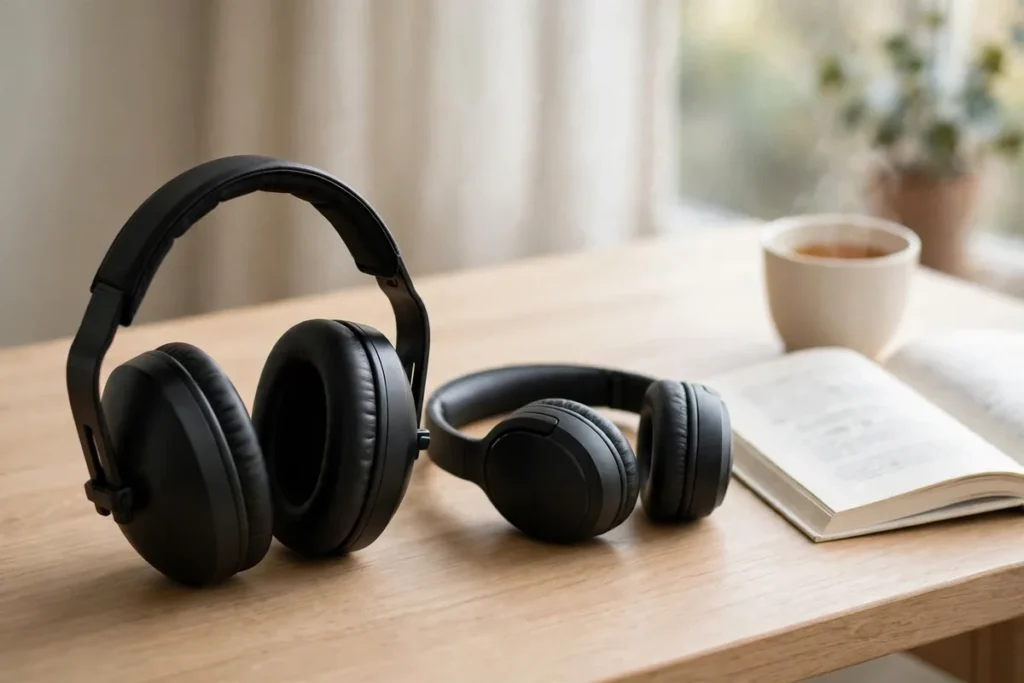
Most guides to the best headphones for hearing protection are written for building sites and shooting ranges. This one is not. If you live with tinnitus or hyperacusis — sound sensitivity where ordinary noise, from a busy cafe to a vacuum cleaner, feels painfully loud — your problem is different. You do not need the highest possible noise rating for an eight-hour shift next to machinery. You need something you can actually wear for hours at home, at work, on a train or in a supermarket without it squeezing your head, overheating your ears or making the pressure in your ears feel worse.
So we have built this list around daily life: passive ear muffs with honest, certified ratings, low-pressure noise cancelling headphones used for quiet rather than music, and filtered earplugs that turn the world down without sealing you off from it. One important line before we start: everything here manages sound exposure. None of it treats tinnitus, hyperacusis or any other condition, and none of it is a substitute for advice from an audiologist or ENT specialist. If your symptoms are new, one-sided, worsening or distressing, get them checked properly first — then use this guide to make everyday noise more manageable.
Our verdict: the best headphones for hearing protection for daily life
Best overall for daily quiet: the Bose QuietComfort Headphones pair class-leading noise cancelling with one of the lightest, lowest-pressure fits in the business — the pair most sound-sensitive people can keep on all day.
Best passive protection, no batteries: the ProCase Noise Reduction Ear Muffs carry a certified NRR 28 dB rating, fold flat and are always ready — no charging, no electronics, nothing to run flat.
Best discreet option for sleep and focus: the Loop Quiet 2 earplugs deliver up to 24 dB (SNR) of reduction in soft silicone that stays comfortable for side sleepers and long study sessions.
All six picks at a glance
| Product | Type | Rated reduction | Best for | Check |
|---|---|---|---|---|
| Bose QuietComfort Headphones | ANC over-ear | Not NRR rated (consumer ANC) | All-day daily quiet, low clamping force | Check Price |
| Sony WH-1000XM5 | ANC over-ear | Not NRR rated (consumer ANC) | Travel and constant low-frequency noise | Check Price |
| ProCase Noise Reduction Ear Muffs | Passive ear muffs | NRR 28 dB, ANSI S3.19 certified | Strong protection with zero batteries | Check Price |
| 3M Peltor X4A | Passive ear muffs | NRR 27 dB | Slim, low-profile passive protection | Check Price |
| Loop Experience | Filtered earplugs | 18 dB (SNR) filtered reduction | Socialising, concerts, keeping speech clear | Check Price |
| Loop Quiet 2 | Silicone earplugs | Up to 24 dB (SNR) | Sleep, focus and discreet daily wear | Check Price |
Hearing protection, noise cancelling and tinnitus: what actually helps?
The single most useful thing to understand is that “hearing protection” covers three different technologies, and they suit different problems. Passive ear muffs physically block sound with foam and a sealed cup, and they carry a lab-tested Noise Reduction Rating (NRR). Active noise cancelling (ANC) headphones use microphones and anti-noise to erase steady, low-frequency sound — engine drone, air conditioning, traffic rumble — but they carry no NRR and are not certified protective equipment. Filtered earplugs sit in between: an acoustic filter lowers volume fairly evenly across frequencies, so speech and music still sound natural, just quieter.
For tinnitus, total silence is often not the goal. Many people notice their tinnitus most in a completely quiet room, which is why heavy muffs worn all day indoors can actually make the ringing feel more prominent, and why clinicians generally warn against over-protecting your ears in normal, safe sound levels — it can make everyday sound feel even more intrusive over time. The practical sweet spot for most sound-sensitive readers is reduction matched to the situation: strong passive protection for genuinely loud environments, gentle ANC or filtering for the moderately noisy middle of daily life, and nothing at all in quiet, safe settings. Our explainer on active noise cancellation vs passive isolation digs into how the two approaches differ frequency by frequency.
Do noise cancelling headphones make tinnitus worse?
ANC does not damage hearing and does not change the underlying causes of tinnitus, but some people dislike the sensation of ear pressure that strong cancelling can create, especially in very quiet rooms where there is little for the system to cancel. If that sounds familiar, our guide to why noise cancelling headphones cause pressure explains the effect and how to reduce it. Models with adjustable cancelling levels — or a lighter-touch fit like the Bose below — are usually the safer starting point for hyperacusis, because you can back the effect off rather than living with an all-or-nothing seal.
What we looked for in this list
Long-wear comfort first. For sound sensitivity, a product you remove after twenty minutes protects nothing. We prioritised low clamping force, soft and spacious ear cups, lighter weights and designs that do not cook your ears over a full morning of wear.
Honest ratings. Where a product claims hearing protection, we only used manufacturer-published, certified figures — NRR for the muffs, SNR where that is the standard a maker publishes for earplugs. Where a product is a consumer ANC headphone, we say plainly that it is not rated hearing protection.
Strength against constant noise. Hyperacusis flare-ups are often triggered by relentless background sound — open-plan offices, flights, road noise. ANC earns its place here because nothing else touches steady drone as effectively, and it does so without needing volume or a vice-like seal.
Options for sleep, concentration and going out. One product rarely covers a whole life. The list deliberately spans over-ear ANC, two muffs with different profiles, and two in-ear options for the situations where headphones are impractical or draw unwanted attention.
1. Bose QuietComfort Headphones — best overall for daily quiet

The Bose QuietComfort line has built its reputation on exactly the two things this article cares about: strong noise cancelling and a fit that disappears. At around 240 grams with plush cushions and a notably gentle clamp, these are the ANC headphones we would hand to someone with hyperacusis first. The cancelling is excellent against the constant noises that wear sensitive ears down — traffic, HVAC, aircraft cabins, the roar of a busy road outside a home office — and Bose’s Quiet and Aware modes let you choose between full cancelling and hearing the world around you without taking the headphones off.
Just as important for this use case, the Bose app gives you control rather than a single fixed effect, and the physical buttons are easy to find by touch. Battery life is rated at up to 24 hours, so a full day of quiet does not end with a charging cable. Be clear-eyed about the limitation, though: like all consumer ANC headphones, these carry no NRR and are not certified hearing protection. For daily-life noise management they are our top pick; for genuinely hazardous noise, use the rated muffs further down this page instead.
2. Sony WH-1000XM5 — best for travel and constant noise

If your hardest environments are planes, trains and long commutes, the Sony WH-1000XM5 is the other ANC heavyweight to consider. Sony’s Auto NC Optimizer adjusts cancelling to your surroundings and wearing conditions, the headset weighs around 250 grams, and battery life is rated at up to 30 hours — enough for the longest travel day with plenty to spare. Multipoint Bluetooth means it can stay connected to a laptop and a phone at once, which suits anyone using it as an all-day work shield as much as a travel one.
The fit is light but the headband design divides opinion: it does not fold flat, and some wearers find the narrower headband concentrates pressure on one spot during very long sessions. For sound-sensitive users we would call it the best travel pick and the runner-up for all-day home wear, behind the softer-clamping Bose. As with the Bose, there is no NRR here — treat it as powerful comfort technology for everyday noise, not as certified protection.
3. ProCase Noise Reduction Ear Muffs — best passive protection, no batteries

Sometimes the right answer is not electronics at all. The ProCase ear muffs are simple passive defenders — a solid ABS shell with thickened foam — carrying a certified NRR 28 dB rating under ANSI S3.19. That is real, lab-rated protection of the kind ANC headphones cannot claim, delivered with nothing to charge, pair or update. They fold down compactly, the headband adjusts across a wide size range, and the padded cups are roomy enough that your ears are not folded against your head.
ProCase is honest that the muffs feel snug at first — a tight seal is how passive protection works — and suggests stretching them over a box for a day or two if the clamp bothers you. For hyperacusis, we would position these as your heavy-duty option: DIY noise, garden machinery, fireworks, a loud family event you cannot leave. For moderate daily noise they are more protection than most people need, and wearing them for hours in quiet settings is exactly the over-protection pattern worth avoiding.
4. 3M Peltor X4A — best slim, low-profile passive muffs

3M’s Peltor X series is the grown-up end of passive protection, and the X4A is the model that best fits a comfort-led list. It is rated at NRR 27 dB, yet the cups are noticeably slimmer and lower-profile than most muffs with similar ratings, and the whole headset weighs around 8 ounces. The wire headband is designed to keep its pressure consistent over long wearing periods rather than gradually squeezing harder, and the ear cushions use a foam formulation aimed at balancing attenuation with comfort.
That slimmer profile matters in daily life more than it does on a work site: the X4A looks less industrial, works better if you wear glasses, and is easier to combine with a hat or hood. It is still a rated muff built for genuinely loud environments, so the same guidance applies — reach for it when the noise is truly loud, not as an all-day default in a quiet house. If your loud environments are workplaces rather than daily life, our separate guide to the best Bluetooth hearing protection covers the job-site end of this category, including models with built-in audio and calls.
5. Loop Experience — best filtered option for socialising and concerts

Over-ear anything is the wrong tool for a restaurant, a family gathering or a gig you actually want to enjoy. The Loop Experience earplugs use an acoustic filter to deliver around 18 dB (SNR) of reduction that is deliberately even across frequencies, so voices and music sound like themselves — just turned down. For hyperacusis, that distinction is the whole point: ordinary foam plugs muffle speech and make you feel cut off, which is why people take them out. A filtered plug you keep in protects far more than a stronger plug sitting in your pocket.
The silicone tips come in four sizes from XS to L, the ring design sits discreetly in the ear rather than dangling like a foam plug, and they are reusable and washable. They are not the strongest reduction on this page and they are not rated for industrial noise — they are a social tool, for concerts, cinemas, busy restaurants, school events and open-plan offices where you need the edge taken off, not the world switched off.
6. Loop Quiet 2 — best for sleep, focus and discreet daily wear

The Loop Quiet 2 is the stronger, softer sibling: up to 24 dB (SNR) of reduction from flexible silicone plugs designed to be worn for hours, including in bed. Four tip sizes help you find a seal that does not ache, the low-profile shape suits side sleepers far better than any over-ear option, and the included carry case makes them an easy permanent resident in a pocket or bag for unpredictable noise — a loud train carriage, a drilling neighbour, a supermarket at peak hour.
For concentration, these are arguably the most practical pick in the whole list: no battery, no Bluetooth, no headband to fight with a chair’s headrest, and enough reduction to take a busy household or office down to a manageable murmur while alarms and a close-by voice still get through faintly. If sleep is your main use case, it is worth reading our dedicated guide to the best noise cancelling headphones for sleeping alongside this pick, as it compares in-bed options in more depth.
Which type fits your day?
For working from home or studying: start with ANC if your enemy is constant noise — traffic, appliances, a boiler hum — and choose the Bose for all-day comfort. If your enemy is intermittent noise like doors, voices and barking, passive options and the Loop Quiet 2 blunt those peaks better than ANC does.
For travel: the Sony WH-1000XM5 is our pick for flights and long journeys, where its cancelling and battery life shine. Pack the Loop Quiet 2 as well for sleeping at the destination — the two together cover a trip better than either alone.
For social life and events: the Loop Experience, every time. It is the only option here designed to keep conversation natural at a lower volume, and its discretion means you will actually use it.
For genuinely loud jobs around the home: mowing, power tools, leaf blowers — use the rated muffs. The ProCase for maximum rated reduction on a simple design, the Peltor X4A if you want the slimmer profile or wear glasses.
A final word on using protection well
The best headphones for hearing protection are the ones matched to the noise in front of you — no more, no less. Wear rated protection whenever sound is genuinely loud enough to be a risk, use lighter reduction for the everyday middle ground, and give your ears regular time with normal, safe sound levels in between. If tinnitus or sound sensitivity is affecting your sleep, work or peace of mind, please treat this article as a starting point for managing your environment, not as medical guidance, and talk to an audiologist about your specific situation.
Frequently asked questions
Are noise cancelling headphones classed as hearing protection?
No. Consumer ANC headphones such as the Bose QuietComfort and Sony WH-1000XM5 carry no NRR and are not certified protective equipment. They are excellent at reducing constant everyday noise for comfort, but for hazardous noise levels you need rated ear muffs or earplugs with a published NRR or SNR.
Can hearing protection make tinnitus sound worse?
In a very quiet environment, any strong reduction makes internal sounds more noticeable, so tinnitus can feel more prominent while you are wearing protection indoors. That is an effect of the quiet, not damage from the product. It is also why clinicians generally advise against wearing strong protection all day in safe, quiet settings.
What is the best option for hyperacusis at work?
For an office, most people do best with either low-pressure ANC headphones for constant background noise, or filtered earplugs such as the Loop Experience when they still need to hear colleagues clearly. Which suits you depends on whether your triggers are steady noise or sudden sounds, and it is worth discussing a long-term plan with an audiologist.
How much noise reduction do I need for daily life?
For everyday environments — commuting, cafes, open-plan offices, busy streets — moderate reduction in the range offered by filtered plugs and ANC is usually the comfortable sweet spot. Save high-NRR muffs for genuinely loud activities such as power tools, mowing or shooting, where certified ratings matter.
Can I sleep in hearing protection?
Soft silicone earplugs such as the Loop Quiet 2 are designed for overnight wear, including for side sleepers, and are the practical choice for sleep. Over-ear muffs and ANC headphones are generally too bulky for bed, though some people use them for naps on their back or while travelling.

I am the founder of Sound Mavericks, where I provide the polite truth about audio equipment. I started this site because consumer electronics reviews are often too technical. Instead of using a silent lab, I test headphones, earbuds, and Bluetooth speakers in the real world – like on a noisy subway or in a busy coffee shop.
To stay independent, I buy my own review units (mostly from the United States) rather than accepting free gifts from brands. Once I finish testing a product, I sell it locally to our community. My goal is to help you understand sound quality, active noise cancellation (ANC), and battery life without the marketing hype.

