
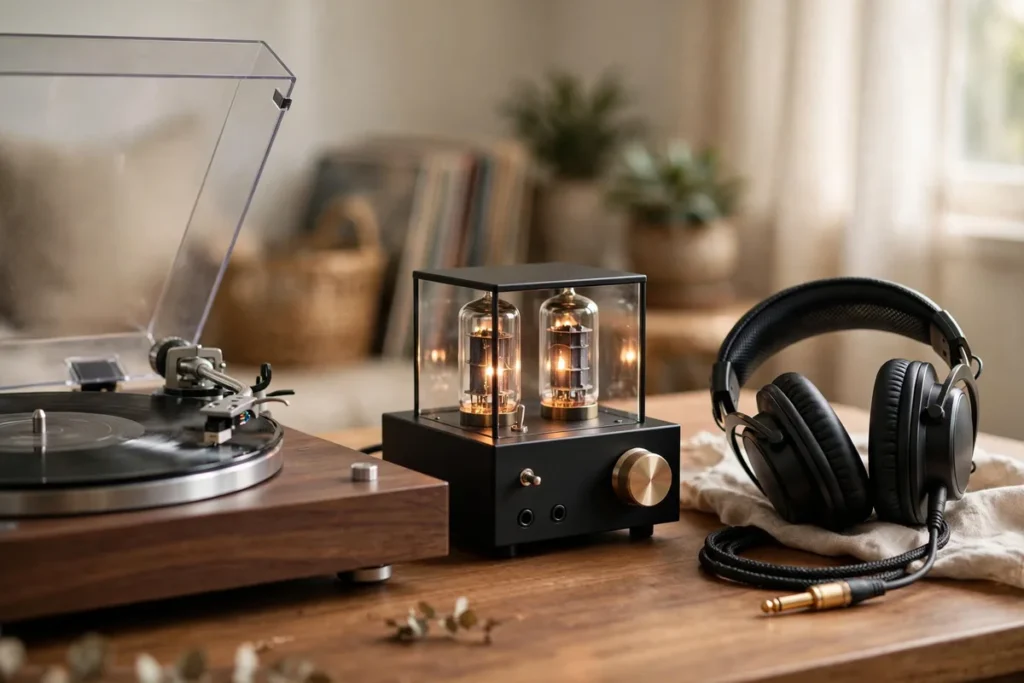
Our Picks at a Glance: Vinyl on Headphones, Sorted by Your Turntable
The right pick depends on one question: does your turntable already have a phono stage? If not, the Fosi Audio Box X4 is the simplest fix — phono stage and headphone amp in one small tube box. If you want one unit that also drives speakers, the Sony STRDH190 takes a turntable directly and feeds headphones from its front jack. If your turntable already outputs line level, the Schiit Magni Heretic is the cleanest dedicated headphone amp to plug it into.
Listening to records on headphones should be simple. In practice it trips up more buyers than almost any other hi-fi purchase, because a turntable does not produce a normal audio signal. Plug a headphone amp straight into a turntable with no phono stage and you get sound that is whisper-quiet, thin and all treble. The missing piece is not power. It is the phono stage — and whether you need one decides which amp actually makes sense for you.
This guide works the problem in the right order. First, the signal chain, explained plainly, so you can tell in about a minute what your turntable needs. Then the picks: amps with a built-in phono stage, full-size amplifiers and receivers whose headphone jacks do the same job, and separate phono stage plus headphone amp pairings. Every recommendation below grows out of that chain — there is no pick here that cannot actually be wired to a record player.
The Vinyl Signal Chain: Why a Headphone Amp Alone Is Not Enough
A phono cartridge generates a signal roughly a hundred times weaker than the line-level output of a phone or streamer. It is also recorded with the bass cut and the treble boosted — the RIAA curve, which lets more music fit in the groove. Before headphones can use that signal, it must be amplified to line level and the RIAA curve reversed so bass and treble return to their natural balance. The circuit that does both jobs is the phono stage, also called a phono preamp.
Only after that does the headphone amp take over, adding the current and volume control your headphones need. The full chain always looks like this:
Turntable → Phono Stage (RIAA) → Headphone Amp → Headphones
The phono stage can live in three places: built into your turntable (output labelled LINE, often via a PHONO/LINE switch on the back), built into the amplifier as a dedicated PHONO input, or in a separate small box between turntable and amp. Or it may not exist in your system at all — the case with most classic and audiophile turntables that offer phono output only.
That single fact decides your shopping list. A turntable with line output can feed any headphone amp directly. A phono-only turntable needs an amp with a phono input or a separate phono stage in front of the amp — no headphone amp, however powerful, can substitute for the missing RIAA stage. A phono preamp and a headphone amp are different products doing different jobs, a distinction we unpack in our preamp vs amp explainer.
Best Headphone Amps for Turntables at a Glance
| Product | Phono Stage? | Headphone Output | Also Drives | Best For | Buy |
|---|---|---|---|---|---|
| Fosi Audio Box X4 | Yes — MM, built in | 3.5mm | Powered speakers via RCA out | One-box vinyl headphone listening | Check Price |
| Sony STRDH190 | Yes — phono input | 6.35mm (1/4 inch) | Passive speakers, Bluetooth sources | Receiver route, speakers + headphones | Check Price |
| Yamaha A-S301BL | Yes — MM phono | 6.35mm (1/4 inch) | Passive speakers, digital sources | Stepping up to a serious integrated amp | Check Price |
| Denon PMA-600NE | Yes — MM phono | 6.35mm (1/4 inch) | Passive speakers, Bluetooth + optical | Premium integrated with vinyl in mind | Check Price |
| Schiit Magni Heretic | No — line level in | 6.35mm (1/4 inch) | Preamp out to powered speakers | Best dedicated headphone amp | Check Price |
| Fosi Audio Box X5 | Yes — MM + MC, it is the phono stage | None — pairs with an amp | Any line-level amp via RCA out | Best separate phono stage pairing | Check Price |
| Fosi Audio MC331 | No — line level in | 3.5mm | Passive speakers, Bluetooth + DAC inputs | Compact tube hub for line-out turntables | Check Price |
Fosi Audio Box X4 — Best One-Box Phono Stage and Headphone Amp

The Fosi Audio Box X4 is the most direct answer to this entire search: a phono preamp and a headphone amplifier in one palm-sized box. Your turntable’s phono output connects to its MM input (ground terminal alongside), the RIAA stage works through a pair of JAN 5654W vacuum tubes, and your headphones plug into the 3.5mm jack on the front. No receiver, no second box. For a phono-only turntable, this is the shortest route from groove to ears.
Fosi rates the headphone output for 16 to 300 ohm headphones, covering most wired headphones, and adds bass and treble controls — genuinely useful with vinyl, where an older pressing can sound dull or bright. A 3.5mm AUX input takes a phone or computer, and an RCA output feeds powered speakers. The honest limits: MM only, so moving-coil cartridges need a different stage, and its noise specifications are modest next to the separates below. As a first vinyl headphone station, nothing else here is this easy.
Sony STRDH190 — Best Receiver for Turntables and Headphones

If your vinyl setup is also your living-room stereo, the Sony STRDH190 is the pragmatic centrepiece. A dedicated phono input with its own phono stage takes a phono-only turntable directly, and a full-size 6.35mm headphone jack on the front covers late-night listening — plugging in headphones is the whole setup. Around that core: 100 watts per channel for passive speakers, four RCA inputs, a 3.5mm input, FM radio and Bluetooth.
SoundMavericks’ read: the STRDH190’s headphone output is a convenience output driven from the main amplifier, not a dedicated headphone circuit, so it will not match the Magni Heretic below with demanding headphones. For the efficient headphones most vinyl listeners own, it is clean, quiet and loud enough — and it replaces three boxes with one. If speakers are half your listening, start here.
Yamaha A-S301BL — Best Integrated Amp Step-Up for Vinyl

The Yamaha A-S301BL is where this list moves from convenience into proper hi-fi. Its MM phono input feeds a well-regarded phono stage, its 60 watts per channel drive real speakers with authority, and the front-panel 6.35mm headphone jack makes it a complete turntable-to-headphones solution in one full-width chassis. Yamaha’s build is a clear class above budget receivers, and the sound stays cleaner at low volume — exactly where headphone listening lives.
Optical and coaxial inputs let a TV or streamer join the same system and headphones. There is no Bluetooth, and the headphone jack is a high-quality convenience output rather than a standalone headphone amplifier. As a system hub you will keep for a decade, the A-S301BL is the strongest value here.
Denon PMA-600NE — Best Premium Integrated With Phono and Headphones

The Denon PMA-600NE takes the same one-box formula — MM phono input, headphone jack, speaker amplification — and executes it at a higher level. Denon’s Advanced High Current design delivers 70 watts per channel into 4 ohms, keeping bass tight on speakers and headphones alike, the phono stage is voiced for a warm, full vinyl presentation, and Bluetooth plus optical and coaxial inputs cover digital sources.
Choose the Denon over the Yamaha if headphones are the priority and your speakers are demanding, or if you prefer Denon’s fuller presentation. The wiring is simple: turntable into PHONO, ground wire to the terminal, headphones into the front jack. It is the most complete single purchase here.
Schiit Magni Heretic — Best Dedicated Headphone Amp for Vinyl

The Schiit Magni Heretic is the opposite philosophy: no phono stage, no speaker amp, no extras — just a dedicated headphone amplifier done properly. Schiit specifies 2.4 watts of output and 120dB SINAD, which in plain terms means enough clean power for almost any headphone you can name, with vanishingly low distortion. It takes a line-level RCA signal, drives headphones from a 6.35mm jack, and doubles as a preamp for powered speakers.
For vinyl, that line-level requirement defines its two valid chains. If your turntable has a built-in phono stage, set it to LINE and connect it straight to the Magni — the best-sounding simple setup in this guide. If your turntable is phono-only, the Magni needs a phono stage in front of it, which is exactly the pairing covered next. What you get for respecting the chain is headphone drive quality receiver jacks cannot match, especially with planar magnetic and high-impedance headphones. It also anchors our broader roundup of the best headphone amps for non-vinyl sources.
Fosi Audio Box X5 — Best Phono Stage to Pair With a Headphone Amp

The Fosi Audio Box X5 is not a headphone amp — we list it because pairing it with one is the best-sounding route for a phono-only turntable. It is a dedicated phono stage handling MM and MC cartridges, with four switchable gain levels (38, 48, 56 and 66dB) covering everything from high-output moving magnets to low-output moving coils. Its RCA output feeds any line-level headphone amp: turntable into the Box X5, Box X5 into the Magni Heretic, headphones into the Magni.
Why bother, when the Box X4 does both jobs in one unit? Headroom and upgrade paths: a stronger headphone amplifier, a more flexible phono stage, and either half upgradeable later. If phono stages are the part of the chain you want to research deeply, our guide to the best preamp for turntable setups is the companion read — it covers phono preamps as products in their own right, while everything here is chosen for getting records into headphones.
Fosi Audio MC331 — Best Compact Tube Hub for Line-Out Turntables

The Fosi Audio MC331 earns its place with a clear condition stated first: it has no phono stage. Its RCA input is line level, so it suits turntables with a built-in phono stage (set to LINE) or one already running through a separate phono preamp. Some roundups blur this point; a phono-only turntable wired into the MC331 gives the same quiet, thin sound this guide opened with. Within its actual role it is a delightful desktop hub: hybrid tube amplification with JAN 5654W tubes, a DAC, a VU meter, 105 watts per channel into 4 ohms, and a 3.5mm headphone output.
Bluetooth, USB, optical and coaxial inputs mean the same box handles your computer and phone, and a pre-out lets you add a subwoofer later. For a desk listener whose turntable already outputs line level, the MC331 is the pick. For a phono-only deck, look back at the Box X4 or the receivers instead.
Do You Need a Phono Stage, a Headphone Amp, or Both?
Work through your turntable, not the listings. If it has a PHONO/LINE switch or a line output, its phono stage is built in: you need only a headphone amp (the Magni Heretic or the MC331), or any amp with a line input and a headphone jack. If it offers phono output only — most vintage and audiophile decks — the phono stage must come from somewhere: an amp’s PHONO input (Sony, Yamaha, Denon), a combined box (Box X4), or a separate unit (Box X5) in front of a headphone amp.
Can I plug headphones directly into my turntable?
Only if the turntable itself has a headphone jack and volume control, which a few modern all-in-one decks offer. A phono or line output alone cannot drive headphones properly — no volume control, not enough current — and a phono output also skips RIAA correction, so the sound is wrong as well as quiet. An amp of some kind is always in the chain; the only question is how it is split across boxes.
What happens if I use two phono stages by mistake?
It is the most common vinyl wiring error: a turntable set to LINE feeding an amp’s PHONO input applies RIAA correction and gain twice, producing loud, boomy, distorted sound. The rule is one phono stage per chain — LINE into a line input, PHONO into a phono input or separate phono stage, never both. If your setup sounds wildly bass-heavy, check this first.
How to Choose: Power, Impedance and Cartridge Type
Three checks finish the decision. First, cartridge type: moving magnet (MM) is standard and every phono stage here supports it; moving coil (MC) cartridges need MC support or higher gain, which only the Box X5 provides among our phono options. Second, headphone demand: most wired headphones are easily driven by any pick here, but low-sensitivity planar magnetics and 300-ohm classics reward a dedicated amp — our explainer on headphone impedance and whether you need an amp covers the matching maths. Third, growth: if speakers or a streamer are in your future, the integrated amps and the MC331 grow with you; if headphones are the whole system, the Box X4 or the Magni pairing is the cleaner spend. Finally, always connect the turntable’s ground wire to the GND terminal, or you will chase a mains hum no upgrade can fix.
Frequently Asked Questions
Can you use a headphone amp with a turntable?
Yes, as long as a phono stage sits somewhere before it in the chain. If your turntable has a built-in phono stage or line output, connect it directly to the headphone amp. If it is phono-only, use an amp with a phono input, a combined phono-and-headphone unit like the Fosi Box X4, or a separate phono stage between the turntable and the amp.
What is the best headphone amp for turntables overall?
For most phono-only turntables, the Fosi Audio Box X4 is the simplest complete answer, since it combines the phono stage and headphone amp in one box. For the best sound quality, pair the Fosi Box X5 phono stage with the Schiit Magni Heretic. If speakers matter too, the Sony STRDH190, Yamaha A-S301BL and Denon PMA-600NE all take a turntable directly and feed headphones from the front panel.
Why does my turntable sound quiet and thin through headphones?
Because the signal is bypassing the phono stage. A phono cartridge’s output is very weak and recorded with the RIAA curve applied, so without a phono stage to amplify it and reverse that curve, the sound is quiet, bass-light and overly bright. Add the phono stage — built into the turntable, the amp or a separate box — and normal volume and tonal balance return.
Does a receiver’s headphone jack sound as good as a dedicated headphone amp?
For most headphones, a good receiver or integrated amp jack is clean and satisfying. A dedicated headphone amp like the Schiit Magni Heretic pulls ahead with demanding headphones — low-sensitivity planars and high-impedance models — where its higher, cleaner power output and lower output impedance keep bass controlled and volume effortless.
Do I need a DAC for a turntable headphone setup?
No. Vinyl is an analogue source end to end: cartridge, phono stage and headphone amp are all analogue, and no digital conversion is involved. A DAC only enters the picture if the same amp also serves digital sources, which is why units like the Fosi MC331 and the Yamaha and Denon integrated amps include digital inputs alongside their analogue ones.
What is the difference between a phono preamp and a headphone amp?
A phono preamp amplifies a cartridge’s weak signal to line level and applies RIAA equalisation; it is not designed to drive headphones. A headphone amp takes a line-level signal and provides the power and volume control headphones need. Vinyl headphone listening requires both jobs done in sequence, whether by one combined unit, an amplifier with a phono input, or two separate boxes.
Final Verdict: The Best Headphone Amp for Turntables and Vinyl Records
Start from your turntable and the answer picks itself. Phono-only deck, headphones only: the Box X4 is the one-box solution, and the Box X5 plus Magni Heretic pairing is the upgrade path. A system with speakers: the Sony STRDH190 for value, the Yamaha A-S301BL for the step up, the Denon PMA-600NE for the premium version of the same idea. A turntable that already outputs line level: the Magni Heretic for pure headphone listening, or the MC331 as a compact tube hub. Get the chain right — phono stage first, headphone amp second — and vinyl on headphones is as simple and as good as it should be.

I am the founder of Sound Mavericks, where I provide the polite truth about audio equipment. I started this site because consumer electronics reviews are often too technical. Instead of using a silent lab, I test headphones, earbuds, and Bluetooth speakers in the real world – like on a noisy subway or in a busy coffee shop.
To stay independent, I buy my own review units (mostly from the United States) rather than accepting free gifts from brands. Once I finish testing a product, I sell it locally to our community. My goal is to help you understand sound quality, active noise cancellation (ANC), and battery life without the marketing hype.

