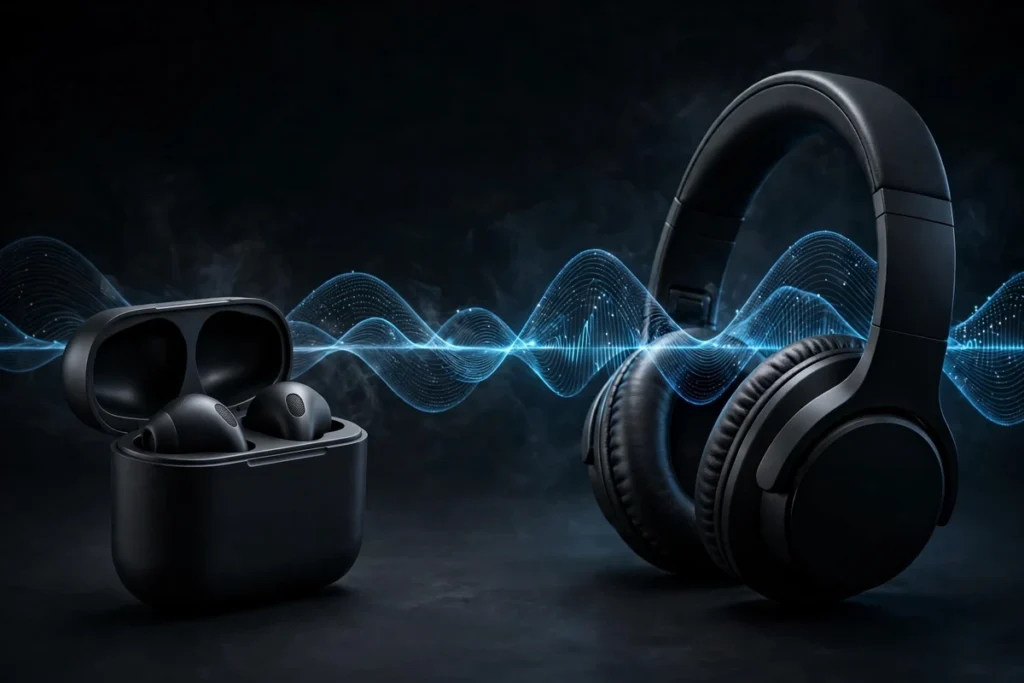
Ask whether earbuds or headphones deliver better bass and you will get a confident answer in both directions — because both sides are measuring something different. If by bass you mean the deepest, lowest notes, a well-sealed earbud can genuinely beat a much bigger headphone. If by bass you mean the physical thump of a kick drum landing, over-ear headphones win, and it is not especially close. The honest answer to earbuds vs headphones for bass is that they win different parts of the low end, for reasons that come down to physics: seal versus size. This guide explains that physics in plain terms, then matches each format to the listening you actually do.
The Short Answer
For deep sub-bass extension: earbuds and in-ear monitors, provided the ear tip seals properly. For slam, impact and space: over-ear headphones. For bass on the move: earbuds, because they keep their seal — and their bass — while you walk, train and travel. The three products below are the examples used throughout this article: a sealed flagship earbud that proves tiny drivers can go deep, and two over-ears built specifically around low-end impact.
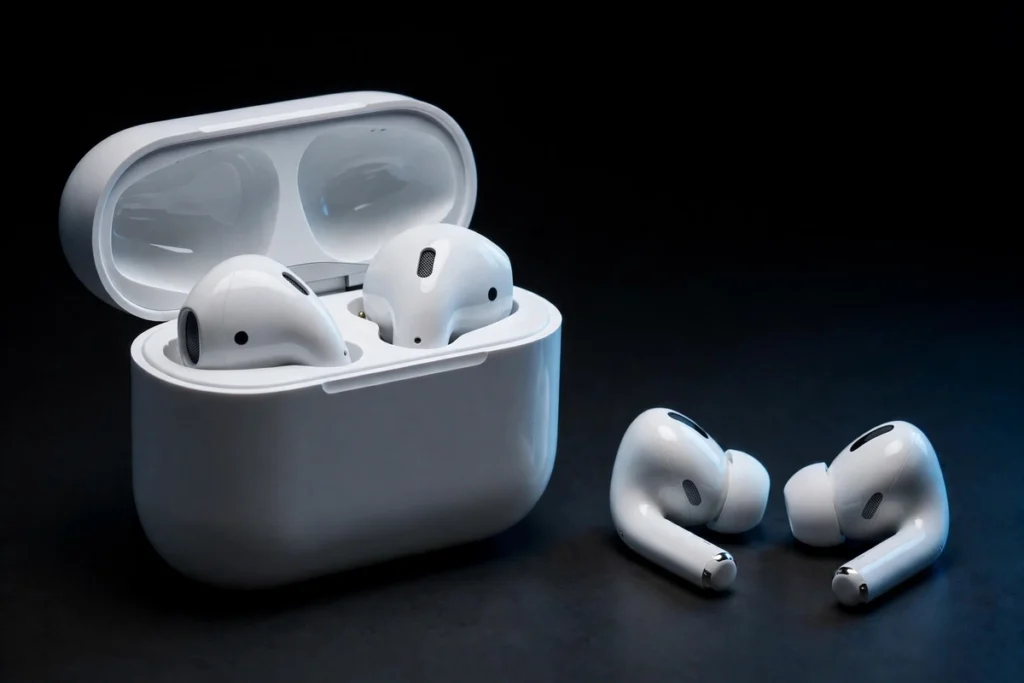
Earbud example — Sony WF-1000XM5: an 8.4mm driver that reaches deep through seal and tuning, not size.
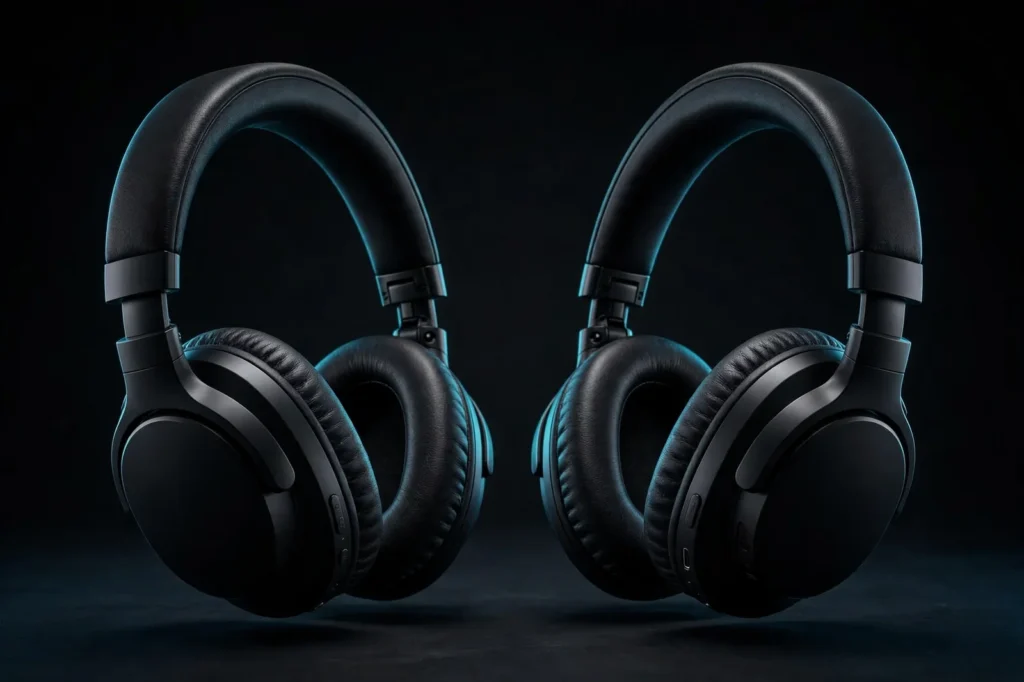
Headphone example — Sony WH-XB910N: a 40mm EXTRA BASS over-ear tuned for weight and punch.
Maximum-impact example — Skullcandy Crusher ANC 2: an over-ear with adjustable sensory bass designed to be felt as much as heard.
What “Better Bass” Actually Means
Most arguments about bass are really arguments about vocabulary. “Bass” covers roughly everything below 250Hz, but your ears and body experience that range in at least two very different ways, and the two formats in this comparison specialise in different halves of it.
Sub-Bass vs. Mid-Bass
Sub-bass, roughly 20–60Hz, is the lowest octave in most music: the rumble under an electronic track, the felt pressure in a film soundtrack. You hear sub-bass partly and feel it partly, and reproducing it is mainly a problem of air pressure — the driver has to pressurise the space in front of your eardrum without that pressure leaking away. Mid-bass, roughly 60–250Hz, is where kick drums punch, bass guitars carry their weight, and most of what people casually call “punchy bass” actually lives. A product can be thunderous in the mid-bass and modest in the sub-bass, or deep in the sub-bass and restrained up top — and listeners will describe both, confusingly, as “great bass.”
Extension vs. Slam
Two more words separate the formats cleanly. Extension is how low a product can go before its output rolls off. Slam is the physical sensation of a bass note arriving — pressure hitting not just your eardrum but the skin around your ear. Earbuds compete on extension; over-ears compete on slam. Keep those contests separate and most contradictions in this debate disappear: the earbud owner who says “mine go deeper” and the headphone owner who says “mine hit harder” are usually both right.
Why Tiny Earbuds Can Hit Surprisingly Deep Sub-Bass
It seems impossible on paper. A typical true wireless earbud driver measures somewhere between 6mm and 11mm across; the Sony WF-1000XM5 uses an 8.4mm driver. A typical over-ear driver is 40mm or more. If bass were purely about diaphragm area, the contest would be over before it started. It is not, because of where the earbud puts that small driver.
An in-ear earbud seals directly into the ear canal and fires into a tiny enclosed volume — a fraction of a millilitre of air between the ear tip and your eardrum. Pressurising a very small sealed volume takes very little air movement: the driver barely has to move to generate real pressure at 30Hz or 40Hz, because almost none of that pressure escapes. The earbud is, in effect, a pressure chamber coupled straight to your eardrum, and pressure chambers are extraordinarily efficient at low frequencies. That is why good in-ear monitors consistently hold their sub-bass level flat down to the bottom of the audible range, sometimes better than far larger headphones.
The catch is in the phrase “well-sealed.” Break that seal — wrong tip size, a shallow fit, jaw movement while talking — and the pressure escapes, and sub-bass collapses first and fastest. A leak that barely changes the treble can cost most of the deepest bass. This is why two people can hear the same earbud as either “deep and full” or “thin and weak,” and why fit is not a comfort detail on the earbud side of this comparison; it is the bass specification.
Why Over-Ear Headphones Win on Slam and Soundstage
Over-ear headphones play a different physical game. Their drivers sit outside the ear, in cups that enclose the whole outer ear, and they move considerably more air with each excursion. That air movement reaches more than the eardrum: it presses against the outer ear and the pads around it, and at higher levels you register bass notes as a physical event, not just a sound. That is slam — and it is something an earbud, pressurising a pinhead of air inside the canal, structurally cannot replicate, no matter how deep its measured extension goes.
The cups buy a second advantage: space. Because the drivers sit further from the ear in a chamber, over-ears create a wider perceived soundstage — instruments feel arranged around you rather than lined up inside your head, and bass in a film score or live recording feels like it occupies a room. Our explainer on what soundstage in headphones actually is breaks it down. The trade-off is that the over-ear seal is a pad resting against skin, hair and glasses frames — a larger, softer, less reliable seal than an ear tip in a canal. Glasses arms under a pad leak low frequencies quietly and constantly, and no driver size fully compensates for a bass leak.
Seal vs. Driver Size: Which Matters More?
Put the two variables head to head and the ranking is clear. Seal decides whether the bass exists at all; driver size decides how it feels. A sealed 8.4mm earbud will out-extend an unsealed 40mm headphone every time, because the headphone’s output is leaking into the room before it builds pressure. But give both a proper seal and the larger driver’s advantages return: more headroom before distortion, more physical impact, and bass that stays composed when the track gets busy and loud.
There is also a consistency difference. An earbud’s seal, once you find the right tip, is repeatable — the bud goes in the same way every time. An over-ear’s seal varies with how the headphone sits, whether you are wearing glasses, and how worn the pads are. So earbud bass tends to be more predictable day to day, while headphone bass can subtly change with a hat or ageing pads. Neither format is “cheating” — they are two engineering answers to the same problem, optimising different variables.
The Examples, Side by Side
The three products below were chosen because each one isolates a lesson from the physics above — not because they are the only good options. Readers comparing full line-ups should also browse our guides to the best bass headphones and the best bass wireless earbuds.
| Product | Format | How It Makes Its Bass | Best For | Buy |
|---|---|---|---|---|
 Sony WF-1000XM5 | In-ear earbuds, 8.4mm driver | Airtight ear-canal seal and tuning — deep sub-bass extension from a tiny pressurised volume | Deep bass on the move; listeners who value extension over physical impact | Check Price |
 Sony WH-XB910N | Over-ear headphones, 40mm driver | EXTRA BASS tuning and a large driver moving air around the whole ear — weight and punch | Home and commute listening where physical bass weight matters | Check Price |
 Skullcandy Crusher ANC 2 | Over-ear headphones, adjustable sensory bass | A dedicated sensory bass system you can dial up or down — slam as a feature, not a side effect | Listeners who want the strongest physical impact, for music and films | Check Price |
Read the middle column as the whole article in miniature: seal and tuning on the earbud row, air movement and dedicated bass hardware on the headphone rows. The Skullcandy Crusher ANC 2 is the clearest illustration of slam as a design goal — its bass is adjustable precisely because impact, unlike extension, is a matter of taste and dose. The Sony WH-XB910N sits in the middle: a conventional large driver with bass-forward tuning, physical without being theatrical.
Leakage, Noise and EQ Headroom
Leakage Works Both Ways
Seal failures leak in both directions. Inward leaks let low frequencies escape and outside noise enter — and outside noise masks bass first, because traffic rumble and train noise live in the same low frequencies as your music. This is why noise cancelling helps perceived bass on a commute even though it adds no bass at all: it removes the competition. Outward leakage is the social version of the same physics: over-ears move more air and can be heard by the person next to you at high volume, while sealed earbuds keep almost everything in the canal — the politer system for a quiet office or shared room.
EQ Headroom: Where Each Format Runs Out
Equalisation can rebalance bass, but each format hits a different ceiling. Sealed earbuds usually have generous sub-bass EQ headroom: the driver is efficient in its tiny chamber, so a few decibels below 60Hz often stays clean, as long as you pull the preamp down to match. Over-ears have more mid-bass headroom — bigger drivers tolerate bigger boosts around 80–150Hz — but pushing sub-bass EQ into a leaky pad seal mostly wastes power. In both cases small moves win: two or three decibels beats a dramatic bass shelf that distorts everything. Our guide to the best bass EQ settings walks through sensible starting points for both formats.
Earbuds vs. Headphones for Bass, by Use Case
Commuting and Travel
Earbuds take this one, on bass consistency under real conditions. On a train or bus, noise cancelling plus an airtight seal protects the sub-bass you would otherwise lose to rumble, the buds stay sealed when you turn your head, and they disappear into a pocket at the other end. A sealed, noise-cancelling earbud like the Sony WF-1000XM5 is built for exactly this problem. Over-ears with strong ANC are a perfectly good travel choice too, but expect to re-seat them, manage the bulk, and accept that glasses and hats will nibble at the seal.
The Gym and Running
Also earbuds, by a wide margin. Over-ears trap heat, shift under movement, and lose their pad seal precisely when you move hardest — which is when the bass vanishes. A properly fitted earbud’s seal survives movement, and the bass stays where it was on the first rep. One warning: a seal that works standing still can still work loose over a long run, so secure-fit tips matter more than driver specifications here.
Home Listening, Films and Gaming
This is over-ear territory. At home there is no pocketability prize, and the things over-ears do best — slam, soundstage, long-session comfort without anything inside your ear canal — are exactly what films, games and long albums reward. Explosions should arrive as pressure, and a two-hour session should not leave your ear canals tired. This is the use case the Sony WH-XB910N and especially the Skullcandy Crusher ANC 2 were designed for, in that order of subtlety.
Office and Shared Spaces
Earbuds again, on leakage alone. Your bass stays in your ears, quick conversations are easy with one bud out, and nobody across the desk hears your playlist. Over-ears make sense at a dedicated desk in your own space, but in shared space their leakage and visibility work against them.
How to Get More Bass From What You Already Own
Before switching formats, exhaust the free fixes — most “not enough bass” complaints are seal complaints in disguise. Earbud owners: try every tip size in the box, including the one that feels slightly too big; test foam tips, which conform to the canal and seal more reliably; and do the jaw test — if the bass changes when you open your mouth, your seal is marginal. Headphone owners: check that glasses arms are not breaking the pad seal (tucking them above the pad or choosing thinner frames helps), replace flattened, worn pads, and make sure the headphone sits centred rather than pushed back. Everyone: add EQ in small steps with a matching preamp cut, and remember that turning down a noisy room — or using noise cancelling — is a bass upgrade that costs no distortion at all.
The Verdict: Which Should You Choose for Bass?
Choose earbuds if your bass listening happens in motion — commuting, training, travelling — or if you prize deep sub-bass extension in the smallest package and will earn it with a proper fit. Choose over-ear headphones if bass, to you, means physical impact: the thump in your chest’s direction, the spaciousness around a bassline, and long, comfortable sessions at home. Be honest about which definition you actually use when you listen — that answer predicts satisfaction better than any specification sheet. Driver size makes headlines; seal makes bass.
Frequently Asked Questions
Do earbuds or headphones have better bass?
It depends on the kind of bass. Sealed earbuds and in-ear monitors often reach deeper sub-bass than expected because they pressurise a tiny, sealed volume right at the eardrum. Over-ear headphones usually win on physical slam, impact and soundstage, because larger drivers move more air around the whole ear. Neither format wins every bass test.
Why do my earbuds lose bass when I move or talk?
Almost always, the seal has broken. Bass depends on the ear tip sealing the canal; jaw movement, a shallow fit or the wrong tip size lets low frequencies leak away instantly. Try a larger tip, a foam tip, or pushing the bud in with a slight twist. If one side is bassier than the other, the seals are uneven.
Does a bigger driver always mean more bass?
No. Driver size sets a ceiling for how much air can be moved, but tuning, seal and enclosure decide what you actually hear. A well-sealed 8.4mm earbud driver can produce deeper measured sub-bass than a poorly sealed 40mm headphone, while the headphone will usually feel more physical. Size is potential; seal and tuning are delivery.
Can EQ make earbuds sound like bass headphones?
EQ can raise the level of bass, and sealed earbuds often have good EQ headroom in the sub-bass because the driver sits so close to the eardrum. What EQ cannot add is physical air movement around the ear, so it cannot fully recreate over-ear slam or soundstage. Push EQ in small steps and lower the preamp to avoid distortion.
Are headphones better for bass at low volume?
Often, yes for impact, and often no for depth. At low volume our ears hear bass less efficiently, so the physical pressure of an over-ear can help bass feel present. But a sealed earbud keeps its sub-bass consistent at low levels too, and noise cancelling on either format stops you turning up just to outrun background noise.
Do bass headphones leak more sound than earbuds?
Generally, yes. Over-ear headphones move more air and have larger enclosures, and bass-heavy closed-back models can still leak at high volume, while open-back models leak a lot by design. Earbuds keep almost everything inside the sealed canal, so they are the more considerate choice for shared spaces and quiet offices.

I am the founder of Sound Mavericks, where I provide the polite truth about audio equipment. I started this site because consumer electronics reviews are often too technical. Instead of using a silent lab, I test headphones, earbuds, and Bluetooth speakers in the real world – like on a noisy subway or in a busy coffee shop.
To stay independent, I buy my own review units (mostly from the United States) rather than accepting free gifts from brands. Once I finish testing a product, I sell it locally to our community. My goal is to help you understand sound quality, active noise cancellation (ANC), and battery life without the marketing hype.