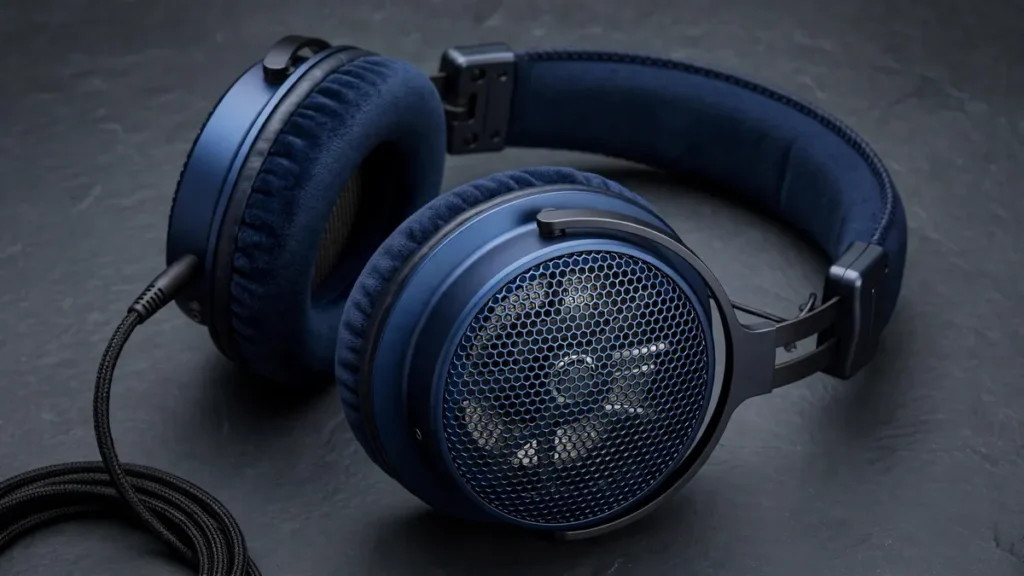
The Dyson Zone is the strangest pair of noise cancelling headphones ever sold by a major brand: a genuinely capable over-ear headphone with a magnetically detachable visor that blows filtered air across your nose and mouth. It launched to headlines, memes, and a price tag that made even flagship buyers blink — and it has since quietly disappeared from Dyson’s own store shelves. So what is it actually like as a headphone, what does the purification visor really do, and does buying one in 2026 make any sense at all? This review is a research- and spec-based assessment built from Dyson’s published data, the Amazon listing, and the broad pattern of published expert coverage. SoundMavericks’ own verdict leads: the Zone is a good headphone carrying an expensive, heavy experiment — and for almost everyone, a normal flagship is the smarter buy.
Buy it only if you specifically want the air-purification visor and find one at a steep discount. As pure headphones, the Dyson Zone pairs strong active noise cancellation with a detailed, full-range sound — but at 595 grams without the visor, it weighs more than twice as much as a Sony or Bose flagship, and purification cuts battery life from 50 hours to as little as 1.5 hours on high. Everyone else should buy a conventional flagship and spend the savings elsewhere.
Availability note: the Zone is no longer sold new through Dyson’s US store, and major retailers list it as unavailable in new condition. Current Amazon stock is the route most buyers will find — check the listing carefully for condition, seller, and what is included before ordering.
What the Dyson Zone Actually Is
Strip away the visor and the Zone is a conventional — if unusually engineered — wireless over-ear headphone. Dyson spent six years and hundreds of prototypes on it, and the audio hardware reflects that effort: 40mm neodymium drivers, a claimed frequency response of 6Hz to 21kHz, and ultra-low distortion figures that Dyson publishes at 0.08% at 94dB and 1kHz. Eight dedicated microphones feed the active noise cancellation system, which monitors surrounding sound 384,000 times per second; two more microphones handle noise reduction and one handles telephony, for eleven in total. Dyson rates the combined active and passive cancellation at up to 40dB of unwanted noise reduction.
Three ANC modes cover the usual ground. Isolation mode is full-strength cancellation for concentration and travel. Transparency mode lets the outside world in for awareness. Conversation mode is the clever one: dip the visor down and purification pauses — saving battery — while outside sound is boosted so you can talk without removing the headphones. Bluetooth is version 5.0 with SBC, AAC, and LHDC codec support, and the MyDyson app adds EQ presets (Enhanced, Bass Boost, and Neutral), airflow control, real-time air quality and noise exposure data, and filter-life tracking.
Published reviews broadly agree that, judged purely as headphones, the Zone performs at a high level — sound quality and cancellation drew consistent praise even from reviewers who disliked everything else about the product. That is the central tension of the Zone, and it runs through everything below: the headphone underneath the experiment is legitimately good. The experiment is the problem.
Dyson Zone Specifications
| Product | Key Specs | Buy |
|---|---|---|
| Dyson Zone | 40mm drivers · 6Hz–21kHz · ANC up to 40dB · 11 microphones · Bluetooth 5.0 · SBC / AAC / LHDC · 595g without visor, 670g with · USB-C | Check Price |
The specs explain the design: the 2,600mAh battery is oversized because it powers two tiny earcup compressors as well as the audio — and those compressors are why the earcups are deep, the headphones do not fold flat, and the weight lands where it does.

The Air-Purifying Visor: What It Does and Doesn’t Do
The visor is a curved, non-contact attachment that snaps onto the earcups with magnets and sits in front of your nose and mouth without touching your face. Air is drawn in through filters housed in the earcups, pushed through the visor by the compressors, and delivered as a continuous stream of purified air across your breathing zone. The two-stage filtration uses electrostatic filters that Dyson says capture 99% of particles down to 0.1 microns — that includes pollen, dust, and bacteria-sized particles — plus a potassium-enriched carbon filter aimed at city gases including nitrogen dioxide, sulphur dioxide, and ozone. Filters last up to twelve months depending on pollution exposure, and the MyDyson app tracks both local air quality and remaining filter life.
Now the honest limits, because this is where buyers most often misunderstand the product. The visor does not seal to your face. It is not a respirator, it is not medical equipment, and Dyson does not claim it protects you the way a fitted mask does. Air that reaches your nose is a blend of the purified stream and the ambient air around the visor’s edges — in calm conditions the purified stream dominates; in wind or while moving quickly, dilution increases. What it genuinely delivers is a measurably cleaner pocket of air in polluted, still environments: a crowded train, a traffic-heavy street, a smoky or dusty city commute. For allergy sufferers sensitive to pollen, that can be a real benefit. What it cannot do is make a crowded room “safe,” and anyone buying it as health protection against airborne infection is buying the wrong tool.
There is also a social reality no spec sheet captures: the visor makes you conspicuous, and reviewers across multiple outlets remarked on the attention it attracts. That is precisely why it detaches — so the Zone can live most of its life as a normal-looking (if bulky) pair of headphones, with purification reserved for the moments you actually want it.
Battery Life: The 50-Hour Headline vs the Purification Reality
No figure in the Zone’s marketing needs more unpacking than battery life. Used as audio-only headphones with ANC on, the Zone runs for up to 50 hours — a genuinely excellent figure that beats most flagships and reflects that oversized battery. Turn purification on and the compressors take over the budget. Dyson’s own figures put combined audio and purification runtime at up to 4 hours on the low airflow setting, around 2.5 hours on medium, and roughly 1.5 hours on high. In other words, the feature that defines the product is the feature you can use for about the length of a commute, not a workday, and certainly not a long-haul flight.
Practical consequences follow. If your plan is purified air for a 45-minute train ride each way, the math works: charge at home, purify in transit, listen all day. If your plan is all-day purification in a polluted office, the math fails — you will be tethered to a charger by lunch. Charging itself takes around three hours over USB-C for a full charge, and auto on/off sensors pause music and stop the fans when you take the headphones off, which helps stretch what you have. SoundMavericks’ read: treat purification as a short-burst feature and the Zone’s battery story is fine; treat it as an all-day feature and disappointment is guaranteed.
| Sound Quality | 8.5 |
| Noise Cancelling | 8.4 |
| Comfort & Design | 5.5 |
| Battery Life | 6.0 |
| Call Quality | 6.5 |
| Value | 5.0 |
That score split tells the Zone’s story in miniature. The audio categories score like a flagship; comfort, battery-in-purification-mode, and value drag it down. Our assessment weights real-world usability heavily — a headphone you can only purify with for a couple of hours, and that presses 595-plus grams onto your head, gives back much of what its drivers earn.
Sound Quality and Noise Cancellation
On published evidence, the Zone’s tuning is one of its strengths: a full, detailed presentation with the low-end weight you would expect from 40mm drivers and a sealed, heavily damped earcup. The three EQ presets in the MyDyson app cover the main tastes — Enhanced is the default Dyson curve, Bass Boost leans into the low end, and Neutral flattens things for critical listening. Distortion figures are excellent on paper, and the in-app sound exposure monitoring — showing both your listening level and the ambient level the microphones are hearing — is a genuinely thoughtful hearing-health feature that more brands should copy. Our guide to how noise cancelling headphones work explains the feedforward and feedback microphone arrangement the Zone uses.
Cancellation performance lands in the flagship conversation rather than clearly ahead of it. Dyson’s up-to-40dB rating and the eight-microphone array produce strong low-frequency suppression of the kind that matters on trains and planes, and published reviewers consistently rated the ANC as very good. The honest caveat is that Sony and Bose have spent more generations refining cancellation across voices and midrange sounds, and the Zone does not dethrone them — see our best noise cancelling headphones guide for how the current leaders compare. One more practical note from owner reports: with purification running and no music playing, a faint fan whir from the earcups is audible. With music on, it disappears into the mix for most listeners.
Comfort, Weight, and Living With 670 Grams
Weight is the Zone’s defining compromise. At 595 grams without the visor and 670 grams with it, the Zone is more than double the weight of a typical flagship — most leaders in our Sony WH-1000XM6 vs Bose QuietComfort Ultra 2 comparison sit between 250 and 255 grams. Dyson fought the physics with generous cushioning, a headband shaped — the company says — with inspiration from a horse saddle to spread load across the sides of the head, and extensive fit trials. The consensus in published coverage is that the padding is genuinely good and the weight is well distributed for shorter sessions, but physics wins over time: this is not a headphone most people forget they are wearing, and multi-hour wear is where owners feel the difference most. Smaller heads can feel swamped by the sheer size of the earcups.
Travel practicality suffers too. The Zone does not fold flat, the hard case is large and heavy in its own right, and the whole package takes up serious bag space — an awkward profile for a product pitched at commuters and city travellers. If your use case is a desk, a home office, or short city hops, none of this is fatal. If your use case is a carry-on and a six-hour flight, read our best noise cancelling headphones for airplanes and long flights guide first — lighter flagships exist precisely for that job.
What Buying a Dyson Zone Means Today
The Zone’s commercial story ended quickly. Dyson no longer sells it new through its US store, and Best Buy lists the product as no longer available in new condition. What remains is the secondary and remaining-stock market: the current Amazon listing, marketplace sellers, refurbishers, and clearance channels. That changes the buying checklist in ways worth stating plainly:
- Check what is in the box. Bundles differed — the standard kit included one set of filters; the Absolute+ bundle added a second filter set, an in-flight adaptor, and a different case. Confirm the visor, filters, case, and USB-C cable are all included.
- Check filter availability and cost. Filters are a consumable with a life of up to twelve months. A cheap Zone with unobtainable filters is a Zone without its defining feature.
- Check the seller and condition. Refurbished and third-party listings vary widely. Prefer listings with clear condition grading and returns.
- Check the app. The MyDyson app is integral to EQ, airflow, and air-quality features. It remains the control centre for the product, so confirm current app support for your phone before buying.
Dyson Zone vs a Normal Flagship: Who Should Buy What
| Product | Best For | Battery (ANC on) | Weight | Buy |
|---|---|---|---|---|
| Dyson Zone | Filtered air on polluted commutes; collectors of unusual tech | 50 hrs audio-only; up to 4 hrs with purification | 595g (670g with visor) | Check Price |
| Sony WH-1000XM6 | Best all-round flagship: ANC, sound, features | Up to 30 hrs | 254g | Check Price |
| Bose QuietComfort Ultra Headphones (2nd Gen) | Maximum quiet and long-session comfort | Up to 30 hrs | 250g | Check Price |
The decision is simpler than the product. If you live in a high-pollution city, your commute is short, pollen season genuinely affects you, and you find a Zone at the kind of clearance pricing discontinued products attract — there is a real, narrow case for it, and nothing else on the market does what it does. For everyone else, the flagship on either row below it in that table is lighter, cheaper to run, easier to travel with, and at least as good at the headphone fundamentals. The difference between active noise cancellation and passive isolation matters more to your daily comfort than filtered air will for most people.
Frequently Asked Questions
Do Dyson Zone headphones actually purify the air?
Yes, within limits. The earcup filters capture 99% of particles as small as 0.1 microns, including pollen and dust, and the carbon filter targets gases such as NO2 and SO2. The visor delivers that filtered air as a stream across your nose and mouth. Because the visor does not seal to your face, some ambient air mixes in, so it is best understood as a cleaner pocket of air — not respirator-grade protection.
How long does the Dyson Zone battery last with purification on?
Up to 4 hours on the low airflow setting, around 2.5 hours on medium, and roughly 1.5 hours on high, with audio and ANC running. With purification off, the Zone runs for up to 50 hours as audio-only headphones — the figure behind the headline battery claim.
Is the Dyson Zone discontinued?
Effectively, yes. Dyson no longer sells the Zone new through its US store, and major retailers such as Best Buy list it as unavailable in new condition. Remaining stock, refurbished units, and third-party listings — including the current Amazon listing — are how most buyers will find one now.
Can you use the Dyson Zone without the visor?
Yes. The visor attaches magnetically and detaches in seconds. Without it, the Zone works as a standard pair of noise cancelling headphones with the full 50-hour audio battery life — though it still weighs 595 grams, more than twice a typical flagship.
Does the Dyson Zone protect against viruses?
No. The filters capture particles down to 0.1 microns, but the visor does not form a seal on your face, and Dyson does not market the Zone as medical or respirator protection. Treat it as comfort equipment for polluted air and pollen, not as health protection equipment.
Is the Dyson Zone worth it in 2026?
Only for a narrow buyer: someone who specifically wants filtered air on a short, polluted commute, or a collector who finds one heavily discounted. At anything near its original asking price, mainstream flagships deliver equal or better sound and cancellation at less than half the weight, with no filters to replace.
The Bottom Line
The Dyson Zone deserves a more thoughtful obituary than “the weird mask headphones.” The audio engineering is real, the cancellation is strong, the filtration works within its limits, and the sound-exposure monitoring is ahead of its time. But the Zone asks you to carry more than double the normal weight, ration its signature feature to a few hours per charge, and pay a heavy premium for the privilege. In 2026, buy one as a discounted curiosity with a purpose, or not at all.

I am the founder of Sound Mavericks, where I provide the polite truth about audio equipment. I started this site because consumer electronics reviews are often too technical. Instead of using a silent lab, I test headphones, earbuds, and Bluetooth speakers in the real world – like on a noisy subway or in a busy coffee shop.
To stay independent, I buy my own review units (mostly from the United States) rather than accepting free gifts from brands. Once I finish testing a product, I sell it locally to our community. My goal is to help you understand sound quality, active noise cancellation (ANC), and battery life without the marketing hype.