Here is the uncomfortable truth about noise cancelling headphones in 2026: a well-chosen budget pair now cancels a surprising amount of noise, lasts longer on a charge than most flagships, and sounds genuinely good. So when a flagship costs three or four times as much, what is the extra money actually buying — and at what point are you paying for polish you will never notice?
We have compared the current flagship, mid-range and budget tiers spec by spec and claim by claim to answer that properly. The short version: expensive noise cancelling headphones are worth it for a specific kind of listener — frequent flyers, daily commuters and people who take calls in noisy places. For almost everyone else, the smart money stops one or two tiers lower, because the performance curve flattens hard once you pass the mid-range.
Below, we break down exactly what each step up buys you — cancellation strength, codecs, build, battery, multipoint and call quality — where the diminishing returns kick in, and how to tell which tier your listening habits actually justify.
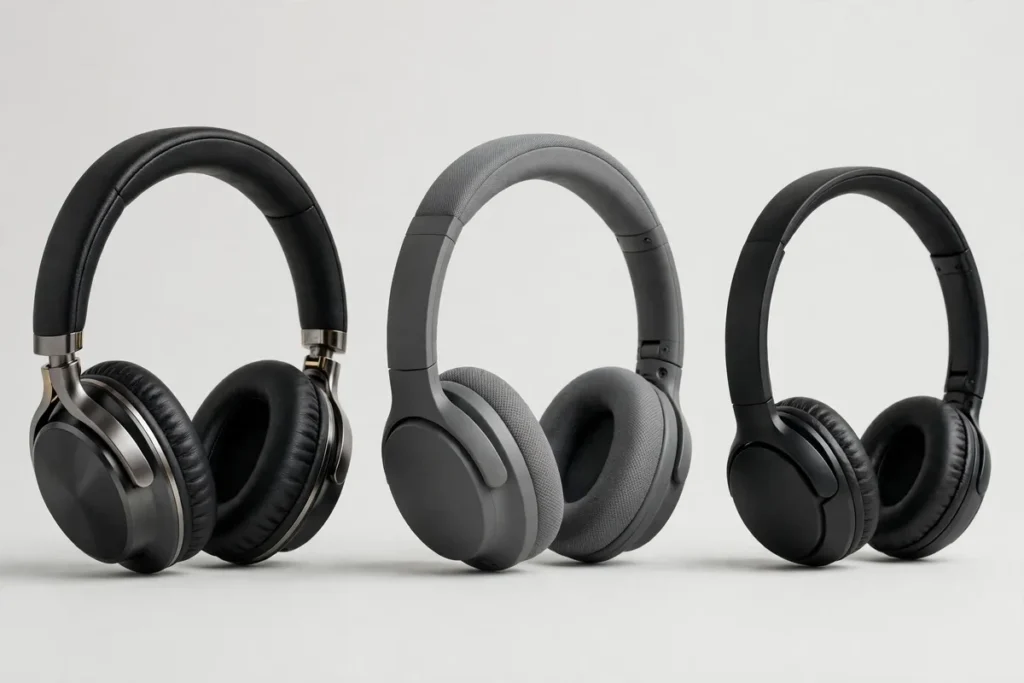
The Three Tiers, In One Box
Flagship pick — Sony WH-1000XM6: the strongest adaptive cancellation in its class, LDAC hi-res audio, and the clearest call quality of the three. Worth it if you fly or commute daily.
Mid-range pick — Sony WH-CH720N: Sony’s lightest noise cancelling headband at 192 g, with multipoint and up to 35 hours of battery. The tier most people should buy.
Budget pick — Soundcore Space Q45: adaptive ANC, LDAC support and a huge 50-hour battery with cancellation on — flagship-style features without the flagship tier’s cost.
What the Extra Money Actually Buys
1. Stronger, smarter noise cancellation
This is the headline purchase, and it is real. A flagship like the Sony WH-1000XM6 runs a dedicated noise cancelling processor with twelve microphones constantly sampling your surroundings and adjusting cancellation in real time. Budget and mid-range models use fewer microphones and slower, simpler processing. In practice, independent lab measurements across the category show flagship ANC removing noticeably more noise — and the gap is biggest exactly where it matters most: low-frequency rumble on planes and trains, and the unpredictable mid-range sounds of a busy office that cheaper systems react to too slowly. The difference is not night and day on a steady bus ride; it is obvious on a long-haul flight when the cheaper pair lets a layer of engine drone through that the flagship erases.
2. Better sound, and the codecs to deliver it
Flagships pair larger, stiffer drivers with far more tuning effort, and support hi-res Bluetooth codecs such as LDAC, which carries roughly three times the data of standard SBC. Our explainer on Bluetooth codecs — AAC vs LDAC vs aptX shows what that means in listening terms. The catch: codec support has leaked down the tiers. The budget Soundcore Space Q45 supports LDAC too, while the mid-range Sony WH-CH720N sticks to SBC and AAC — a reminder that price and features do not climb in lockstep, and spec sheets beat assumptions.
3. Call quality you can hold a meeting on
This is the most underrated flagship advantage. Premium models dedicate multiple microphones and AI-based beamforming purely to your voice, stripping wind and crowd noise before it reaches the other end. The XM6 uses a six-microphone AI system for calls; cheaper models rely on simpler setups that sound fine in a quiet room and fall apart on a windy street or a station platform. If your headphones double as your work headset, this difference alone can justify a tier jump — and if they never take a call, it is worth almost nothing to you.
4. Build quality and long-session comfort
More money buys metal-reinforced hinges instead of creaky plastic, earpads that survive years rather than seasons, and clamping force tuned for four-hour wear. Flagships also tend to fold into proper protective cases. None of this shows up in a five-minute demo, and all of it shows up in year two. That said, weight cuts the other way: the mid-range CH720N, at just 192 g, is lighter on the head than any flagship, and plenty of long-session listeners prefer it for exactly that reason.
5. The convenience layer: multipoint, sensors and apps
Multipoint — staying connected to your phone and laptop at once, explained in our guide to what Bluetooth multipoint is — used to be a flagship signature. Today all three picks in our box include it. What remains premium is the polish around it: wear detection that pauses when you lift a cup, adaptive sound modes that switch profiles by location, richer EQ apps and faster quick-charge. Useful, genuinely — but these are quality-of-life features, not core performance.
6. Battery life — where the flagship does NOT win
Here is the spec that breaks the price-equals-better story. With ANC on, the flagship XM6 is rated for up to 30 hours, the mid-range CH720N for up to 35 hours, and the budget Space Q45 for up to 50 hours. Cheaper models often win on battery because their processors do less. If your priority is a week of commuting per charge, the budget tier is not a compromise — it is the better tool.
Flagship vs Mid-Range vs Budget: The Specs That Matter
| Spec | Sony WH-1000XM6 (flagship) | Sony WH-CH720N (mid-range) | Soundcore Space Q45 (budget) |
|---|---|---|---|
| Battery (ANC on) | Up to 30 hours | Up to 35 hours | Up to 50 hours |
| Codecs | SBC, AAC, LDAC | SBC, AAC | SBC, AAC, LDAC |
| Multipoint | Yes | Yes | Yes |
| Weight | Approx. 254 g | Approx. 192 g | Approx. 281 g |
| Cancellation system | 12-mic adaptive ANC, dedicated QN3 processor | Dual Noise Sensor, Integrated Processor V1 | Adaptive ANC with multiple levels |
| Check the listing | Check Price | Check Price | Check Price |
Read that table carefully and the value story tells itself. The flagship’s clear wins are cancellation hardware and call processing. The budget model matches or beats it on battery and codecs. The mid-range Sony wins on weight. Expensive buys you the top row of the cancellation column — everything else is negotiable at lower prices.
Where Diminishing Returns Kick In
Audio pricing follows a curve, not a ladder. The jump from a basic pair to a competent budget ANC model is enormous — real cancellation, real battery life, app control, multipoint. The jump from budget to mid-range is solid: better tuning, better materials, lighter designs. The jump from mid-range to flagship is the smallest of the three, and it is concentrated in two places: the last layer of cancellation strength, and call quality in hostile environments. In a quiet room, playing the same track, most listeners would struggle to rank these three picks blind. On a red-eye flight with a crying baby two rows back and a work call at the gate, the ranking becomes obvious. Diminishing returns are not about the products being similar — they are about whether your life contains the situations where the differences switch on.
There is also a smarter way to climb the curve: last generation’s flagship. When a new flagship launches, the previous model typically keeps most of the cancellation and sound quality at a mid-range cost. Our head-to-head of the Sony WH-1000XM6 vs Bose QuietComfort Ultra 2 shows how tight the flagship race is — and our full roundup of the best noise cancelling headphones tracks which previous-generation models currently sit in the value sweet spot.
Who Should Pay for Expensive Noise Cancelling Headphones
- Frequent flyers: you live in the exact environment where flagship ANC earns its keep — hours of low-frequency drone, where the last few decibels of cancellation are the difference between arriving rested and arriving drained.
- Daily train and bus commuters: an hour or more of transit noise every day multiplies small per-trip gains into a genuinely better quality of life.
- People who take calls in noise: if clients hear you from platforms, job sites or busy streets, flagship call processing is a professional tool, not a luxury.
- Long-session listeners: four-plus hours a day makes build quality, pad durability and balanced clamping force worth paying for once rather than replacing cheap pairs.
Who Should Not
- Mostly-quiet-room listeners: at home in silence, ANC strength is irrelevant; spend on sound quality or save the difference entirely.
- Occasional travellers: two flights a year do not amortise a flagship. A budget pick like the Space Q45 handles holiday trips comfortably.
- Battery-first users: the budget tier literally outlasts the flagships — paying more gets you less of the thing you care about.
- The loss-prone: headphones that get left on trains should be priced accordingly. There is no shame in the tier you can afford to lose.
Whichever side of the line you land on, our guide to the best budget noise cancelling headphones under $100 shows how far the lowest tier now stretches, and it is further than most people expect.
The Bottom Line
Are expensive noise cancelling headphones worth it? Yes — conditionally. The flagship premium buys measurably stronger adaptive cancellation and dramatically better calls in noise, and for flyers, commuters and noisy-environment callers those are daily, tangible returns. But the curve flattens fast: a mid-range model delivers the great majority of the experience, and the best budget models now match flagships on battery and codecs while cancelling enough noise for most real journeys. Buy the tier that matches your noisiest regular day — not your noisiest imaginable one — and expensive headphones stop being a gamble and start being a tool you can justify.
Frequently Asked Questions
Are expensive noise cancelling headphones worth it?
For frequent flyers, daily commuters and people who take calls in noisy places, yes — flagship models cancel noticeably more noise and handle calls far better. For listeners who mostly use headphones in quiet rooms or travel only occasionally, mid-range and budget models deliver most of the experience for much less.
How much better is flagship ANC than budget ANC?
Flagship systems use more microphones and faster processors, so they remove more noise and adapt better to changing sounds like office chatter and wind. The gap is smallest against steady low-frequency noise, where good budget models perform respectably, and largest on flights and in unpredictable environments.
What is the best budget alternative to expensive noise cancelling headphones?
The Soundcore Space Q45 is the standout value pattern to look for: adaptive ANC, LDAC support, multipoint and up to 50 hours of battery with cancellation on. Previous-generation flagships on sale are the other proven route to premium performance without the premium tier’s cost.
Do expensive headphones last longer than cheap ones?
Generally, yes. Flagships use metal-reinforced hinges, more durable earpad materials and include protective cases, and their batteries and firmware tend to be supported longer. With care, a flagship can outlast two budget pairs — which is part of the value calculation if you keep headphones for years.
Is the Sony WH-1000XM6 worth it over the WH-CH720N?
The XM6 cancels more noise, supports LDAC, and is far better for calls in loud places. The CH720N is lighter at 192 g, lasts longer per charge with ANC on, and costs far less. Choose the XM6 for flights and calls; choose the CH720N for comfortable everyday listening where the environment is only moderately noisy.
When do diminishing returns start with noise cancelling headphones?
Roughly at the mid-range tier. The step from basic to good budget ANC is transformative, budget to mid-range is worthwhile, and mid-range to flagship mainly adds the final layer of cancellation strength and call clarity. Most listeners reach their personal point of diminishing returns one tier below the flagship.

I am the founder of Sound Mavericks, where I provide the polite truth about audio equipment. I started this site because consumer electronics reviews are often too technical. Instead of using a silent lab, I test headphones, earbuds, and Bluetooth speakers in the real world – like on a noisy subway or in a busy coffee shop.
To stay independent, I buy my own review units (mostly from the United States) rather than accepting free gifts from brands. Once I finish testing a product, I sell it locally to our community. My goal is to help you understand sound quality, active noise cancellation (ANC), and battery life without the marketing hype.