Short Answer: Helpful on Long Flights, Not Mandatory — and Not True ANC
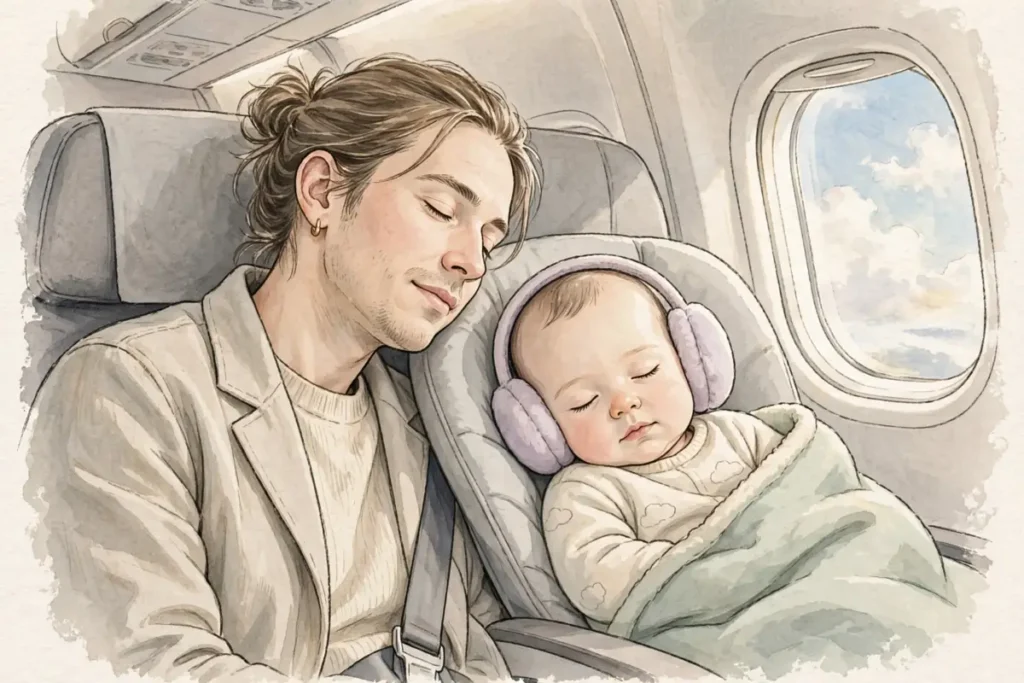
For do babies need noise cancelling headphones on planes, SoundMavericks’ honest answer is: no baby needs them for a short flight, but passive baby earmuffs are genuinely useful on longer flights. Cabin noise sits around 80–85 dB in cruise and is louder at takeoff, and babies’ ears are more sensitive than adults’. What parents actually buy is not electronic active noise cancelling — nobody makes true ANC earmuffs for infants — it is soft, passive earmuffs such as the Baby Banz earmuffs and the Alpine Muffy Baby. They lower the noise reaching your baby’s ears, which protects hearing on long flights and helps many babies sleep through announcements and cabin chatter. One warning up front: earmuffs do not help with ear pressure or ear pain. That is a separate problem, covered in full below.

Baby Banz Earmuffs
Padded over-ear cups on a soft headband, sized for infants from the newborn months through the toddler years.

Alpine Muffy Baby
Soft elastic headband design made for babies and toddlers up to 36 months, with no hard parts pressing on the head.
Every parent booking a flight with a baby has seen the photos: a sleeping infant in oversized earmuffs, unbothered at 35,000 feet. Are those earmuffs essential safety gear, a sleep aid, or just something parents buy because everyone else does? This guide separates the three jobs — hearing protection, sleep, and ear pressure — because earmuffs help with the first two and do nothing for the third. For the full product comparison, see our best baby noise cancelling headphones roundup, and for your own ears, our best headphones for airplane guide.
How Loud Is a Plane Cabin for a Baby?
A cruising airliner is a loud room that never gets quiet. In cruise, cabin noise typically sits around 80–85 dB — roughly a busy city street — and stays there for the whole flight. Takeoff is louder, and seats at the rear and close to the engines are louder than seats ahead of the wing. Over that steady drone come the sharp sounds: chimes, trolley clatter, announcements, and other passengers.
For a baby, two things make it harder. Their hearing is still developing, and smaller ear canals can make sound feel more intense. And a baby cannot tell you the noise bothers them or move seats — they can only get unsettled, struggle to sleep, and cry. A single short flight at cabin levels is unlikely to harm a healthy baby’s hearing, and SoundMavericks will not pretend otherwise. The case for earmuffs builds with exposure time: the longer the flight, the more worthwhile it is to turn that constant 80–85 dB down.
Do Babies Need Noise Cancelling Headphones on Planes?
Need is a strong word, and the honest answer is no — airlines do not require them, and plenty of babies fly happily without any ear protection, especially on short hops where exposure is brief. If your flight is an hour and your baby sleeps through the car and the supermarket, earmuffs are optional.
SoundMavericks’ analysis is that earmuffs earn their carry-on space in three situations. First, long flights, where hours of drone add up and a quieter baby is far more likely to sleep for a useful stretch. Second, light sleepers and easily startled babies, for whom the sudden sounds over the drone are what keep breaking sleep. Third, trips that continue past the airport: the same earmuffs help at weddings, sports events, and fireworks. Bought once and used for two or three years, they stop looking like a single-flight purchase.
Baby Earmuffs Are Passive — There Is No True ANC for Infants
This is the most misunderstood part of the category, and product names do not help. When a listing calls baby earmuffs “noise cancelling,” it almost always means passive noise reduction: padded cups that physically cover the ear and muffle sound before it arrives — the building-site earmuff principle, just softer and smaller.
True active noise cancelling is different: microphones and electronics generating anti-noise, a battery, a tight seal, all built for adult heads. Nobody makes a true ANC headphone for infants, and no reputable baby brand offers one. That is not a flaw. Passive muffling is the right tool here: no power, nothing that can play sound into your baby’s ears, and it works instantly. Just buy it knowing what it is — hearing protection, not a miniature version of your own ANC headphones.
The Myth: Baby Earmuffs Do Not Help With Ear Pressure
Here is the myth this article most wants to bust, because it sends parents down the wrong path: earmuffs do not help with airplane ear pressure or ear pain. If your baby screams during descent, earmuffs will not fix it, no matter how well they fit.
Pressure pain has nothing to do with noise. As the plane climbs and especially as it descends, cabin pressure changes faster than the pressure in the middle ear can match it. The bridge is the Eustachian tube, and in babies that tube is smaller and less efficient — which is why babies feel pressure changes more and cannot “pop” their ears on demand. A padded cup over the outside of the ear changes the pressure on neither side of the eardrum. It only quiets sound.
The fix for pressure is swallowing. Feeding — breast, bottle, or a drink for an older baby — during ascent and descent makes a baby swallow repeatedly, and swallowing opens the Eustachian tube and equalizes pressure. A pacifier does the same job, which is why experienced parents time a feed for takeoff and, most importantly, for the start of descent, even if it means gently waking a sleeping baby. So pack both tools, each for its own job: earmuffs for noise and sleep, feeding or a pacifier for pressure. If your baby has had a recent ear infection or ear surgery, ask your pediatrician before you fly — that is an individual medical question.
When Does Hearing Protection Matter Most on a Flight?
Protection matters most when noise is loudest and exposure is longest: three windows. Takeoff, the loudest phase — if you use earmuffs at only one point on a short flight, use them then. Long stretches in cruise on a long flight, where the hours at 80–85 dB are the exposure you are managing. And any time your seat is at the back or beside the engines, where levels run higher than ahead of the wing. It matters least at boarding and during the calmest parts of a short flight — good moments to give your baby a break from wearing anything.
How Long Should a Baby Wear Earmuffs?
There is no benefit in keeping earmuffs on for a whole flight, and most babies would object long before you finished trying. Use them in stretches: on for takeoff, on while your baby settles into a nap, off for feeds, play, and contented awake time. Check regularly that the cups still cover the ears fully — a cup slipped onto the cheek protects nothing.
Comfort is the limit, and your baby will enforce it. Deep band marks, overheating, or a baby fighting the earmuffs harder than the noise was upsetting them all mean: take them off. A test run at home first — a few minutes at a time, as a game — makes the in-flight version far more likely to be accepted. And never leave a sleeping baby wearing earmuffs unattended.
Fit on Tiny Heads: Headbands and the Soft Spot
Fit is where baby earmuffs succeed or fail. A newborn’s head is small, the fit must be gentle, and parents are rightly cautious about pressure — including around the fontanelle, the soft spot on a young baby’s skull. Good designs work around that concern. Instead of a stiff band clamping from the sides, the Alpine Muffy Baby spreads the hold through a soft, wide elastic headband, with no hard parts and no single pressure point on top of the head. Baby Banz uses a padded headband with cushioned cups sized to sit around a small ear rather than pressing on it.
The checks are the same either way. The cup should enclose the whole ear, cushion resting on the head around it, not folded over the ear. The band should be snug enough to stay put when your baby turns their head, never tight enough to leave more than a faint, quickly fading mark. Follow the maker’s age guidance rather than sizing up — an oversized cup leaks and muffles far less. Unsure about fit for a very young or premature baby? Ask your pediatrician before the trip.
Baby Banz vs Alpine Muffy Baby: Which Should You Pack?
The two most established names in this category take slightly different routes to the same job, and both are linked in the table below with a Check Price option in every row.
| Product | Design | Best for | Check Price |
|---|---|---|---|
| Baby Banz Earmuffs | Padded over-ear cups on a soft headband | Parents who want a classic earmuff fit that grows from the infant months into the toddler years | Check Price |
| Alpine Muffy Baby | Soft elastic headband with no hard parts, for babies and toddlers up to 36 months | Very young babies, and parents who want the gentlest possible hold with nothing pressing on the top of the head | Check Price |
SoundMavericks’ take: choose the Alpine Muffy Baby for a newborn or very young baby — the soft headband and absence of hard parts make the first fit easiest. Choose Baby Banz for a traditional cup-and-band shape likely to still suit a two-year-old at loud events. Either way, order early enough for home practice: the best earmuff on flight day is one your baby has already met. More options are in our best baby noise cancelling headphones roundup.
Carry-On Practicalities for Flying With Baby Earmuffs
Small logistics decide whether earmuffs help or stay buried in the overhead bin. Keep them in your personal item under the seat, reachable during takeoff without unbuckling a sleeping baby. Put them on before the engines spool up, not after the noise has startled your baby awake. Use the carry case or a clean pouch — earmuffs dropped on a cabin floor will go straight in your baby’s mouth when handed back.
And set expectations for the whole flight: earmuffs are one tool among several, alongside a feed timed for descent, a familiar blanket, and a seat ahead of the wing where the cabin is quieter. Parents guarding their own rest should see our best headphones for airplane picks — a rested parent is part of the baby’s travel kit too.
Do Babies Need Noise Cancelling Headphones on Planes? FAQ
At what age can a baby fly with headphones?
Baby earmuffs are made from the newborn months onward — the Alpine Muffy Baby is designed for babies and toddlers up to 36 months, and Baby Banz earmuffs are sized for infants through the toddler years — so there is no minimum age where earmuffs suddenly become allowed. The real questions are fit and your pediatrician’s view for a very young or premature baby. Separately, airlines set their own minimum ages for flying at all, often in the first days or weeks of life, so check your airline’s policy and ask your pediatrician if your baby is newborn, premature, or has any ear or breathing condition.
Do baby earmuffs help with airplane ear pressure?
No. Earmuffs reduce noise; they do nothing for pressure. Ear pain on a plane comes from pressure differences across the eardrum as the cabin pressure changes, equalized through the Eustachian tube — and the way to open that tube is swallowing. Feed your baby, offer a bottle, or use a pacifier during ascent and especially descent. That, not earmuffs, is the fix for pressure.
Are noise cancelling headphones safe for babies?
Passive baby earmuffs are the safe, appropriate format: they play no sound, need no electronics, and simply muffle what reaches the ear. True electronic ANC headphones are adult products — they are not sized for infants, are not made for them, and should not be adapted for a baby. Keep volume-playing headphones and earbuds off babies entirely, make sure any earmuff fits gently without hard pressure points, and never leave a baby wearing them unattended.
Will baby earmuffs help my baby sleep on a plane?
Often, yes — this is the benefit parents report most. The steady drone can act almost like white noise; what breaks a baby’s sleep is the irregular sounds over it: announcements, chimes, trolley noise, nearby conversation. Earmuffs soften exactly those peaks, so many babies settle faster and sleep longer, particularly on long flights. No guarantee — a hungry or pressure-uncomfortable baby will still wake — so pair them with a well-timed feed.
How long can a baby wear earmuffs on a flight?
In stretches, not for the whole flight: takeoff, settling into a nap, and the noisiest parts of a long flight, with breaks for feeds and play. Check fit regularly, watch for overheating or deep band marks, and remove them if your baby is clearly distressed.
Do babies need ear protection on a short flight?
Usually optional. On a flight of an hour or so, exposure is brief and a healthy baby who sleeps easily will generally be fine without earmuffs. They become more worthwhile as flights get longer, for light sleepers and frequent flyers, or if the pair will also be used at loud events. They are small and light enough that packing them and deciding on the day costs almost nothing.

I am the founder of Sound Mavericks, where I provide the polite truth about audio equipment. I started this site because consumer electronics reviews are often too technical. Instead of using a silent lab, I test headphones, earbuds, and Bluetooth speakers in the real world – like on a noisy subway or in a busy coffee shop.
To stay independent, I buy my own review units (mostly from the United States) rather than accepting free gifts from brands. Once I finish testing a product, I sell it locally to our community. My goal is to help you understand sound quality, active noise cancellation (ANC), and battery life without the marketing hype.