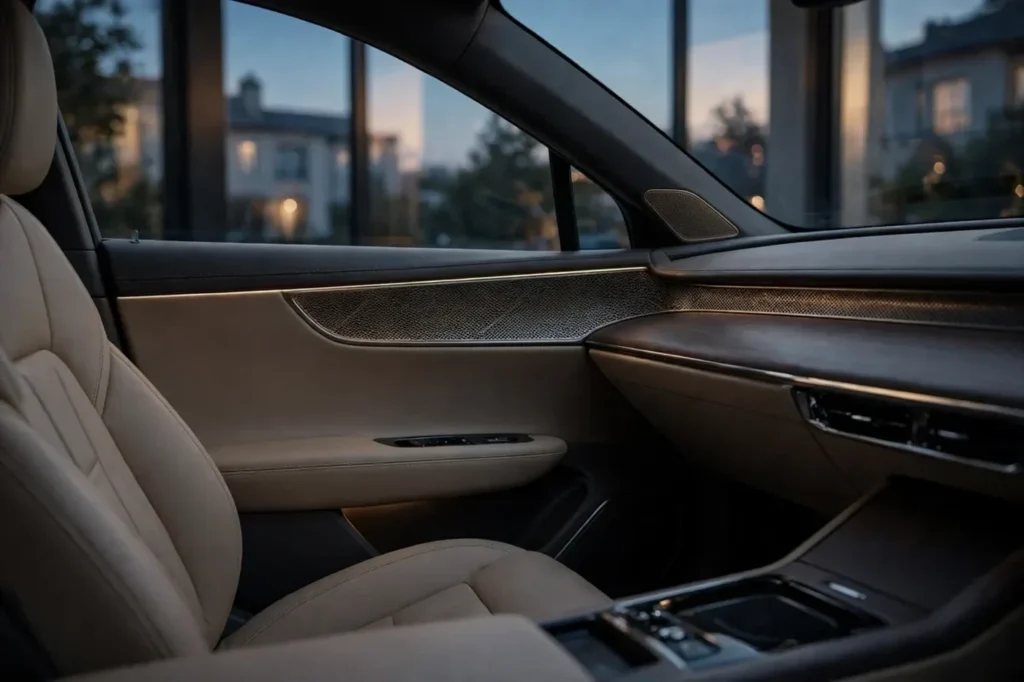
The quietest cabins in modern cars are no longer quiet just because of thicker glass and heavier insulation. A growing number of premium models now fight noise the way your headphones do: by listening to it, computing its opposite, and playing that anti-noise back into the cabin in real time. Automotive active noise cancellation has moved from concept-car theatre to a production feature on flagship SUVs and EVs, and in 2026 it is one of the clearest dividing lines between a premium cabin and an ordinary one.
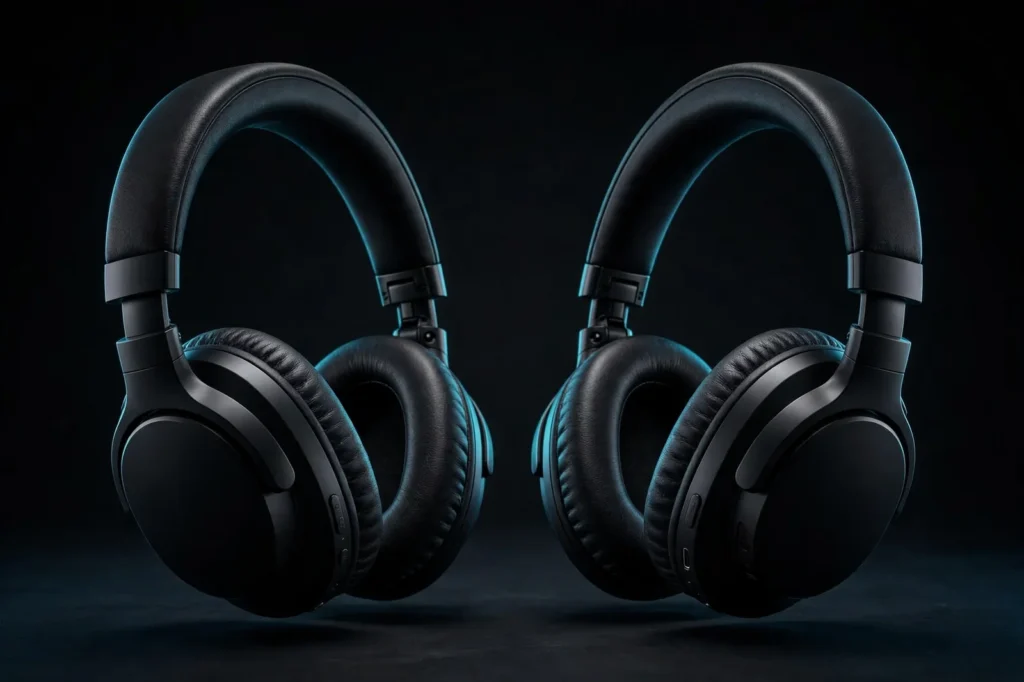
It is also widely misunderstood. Car ANC is not simply headphone ANC scaled up, it cannot be added to your current car with an accessory, and its real-world gains — a few decibels, in a narrow frequency band — sound modest on paper while feeling significant on a motorway. This explainer breaks down how the technology actually works, which manufacturers ship it, why electric cars made it essential rather than optional, and where its limits are. And if you are a passenger rather than a buyer of new cars, the practical shortcut to a quieter journey remains a good pair of travel headphones like the Sony WH-1000XM5 — more on that trade-off at the end. For the underlying physics, our primer on active noise cancellation vs passive isolation is the place to start.
How Automotive Active Noise Cancellation Works
Every ANC system, whether it sits on your head or in a headliner, runs the same loop: sense the noise, generate an inverted copy of it, and deliver that anti-noise so the two waves sum towards quiet. A car makes each step harder. The space is enormous compared with an ear cup, there are four or five heads in different seats rather than one pair of ears, and the noise is arriving through the structure of the vehicle itself — tyres, suspension, and body panels — not just through the air.
That is why production car systems lean on feedforward sensing. Accelerometers bolted to the suspension and chassis pick up road vibration before it becomes cabin sound, giving the digital signal processor (DSP) a head start measured in milliseconds. Hyundai Motor Group’s published figures for its Road-noise Active Noise Control (RANC) system make the race concrete: road noise takes roughly 0.009 seconds to travel from tyre to ear, and RANC analyses the vibration and generates its inverted wave in about 0.002 seconds. The DSP then plays the anti-noise through the car’s own audio speakers, while small error microphones in the cabin monitor what remains at each seat and continuously correct the output. Done well, the system adapts per seating position and keeps adapting as speed, road surface, and even tyre wear change.
Two different enemies: engine order and road noise
Automotive ANC historically split into two problems. Engine-order cancellation targets the predictable, rhythmic drone of a combustion engine, which rises and falls in lockstep with RPM — the easiest kind of noise to cancel, because it can be predicted from the engine’s own signals. Bose’s earlier Engine Harmonic Cancellation work is an example of this approach, and Bose has been explicit that cancelling a narrow band of low-frequency engine noise across a whole cabin is a fundamentally different job from cancelling a wide band of sound inside an ear cup. Road-noise cancellation is the harder, newer problem: tyre roar and road rumble are irregular, structure-borne, and broadband within the low frequencies. RANC and Bose’s QuietComfort Road Noise Control — which likewise combines body-mounted accelerometers with cabin microphones — exist specifically to attack it, because in an electric car it is nearly all that is left.
Which Premium Brands Actually Ship It?
Hyundai Motor Group (Hyundai, Kia, Genesis) with Harman. RANC was developed over six years and reached production first on the Genesis GV80 luxury SUV, with Harman as the production audio partner. Hyundai reports a reduction of about 3 dB of in-cabin road noise — which, as the company points out, corresponds to roughly halving the perceived noise energy compared with no system. The strategic point Hyundai makes is as interesting as the number: effective active cancellation lets a manufacturer use less passive insulation and damping material, cutting weight.
Bose. Bose sells its automotive noise management to carmakers rather than to drivers: QuietComfort Road Noise Control uses accelerometers on the vehicle body to detect road-induced vibration, an algorithm to build the cancellation signal, the cabin speakers to deliver it, and in-cabin microphones to fine-tune it against changing conditions and vehicle wear. Because Bose supplies the system as part of its automotive audio engineering, it appears across multiple premium brands rather than under one badge.
Jaguar Land Rover. JLR’s Active Road Noise Cancellation, introduced on models including the Jaguar F-PACE and Range Rover Velar with Meridian audio, monitors road vibrations and generates its counter-signal through the sound system; JLR has described the perceived effect as equivalent to turning the audio system down several steps, and has specifically linked reducing low-frequency noise (its system addresses noise up to around 300 Hz) to reduced driver fatigue on long journeys.
Silentium and the supplier layer. Much of the innovation now sits with specialist suppliers. Silentium’s “Quiet Bubble” approach creates localised quiet zones around each passenger’s head — delivered through the cabin speakers or speakers built into the seats and headrests — and the same company applies active cancellation at noise sources such as the HVAC system. Expect this supplier model to spread the technology downmarket faster than any single car brand will.
A buying caveat SoundMavericks would give on any option list: naming is inconsistent (ANC, RANC, ARNC, “road noise control”), availability is trim- and audio-package-dependent, and a model offering engine-order cancellation is not offering the same thing as one with full road-noise cancellation. Check the exact system, on the exact trim, before paying for the badge.
Why EVs Made Cabin ANC Essential
In a combustion car, the engine provides an accidental favour: a constant blanket of sound that masks a portion of tyre and wind noise. Remove the engine and the mask disappears. In an EV at motorway speed, the dominant sounds are tyre roar, road rumble, and wind — precisely the noises passengers find most fatiguing, and precisely the ones traditional NVH (noise, vibration, harshness) engineering fights with weight: thicker carpets, heavier dampers, laminated everything. For an EV, that weight is range. Active cancellation offers quiet without kilograms, which is why Hyundai framed RANC as an imperative for electric and fuel-cell vehicles and why the technology’s centre of gravity has shifted from engine drone to road noise.
There is a second EV-specific twist: with no engine note, every other sound becomes more noticeable — a creak, a whine from the motor, a rattling parcel shelf. Cabin ANC does not fix build quality, but by lowering the low-frequency floor it makes the cabin feel more composed, which is a large part of what “premium” means in practice.
The Limits of the Technology
Honesty about limits is what separates an explainer from a brochure, so here they are plainly. The gains are a few decibels, not silence. Hyundai’s own figure for RANC is around 3 dB on road noise. That is clearly audible — and worth having across a three-hour drive — but no system makes a cabin silent. The cancellation zone is low-frequency. Physics favours long wavelengths; systems work in the range up to a few hundred hertz. Voices, horns, sirens, and wind whistle at higher frequencies pass through largely untouched, which is also a safety feature: you still hear the world. It is tuned, not universal. Each system is calibrated to a specific cabin, speaker layout, and seat geometry; move to a different model and the engineering starts again. And it depends on the audio system. The speakers are the weapon, so ANC performance is bound up with the car’s amplifier and speaker quality — one reason it clusters in premium audio packages. If in-car audio quality itself is your project, our guide to the best car speakers covers the upgrade path that actually is DIY-friendly.
Can You Retrofit It? The Aftermarket Reality
No — and this is the section most articles skip. True cabin ANC cannot be retrofitted to an existing car in any meaningful sense. The system needs accelerometers integrated with the chassis, a DSP wired into the vehicle’s audio architecture, error microphones at each seat, and thousands of hours of model-specific calibration. Products sold as aftermarket “noise cancelling” for cars are, at best, passive sound-deadening mats or small devices that add masking sound; neither is active cancellation, and we would not spend money expecting otherwise.
What genuinely works on a car you already own: quieter tyres (the single biggest lever, since tyre roar is the dominant source), fresh door and window seals, and professionally fitted sound-deadening in the doors and floor — all passive, all unglamorous, all real. And for the person in the passenger seat, the maths is simpler still: a strong pair of ANC headphones delivers, at the ear, far more cancellation than any cabin system delivers at the seat. The Sony WH-1000XM5 remains our reference recommendation for that job; our roundups of the best noise cancelling headphones for airplanes and long flights and the overall best noise cancelling headphones cover the alternatives at every level. Drivers, of course, should not wear headphones at the wheel — cabin ANC’s real gift is that it is the one form of cancellation the driver is allowed.
What This Means for Headphone Users on the Road
The convergence cuts both ways. Headphone ANC taught carmakers that customers will pay for quiet and can hear the difference a few decibels make; car ANC is now pushing the consumer expectation back the other way, training buyers to judge a cabin the way they judge earbuds — by what is left when the system is on. The practical takeaways: if you are shopping for a premium car in 2026, put the noise-cancellation system on your test-drive checklist and evaluate it at motorway speed on coarse tarmac, not in the showroom. If you are keeping your current car, spend on tyres and seals before electronics. And if you are the passenger on long journeys, your headphones are still — by a wide margin — the most effective noise-cancelling technology in the vehicle.
Frequently Asked Questions
How does noise cancellation work in a car?
Accelerometers on the suspension and chassis detect road vibration before it becomes sound, a DSP computes an inverted anti-noise wave within milliseconds, and the car’s speakers play it into the cabin. Microphones at each seat monitor the result and continuously correct the signal for each seating position.
Which cars have active noise cancellation?
Production systems include Hyundai Motor Group’s RANC (launched on the Genesis GV80, developed with Harman), Bose QuietComfort Road Noise Control supplied to several premium brands, and Jaguar Land Rover’s Active Road Noise Cancellation on models such as the F-PACE and Range Rover Velar. Availability depends on model, trim, and audio package.
Can I add active noise cancellation to my existing car?
No. True cabin ANC requires factory-integrated sensors, DSP processing, cabin microphones, and model-specific calibration, so it cannot be retrofitted. Aftermarket options are passive sound deadening, quieter tyres, and refreshed seals — or ANC headphones for passengers.
Why do electric cars need noise cancellation more?
An EV has no engine noise to mask road and wind noise, so tyre roar and rumble dominate the cabin at speed. Active cancellation reduces that low-frequency noise without the heavy insulation that would otherwise cost range.
How much quieter does car ANC actually make a cabin?
Hyundai reports about a 3 dB reduction in road noise from RANC, which is clearly audible and roughly halves the perceived noise energy in that band. It works mainly on low frequencies up to a few hundred hertz; voices, horns, and sirens remain audible.

I am the founder of Sound Mavericks, where I provide the polite truth about audio equipment. I started this site because consumer electronics reviews are often too technical. Instead of using a silent lab, I test headphones, earbuds, and Bluetooth speakers in the real world – like on a noisy subway or in a busy coffee shop.
To stay independent, I buy my own review units (mostly from the United States) rather than accepting free gifts from brands. Once I finish testing a product, I sell it locally to our community. My goal is to help you understand sound quality, active noise cancellation (ANC), and battery life without the marketing hype.