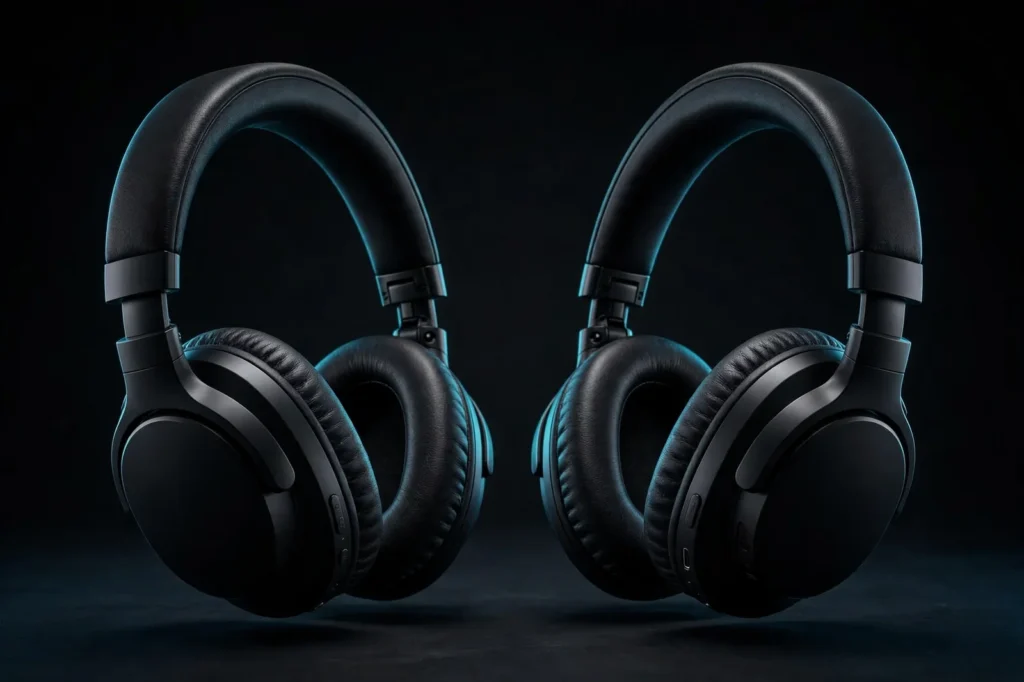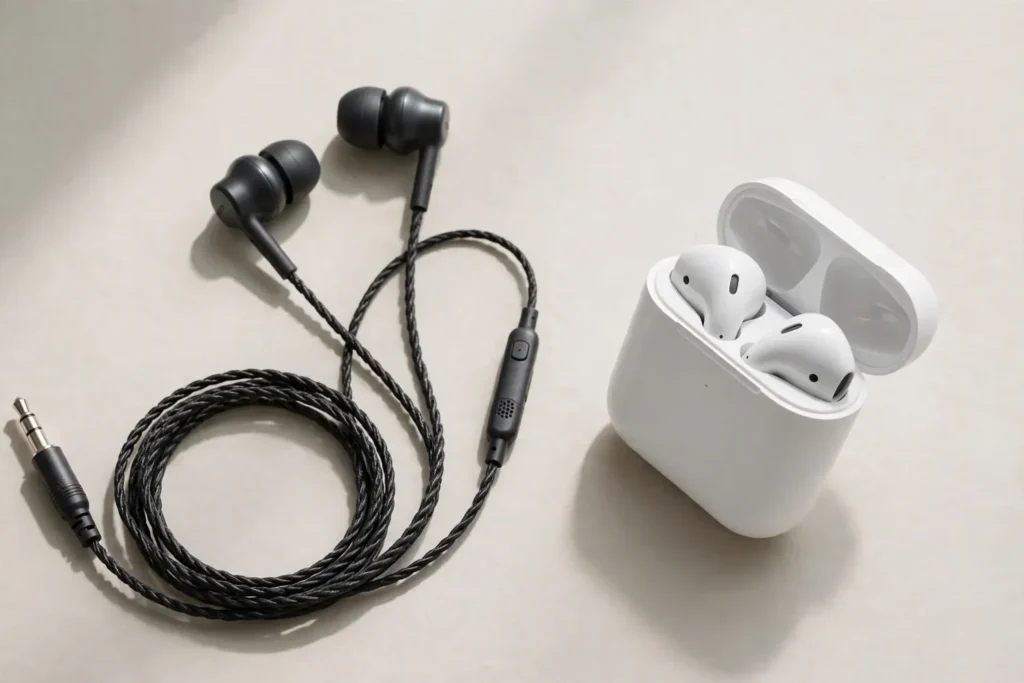
Quick Verdict: Wired Wins on Sound and Latency, Wireless Wins on Everyday Life
So, are wired earbuds better than wireless? For pure sound quality per dollar, zero-latency gaming, and never thinking about a battery — yes, wired still wins, and it is not particularly close. For commuting, workouts, calls on the move, and noise cancelling — wireless wins, and that is not close either. SoundMavericks’ short answer is to own the format that matches your day, and many listeners end up keeping one of each: a serious wired pair for the desk and gaming, and a wireless pair for everything that moves. Our two reference picks below show what “good” looks like on each side.
It is the oldest argument in portable audio, and phones removing their headphone jacks was supposed to settle it. It did not. Wired earbuds keep selling — to gamers, audiophiles, frequent flyers, and anyone tired of charging yet another device — while wireless earbuds keep getting better codecs, better noise cancelling, and longer battery life. This explainer compares the two formats honestly, attribute by attribute: sound quality, latency, battery and convenience, durability, the dongle reality on modern phones, calls, gaming, and workouts. No format wins everywhere. Here is where each one actually wins.

Moondrop CHU II — Top Wired Pick
Our budget audiophile pick from the wired roundup

Sony WF-1000XM5 — Top Wireless Pick
Flagship noise cancelling with LDAC support
The Short Answer
Wired earbuds are better at the audio itself. A wired connection carries the full signal with no Bluetooth compression, no codec ceiling, and effectively zero delay, and because none of the budget goes to batteries, radios, and charging cases, wired earbuds deliver more sound quality per dollar at almost every price tier. Wireless earbuds are better at everything surrounding the audio: freedom of movement, active noise cancelling, water resistance, multipoint pairing, and not being physically tethered to a phone that lives in your pocket. The sections below score each attribute, and the table after them sums it up. If you want the product-level version of this argument, our best wired earbuds roundup ranks the wired side, and our best noise cancelling earbuds guide ranks the wireless one.
| Attribute | Wired Earbuds | Wireless Earbuds | Winner |
|---|---|---|---|
| Sound quality | Full uncompressed signal; no codec ceiling; more of the cost goes to the drivers | Bluetooth codecs compress the signal; LDAC narrows the gap on Android | Wired |
| Latency | Effectively zero — sound and action stay in sync | Noticeable delay on standard Bluetooth; gaming modes reduce but do not erase it | Wired |
| Battery | No battery at all — powered by the device, always ready | Hours per charge plus case top-ups; batteries age and eventually end the product’s life | Wired |
| Convenience | Plug and play, but the cable tangles, snags, and tethers you to the device | Total freedom of movement; pairing, charging, and case management required | Wireless |
| Noise cancelling | Passive isolation only on most models; a handful of wired ANC models exist | Full active noise cancelling is standard at mid and high tiers | Wireless |
| Durability & repair | Cable is the weak point, but detachable cables are replaceable; no battery to die | No cable to fray, but sealed batteries wear out and buds are easy to lose | Wired, if the cable detaches |
| Call quality | Inline mic sits close to the mouth; stable and clear | Beamforming mics and wind processing; quality varies widely by model | Tie — model-dependent |
| Value | More sound per dollar; no electronics tax | You pay for radios, batteries, ANC, and cases on top of the drivers | Wired |
Sound Quality: Compression Is the Whole Argument
A wired earbud receives the audio signal exactly as your device sends it. Nothing is squeezed, re-encoded, or thrown away en route, which is why wired earbuds can reproduce lossless and high-resolution files at their full quality — the only ceiling is the earbud’s own drivers and your device’s output. Wireless earbuds cannot say that. Bluetooth audio must be encoded into a codec stream, transmitted, and decoded in the bud, and every mainstream codec discards some of the original data to fit the wireless pipe.
How much gets discarded depends on the codec pairing between your phone and your earbuds. The baseline SBC codec is the universal fallback and the most compressed-sounding. AAC performs well on iPhones, where Apple optimises the whole chain, but is inconsistent across Android phones. LDAC, Sony’s high-bitrate codec, carries roughly three times the data of a standard connection and is the closest wireless gets to wired quality — on Android phones that support it, with high-resolution source files, and ideally in stable wireless environments, since LDAC’s highest mode is the first to wobble in a crowded radio space. aptX variants sit between those poles on supported Android devices. Our full explainer, Bluetooth codecs explained: AAC vs LDAC vs aptX, walks through each codec’s real limits.
SoundMavericks’ honest calibration: with ordinary streaming in a noisy street, most listeners will not reliably separate a good wireless earbud from a wired one. The wired advantage becomes audible in the conditions audiophiles actually listen in — quiet room, good source files, attention on the music — and it grows as you spend, because at higher tiers the wired budget buys better drivers while the wireless budget is still paying for electronics first. That is why the wired pick here, the Moondrop CHU II, punches so far above its tier: nearly every cent of its cost is in the acoustic hardware.
Latency: Gaming and Video Expose Bluetooth
Latency is delay — the gap between something happening on screen and its sound reaching your ears. A wired connection’s latency is effectively zero for human purposes. Bluetooth always adds delay while it encodes, transmits, and decodes, and on standard connections that delay is large enough to notice: lips move before dialogue lands, and a gunshot registers after the muzzle flash. Modern phones and apps compensate for video playback by delaying the picture to match, which hides the problem for films and streaming. Games cannot do that trick — delaying the image would delay your inputs — so gaming is where wireless latency stays exposed. Dedicated gaming modes on wireless earbuds cut latency substantially, but they trade away some audio quality or connection stability to do it, and they still do not reach wired’s zero. For competitive play, SoundMavericks’ position matches our wired vs wireless gaming headset analysis: if the match matters, plug in. Our reference wired pick doubles as a gaming-capable in-ear for exactly this reason; for dedicated picks, see the best IEMs for gaming.
Battery and Everyday Convenience
Wired earbuds have no battery. They draw a whisper of power from whatever they are plugged into, they work after a year in a drawer, and they will never die mid-flight, mid-run, or mid-call. There is nothing to charge, nothing to pair, and no case to keep track of. That permanence is a genuine quality-of-life advantage that wireless marketing never answers.
Wireless earbuds answer with freedom, and the freedom is real. No cable means nothing to tangle in a pocket, nothing to snag on a door handle or gym equipment, and the ability to leave your phone on a desk and keep listening across the room. Multipoint models stay connected to a laptop and a phone at once. The costs are administrative: buds and case both need charging, total playtime is finite per outing, and the sealed lithium batteries lose capacity every year until the earbuds’ useful life ends, however good the drivers still are. Convenience cuts both ways: wireless removes friction from every hour of use and adds a small maintenance tax forever; wired has zero maintenance and a cable’s worth of friction in every hour.
Durability, Loss, and Repairability
Each format has one characteristic way of dying. Wired earbuds die at the cable — specifically at the strain points near the plug and the earpieces, where years of bending fatigue the conductors inside. Wireless earbuds die at the battery, and they get lost: a single bud down a drain, on a train, or in a gym car park can orphan the other one, and replacement singles are model-specific when they exist at all.
Repairability is where wired pulls ahead decisively. A wired earbud with a detachable cable — like the Moondrop CHU II below, whose cable unplugs from the earpieces — turns the most common fatal failure into a cheap, five-minute parts swap, and tips and cables are standardised enough to source for years. A wireless earbud is a sealed unit: when its battery fades, the whole bud is effectively spent, and no user-serviceable parts exist. Treated gently, a good wired pair can serve for many years; a wireless pair is on a battery clock from the day it is made. If wired-with-silence is your goal, our best wired earbuds with noise cancelling guide covers the small wired ANC niche as well.
Phones Without Headphone Jacks: The Dongle Reality
None of the wired advantages matter if you cannot plug in, and on most current flagship phones there is no 3.5mm jack. The modern wired setup is one of two things: USB-C earbuds that connect directly, with the conversion built into the plug, or a small USB-C-to-3.5mm dongle — itself a tiny DAC — between the phone and any standard wired earbud. In practice this works far better than its reputation: a decent dongle sounds clean and lives permanently attached to your earbuds’ plug, at which point the daily experience is identical to the old jack. The genuine annoyances are narrower: you cannot charge the phone and listen through the same port without a splitter, cheap dongles vary in quality, and the dongle is one more small thing to lose. Weigh those against wireless’s charging routine and the dongle stops looking like a dealbreaker.
Call Quality
Calls are closer than the marketing suggests. A wired inline microphone hangs near your mouth by design, picks up your voice at close range, and never contends with Bluetooth’s bandwidth limits — hard to beat in a quiet or moderately noisy room. Good wireless earbuds counter with beamforming microphones, wind-noise processing, and voice-isolation software that can outperform an inline mic outdoors, but quality varies enormously by model, and budget wireless mics are frequently worse. Verdict: at the desk, wired is dependably good; on a windy street, a well-reviewed wireless flagship is better.
Gaming and Working Out: The Two Split Decisions
Gaming goes to wired, outright. Zero latency, no battery to die mid-session, no pairing dance when switching between a controller, a PC, and a handheld — and spatial detail from a good in-ear is genuinely competitive-grade. Wireless is playable for casual and single-player gaming, especially with a low-latency mode, but it is a compromise you accept for the couch, not an advantage.
Working out goes to wireless, outright. A cable bounces, tugs, catches on equipment, and transmits handling noise into your ears with every footstrike. Wireless sport earbuds add sweat and water resistance ratings, secure-fit wings and hooks, and total freedom on the platform or the road. The one wired workout case is the person who keeps killing wireless buds with sweat or loss — and even then, the honest fix is usually a cheaper wireless pair, not a cable in the gym.
Our Two Reference Picks
One pick per side, chosen to embody what each format does best — the wired pick is the budget audiophile standout from our live best wired earbuds roundup, and the wireless pick is a mainstream flagship that shows wireless at its ceiling, LDAC included.
| Pick | Format | Why It Represents Its Side | Buy |
|---|---|---|---|
| Moondrop CHU II | Wired in-ear (3.5mm, detachable cable) | Detailed, balanced sound that rivals far pricier earbuds, alloy shell, and a replaceable cable that fixes wired’s one big weakness | Check Price |
| Sony WF-1000XM5 | Wireless true wireless (Bluetooth, LDAC) | Flagship active noise cancelling, LDAC high-bitrate audio on Android, strong call processing, and all-day case battery | Check Price |
Who Should Buy Which?
Buy wired if you listen critically at a desk or in quiet rooms, play competitive games, fly often and want a pair that always works with the seatback screen, hate charging things, or want the most sound quality your budget can possibly buy. A wired pair is also the best backup in audio: it weighs nothing in a bag and rescues every dead-battery moment.
Buy wireless if you commute, train, walk, or work on the move; if outside noise is part of your day and you want real active noise cancelling; if you take calls while moving around; or if a cable in your life genuinely gets in the way. Wireless is the default for a reason — most people’s listening happens in motion.
Own both if you can. It is the answer most enthusiasts land on: wireless for the world, wired for the desk and the game — each covering the other’s weakest ground.
Are Wired Earbuds Better Than Wireless? FAQ
Do wired earbuds sound better than wireless?
They can, and at the same budget they usually do. A wired connection carries the full, uncompressed signal with no codec ceiling, and none of the purchase cost goes to batteries, radios, or cases — so more of it buys drivers and tuning. Wireless narrows the gap with high-bitrate codecs like LDAC, and with everyday streaming in noisy places most listeners will not hear a difference. In quiet, focused listening with good source files, wired keeps a real edge.
Why do audiophiles prefer wired earbuds?
For three reasons: fidelity, latency, and longevity. Wired earbuds reproduce lossless and high-resolution files without Bluetooth compression, respond with effectively zero delay, and have no battery to age — a good pair with a detachable cable can be maintained for years by replacing the cable and tips. Audiophiles optimise for the listening itself, and wired wins on the listening itself.
Are wired earbuds better for gaming?
Yes. Wired earbuds have effectively zero audio latency, so footsteps, shots, and cues land exactly when they happen. Bluetooth always adds delay; gaming modes on wireless earbuds reduce it but cannot eliminate it, and they often trade away audio quality to do so. For competitive gaming, wired is the clear recommendation.
Can you use wired earbuds with a phone that has no headphone jack?
Yes, two ways: buy earbuds built with a USB-C connector, which plug straight in, or use a small USB-C-to-3.5mm dongle with any standard wired earbuds. A quality dongle sounds clean and can stay attached to the earbuds’ plug permanently. The main trade-off is that the port is occupied, so charging while listening needs a splitter.
Which lasts longer, wired or wireless earbuds?
Wired, usually by a wide margin. A wireless earbud’s sealed battery loses capacity every year and cannot be replaced, which sets the product’s lifespan. A wired earbud’s weak point is its cable — and on models with detachable cables, that is a cheap, replaceable part. A well-kept wired pair can last many years.
Do wired earbuds have better call quality?
At a desk, generally yes: an inline mic sits close to your mouth and gives stable, clear calls without Bluetooth’s limits. Outdoors and in wind or transit noise, good wireless earbuds with beamforming mics and voice processing can do better. Call quality is model-dependent on the wireless side, so check reviews for the specific earbuds you are considering.

I am the founder of Sound Mavericks, where I provide the polite truth about audio equipment. I started this site because consumer electronics reviews are often too technical. Instead of using a silent lab, I test headphones, earbuds, and Bluetooth speakers in the real world – like on a noisy subway or in a busy coffee shop.
To stay independent, I buy my own review units (mostly from the United States) rather than accepting free gifts from brands. Once I finish testing a product, I sell it locally to our community. My goal is to help you understand sound quality, active noise cancellation (ANC), and battery life without the marketing hype.