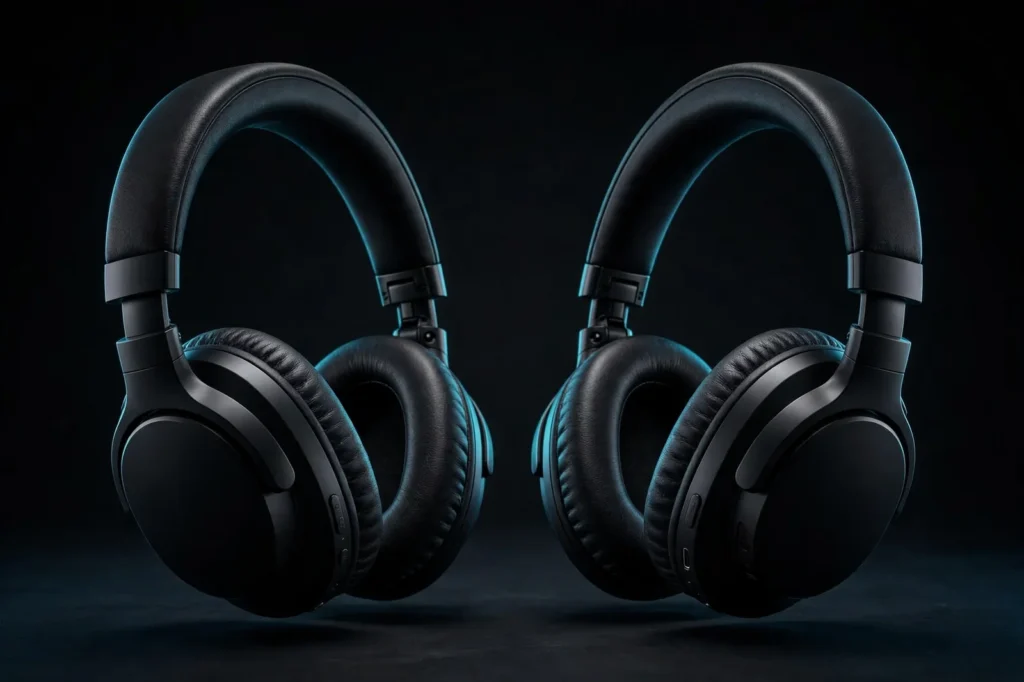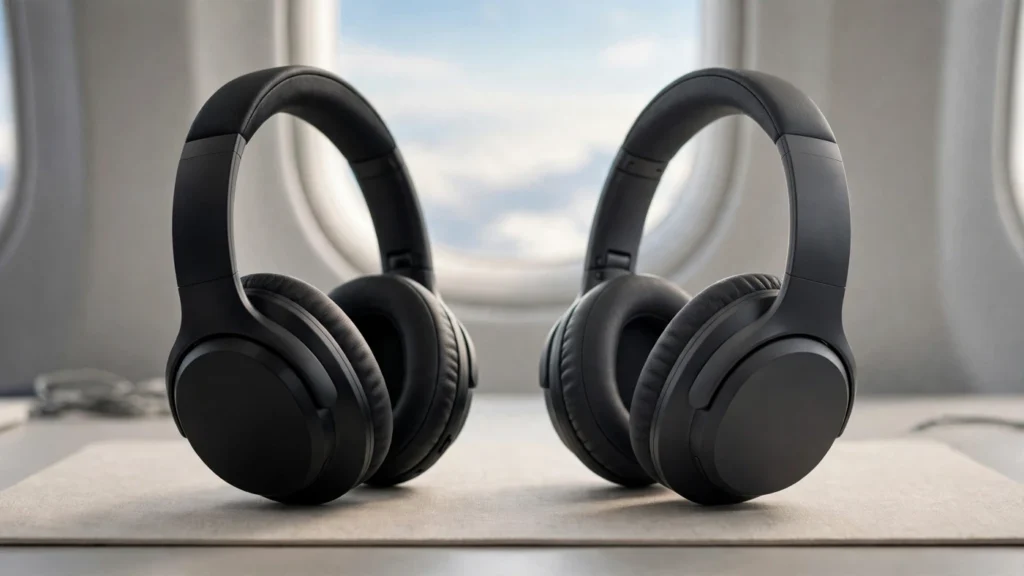
Bose QC vs Sony XM4 is one of the most searched headphone comparisons still running — and one of the most confusing, because “Bose QC” can mean several different products. So let us be explicit: by Bose QC we mean the Bose QuietComfort Headphones, the current mainline QuietComfort over-ear model released in 2023 — not the QuietComfort Ultra, and not the older QC45 it replaced. On the other side is the Sony WH-1000XM4, Sony’s 2020 flagship, usually shortened to Sony XM4. Same job, two very different philosophies.
SoundMavericks’ verdict, up front: the Sony XM4 is the better all-rounder — longer battery life, LDAC hi-res support, smarter features and a fuller app. The Bose QC is the better pure noise-cancelling comfort pick — lighter, softer on the head, simpler to live with, and the one we would choose for long flights and long workdays where features matter less than disappearing on your head. This is a research-based comparison built from the manufacturers’ specifications and published head-to-head evaluations; we do not claim hands-on testing, and every key figure below is a rated manufacturer specification.
Quick verdict
Buy the Bose QuietComfort Headphones if: comfort and calm are your priorities. It is lighter at around 240 g, its physical buttons never misread a swipe, and its Quiet and Aware modes are set-and-forget simple.
Buy the Sony WH-1000XM4 if: you want the most complete package. Thirty hours of battery, LDAC for hi-res wireless, wearing detection, Speak-to-Chat and deep app customisation make it the feature winner — frequently the smarter value now that it is an older model.
Bose QC vs Sony XM4: comparison table
| Feature | Bose QuietComfort Headphones (2023) | Sony WH-1000XM4 (2020) |
|---|---|---|
| Release year | 2023 | 2020 |
| Weight | Around 240 g | 254 g |
| Battery life (ANC on) | Up to 24 hours | Up to 30 hours |
| Quick charge | 15 minutes for up to 2.5 hours | 10 minutes for up to 5 hours |
| Bluetooth | 5.1, multipoint | 5.0, multipoint |
| Codecs | SBC, AAC | SBC, AAC, LDAC |
| Noise cancelling | Quiet and Aware modes, custom modes in app | Dual Noise Sensor with QN1 processor, automatic optimisation, app-adjustable levels |
| Controls | Physical buttons | Touch panel on earcup |
| Wearing detection | No | Yes — pauses when removed |
| App EQ | Bose app, simple adjustable EQ | Sony Sound Connect app, EQ, Adaptive Sound Control, Speak-to-Chat, DSEE Extreme |
| Wired listening | Yes, cable included | Yes, cable included |
| Charging | USB-C | USB-C |
Noise cancelling: Bose QC vs Sony XM4 ANC compared
This is the round most buyers care about, and it is close. Bose built its reputation on cancellation, and the QuietComfort’s strength is steady, deep suppression of constant low-frequency noise — aircraft cabins, train rumble, air conditioning — with a natural, pressure-light feel that many listeners find easier to wear for hours. Its two main modes, Quiet and Aware, cover almost every real situation, and the Bose app lets you save custom modes, including a wind-block setting for blustery platforms.
The XM4 counters with flexibility. Its Dual Noise Sensor system and QN1 processor continuously optimise cancellation for fit and environment, and the app offers finer-grained control over how much of the world leaks in. Published comparisons generally score the two within touching distance on raw cancellation, with Bose often praised for consistency on steady drone and Sony for adaptability as conditions change. Our call: a narrow Bose win for travellers who live in engine noise, a draw everywhere else — and both sit comfortably in the class covered by our best noise cancelling headphones guide.
Sound quality and codecs
The two sound signatures reflect their brands. The Bose QC is balanced and easy-going out of the box: clear mids, present vocals, and a low end with weight but without the boom that fatigues. The adjustable EQ in the Bose app covers bass, mid and treble, which is enough for most listeners to nudge it toward taste. The XM4 defaults to a warmer, more bass-forward presentation, and Sony’s app EQ gives you more scope to reshape it — many owners tame the low end slightly and are rewarded with a detailed, engaging listen.
The decisive technical difference is codec support. The XM4 supports LDAC, Sony’s high-bitrate Bluetooth codec, so with an Android phone or a hi-res source it can carry noticeably more musical information — pair it with a lossless service and the gap is real. The Bose QC supports SBC and AAC only: excellent for iPhone owners, who use AAC anyway, but a genuine limitation for hi-res Android listeners. Neither headphone is a wired-first audiophile design, though both play happily over their included cables with the power off. If codec flexibility matters to you, this round goes clearly to Sony.
Battery life and charging
Sony wins this round outright. The XM4 is rated for up to 30 hours with ANC on — and longer still with ANC off — against the Bose QC’s up to 24 hours. Over a working week, that is roughly an extra day of listening between charges. Sony’s quick charge is stronger too: around 10 minutes plugged in returns up to 5 hours of playback, versus up to 2.5 hours from a 15-minute charge on the Bose. Both charge over USB-C, and both survive a long-haul flight comfortably, but if you routinely forget to charge your headphones, the XM4 forgives you more often. For travel context, see our picks in best headphones for airplane travel.

Comfort, design and controls
Comfort is where the Bose fights back hardest. At around 240 g it is the lighter headphone, its clamping force is gentle, and its plush cushions spread pressure evenly — the combination that makes it our pick for all-day wear and for listeners who wear glasses. The XM4, at 254 g, is still a comfortable headphone with soft, roomy earcups, but its fit is a touch firmer and it can feel warmer over long sessions. Both fold for travel and ship with proper hard cases; neither feels fragile.
The control philosophies could not be more different. Bose uses physical buttons: unfashionable, unambiguous, and usable with gloves, in the rain, without looking. Sony uses a touch panel: swipes for volume and tracks, taps to pause, a palm over the earcup to let conversation in. Touch is slicker when it works — and on the XM4 it mostly does — but buttons never misread a gesture. Add Sony’s wearing detection, which pauses your music when you lift an earcup or take the headphones off entirely, and each side has a real everyday argument. We score usability a draw, comfort a Bose win.

Calls, multipoint and smart features
Both headphones connect to two devices at once over multipoint Bluetooth, so hopping between a laptop meeting and a phone call works on either. For calls, published evaluations tend to favour the Bose for a natural, clear voice in quiet and moderately noisy settings, while the XM4’s call quality is serviceable but more easily roughened by wind and street noise — neither replaces a dedicated headset for all-day calling. Treat calls as a slight Bose edge, not a reason to buy on its own.
On smart features, Sony pulls away. Speak-to-Chat pauses music and opens transparency the moment you start talking; Adaptive Sound Control adjusts settings based on whether you are sitting, walking or travelling; 360 Reality Audio support and DSEE Extreme upscaling round out a genuinely deep app. The Bose app is deliberately simpler: EQ, noise modes, multipoint management. Some buyers will read that as a limitation; others, honestly, will read it as relief. If you are cross-shopping the generations as well, our Sony WH-1000XM4C vs XM5 vs XM6 comparison shows what newer Sony models add, and our Bose QC45 review covers the Bose QC’s direct predecessor.
Who should buy which?
Buy the Bose QuietComfort Headphones if you fly often, wear headphones for most of the working day, wear glasses, or simply want the calmest, lightest, simplest experience. Its cancellation is superb where it matters most, its buttons always work, and it asks almost nothing of you.
Buy the Sony WH-1000XM4 if you want maximum battery, hi-res LDAC listening on Android, the deepest app and smart features that genuinely save effort every day. As the older model it also tends to be the value play of the two — the smarter buy for most people, most of the time.
SoundMavericks’ final word on Bose QC vs Sony XM4: the XM4 wins more rounds on the scorecard, so it is our default recommendation. The Bose wins the rounds — comfort, simplicity, steady cancellation — that decide how a headphone feels after month six. Choose by which of those sentences sounds like you.
Frequently asked questions
Is Bose QC better than Sony XM4 for noise cancelling?
For constant low-frequency noise such as aircraft cabins and trains, the Bose QuietComfort Headphones have a narrow edge, with steady, deep cancellation and a pressure-light feel. The Sony WH-1000XM4 is very close overall and adapts more flexibly to changing environments. Most listeners would be happy with either.
Which has better battery life, Bose QC or Sony XM4?
The Sony WH-1000XM4, clearly. It is rated for up to 30 hours with noise cancelling on, against up to 24 hours for the Bose QuietComfort Headphones. The Sony also quick-charges faster, returning up to 5 hours of playback from around 10 minutes plugged in.
Does the Bose QC support LDAC like the Sony XM4?
No. The Bose QuietComfort Headphones support SBC and AAC Bluetooth codecs only. The Sony WH-1000XM4 adds LDAC, which can carry higher-resolution audio from compatible Android phones and hi-res sources, making the Sony the better choice for hi-res wireless listening.
What does Bose QC mean in this comparison?
Here, Bose QC means the Bose QuietComfort Headphones, the mainline QuietComfort over-ear model released in 2023. It does not mean the Bose QuietComfort Ultra, which is a higher-tier model, or the older QC45, which the 2023 QuietComfort Headphones replaced.
Is the Sony XM4 still worth buying in 2026?
Yes, for most buyers. The WH-1000XM4 still offers strong noise cancelling, 30-hour battery life, LDAC and multipoint in a comfortable folding design. Newer models add refinements rather than revolutions, so a well-priced XM4 remains one of the smartest value buys in premium noise cancelling.

I am the founder of Sound Mavericks, where I provide the polite truth about audio equipment. I started this site because consumer electronics reviews are often too technical. Instead of using a silent lab, I test headphones, earbuds, and Bluetooth speakers in the real world – like on a noisy subway or in a busy coffee shop.
To stay independent, I buy my own review units (mostly from the United States) rather than accepting free gifts from brands. Once I finish testing a product, I sell it locally to our community. My goal is to help you understand sound quality, active noise cancellation (ANC), and battery life without the marketing hype.