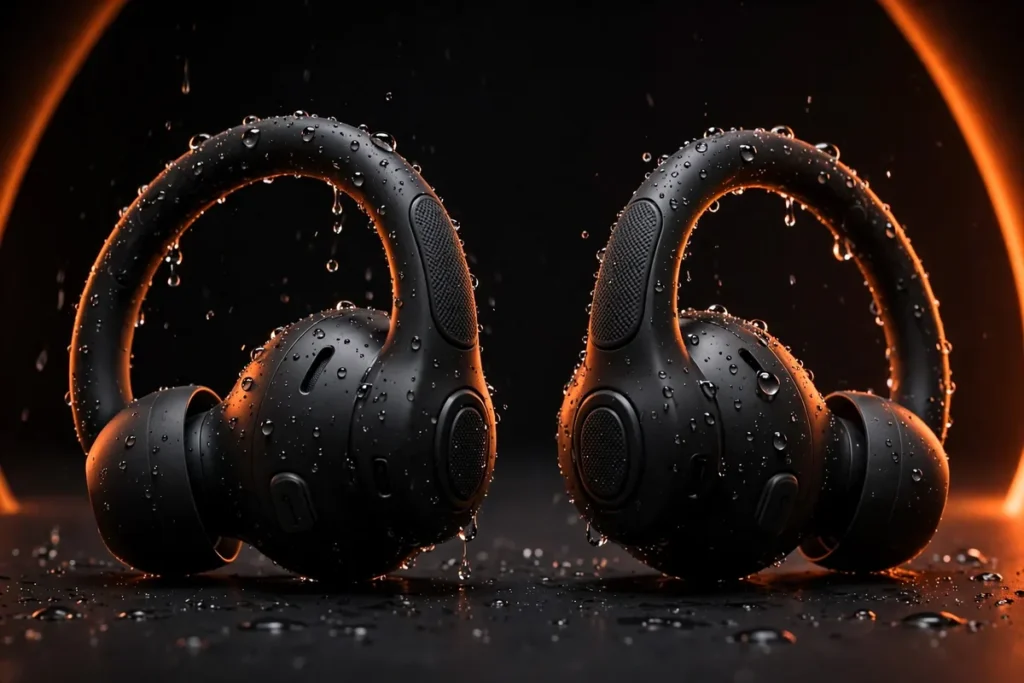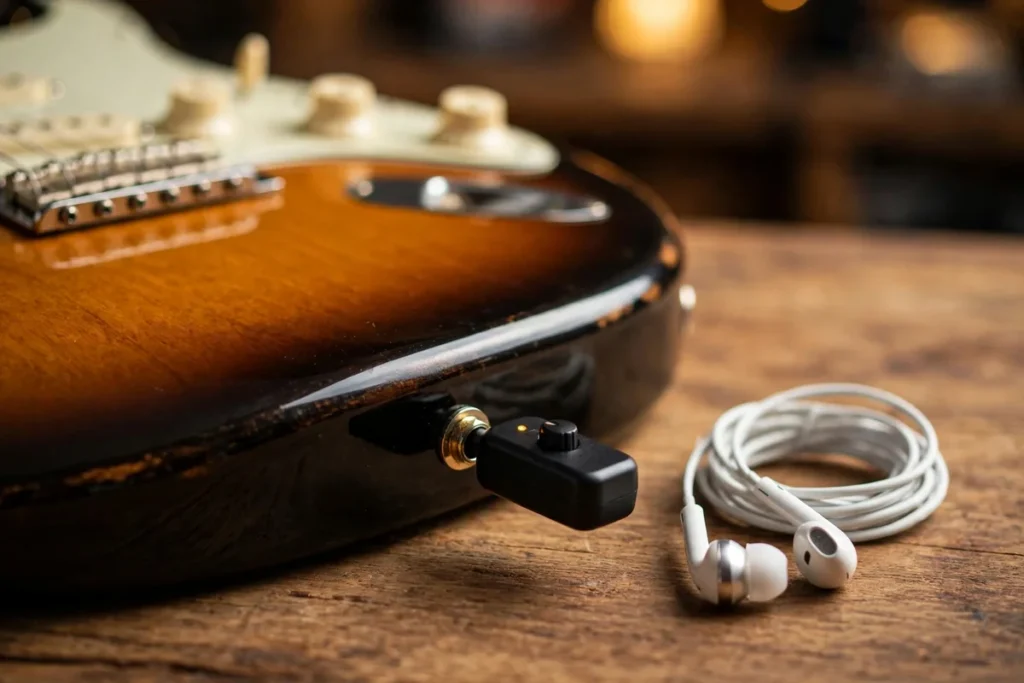
Shopping for the best guitar headphone amplifier can get confusing fast — because two completely different products share similar names. A guitar headphone amplifier (this guide) is a tiny amp that plugs directly into your guitar; you then plug your headphones into it, and it replaces your full-size amp for silent practice. Headphones for a guitar amp are the opposite: regular headphones you plug into the headphone jack of an amp you already own. If you need the latter, see our headphones for guitar amp guide instead.
This guide is for players who want to practice silently with great tone and zero setup: plug-in headphone amps with built-in amp modeling and effects. Our top pick is the Fender Mustang Micro Plus — 25 amp models, 25 effects and Bluetooth backing-track streaming in a unit smaller than a phone. The Vox amPlug 3 AC30 is the pick for analog purists who want real AC30 character, and the Boss Katana:GO is the most feature-packed option with its Stage Feel spatial audio. Read on for all six picks and a full buying guide.
Our top guitar headphone amplifier picks
| Pick | Best for | Standout feature |
|---|---|---|
| Fender Mustang Micro Plus | Best overall | 25 amp models + Fender Tone app |
| Vox amPlug 3 AC30 | Best analog tone | True analog AC30 circuitry, 16-hr battery |
| Boss Katana:GO | Most innovative | Stage Feel 3D spatial audio |
| NUX Mighty Plug Pro MP-3 | Best for tweakers | Custom IR loading, deep app editing |
| Positive Grid Spark NEO | Best wireless option | Cable-free practice via Spark app |
| SONICAKE Mini US Classic | Best budget | Simple plug-and-play, rechargeable |
What is a guitar headphone amplifier?
A guitar headphone amplifier is a pocket-sized device that does the job of a guitar amp — preamp, tone shaping, amp modeling, effects and speaker simulation — but outputs only to headphones instead of a speaker cabinet. You plug it straight into your guitar’s output jack (most have a rotating 1/4-inch plug), connect any wired headphones or earbuds, and practice at full volume without making a sound in the room.
Most modern units fall into two camps. Digital modelers (Fender Mustang Micro, Boss Katana:GO, NUX Mighty Plug) use DSP to simulate multiple famous amps and effects, usually with a companion app for deep editing. Analog plug-ins (the Vox amPlug series) use real analog circuitry voiced after one specific classic amp — simpler, with a feel many players describe as more immediate. Neither needs a speaker, a cable to an amp, or any software on your computer, though several double as USB audio interfaces for recording.
How to choose the right one
Amp models vs. one great sound. If you play many styles, a modeler with 10–25 amp types covers everything from pristine cleans to high gain. If you live in one genre, an analog unit voiced for that sound (like the AC30-flavored amPlug) often feels more authentic.
Effects and editing. Built-in reverb, delay, chorus and overdrive make practice far more inspiring. App-connected units (Mustang Micro Plus, Katana:GO, Mighty Plug Pro) let you build and save presets; analog units give you knobs and nothing else — which many players prefer.
Play-along features. Bluetooth audio streaming or an aux input lets you jam along with songs and backing tracks through the same headphones. If you learn songs by ear, treat this as essential.
Battery life and power. Rechargeable lithium units typically run 4–6 hours per charge; AAA-powered analog units can run 10–16 hours on a pair of batteries. Rechargeable is more convenient; replaceable batteries never leave you waiting on a charger.
Extras that matter. A built-in tuner saves you carrying one. USB recording turns the unit into a practice-and-demo interface. And check headphone compatibility — most use a standard 3.5mm jack that works with the earbuds you already own (see our best wired earbuds if you need a pair).
1. Fender Mustang Micro Plus — best overall guitar headphone amplifier

The Fender Mustang Micro Plus takes everything players loved about the original Mustang Micro and expands it: 25 amp models and 25 effects (up from 12 and 12), 100 editable preset slots, an integrated display and tuner, and full compatibility with the Fender Tone app for deep editing and preset sharing. It plugs directly into your guitar jack with a rotating 1/4-inch plug, streams backing tracks over Bluetooth with audio/video sync, and records to a computer or phone over USB.
What earns it the top spot is the balance. The amp models cover genuine Fender cleans through modern high gain, the effects are genuinely usable rather than filler, and the Tone app means the unit grows with you instead of gathering dust once you’ve tried every preset. Battery life runs around 4–6 hours of playing per charge depending on use. The main trade-off is complexity: with this many options, beginners may spend their first sessions menu-diving instead of playing — though the factory presets are strong enough to just plug in and go.
Key features: 25 amp models, 25 effects, 100 preset slots, Bluetooth audio streaming, Fender Tone app, built-in tuner and display, USB recording, rechargeable battery.
Best for: players who want one silent-practice tool that covers every genre and keeps expanding via the app.
2. Vox amPlug 3 AC30 — best analog tone

Now in its third generation, the Vox amPlug 3 AC30 remains the purist’s choice: a true analog circuit voiced after the legendary Vox AC30 tube amp, in a 40-gram unit that plugs straight into your guitar. The dual-channel design gives you the AC30’s Normal channel for warm cleans and the Top Boost channel for that chiming, singing overdrive, plus stereo effects (reverb, delay, chorus/flanger), speaker emulation and nine built-in rhythm patterns for play-along practice.
The appeal here is feel. Analog circuitry responds to your picking dynamics the way a real amp does — notes bloom and decay naturally instead of feeling processed. Battery life is outstanding at up to 16 hours from two AAA batteries, and the aux input handles backing tracks. The compromises: the tiny controls are fiddly, there’s no app or USB recording, and high-gain players should look at the UK Drive or High Gain models in the amPlug 3 range instead. But if the AC30 sound is your sound, nothing else in this size delivers it this faithfully.
Key features: analog AC30-voiced circuit, dual channels (Normal/Top Boost), stereo FX, 9 rhythm patterns, aux input, up to 16-hour AAA battery life, 40 g.
Best for: players who want authentic British-voiced tone with zero menus and marathon battery life.
3. Boss Katana:GO — most innovative

The Boss Katana:GO shrinks the stage-class Katana amp series into a 65-gram plug-in: 10 guitar amp types and over 60 effects in guitar mode, plus a dedicated bass mode with 3 amp types and over 60 effects, 30 user memories per mode, an OLED display with onboard tuner, and Bluetooth editing via the Boss Tone Studio app. Its headline trick is Stage Feel — spatial audio processing that simulates the experience of playing through a real amp in a room, which makes headphone practice feel dramatically less boxy.
This is the pick for players who already love the Katana ecosystem: you can import tone settings from full-size Katana amps, download and share livesets on Boss Tone Exchange, and record over USB-C. Battery life is around 5 hours per charge. The depth is also the caveat — getting the most from it means engaging with the app, and the sheer number of options can overwhelm beginners. But as a complete silent rig for guitar and bass, nothing else here does as much.
Key features: 10 guitar + 3 bass amp types, 60+ effects per mode, Stage Feel spatial audio, OLED display, 30 memories per mode, Bluetooth, USB-C recording, ~5-hour battery.
Best for: Katana fans and players who want the deepest feature set, including bass support.
4. NUX Mighty Plug Pro MP-3 — best for tweakers

The NUX Mighty Plug Pro (MP-3) is the tweaker’s headphone amp: TSAC-HD white-box amp modeling with realistic playing feel, a full signal chain of effect blocks (gate, compressor, EFX, amp, IR, EQ, modulation, delay, reverb) in freely reorderable order, and — the standout — custom impulse-response loading with 36 premium built-in IRs plus user slots for third-party cabinet IRs. It runs at 48 kHz/32-bit with just 1.2 ms of system latency and 103 dB of dynamic range.
Beyond the modeling, you get 7 active presets, a drum machine and metronome for practice, Bluetooth for backing tracks and app control, and USB-C audio for recording or livestreaming. Battery life is around 5 hours. The MightyAmp app and Mighty Editor software unlock the deep editing; without them you’re only scratching the surface, so this one rewards players who enjoy building rigs. If you want pro-level cab simulation in your pocket and don’t mind an app, the MP-3 punches far above its size.
Key features: TSAC-HD amp modeling, custom IR loading, reorderable effect blocks, drum machine + metronome, Bluetooth, USB-C recording, ~5-hour battery, 70 g.
Best for: tone builders who want custom cabinet IRs and deep signal-chain editing.
5. Positive Grid Spark NEO — best wireless option

The Positive Grid Spark NEO takes a different approach: instead of a plug-in dongle, it’s a wireless smart headphone amp that pairs with Positive Grid’s Spark app, giving you Spark’s acclaimed amp modeling and effects with no cable between you and your guitar. For players who hate being tethered — practicing while moving around the room, or playing in spaces where a dangling dongle is awkward — the cable-free experience is genuinely liberating.
The trade-off is dependence on the ecosystem: the full experience lives inside the Spark app, and purists may prefer a dedicated plug-in unit’s immediacy. But if you’re already in the Spark world or you simply want the most convenient silent-practice setup possible — pick up the guitar, put on the NEO, play — this is the most frictionless option on this list.
Key features: wireless smart headphone amp, Spark app amp modeling and effects, cable-free practice.
Best for: players who want zero cables and already like the Spark ecosystem.
6. SONICAKE Mini US Classic — best budget

The SONICAKE Mini proves you don’t need to spend much for satisfying silent practice. This pocket-sized plug-in delivers American-voiced amp tone (the “US Classic” voicing) with built-in overdrive and reverb effects, a rechargeable battery, and genuinely simple operation: plug it in, plug in headphones, play. No app, no menus, no firmware updates.
Expectations should be set accordingly — you get one voicing family rather than 25 amp models, and the effects are basic compared to the app-driven units above. But for beginners, travel practice, or a backup that lives in your gig bag, the SONICAKE nails the essentials: it sounds like a real amp in your headphones, it’s rechargeable, and it costs a fraction of the flagship modelers. It’s the easiest recommendation on this list for anyone who just wants to practice quietly tonight.
Key features: US Classic amp voicing, overdrive + reverb effects, rechargeable battery, plug-and-play operation, ultra-compact.
Best for: beginners and budget-conscious players who want simple silent practice.
Guitar headphone amplifiers compared
| Model | Technology | Amp models | Bluetooth / aux | Battery | USB recording |
|---|---|---|---|---|---|
| Fender Mustang Micro Plus | Digital modeling | 25 | Bluetooth | Rechargeable, ~4–6 hrs | Yes |
| Vox amPlug 3 AC30 | Analog | 1 (AC30, 2 channels) | Aux in | 2× AAA, up to 16 hrs | No |
| Boss Katana:GO | Digital modeling | 10 guitar + 3 bass | Bluetooth | Rechargeable, ~5 hrs | Yes (USB-C) |
| NUX Mighty Plug Pro | Digital modeling | TSAC-HD + custom IRs | Bluetooth | Rechargeable, ~5 hrs | Yes (USB-C) |
| Positive Grid Spark NEO | Digital (app-based) | Via Spark app | Wireless | Rechargeable | Via app |
| SONICAKE Mini | Digital | 1 voicing family | — | Rechargeable | No |
Model counts and battery figures are manufacturer specifications.
Do you need a guitar headphone amp or just good headphones?
Quick recap of the distinction from the top of this guide: if you already own an amp with a headphone output, you don’t need any of the products above — you need a comfortable pair of headphones to plug into it, and our headphones for guitar amp guide covers exactly that. A guitar headphone amplifier is for when you want to leave the amp behind entirely: late-night practice, travel, dorm rooms, or a minimalist setup with just a guitar and earbuds.
One more consideration: the headphones you pair with a headphone amp matter. These units are voiced for typical earbuds and headphones, but high-impedance studio headphones may play quietly — if you’re unsure whether your cans need extra juice, our impedance explainer walks through it, and our headphone amp guide covers full-size desktop units for critical listening.
Guitar headphone amplifier FAQs
What is the best guitar headphone amplifier overall?
The Fender Mustang Micro Plus is our top pick: 25 amp models, 25 effects, Bluetooth backing-track streaming, a tuner and the Fender Tone app in a pocket-sized unit. The Vox amPlug 3 AC30 is the best analog alternative, and the Boss Katana:GO packs the most features.
Can I use any headphones with a guitar headphone amp?
Yes — virtually all guitar headphone amps use a standard 3.5mm headphone jack, so any wired earbuds or headphones work. Wireless headphones generally don’t connect directly to plug-in units (the Positive Grid Spark NEO is the wireless exception).
Do guitar headphone amps need an app?
No. Analog units like the Vox amPlug 3 work entirely with physical knobs. App-connected modelers (Mustang Micro Plus, Katana:GO, Mighty Plug Pro) work standalone too — the app just unlocks deeper editing and preset management.
Can I record with a guitar headphone amplifier?
Many can. The Fender Mustang Micro Plus, Boss Katana:GO and NUX Mighty Plug Pro all function as USB audio interfaces, so you can record directly to a computer or phone. The Vox amPlug 3 and SONICAKE Mini are practice-only devices.
How long does the battery last on a guitar headphone amp?
Rechargeable digital modelers typically run 4–6 hours per charge. The analog Vox amPlug 3 runs up to 16 hours on two AAA batteries — the longest here by a wide margin.
What’s the difference between a guitar headphone amp and a regular headphone amp?
A guitar headphone amp includes a guitar preamp, amp modeling and speaker simulation — it replaces your guitar amp. A regular headphone amp (see our headphone amp guide) just boosts a line-level signal for hard-to-drive headphones; it can’t take a guitar input directly. Our preamp vs amp explainer breaks down the signal chain further.
Are cheap guitar headphone amps worth it?
For basic silent practice, yes — the SONICAKE Mini delivers genuinely usable amp tone for a fraction of the flagship price. You give up multiple amp models, deep editing and USB recording, but if you just want to practice quietly, the core experience is there.

I am the founder of Sound Mavericks, where I provide the polite truth about audio equipment. I started this site because consumer electronics reviews are often too technical. Instead of using a silent lab, I test headphones, earbuds, and Bluetooth speakers in the real world – like on a noisy subway or in a busy coffee shop.
To stay independent, I buy my own review units (mostly from the United States) rather than accepting free gifts from brands. Once I finish testing a product, I sell it locally to our community. My goal is to help you understand sound quality, active noise cancellation (ANC), and battery life without the marketing hype.