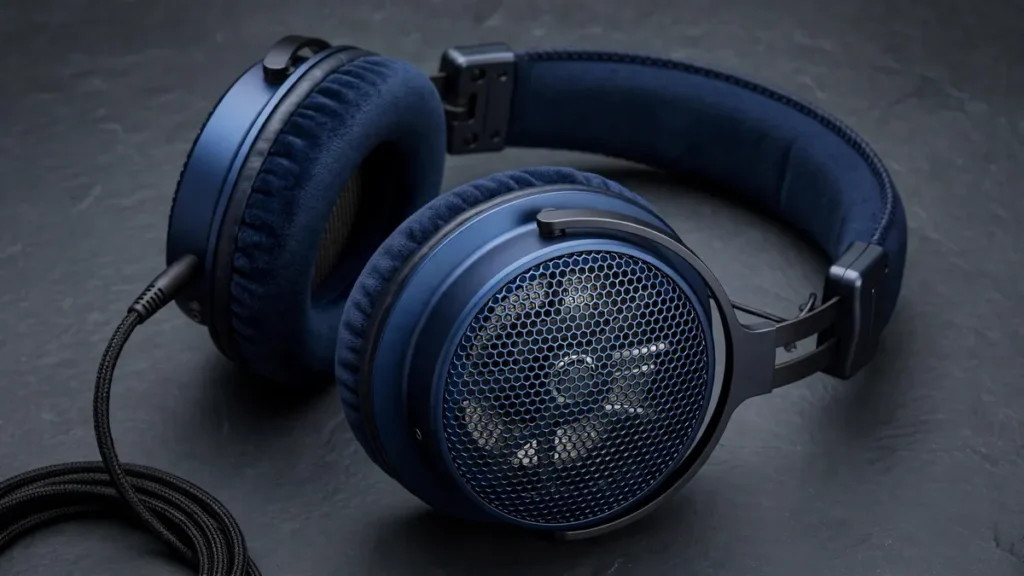
The Sennheiser HDVD 800 is a discontinued flagship headphone amplifier and DAC — the companion unit Sennheiser built alongside its legendary HD 800 headphones. New units are long gone from retail shelves, but the HDVD 800 still trades regularly on the used market, where it remains one of the most respected solid-state amplifiers ever made for the HD 800, HD 800 S, HD 650, and HD 600 family.
If you are shopping for one today, read this guide first: you need to know exactly what the HDVD 800 offers, how it differs from its successor the Sennheiser HDV 820, and what to check before buying used.
Our Verdict
The HDVD 800 was Sennheiser’s statement piece: a fully symmetrical, German-engineered amplifier with a built-in Burr-Brown DAC resolving up to 24-bit/192 kHz, driving up to four pairs of headphones at once through balanced and unbalanced outputs. In its day it won TEC technical achievement awards and became the default pairing for the HD 800 in enthusiast rigs. SoundMavericks’ take: as a used-market purchase it is still a superb-sounding amplifier, but it is outclassed on features and format support by modern flagships like the HDV 820 — buy it for its legendary amp section, not as a cutting-edge DAC.
| Sound Quality | 9.2 |
| Build & Design | 9.0 |
| DAC Performance | 8.6 |
| Connectivity | 8.8 |
| Value (Used Market) | 7.6 |
The HDVD 800 is discontinued, so Amazon’s search page (used and marketplace listings) is the honest place to look.
What Is the Sennheiser HDVD 800?
The HDVD 800 is a digital headphone amplifier with an integrated digital-to-analog converter, launched in 2013 as Sennheiser’s official companion for its flagship HD 800 headphones. Engineered and manufactured in Germany, it was designed to squeeze the absolute best from high-end Sennheiser models — the HD 800, HD 700, HD 650, and HD 600 — though it works with any quality dynamic headphone.
It was Sennheiser’s first ever solid-state DAC/amplifier combo, and its reputation stuck: the HDVD 800 received Outstanding Technical Achievement honors at the TEC Awards, and it remains a benchmark in headphone amplifier comparisons more than a decade later. For context on why solid-state designs like this sound the way they do, see our breakdown of tube amps vs solid-state amps.
A closely related sibling, the HDVA 600, is the amplifier-only version (no DAC) for listeners who already own a favorite DAC. If you are pairing the HDVD 800 with a classic mid-range Sennheiser, our HD 6XX review covers a natural partner headphone.
Sennheiser HDVD 800 Specifications
| Type | Solid-state headphone amplifier with built-in DAC |
| DAC chip | Burr-Brown, 24-bit / up to 192 kHz |
| Frequency response | 0.3 Hz to 100 kHz (−3 dB) |
| THD+N | < 0.001% |
| Crosstalk attenuation | min. 93 dB @ 1 kHz |
| Dynamic range | > 115 dB @ 600 Ω (A-weighted) |
| Gain (RCA in → XLR-4 out) | Adjustable 14 / 22 / 30 / 38 / 46 dB (rear gain switch) |
| Gain (XLR in → XLR-4 out) | 16 dB |
| Headphone outputs | 2 × 6.35 mm (1/4″) unbalanced + 2 × 4-pin XLR balanced; up to 4 pairs simultaneously |
| Digital inputs | USB Type B (USB Audio 2.0, 24/192), AES/EBU (XLR-3), optical TosLink S/PDIF, coaxial RCA S/PDIF |
| Analog inputs | 1 pair balanced XLR-3 (max 14 dBV, 10 kΩ); 1 pair unbalanced RCA (max 20 dBV, 10 kΩ, input attenuation switch) |
| Preamp output | 1 pair balanced 3-pin XLR |
| Volume control | ALPS quadruple potentiometer, precision channel balance |
| Sampling rate | Auto-adjusted 44.1 kHz to 192 kHz |
| Driver requirements | Dedicated USB driver for Windows (supplied on CD); no driver needed for Mac OS X 10.6.4 or later |
| Dimensions | 224 × 44 × 306 mm |
| Weight | 2.2 kg |
| Power | 100–240 V AC, 50/60 Hz; consumption under 30 VA |
| Availability | Discontinued; replaced by the Sennheiser HDV 820 |
Specifications compiled from Sennheiser’s official technical data and Crutchfield’s product research.
Sennheiser HDVD 800 Features
Burr-Brown DAC with 24-Bit/192 kHz Support
At the heart of the digital section sits a high-quality Burr-Brown converter resolving up to 24-bit depth at 192 kHz sampling rates across every digital input. The sampling rate adjusts automatically between 44.1 kHz and 192 kHz, so standard-resolution and high-resolution files are both handled without manual switching. If you want to understand what the DAC is actually doing in the chain, our DAC explainer covers the essentials.
Fully Symmetrical Signal Processing
The HDVD 800 uses symmetrical — balanced — circuitry throughout, with two completely independent signal paths for the left and right channels from input to output. This design keeps the noise floor extremely low and reduces interference and distortion. Measured performance backs it up: THD+N under 0.001%, crosstalk attenuation of at least 93 dB at 1 kHz, and a dynamic range above 115 dB at 600 Ω.
Four Headphone Outputs, Including Balanced XLR
Two full-size 6.35 mm jacks handle standard unbalanced headphones, while two four-pin XLR outputs serve headphones wired for balanced operation — the way to get the full benefit of the symmetrical design. All four can run simultaneously, which makes the HDVD 800 genuinely useful for side-by-side comparisons or group listening. Unsure whether your headphones even need a dedicated amp? Our guide to headphone impedance and amplifier requirements will tell you.
Digital and Analog Inputs for Any Source
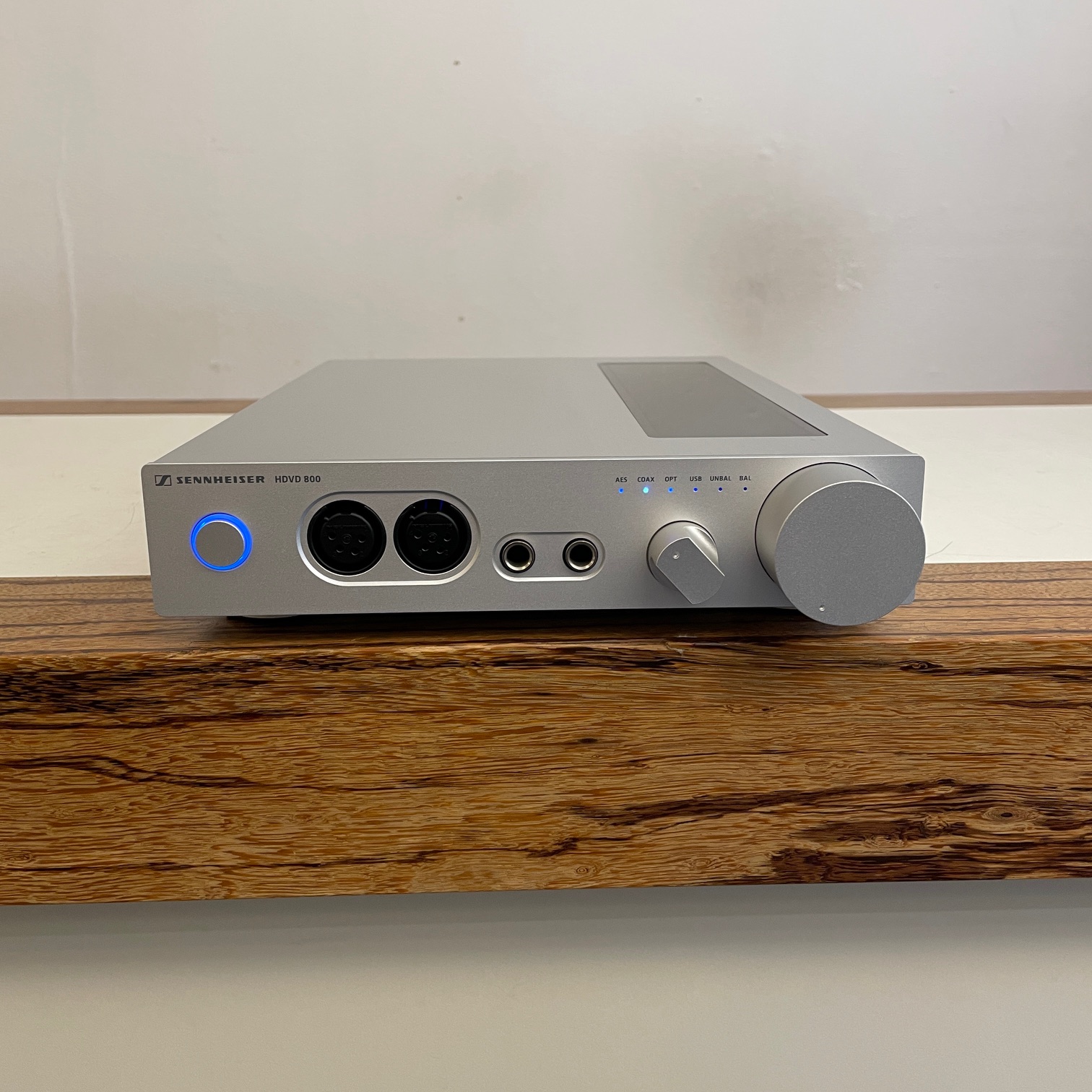
The rear panel covers essentially every source type: USB Type B for computer audio (USB Audio Class 2.0), AES/EBU over XLR-3, optical TosLink, and coaxial S/PDIF on the digital side; plus a balanced XLR-3 pair and an unbalanced RCA pair on the analog side. A six-position rotary selector on the front (AES, COAX, OPT, USB, UNBAL, BAL) switches between them, with an LED showing the active input. A five-stage gain switch on the rear optimizes the amp for low-impedance headphones when needed.
Preamp Output and Tank-Like Build
A balanced 3-pin XLR preamp output lets the HDVD 800 double as a preamp feeding a compatible power amp or active speakers. Build quality is a standout: an aluminum housing with a glass viewing panel, front panel and knobs milled from solid metal, and a premium ALPS quadruple potentiometer volume control mechanically linked to the knob by an unusually long shaft — a design choice that keeps the audio signal path extremely short.
Is the Sennheiser HDVD 800 Discontinued?
Yes. The Sennheiser HDVD 800 is discontinued. It was succeeded by the Sennheiser HDV 820, which keeps an improved version of the HDVD 800’s analog amplifier section but replaces the digital side with an ESS SABRE32 DAC supporting 32-bit/384 kHz PCM and DSD256, adds 4.4 mm Pentaconn balanced outputs, and adopts the black-anodized look that matches the HD 800 S.
You will not find new HDVD 800 units from retailers. What you will find: a steady supply of used units on the secondary market and Amazon marketplace sellers. Because the amplifier section was so highly regarded, used examples remain in demand among HD 800 and HD 800 S owners — which also means sellers rarely give them away.
Sennheiser HDVD 800 vs HDV 820
| HDVD 800 | HDV 820 (successor) | |
| DAC chip | Burr-Brown, 24/192 | ESS SABRE32, 32/384 |
| DSD support | No | DSD256 (up to 12.3 MHz) |
| Balanced outputs | 2 × 4-pin XLR | 1 × 4-pin XLR + 2 × 4.4 mm Pentaconn |
| Design | Silver aluminum with glass panel | Black anodized housing |
| Availability | Discontinued — used market only | Current product |
The bottom line from SoundMavericks: the HDVD 800’s amplifier section holds up beautifully — Sennheiser carried its design philosophy straight into the HDV 820. The meaningful upgrades in the successor are all on the digital side (higher-resolution DAC, DSD, modern Pentaconn connectors). If you primarily need a reference-grade amp for your HD 800 or HD 800 S and can find a clean used HDVD 800 at a fair used-market price, it is still a legitimate buy. If you want modern digital features and full manufacturer support, buy the successor instead.
Modern Alternatives to the HDVD 800
If a used flagship is not your thing, the obvious modern alternative is Sennheiser’s own HDV 820 — the direct successor, currently in production. Its amplifier section derives from the HDVD 800’s with refinements, and its ESS SABRE32 DAC brings the digital section fully up to date with 32-bit/384 kHz and DSD256 support.
Sennheiser HDV 820 — verified live Amazon listing (successor to the HDVD 800).
Beyond Sennheiser, the current best headphone amplifiers roundup covers flagship DAC/amp combos that match or exceed the HDVD 800’s digital capabilities while costing far less than either Sennheiser flagship.
Buying a Used Sennheiser HDVD 800: What to Check
- Test every output. Ask the seller to confirm all four headphone outputs work — the 4-pin XLR sockets and the 1/4″ jacks — plus each input position on the rotary selector.
- Check the volume pot. The ALPS quadruple potentiometer is the heart of the analog section; listen for channel imbalance or scratchiness at low volumes, which suggests a worn pot.
- Confirm the USB driver situation. Windows users need Sennheiser’s dedicated USB driver, which was distributed on an included CD; verify the seller includes it or that you can source the driver before paying.
- Ask about the gain switch. The rear five-stage gain switch is a mechanical rotary; make sure it clicks cleanly through all positions.
- Inspect the glass panel. The aluminum housing’s viewing glass is a cosmetic hallmark of this amp — cracks or deep scratches hurt resale, even if they do not affect sound.
Frequently Asked Questions
Is the Sennheiser HDVD 800 discontinued?
Yes. The HDVD 800 is discontinued and was succeeded by the Sennheiser HDV 820. New units are no longer sold; the HDVD 800 is available only on the used market.
What DAC chip does the Sennheiser HDVD 800 use?
The HDVD 800 uses a Burr-Brown DAC supporting up to 24-bit resolution at 192 kHz sampling rates across its USB, AES/EBU, optical, and coaxial digital inputs.
Does the HDVD 800 work with the HD 800 S, HD 650, and HD 600?
Yes. Sennheiser designed the HDVD 800 specifically around its high-end headphones, and it pairs well with the HD 800, HD 800 S, HD 700, HD 650, and HD 600 — as well as other quality dynamic headphones.
Can the HDVD 800 drive four headphones at once?
Yes. It has two 6.35 mm unbalanced outputs and two 4-pin XLR balanced outputs, and can power up to four pairs of dynamic headphones simultaneously.
What is the difference between the HDVD 800 and the HDV 820?
The HDV 820 is the successor: its analog amp section is an improved version of the HDVD 800’s, but it upgrades the digital side to an ESS SABRE32 DAC (32-bit/384 kHz, DSD256) and adds 4.4 mm Pentaconn balanced outputs in a black-anodized housing.
Does the HDVD 800 need a driver on Windows or Mac?
On Windows a dedicated Sennheiser USB driver (supplied on CD) is required. On Mac OS X 10.6.4 or later, no driver is needed.
Final Thoughts
The Sennheiser HDVD 800 is one of those rare discontinued products that earned its legend: a reference-grade solid-state amplifier with a thoroughly engineered digital front end, built in Germany to a standard few modern products match. If you own an HD 800 or HD 800 S and a clean used unit crosses your path, it remains a genuinely excellent pairing. Just go in with open eyes: the DAC is a 24/192 Burr-Brown design from 2013, there is no DSD support, and manufacturer support is gone. For modern digital formats and a warranty, the HDV 820 — or one of the current best headphone amps — is the smarter buy.

I am the founder of Sound Mavericks, where I provide the polite truth about audio equipment. I started this site because consumer electronics reviews are often too technical. Instead of using a silent lab, I test headphones, earbuds, and Bluetooth speakers in the real world – like on a noisy subway or in a busy coffee shop.
To stay independent, I buy my own review units (mostly from the United States) rather than accepting free gifts from brands. Once I finish testing a product, I sell it locally to our community. My goal is to help you understand sound quality, active noise cancellation (ANC), and battery life without the marketing hype.