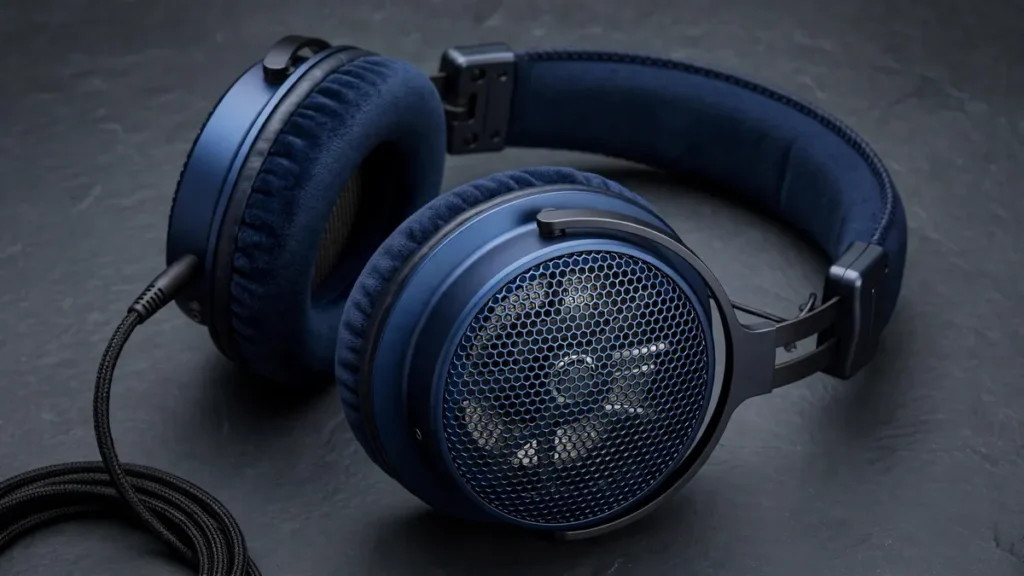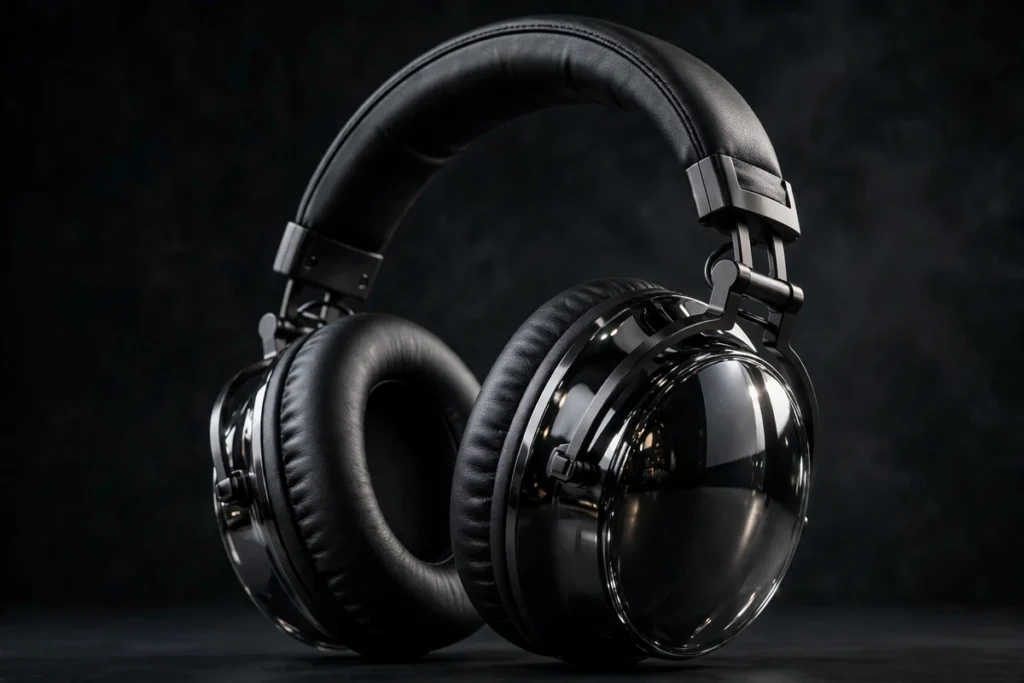
The Sennheiser HD 820 set out to do what most engineers considered impossible: deliver the vast, open soundstage of the legendary HD 800 S from a fully closed-back headphone. Sennheiser’s answer was radical — concave Gorilla Glass reflectors that bounce rear sound waves away from the ear into an absorber system, paired with the same 56mm ring radiator driver architecture as its open-back sibling. Our verdict after analyzing the specs, published reviews and owner feedback: the HD 820 is the closed-back endgame for listeners who love the HD 800 family sound but need isolation — with tighter, punchier bass than the open version. It is not, however, a headphone you buy on a whim: the 300-ohm impedance demands serious amplification, and this is a flagship-priced, reference-grade tool.
A quick note on how this review is built: SoundMavericks scores are based on our analysis of manufacturer specs, published third-party reviews and long-term owner feedback — not on a test bench of our own. The verdict below is our own; outside reviewers are credited only where their reporting adds something specific.
The verdict up front
| Sound Quality | 9.4 |
| Build Quality | 9.3 |
| Comfort | 9.2 |
| Soundstage & Imaging | 9.0 |
| Value | 7.8 |
| Ease of Driving | 7.5 |
Sennheiser HD 820 specifications
| Specification | Detail |
|---|---|
| Driver | 56mm ring radiator dynamic transducer |
| Design | Closed-back, circumaural (over-ear) |
| Frequency response | 12–43,800 Hz (-3 dB); 6–48,000 Hz (-10 dB) |
| Impedance | 300 ohms |
| Sensitivity (SPL) | 103 dB (1 kHz, 1 Vrms) |
| THD | < 0.02% (1 kHz, 100 dB) |
| Weight | 360 g (without cable) |
| Cable | 3 m detachable; 6.35mm unbalanced and 4.4mm Pentaconn balanced included |
| Key technologies | Concave Gorilla Glass reflectors, acoustic absorber system |
| Build | Metal headband with inner damping, microfiber ear and headband padding; developed in Germany, built in Ireland |
Specs are manufacturer figures from Sennheiser.

Design and build: glass, metal and microfiber
The HD 820’s defining visual feature is also its defining engineering feature: the concave Gorilla Glass covering each earcup. In a conventional closed-back, sound waves bouncing off the inside of the cup create resonances and standing waves that smear detail. Sennheiser’s glass reflectors redirect those rear waves at an angle into an absorber system, effectively removing them — the acoustic trick that lets a sealed headphone image like an open one. Reviewers at Headphones.com and StereoNET both singled out the build as among the most refined they’ve handled: precise metalwork, an ultra-ergonomic headband with an inner damping element, and luxuriously soft microfiber padding on every contact point.
Comfort is a genuine strength. At 360 g the HD 820 is light for a flagship, the clamp force is minimal, and the earpads run slightly deeper than the HD 800 S’s — so ears don’t touch the inner mesh. Multiple reviewers report wearing it all day at a desk without pressure points. In the box you get two 3 m cables (6.35mm single-ended and 4.4mm Pentaconn balanced), a storage box and a microfiber cloth.
Sound: open-back scale, closed-back punch
The headline question every review tried to answer: does it actually sound like an open headphone? The consensus is closer than anyone expected. Soundstage width and depth land well beyond typical closed-back performance — reviewers describe precise instrument placement with a genuine sense of space — though the presentation centers slightly more “in the head” than the HD 800 S, with a touch of extra contrast that gives dynamic music real emotional punch.
Bass is the surprise standout. Where the HD 800 S is famously lean down low, the sealed HD 820 delivers tighter, punchier and more extended low frequencies — reviewers call it staggering for a closed-back, if still short of basshead territory. The treble is detailed and airy with the ring radiator’s signature clarity, though a couple of reviewers noted a hint of edginess at the very top. Mids stay clean and unmasked thanks to the absorber system doing its job.
Isolation is good but not total — it’s a sealed audiophile headphone, not an ANC commuter can. Expect meaningful attenuation of ambient noise and minimal leakage at moderate volumes, which is exactly the use case: reference listening without disturbing the room. For the full open-vs-closed trade-off, see our open-back vs closed-back guide.
The 300-ohm question: you need an amplifier
At 300 ohms with 103 dB sensitivity, the HD 820 is not a plug-into-your-phone headphone — it needs voltage swing to show what it can do. Sennheiser’s own HDV 820 DAC/amp was developed as the intended partner, but any quality desktop amp with a balanced output will work; the included 4.4mm Pentaconn cable is there for exactly that. Underpowered, it will sound thin and dynamically flat — which explains some of the mixed casual impressions online. Our impedance explainer covers why high-impedance flagships behave this way.
HD 820 vs HD 800 S: which flagship?
The HD 800 S remains the pick for pure soundstage scale and a slightly more refined top end in a quiet room — and it typically costs less. Choose the HD 820 if you need isolation: shared offices, late-night listening, or any room where open-back leakage is a problem. Sonically, the 820 trades a touch of the 800 S’s airiness for notably stronger, tighter bass. If your room is quiet and private, the open-back sibling is the more natural flagship; if it isn’t, the 820 is the only way to get this driver technology without the leakage.
HD 820 vs Focal Stellia: the other closed-back flagship
The only closed-back that consistently gets mentioned in the same breath as the HD 820 is the Focal Stellia. The two take opposite approaches to the same problem. The Stellia is the easier daily driver: lower impedance so it’s far simpler to power, stronger passive isolation, a thicker, more forward midrange that flatters rock, pop and hip-hop, and it ships with a proper travel case. The HD 820 counters with a more realistic, harmonically complex treble that reviewers prefer for classical, jazz and singer-songwriter material, a wider and more open-feeling soundstage, and superior long-session comfort for desk listening. Choose the Stellia if you want flagship closed-back sound that also travels; choose the HD 820 if your listening happens in one chair and you want the most spacious presentation a sealed headphone can offer.
Who should buy the HD 820 — and who shouldn’t
Buy it if: you want endgame closed-back sound, you already own or plan to buy a proper headphone amp, and you love the Sennheiser reference tuning. Skip it if: you don’t own an amp, you want a portable or commuting headphone, or your listening is mostly casual — the Sennheiser HD 660S2 or HD 6XX deliver much of the house sound for far less demanding setups. Shoppers wanting a current closed-back Sennheiser at a saner outlay should also look at the newer HD 620S line and our best closed-back headphones roundup.
Sennheiser HD 820 FAQs
Is the Sennheiser HD 820 worth it?
For its target buyer — yes. It’s the only closed-back headphone with the HD 800 family’s ring radiator driver and glass-reflector acoustics, and reviewers consistently rank it among the finest closed-backs ever made. It’s poor value as a casual purchase, since it needs a quality amp to perform.
Does the HD 820 need an amplifier?
Yes. At 300 ohms it requires a dedicated headphone amp or a powerful DAC/amp to reach its potential; a phone or laptop headphone jack won’t drive it properly.
Is the HD 820 really a closed-back headphone?
Yes — fully sealed earcups with meaningful isolation and low leakage. The Gorilla Glass reflectors and absorber system are what let it image like an open-back despite the sealed design.
What is the difference between the HD 820 and HD 800 S?
The HD 820 is the closed-back counterpart: stronger, punchier bass and real isolation, with a slightly more centered soundstage. The HD 800 S stays the pick for maximum openness in a quiet room.
What cables come with the HD 820?
Two detachable 3 m cables: a 6.35mm single-ended cable and a 4.4mm Pentaconn balanced cable. An XLR-4 balanced cable is available separately.
Is the HD 820 comfortable for long listening sessions?
Yes — reviewers consistently praise the comfort: 360 g weight, minimal clamp force, deep microfiber pads and a damped metal headband make it an all-day wearer.
Is the Sennheiser HD 820 discontinued?
Sennheiser’s newer closed-back focus is the HD 620S line, and the HD 820’s retail presence has narrowed — but the listing we link to was live and purchasable at the time of writing. Availability can vary, so check the listing before planning a full system around it.

I am the founder of Sound Mavericks, where I provide the polite truth about audio equipment. I started this site because consumer electronics reviews are often too technical. Instead of using a silent lab, I test headphones, earbuds, and Bluetooth speakers in the real world – like on a noisy subway or in a busy coffee shop.
To stay independent, I buy my own review units (mostly from the United States) rather than accepting free gifts from brands. Once I finish testing a product, I sell it locally to our community. My goal is to help you understand sound quality, active noise cancellation (ANC), and battery life without the marketing hype.