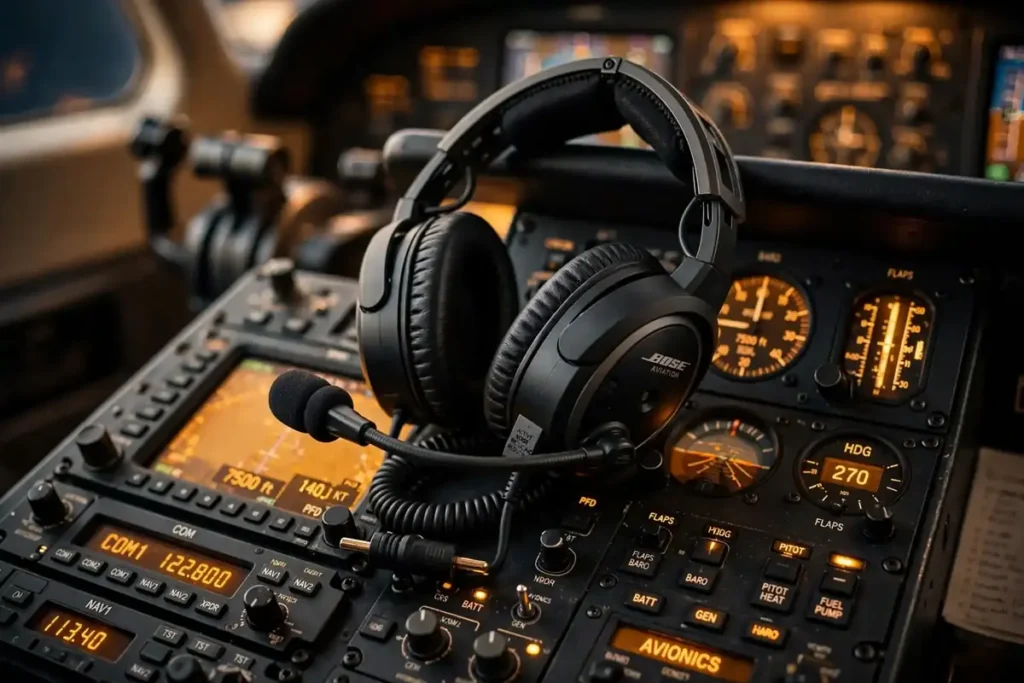
A pilot’s headset is not a pair of consumer headphones with a microphone bolted on. It is purpose-built communications equipment: the microphone impedance, the plugs, and the noise reduction are all engineered for a cockpit that sits between 85 and 95 decibels in cruise. Get the wrong one and you will spend every lesson straining to hear ATC; get the right one and radio calls cut through the engine drone like the cockpit is silent.
This guide compares the best aviation headset options for 2026 — from flagship ANR (active noise reduction) headsets to dependable passive trainers — using manufacturer-published specifications and what pilots actually report about long-term comfort. Whether you are a student pilot buying your first headset or a professional upgrading from a discontinued model, you will find a pick that fits how you fly.
The Best Aviation Headsets at a Glance
| Headset | Type | Weight | Battery | Bluetooth | Warranty | Best For |
|---|---|---|---|---|---|---|
| Bose A30 | ANR | 14.2 oz | 45 hrs (2xAA) | Yes | 5 years | Best overall |
| Lightspeed Delta Zulu | ANR | 14.9 oz | 30 hrs (rechargeable) | Yes | 7 years | Safety technology |
| Lightspeed Zulu 4 | ANR | 14.6 oz | 40 hrs | Dual | 7 years | Premium value |
| David Clark DC ONE-X | ANR | 12.3 oz | 50 hrs | Yes | 5 years | Lightest ANR |
| Bose ProFlight Series 2 | ANR (in-ear) | 4.5 oz | 45 hrs | Yes | 5 years | Airline pilots |
| David Clark H10-13.4 | Passive | 16.5 oz | n/a | No | 5 years | Best passive |
| Faro G2 | ANR | 13 oz | 30 hrs | No | 3 years | Budget ANR |
| Kore Aviation KA-1 | Passive | — | n/a | No | 5 years | Best budget |
Our Top Aviation Headset Picks for 2026
1. Bose A30 — Best Overall Aviation Headset

The Bose A30 replaced the long-running A20 and remains the benchmark ANR aviation headset in 2026. Its three selectable ANR modes let you tune cancellation to the aircraft — maximum attenuation for loud piston singles, a balanced mode for typical GA flying, and a setting optimized for high-altitude turbine and jet environments. The redesign carries roughly 20% less clamping force than the A20, which matters on four-hour cross-countries, and it runs at least 45 hours on two AA batteries.
What separates the A30 from every competitor here is certification: it is the only headset in this guide with both FAA TSO and EASA E/TSO-C139a authorization. If your operator requires authorized equipment, the decision is effectively made. Bluetooth is built in for ForeFlight audio alerts, music, and phone calls, and it backs everything with a 5-year warranty.
- Why it wins: Strongest overall ANR, three user-selectable noise modes, TSO certification, light 14.2 oz weight.
- Keep in mind: Premium flagship pricing; the lightest-clamping fit will not suit every head shape.
2. Lightspeed Delta Zulu — Best Safety Technology

The Lightspeed Delta Zulu earns its place on one feature no other headset offers: a built-in carbon monoxide detector. Using always-on Kanari sensor technology, it warns you audibly and visually when cabin CO levels rise — carbon monoxide is odorless, and in a piston cockpit it is a genuine hazard. If cockpit safety is your priority, this is the premium pick.
Beyond the CO sensor, the Delta Zulu is a fully modern ANR headset: active noise reduction, full Bluetooth and wired connectivity, a rechargeable lithium-ion pack rated at about 30 hours with an AA backup pack, and the HearingEQity system that tailors audio to your personal hearing profile from a 12-frequency in-app test. It weighs 14.9 oz, uses a stainless steel headband with Kevlar-wrapped cables, and carries a 7-year warranty — the longest here. Note that Lightspeed does not currently certify its headsets to TSO.
- Why it wins: Exclusive CO monitoring, personalized audio profiles, 7-year warranty, rugged build.
- Keep in mind: No TSO certification; slightly heavier than the A30.
3. Lightspeed Zulu 4 — Best Premium Value

Announced in mid-2025 as the follow-on to the widely loved Zulu 3, the Lightspeed Zulu 4 is the sweet spot for pilots who want flagship-grade ANR without the flagship price. It matches the core spec sheet of headsets costing considerably more: active noise reduction, dual Bluetooth connections (keep your phone and tablet paired at once), a 40-hour battery, and the FrameFit ear seals designed to work with glasses or sunglasses without breaking the acoustic seal.
Lightspeed’s customer support is legendary among GA pilots, and the 7-year warranty backs that reputation. For cross-country pilots and instrument-rated flyers logging serious hours, the Zulu 4 is the headset we would recommend first when the A30’s certification is not required.
- Why it wins: Near-flagship ANR at a lower price, dual Bluetooth, glasses-friendly ear seals, 7-year warranty.
- Keep in mind: No TSO certification; the Zulu 3 remains a solid cheaper alternative if you find it in stock.
4. David Clark DC ONE-X — Lightest Full-Size ANR

At 12.3 oz, the David Clark DC ONE-X is the lightest full-size ANR headset in this guide — and unlike some ultralight designs, it does not compromise on endurance, delivering 50 hours of battery life. David Clark’s digital hybrid ENC (electronic noise cancellation) targets engine frequencies while keeping voices natural, and Bluetooth is included for wireless audio.
The DC ONE-X carries TSO certification and a 5-year warranty, and it inherits the tank-like build quality David Clark is famous for. Pilots who find other ANR headsets fatiguing on long legs should look here first: less weight on your head, hour after hour, is a comfort feature no software can replicate.
- Why it wins: Lightest ANR design, 50-hour battery, TSO certified, proven David Clark durability.
- Keep in mind: Fewer “smart” extras than the Lightspeed flagships; classic rather than cutting-edge styling.
5. Bose ProFlight Series 2 — Best for Airline and Turbine Pilots

The Bose ProFlight Series 2 is built for a different cockpit: the pressurized, relatively quiet flight deck of a turbine or airliner. Instead of over-ear cups, it uses a lightweight in-ear design weighing just 4.5 oz — a fraction of any full-size headset — with active noise cancellation tuned for the frequency profile of jet and turboprop flight decks.
Despite the minimal footprint, you get Bluetooth connectivity, a 45-hour battery, TSO certification, and the 5-year Bose warranty. Airline pilots who wear a headset for 8-hour duty days consistently rank comfort as the deciding factor, and nothing else in aviation weighs 4.5 ounces. If you fly pistons, pick the A30 instead; if you fly jets, this is the specialist tool.
- Why it wins: Featherweight in-ear comfort for long duty days, TSO certified, 45-hour battery.
- Keep in mind: Tuned for turbine cockpits — not the right choice for loud piston aircraft.
6. David Clark H10-13.4 — Best Passive Aviation Headset

The David Clark H10-13.4 has been the default training headset at flight schools for decades, and it earned that status the hard way: it survives student abuse, keeps working with zero batteries to charge, and its passive noise reduction — achieved through clamping force and deep ear seals — is genuinely effective in a trainer cockpit.
At 16.5 oz it is heavier than the ANR options, and it will not cancel low-frequency drone the way electronics do. But it is TSO certified, carries a 5-year warranty, and routinely lasts a decade or more of regular use. For students, renters, and anyone who wants the simplest possible setup — put it on, plug it in, fly — it remains the sensible default.
- Why it wins: Legendary durability, no batteries ever, TSO certified, proven in thousands of flight schools.
- Keep in mind: Heavier than ANR rivals; passive isolation cannot match electronic cancellation.
7. Faro G2 — Best Budget ANR Aviation Headset

Active noise reduction used to mean flagship money. The Faro G2 brings ANR down to a budget price while keeping the fundamentals right: 13 oz weight, a 30-hour battery, an MP3/audio input for wired audio, and a noise-canceling microphone for clear transmissions. There is no Bluetooth — a fair trade at this price — but the core ANR performance is what student pilots feel on every lesson.
The 3-year warranty is shorter than the big names, and the fit and finish are a step below the premium tier. But as the cheapest route into genuine active noise reduction, the G2 is an easy recommendation for students and renters who want ANR without flagship cost.
- Why it wins: The most affordable ANR headset here, light 13 oz design, 30-hour battery.
- Keep in mind: No Bluetooth; 3-year warranty; a step down in fit and finish from premium picks.
8. Kore Aviation KA-1 — Best Budget Aviation Headset

For student pilots watching every dollar of their training budget, the Kore Aviation KA-1 is the entry point that still does the job properly. It is a passive noise reduction headset with a noise-canceling electret microphone, gel ear seals for comfort, and mono/stereo compatibility so it works with any standard GA intercom.
You give up ANR and Bluetooth, and the long-term durability will not match a David Clark. But it is backed by a 5-year warranty, it costs less than a couple of hours of flight instruction, and it gets you a personal, hygienic headset instead of a shared flight-school loaner. For primary training, that is a smart trade.
- Why it wins: Genuine passive noise reduction at an entry-level price, gel ear seals, 5-year warranty.
- Keep in mind: No ANR, no Bluetooth; durability trails the premium brands over many years.
ANR vs Passive: Which Does a Pilot Need?
Every aviation headset reduces cockpit noise in one of two ways. Passive noise reduction (PNR) works mechanically: tight ear seals and clamping force physically block sound. It needs no batteries, never fails electronically, and works well in the 85–95 dB environment of a typical trainer. Active noise reduction (ANR) adds electronics that sample low-frequency noise — engine drone — and cancel it with an inverted signal. ANR is dramatically more effective against the deep rumble that causes fatigue on long flights.
Our take: if you fly more than a few hours a month, or you fly loud piston aircraft regularly, ANR is worth the investment — fatigue is a safety factor, and quieter cockpits make radio calls easier to copy. If you are a student on a budget or an occasional renter, a quality passive headset like the H10-13.4 or KA-1 is completely adequate for training. Many professional pilots started passive and upgraded to ANR once they were flying for a living.
Choosing the Right Plug for Your Aircraft
Aviation headsets do not use standard audio jacks. Match the plug to the aircraft:
- Dual GA plugs (PJ-055 and PJ-068): The standard for nearly all piston GA aircraft — Cessnas, Pipers, Diamonds. This is the default configuration and what most student pilots need.
- LEMO (6-pin): Found in aircraft with panel-powered headset jacks (many Cirrus and newer panels). No batteries required — the aircraft powers the ANR.
- U-174 (single plug): The helicopter standard.
- XLR-5: Used in some military and professional applications.
When in doubt, order the dual GA plug version — it fits the training fleet. All of the headsets in this guide are available in GA dual-plug configuration.
Frequently Asked Questions About Aviation Headsets
What is the best aviation headset for student pilots?
For most students, the Kore Aviation KA-1 or the David Clark H10-13.4 are the right starting points. Both are passive headsets that are simple, durable, and affordable — and both are far better than sharing a worn flight-school loaner. If your budget stretches to ANR from day one, the Faro G2 brings active noise reduction into student-pilot price territory.
What is the difference between ANR and passive aviation headsets?
Passive headsets block noise mechanically with ear seals and clamping force. ANR headsets add electronics that actively cancel low-frequency engine drone. ANR is noticeably quieter and less fatiguing on long flights; passive headsets are simpler, need no batteries, and cost less. Both are legitimate choices — it comes down to how much you fly and what your budget allows.
Is the Bose A30 worth it for pilots?
For professional pilots and serious GA flyers who log significant hours, yes. The A30 is the benchmark for ANR performance, it is the lightest premium option at 14.2 oz, and it is the only headset here with FAA TSO and EASA certification. For students or budget-conscious pilots, the Kore KA-1 or Faro G2 deliver the essentials for far less.
Do I need a TSO-certified aviation headset?
Only if your operator requires it. TSO (Technical Standard Order) certification means the headset meets FAA minimum performance standards. In this guide, the Bose A30, Bose ProFlight Series 2, David Clark DC ONE-X, and David Clark H10-13.4 are TSO certified. For private GA flying, TSO is not required — it matters mainly for airline and charter operations.
Can I use regular consumer headphones in an airplane?
No — not for communicating. Aviation headsets use different microphone impedance and aircraft-specific plugs, and consumer ANC headphones are not designed to pass through or mix intercom audio. Consumer headphones are fine for passengers listening to music; pilots need a proper aviation headset to talk to ATC and the intercom.
How long do aviation headsets last?
A well-maintained aviation headset typically lasts 5 to 15 years. Passive headsets like the David Clark H10-13.4 are famous for decade-plus service lives. ANR headsets may eventually need battery door or electronics servicing, which is one reason longer warranties — like Lightspeed’s 7-year coverage — carry real value.
Should I buy my own headset or rent from my flight school?
Buy your own. Flight-school loaners are shared, often worn, and fit poorly — and poor fit means poor noise reduction. A personal headset fits better, seals better, and is more hygienic. Even a budget option like the KA-1 outperforms a tired rental, and it pays for itself in comfort over the course of your training.
Ready to upgrade your cockpit?
The right aviation headset is a safety tool, a comfort tool, and — over a flying career — one of the best investments a pilot makes.
Check Price on Amazon
I am the founder of Sound Mavericks, where I provide the polite truth about audio equipment. I started this site because consumer electronics reviews are often too technical. Instead of using a silent lab, I test headphones, earbuds, and Bluetooth speakers in the real world – like on a noisy subway or in a busy coffee shop.
To stay independent, I buy my own review units (mostly from the United States) rather than accepting free gifts from brands. Once I finish testing a product, I sell it locally to our community. My goal is to help you understand sound quality, active noise cancellation (ANC), and battery life without the marketing hype.