
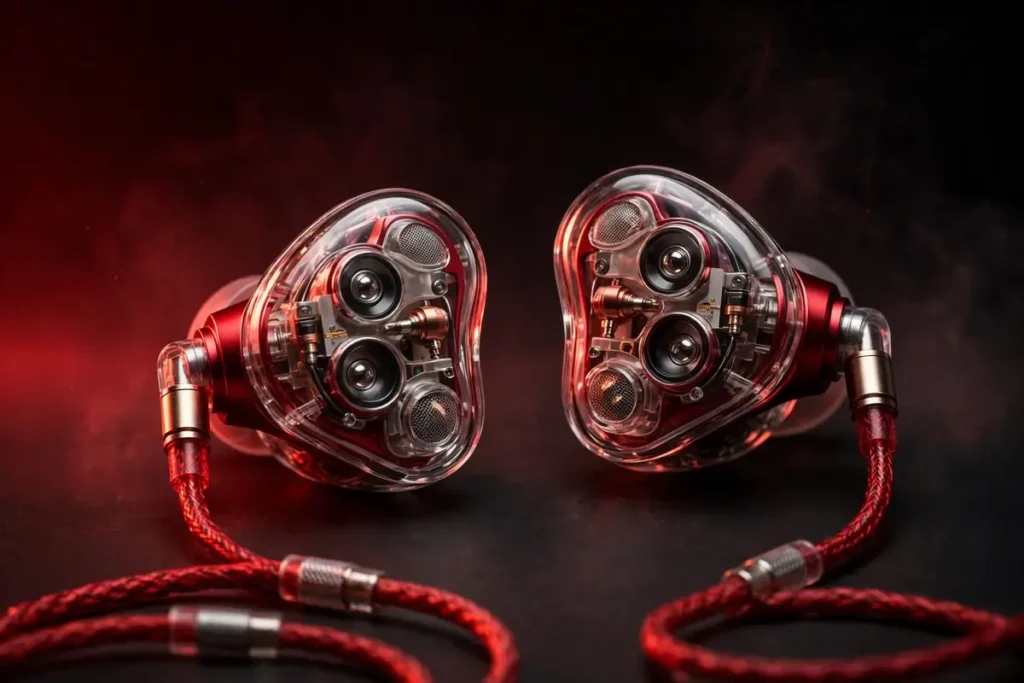
This truthear x crinacle zero red review covers the Zero:RED, the retuned sibling of the original Truthear x Crinacle Zero, and not the original itself, which has its own review on this site. The Red keeps the unusual dual dynamic driver layout, a 10 mm woofer and a 7.8 mm driver in the same resin shell, and retunes it toward a neutral target with a clean sub-bass shelf. A 10 ohm adapter in the box lifts the bass on demand. Our provisional scoring puts it at 5.9 overall on the wired scale, with Sound and Value doing the heavy lifting.
A note on method. This review is research-based and the scores are provisional. They are built from published measurements, manufacturer specifications and the consensus of specialist reviewers who tested this exact model, scored on the same six-bar scale our headphone database uses. Wired models follow our standard conventions: Battery sits at a neutral 5.0 because there is no battery, and Calls scores 3.0 where the stock cable carries no microphone.

Truthear x Crinacle Zero:RED 5.9/10
Why you: you want the most honest tuning at this money. The Red measures close to a neutral target with a tidy sub-bass lift, vocals sound natural, and the included adapter gives you a second, warmer tuning without buying anything else.
Trade-off: the nozzle is wide and long, so fit is a lottery for smaller ears, and the technical side is ordinary: imaging and separation are average for the class. The stock cable has no microphone.
Dual dynamic drivers, 10 mm + 7.8 mm · 17.5 ohms · Detachable 2-pin cable · 10 ohm bass adapter included · No microphone
Sound quality
Sound scores 8.4, and the tuning is the whole story. Dozens of measurement rigs draw the same curve for the Red within a decibel or so: a sub-bass shelf of roughly 6 dB, a tucked lower midrange, a gentle ear-gain plateau that sits a little under the Harman target and a treble that stays safe. Reviewers who disagree about almost everything else agree the result is mature and fatigue-free, with the midrange the best region: vocals sound clean and honest, with none of the shout that budget sets often add around the presence range. Our Truthear x Crinacle Zero review covers the brighter, bassier original; the Red is the calmer take on the same hardware idea.
The honest limits are technical rather than tonal. Transients are a touch soft, separation is average and the stage stays close, so dense mixes do not open up the way they do on pricier sets in our best budget IEMs guide. The bass adapter changes the balance more than most pack-in extras do, adding weight that suits electronic and hip-hop listening, though some reviewers found it cost midrange clarity. Treat it as a free second tuning and decide with your own library.
Fit and isolation
Comfort scores 6.6, and the reason is the nozzle. It is wide and long, a carry-over from the original Zero, and ears that suit it get a deep, stable fit while smaller ears can find it tiring within an hour. The shells themselves are light resin and the box includes several tip sets in different bores, plus spare filters and a pouch, a generous accessory pack for the money. Try every tip before judging the fit; the wrong tip makes the sound thin and the comfort worse.
There is no active cancelling on a wired set. ANC scores 3.5 for passive isolation only, which is decent once the seal is right: the closed shell and deep fit block a fair share of office and street noise, but low rumble passes through in a way true ANC buds in our best IEMs roundup cannot match either, since none of them cancel actively. Know what you are buying: isolation by fit, not by electronics.
Cable, calls and everyday use
The cable detaches on standard 0.78 mm 2-pin connectors and ends in a 3.5 mm plug, so a worn cable is a cheap replacement rather than a dead earphone. Calls score 3.0 under our wired convention because the stock cable carries no microphone; if calls matter, third-party cables with an inline mic fit the same sockets. Battery scores the neutral 5.0 because there is no battery to score, and the set runs happily from a phone dongle, a laptop socket or a small DAC.
Sensitivity is high and impedance is low at 17.5 ohms, so volume is never a problem from portable sources. The one pairing note is the adapter: adding the 10 ohm bass adapter raises the effective load, and weak dongles still drive it without complaint. For gaming, the wired connection means no latency, and the tidy tuning keeps dialogue clear, which is why the Red shows up so often in budget gaming setups.
Red or the original Zero?
This is the choice most buyers are actually making. The original Zero is brighter and bassier, with more immediate excitement and more fatigue over long sessions. The Red trades that edge for balance: cleaner sub-bass, calmer treble and a midrange that flatters voices. Reviewer consensus leans toward the Red as the better all-rounder and the set to recommend first, while listeners who found the original thrilling sometimes call the Red plain.
Value scores 9.0, the highest bar in this review. At its price the Red competes on tuning with sets costing far more, and the adapter, tips and pouch in the box remove the usual extra purchases. The score assumes the fit works for you. If it does not, the value argument collapses, which is the one warning worth repeating.
Sources and pairing
The Red asks little from a source. A phone dongle, a laptop socket or a handheld console all drive it to full volume with headroom to spare, and its tuning does not shift with the modest output impedances of typical dongles. A cleaner DAC tightens the low end slightly, but no purchase is required to hear what the set does well. That ease is part of the budget appeal: the money goes on the earphones, not on the chain behind them.
Truthear x Crinacle Zero:RED specs
| Spec | Truthear x Crinacle Zero:RED |
|---|---|
| Design | Wired in-ear monitor, resin shell, closed |
| Drivers | Dual dynamic: 10 mm + 7.8 mm |
| Impedance | 17.5 ohms |
| Sensitivity | 117.5 dB/Vrms |
| Frequency response | 20 Hz to 40.5 kHz |
| Cable | Detachable 0.78 mm 2-pin, 3.5 mm plug |
| Extras | 10 ohm bass adapter, spare filters, tip sets, pouch |
| Microphone | None on the stock cable |
| Model note | Zero:RED, the retuned model. Not the original Zero |
Verdict
Buy the Zero:RED if tuning accuracy at a low price is the goal. An 8.4 Sound score built on a measured, repeatable curve, plus a 9.0 Value score, describes the set that budget IEM buyers are pointed at first, and the bass adapter widens its appeal beyond the neutral crowd.
Skip it if your ears are small or you want sparkle and stage more than balance. The 5.9 overall follows our wired scoring conventions, with passive isolation, no microphone and no battery pulling the mean down; the sound and value bars tell you why people buy it anyway.
Frequently asked questions
What is the difference between the Zero Red and the original Zero?
Tuning. Both use a 10 mm plus 7.8 mm dual dynamic layout in a similar shell, but the Red is retuned toward a neutral target with a cleaner sub-bass shelf and calmer treble, and it ships with a 10 ohm bass adapter. The original is brighter and bassier, and has its own review on this site.
Does the Zero Red have a microphone?
No. The stock cable has no microphone, which is why Calls scores 3.0 under our wired convention. The cable is a standard detachable 2-pin design, so a third-party cable with an inline mic is an easy swap.
What does the 10 ohm adapter do?
It raises the bass. Plugging the included adapter between the source and the cable lifts the low end, giving a warmer, heavier tuning for bass-led music. Some listeners prefer the stock response for its clarity, so treat it as an option, not a default.
Is the Truthear Zero Red good for gaming?
Yes, within wired limits. There is no latency, dialogue stays clear and the tuning is easy to listen to for long sessions. Imaging is average rather than pinpoint, so competitive players chasing positional detail may want to spend more.
Does the Zero Red need an amplifier?
No. At 17.5 ohms with high sensitivity it runs loudly from a phone dongle, a laptop or a handheld console. A clean source helps, but power is never the problem.

I am the founder of Sound Mavericks, where I provide the polite truth about audio equipment. I started this site because consumer electronics reviews are often too technical. Instead of using a silent lab, I test headphones, earbuds, and Bluetooth speakers in the real world – like on a noisy subway or in a busy coffee shop.
To stay independent, I buy my own review units (mostly from the United States) rather than accepting free gifts from brands. Once I finish testing a product, I sell it locally to our community. My goal is to help you understand sound quality, active noise cancellation (ANC), and battery life without the marketing hype.
