
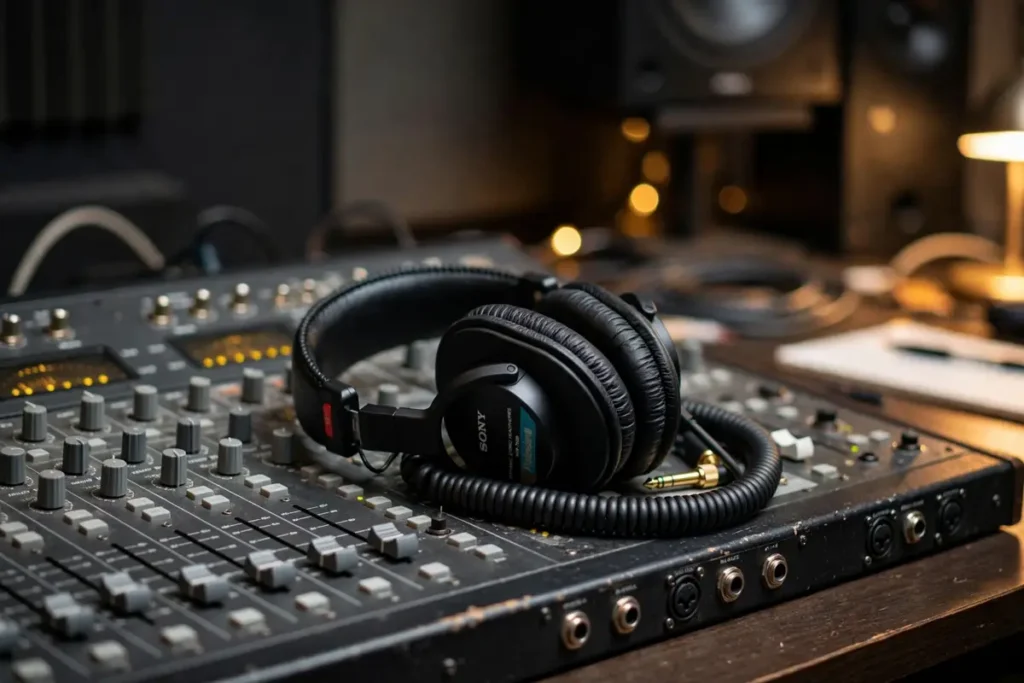
This sony mdr 7506 review covers the folding studio staple that has hung on mixing desks for decades, and it starts with the number that needs explaining: 6.1 overall, next to a Sound score of 8.6. Both numbers are fair. The sound is why every studio owns a pair. The overall is what happens when a wired, microphone-free tool from another era is scored on the same card as modern wireless headphones. Value, at 9.0, is the third number that matters here.

Sony MDR-7506 6.1/10
Why you: you track, edit or record and want a brutally honest tone that shows flaws instead of hiding them. This is the studio standard for that job, and it folds flat into a kit bag.
Trade-off: wired only, with a fixed coiled cable and no microphone. The thin pads and bright treble ask something of the wearer, and there is no ANC or Bluetooth to fall back on.
Wired only · Fixed coiled cable · Folding frame · No microphone · No ANC
Sound quality
Sound scores 8.6, and the character is easy to describe: honest to the point of rudeness. The midrange is the strength. Voices, dialogue and guitar parts sit clear and unflattered, so problems in a recording announce themselves instead of slipping past. TechGearLab, in its lab review, found the same shape, praising the excellent midrange and clean, present bass while calling the highs “shouty” and harsh at times. That treble lift is the 7506’s defining trait. It reveals sibilance and sloppy edits beautifully. It can also tire your ears on bright material at high volume.
Bass behaves like a tool rather than a treat. It is tight, quick and proportionate, with no boost to make dance music feel bigger than it is. Listeners raised on consumer tuning often call it lean on first hearing, then notice how much low-end clutter they can suddenly hear in their own mixes. For casual listening that honesty cuts both ways. Well-recorded music sounds superb. Thin, harsh recordings get no forgiveness at all.
There is a second listening trait worth naming: the 7506 is easy to drive. Almost any interface, mixer headphone output, camera or laptop runs it to full volume without strain, so the sound you get is the sound of the headphone, not of an underpowered output stage struggling. That consistency across gear is part of why a pair in one studio sounds like a pair in another, and why engineers trust what they hear on an unfamiliar desk. Consistency, more than any single measurement, is the professional feature here.
Tracking versus mixing on the 7506
The distinction matters. For tracking, where a singer or podcaster needs to hear themselves clearly and catch mistakes as they happen, the 7506 is close to ideal, and its closed back keeps headphone bleed out of the microphone. For final mixing, use it as a checker rather than your only reference. The treble lift can talk you into dulling a mix that was fine. Studios keep it beside flatter references for exactly this reason, and our guide to the best headphones for recording vocals puts it in that tracking role.
Reading the low bars honestly
Three bars drag the overall down, and each has a plain explanation. Calls score 3.0 because there is no microphone. You cannot take a call on a 7506 without another device doing the talking. ANC scores 3.5 because there is no cancelling, only the passive isolation of closed cups, which helps with higher sounds and does little against rumble. Battery sits at 5.0 as a neutral mark for a headphone with no battery to rate. None of these are hidden flaws. They are the cost of a single-purpose tool, and the 6.1 overall is what that cost looks like on a shared scale.
Comfort and build, the real trade-offs
Comfort scores 7.8, the most argued number on the card. The frame is light and the cups fold, which location recordists love, but the pads are thin, the fit sits close, and glasses wearers can feel pressure where the arms meet the cushions. TechGearLab also flagged the cheap-feeling materials and awkward fit as the main detractors from the sound performance. Long tracking sessions are fine for most heads. All-day casual wear is where owners start swapping in thicker aftermarket pads.
Build is the counterweight to the comfort complaints. The 7506 is screwed together, serviceable and famously hard to kill. MusicRadar noted that the packaging even includes an exploded schematic of the replacement parts, down to drivers and pads, which tells you how Sony expected these to be maintained: indefinitely, by the owner. The weak point is the fixed coiled cable. It stretches usefully around a studio, it cannot be replaced when it eventually fails without opening the headphones, and its weight tugs when you walk away from the desk still wearing them.
Everyday use outside the studio
Plenty of people buy the 7506 for ordinary listening, and it can work, with eyes open. There is nothing to charge, pair or update. Plug the gold 3.5mm jack into a laptop, an interface or an instrument and it simply plays, and the screw-on adapter covers larger sockets. It appears in our roundup of the best studio headphones and our guide to the best Sony headphones because that simplicity still has a market. What it will not do is follow you onto a train with silence, take a call, or fold into a pocket. It folds into its pouch, cable and all, like the working tool it is.
The ownership story supports the value score. Pads wear, and owners replace them for less than a night out. Headbands crack on some units after heavy years, and the parts exist to fix that too. Compare that with sealed wireless models whose batteries fade into e-waste, and the 7506’s 9.0 Value bar reads less like nostalgia and more like arithmetic. Buy one pair, maintain it with basic care, and it can cover a decade of sessions without asking for a charger, an app or an account.
Sony MDR-7506 specs
| Spec | Sony MDR-7506 |
|---|---|
| Form | Over-ear, closed-back, folding |
| Connection | Wired only, fixed coiled cable |
| Plug | 3.5mm with screw-on adapter |
| Noise cancelling | None, passive isolation only |
| Microphone | None |
| Battery | None, no charging needed |
Verdict
Buy the MDR-7506 if you record, edit or podcast and want the reference sound studios trust, at a Value score of 9.0. The 8.6 Sound bar is the product. Everything else is a tool built around it, and tools are allowed to be plain.
Skip it if you want wireless freedom, calls, cancelling or plush all-day comfort. Those buyers are better served by modern models, including several in our best closed-back headphones guide. The 6.1 overall is not a warning about the sound. It is the price of specialisation, stated in one number.
Frequently asked questions
Why is the Sony MDR-7506 overall score only 6.1 if the sound scores 8.6?
Because the overall reflects the whole product, not just the tuning. The 7506 is wired only, with no microphone and no noise cancelling, so the Calls and ANC bars score low and the Battery bar sits at a neutral 5.0 for a model with no battery at all. As a listening and tracking tool the sound carries it. As a modern all-rounder it gives up a lot.
Is the Sony MDR-7506 good for mixing?
For tracking, editing and checking vocals, yes. The clear midrange shows problems honestly, which is the job in a studio. For final mix decisions, treat the bright upper treble with care: it can push you to cut highs that are not actually excessive on other systems, so cross-check on speakers or a second headphone.
Does the Sony MDR-7506 have a microphone or Bluetooth?
Neither. It is a wired headphone with a fixed coiled cable ending in a 3.5mm plug, plus a screw-on adapter for larger jacks. There is no microphone, no Bluetooth and no battery, which is why it never needs charging and never drops a connection.
Are the Sony MDR-7506 ear pads replaceable?
Yes. The pads pull off and replacements are widely available, and the design uses screws and serviceable parts throughout. The thin stock pads are the part owners replace most, both when the covering wears and to improve comfort with thicker alternatives.
Who should buy the Sony MDR-7506 today?
Podcasters, video editors, musicians tracking at home and anyone who wants an honest reference sound from a proven tool. If you want wireless convenience, plush comfort for all-day casual listening or strong bass for fun, newer models serve you better.

I am the founder of Sound Mavericks, where I provide the polite truth about audio equipment. I started this site because consumer electronics reviews are often too technical. Instead of using a silent lab, I test headphones, earbuds, and Bluetooth speakers in the real world – like on a noisy subway or in a busy coffee shop.
To stay independent, I buy my own review units (mostly from the United States) rather than accepting free gifts from brands. Once I finish testing a product, I sell it locally to our community. My goal is to help you understand sound quality, active noise cancellation (ANC), and battery life without the marketing hype.
