
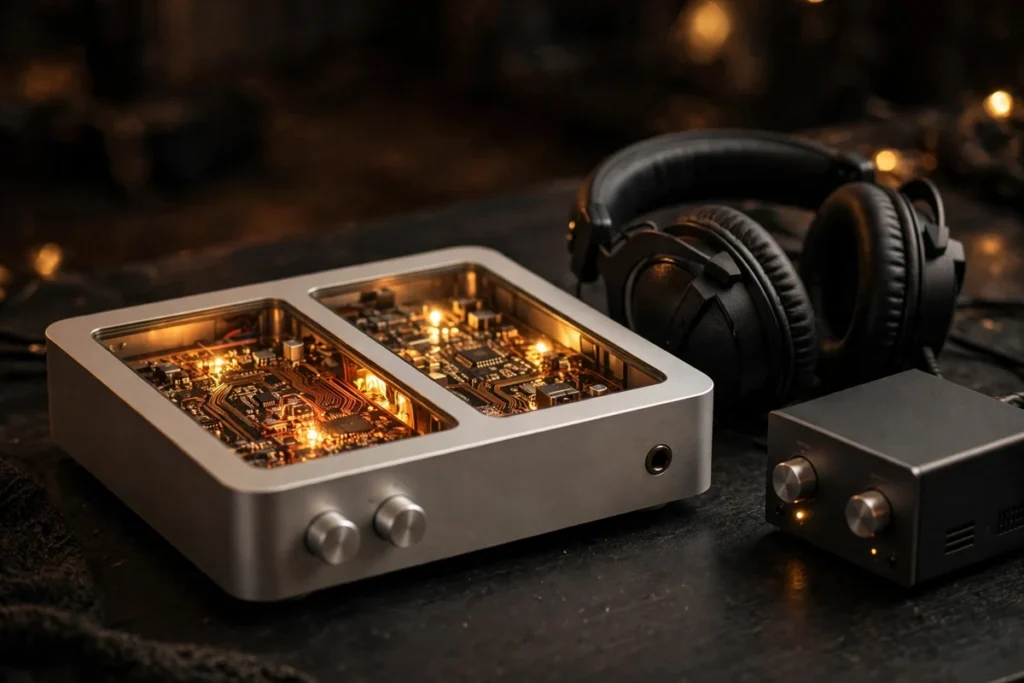
The SMSL R100 is a desktop DAC built on a deliberate step backwards: two vintage Analog Devices AD1861-J chips, one per channel, doing the conversion with a proper resistor ladder. Around those 18-bit monolithic R2R chips, SMSL wraps modern support hardware, a browser-configured parametric EQ and balanced outputs. It is a line-level DAC and nothing else, with no headphone output and no volume control. SMSL introduced it on September 9, 2026, and it is on sale in the US at Apos Audio, HiFiGo and Amazon US.
This is a launch review, built from SMSL’s published specifications as carried by Apos, HiFiGo and Audiophonics, launch coverage from Darko and HiFi Pig, and the verified Amazon US listing. We have not listened to the R100, and nothing here pretends otherwise. What follows is paper analysis: the hardware, the honest limits of those vintage chips, and who should buy now or wait. This page will be updated as independent measurements and reviews appear.

SMSL R100 On sale now
What it is: a pure desktop DAC with genuine R2R conversion from two hand-matched AD1861-J ladder chips, plus a parametric EQ you configure in a web browser.
Watch out: there is no headphone output and no volume control, so an amplifier is mandatory. The converter chips themselves resolve 18 bits; the headline input rates describe what the R100 accepts, not what the ladders resolve.
2x AD1861-J R2R chips · USB PCM 32-bit/768kHz, DSD512 input · XLR 3.5Vrms and RCA 1.75Vrms · Browser PEQ with 2 profiles
SMSL R100 quick facts
| Type | Desktop R2R DAC (line-level outputs only, no headphone amplifier, no volume control) |
| Launch price | $289 at Apos Audio |
| Status | Introduced September 9, 2026; on sale in the US now |
| Where to buy | Amazon US, Apos Audio and HiFiGo |
| Amazon US | Listed, ASIN B0HJ4VHH5Q (verified November 3, 2026) |
| DAC chips | 2x Analog Devices AD1861-J (monolithic R2R, one per channel) |
What the R100 is
The AD1861 was a fixture of well-regarded 1990s CD players, a monolithic chip with its resistor ladder on the silicon itself. Analog Devices now classifies it as obsolete. SMSL’s pitch, as Darko reported at launch, is that the chip has simply never had better surroundings: each unit is adjusted by hand at the factory so the two channels match, a de-glitch circuit cleans up switching artefacts at the ladder, a self-developed SPDIF receiver handles the optical and coaxial inputs, and SMSL’s own DSD conversion algorithm feeds DSD material to the ladder in a form it can use. Our R2R DAC explainer covers how ladder conversion differs from the delta-sigma chips in almost every other DAC at this price.
The box itself is part of the pitch. The CNC-machined chassis, 170 by 39.8 by 136mm and 712g in silver, has two transparent top panels so the circuitry stays visible, plus a small front screen and an EQ selector. Inputs are USB-C, optical and coaxial; outputs are balanced XLR at 3.5Vrms and RCA at 1.75Vrms, enough to drive an integrated amplifier or active speakers through a separate volume control. There is deliberately nothing else: no headphone jack, no knob, no Bluetooth.
R100 vs SU-3: SMSL’s two new DACs
SMSL launched two small pure DACs within a fortnight of each other, and they take opposite routes to the same job. The SU-3 is the modern one: a current AKM delta-sigma chip, far better published distortion and dynamic-range figures, and a 32-band EQ stored in the device. The R100 is the character option: vintage ladders, modest published figures, and an EQ that lives in a browser tab instead. Neither has a headphone output or a volume control.
| SMSL R100 | SMSL SU-3 | |
|---|---|---|
| Conversion | 2x AD1861-J monolithic R2R | AK4496 delta-sigma |
| USB input | USB-C; PCM 32-bit/768kHz, DSD512 | USB; PCM 32-bit/768kHz, DSD512 |
| Outputs | XLR 3.5Vrms, RCA 1.75Vrms | XLR 4Vrms, RCA 2Vrms |
| THD+N (published) | 0.003% | 0.00012% |
| Equalizer | Browser PEQ, 2 profiles plus Direct bypass | 32-band PEQ, stored in the device |
| Headphone output | None | None |
| Check Price | Check Price | Check Price |
SMSL R100 specifications
| Product | SMSL R100 Check Price |
| Type | Desktop R2R DAC |
| DAC chips | 2x Analog Devices AD1861-J (18-bit monolithic R2R) |
| Inputs | USB-C, Toslink optical, coaxial |
| Outputs | RCA single-ended, XLR balanced (fixed level) |
| Output level | 1.75Vrms RCA; 3.5Vrms XLR |
| Output impedance | 33Ω |
| Sampling rates, USB | PCM 32-bit/768kHz; DSD512 |
| Sampling rates, optical/coaxial | PCM 24-bit/192kHz; DSD64 via DoP |
| THD+N | 0.003% (-90dB), as published |
| Dynamic range | 108dB RCA; 107dB XLR |
| SNR | 108dB RCA; 107dB XLR |
| Equalizer | Browser-based parametric EQ (dsptuner.com); EQ1 and EQ2 profiles plus Direct bypass, saved in the device |
| Filtering | 16x oversampling FIR ahead of the ladder chips; de-glitch circuit |
| Power | 100-240V AC mains |
| Dimensions | 170 x 39.8 x 136mm |
| Weight | 712g |
| Launch price | $289 |
Architecture: vintage ladders, modern scaffolding
The honest technical story matters here, and Darko’s launch coverage states it plainly. The AD1861 is an 18-bit converter. The R100’s front door accepts 32-bit/768kHz PCM and DSD512, but those numbers describe acceptance, not resolution: SMSL’s 16x oversampling FIR filter sits in front of the chips to bridge the gap, and DSD is converted before it reaches the ladders. Buyers who shop by input-rate headlines should understand that distinction, because it is the whole trade. In exchange, the R100 offers conversion that is physically a resistor ladder rather than a delta-sigma modulator, with distortion figures (a published 0.003 percent; SMSL’s own APx555 measurements put balanced THD+N around 0.0025 percent, per Darko) that are honest rather than spectacular.
SMSL describes the intended result as natural and fatigue-free, which is the manufacturer’s claim, not a verdict. The verifiable extras are the de-glitch circuitry and the EQ. The browser interface at dsptuner.com needs no installed software, holds two profiles plus a bypass, and early hands-on coverage on Head-Fi notes that boosts automatically pull the pre-amp level down to compensate. Two profiles is enough for the obvious use: one for speakers, one for headphones, switched at the front panel.
Early coverage
Darko and HiFi Pig covered the R100 at its September 2026 introduction, and Head-Fi’s showcase carries the first owner reviews, written from sample and retail units. As of November 3, 2026, independent bench measurements beyond SMSL’s own published figures have not appeared. This section updates as they do.
Should you buy, or wait?
The buy case is specific: you already own an amplifier you like, you want to hear what genuine ladder conversion does in your system, and the browser EQ is a bonus rather than a requirement. At its price, the R100 is one of very few new R2R DACs with balanced outputs, and its see-through case makes the vintage chips part of the furniture in a way buyers in this niche tend to enjoy.
The wait case: the published figures are a generation behind modern delta-sigma DACs, SMSL’s own SU-3 measures far better on paper for less money, and nobody independent has yet measured whether the hand-matching and de-glitch work deliver what the story promises. If your system needs a volume control or a headphone output, this is the wrong product at any price; the scored alternatives below include R2R hardware that has both.
Also consider
Three desktop DACs from our best DACs roundup, already covered and scored.

The other budget R2R in our coverage: FiiO’s own resistor-ladder DAC, inside a unit that also has a headphone amplifier and volume control.

Costs less than the R100 and adds the two things it lacks: a headphone amplifier and a volume control. Delta-sigma conversion, though.

The straightforward modern DAC from our roundup: no ladder, no EQ, no balanced output, and the benchmark scores for ease of use and value.
FAQ
When is the SMSL R100 released?
SMSL introduced the R100 on September 9, 2026, and it is on sale in the US now through Apos Audio, HiFiGo and Amazon US.
How much does the SMSL R100 cost?
The launch price is in the quick facts box at the top of this page. Apos listed it at launch, and the Amazon button shows the current US figure.
Where can I buy the SMSL R100?
It is on sale at Amazon US under ASIN B0HJ4VHH5Q, and at Apos Audio and HiFiGo. The button at the top of this page goes to the Amazon listing.
Is the SMSL R100 on Amazon?
Yes, as a listing under ASIN B0HJ4VHH5Q, verified on November 3, 2026.
Does the SMSL R100 have a headphone output?
No. The R100 is a line-level DAC with RCA and balanced XLR outputs at fixed level, and no volume control. Headphones need a separate headphone amplifier behind it.
Is the SMSL R100 really an R2R DAC?
Yes. Conversion is done by two AD1861-J chips, which are monolithic R2R designs with the ladder on the chip. They are 18-bit parts, fed through SMSL’s 16x oversampling FIR filter; the USB input accepts up to 32-bit/768kHz PCM and DSD512, and DSD is converted before it reaches the ladder.

I am the founder of Sound Mavericks, where I provide the polite truth about audio equipment. I started this site because consumer electronics reviews are often too technical. Instead of using a silent lab, I test headphones, earbuds, and Bluetooth speakers in the real world – like on a noisy subway or in a busy coffee shop.
To stay independent, I buy my own review units (mostly from the United States) rather than accepting free gifts from brands. Once I finish testing a product, I sell it locally to our community. My goal is to help you understand sound quality, active noise cancellation (ANC), and battery life without the marketing hype.

